Introduction
Data has become an essential business asset for organisations across the UK. From improving operational efficiency and understanding customer behaviour to forecasting business performance and supporting strategic decisions, companies increasingly depend on reliable data infrastructure and advanced analytics capabilities.
However, building and maintaining an experienced in-house data team can be challenging. Organisations often require specialised expertise in data engineering, business intelligence, cloud data platforms, data science, database management, and data governance.
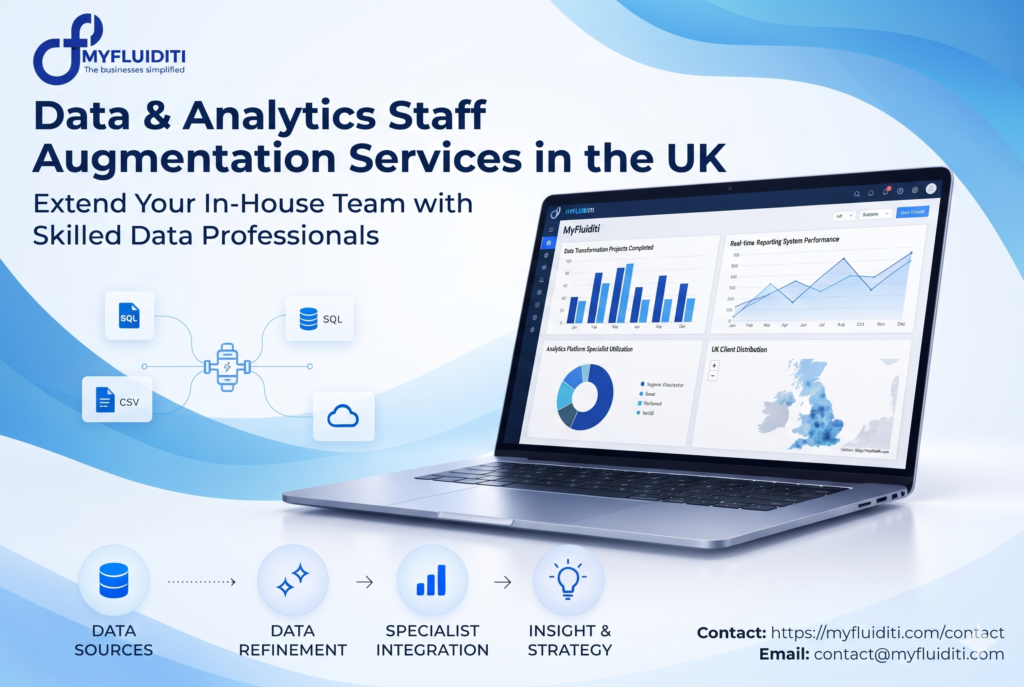
Data & Analytics Staff Augmentation Services in the UK provide a flexible approach to addressing these challenges. Businesses can extend their existing technology teams with experienced data professionals who contribute to ongoing projects, digital transformation initiatives, analytics development, and enterprise data management.
MyFluiditi provides IT staff augmentation services that help organisations strengthen their technical capabilities through flexible access to IT professionals. Our approach supports businesses looking to expand their data and analytics capabilities while maintaining control over project execution, internal workflows, and technical requirements.
Why UK Businesses Need Data & Analytics Staff Augmentation
UK organisations across financial services, healthcare, retail, manufacturing, logistics, and technology are investing in modern data platforms and analytics solutions. As data volumes increase, businesses need professionals who can manage complex data environments, develop reporting systems, integrate information sources, and transform raw data into actionable insights.
However, internal teams may not always have the required technical expertise or capacity to manage these initiatives independently.
Data and analytics staff augmentation enables organisations to address skill gaps and increase project capacity without relying exclusively on permanent recruitment.
UK businesses can use this approach to:
- Strengthen existing data engineering, analytics, and BI teams.
- Accelerate data warehouse and cloud migration projects.
- Develop and maintain scalable ETL and ELT pipelines.
- Improve business intelligence dashboards and reporting systems.
- Integrate data from multiple enterprise applications.
- Support AI, machine learning, and advanced analytics initiatives.
- Improve data quality, governance, and accessibility.
- Manage increasing workloads without unnecessarily expanding permanent headcount.
Data & Analytics Professionals Available Through Staff Augmentation
Different business initiatives require different technical capabilities. MyFluiditi’s IT staff augmentation approach can support organisations seeking data professionals with expertise aligned with their project requirements and technology environments.
1. Data Engineers
Data engineers develop and maintain the infrastructure that enables organisations to collect, process, transform, and store business data.
Key areas of expertise include:
- ETL and ELT pipeline development.
- Data integration and transformation.
- Data warehouse and data lake development.
- Apache Spark and Apache Kafka.
- SQL and Python-based data processing.
- Cloud data engineering across AWS, Azure, and Google Cloud.
2. Data Analysts
Data analysts examine business datasets to identify trends, patterns, performance indicators, and opportunities for improvement.
Their responsibilities may include:
- Business and operational data analysis.
- KPI development and performance tracking.
- Data cleaning and preparation.
- Statistical analysis and trend identification.
- Customer and sales analytics.
- Analytical reporting and visualisation.
3. Business Intelligence Developers
BI developers create reporting environments and interactive dashboards that help business stakeholders understand performance and make informed decisions.
Their technical expertise may include:
- Microsoft Power BI.
- Tableau and Looker.
- SQL-based reporting.
- Data modelling and semantic layers.
- Dashboard development.
- Enterprise reporting and KPI visualisation.
4. Data Scientists
Data scientists use statistical techniques, programming, and machine learning methods to extract insights from complex datasets.
They can support:
- Predictive analytics and forecasting.
- Statistical modelling.
- Customer segmentation.
- Machine learning model development.
- Recommendation systems.
- Anomaly detection and pattern recognition.
5. Database Specialists
Database specialists help organisations manage, optimise, and maintain their database environments.
Their expertise may include:
- SQL and NoSQL database management.
- Database architecture and administration.
- Query optimisation and performance tuning.
- Database migration and integration.
- Data backup and recovery.
- Database security and availability.
6. Data Architects
Data architects design and manage the structures, standards, and frameworks used to organise enterprise data.
They can contribute to:
- Enterprise data architecture.
- Data modelling and schema design.
- Data warehouse architecture.
- Cloud data platform design.
- Data integration strategies.
- Data governance and architectural standards.
7. Analytics Engineers
Analytics engineers bridge the gap between data engineering and business intelligence by transforming raw data into reliable, structured datasets for analytical use.
Their expertise may include:
- dbt development.
- SQL-based data transformation.
- Data modelling.
- Analytics workflow development.
- Data testing and documentation.
- Semantic layer development.
Data & Analytics Staff Augmentation Services Offered by MyFluiditi
MyFluiditi helps businesses extend their existing technology teams with IT professionals who can support different stages of data development, integration, management, and analytics initiatives.
Data Engineering and Pipeline Development
Businesses require reliable data pipelines to move information between applications, databases, cloud platforms, and analytical environments.
Augmented data engineering professionals can support ETL and ELT development, data transformation, API integration, workflow orchestration, and pipeline optimisation.
Business Intelligence and Dashboard Development
Business intelligence enables organisations to convert complex datasets into accessible business information.
BI professionals can support dashboard development, KPI reporting, data visualisation, analytical reporting, and business performance monitoring using platforms such as Microsoft Power BI, Tableau, and Looker.
Data Warehousing and Cloud Data Platforms
Modern businesses require scalable environments to store, process, and analyse growing volumes of information.
Augmented professionals can contribute to data warehouse development, cloud migration, data lake implementation, platform integration, and performance optimisation using technologies such as Snowflake, Databricks, Amazon Redshift, Google BigQuery, and Microsoft Fabric.
Data Analysis and Advanced Analytics
Data analysis helps organisations understand business performance and identify opportunities for improvement.
Data professionals can support descriptive analytics, statistical analysis, trend identification, predictive modelling, forecasting, and customer analytics according to business requirements.
Data Integration and Database Management
Businesses often operate multiple applications and databases that need to exchange information reliably.
Staff augmentation can provide access to specialists supporting database development, SQL optimisation, API integration, data synchronisation, database migration, and data management.
Data Science, AI and Machine Learning
Organisations exploring intelligent applications may require specialists who can work with advanced analytics and machine learning technologies.
Relevant capabilities include predictive modelling, recommendation systems, anomaly detection, machine learning development, model deployment, and AI-enabled data solutions.
Data Governance and Data Quality
Reliable analytics depends on accurate, consistent, secure, and well-managed data.
Data governance professionals can support data quality management, metadata management, data lineage, master data management, access controls, and governance frameworks.
Key Technology Domains and Platforms
MyFluiditi’s Data & Analytics staff augmentation requirements can cover a broad range of technologies and enterprise platforms.
| Technology Domain | Platforms and Technologies |
| Data Engineering | Python, SQL, Apache Spark, Apache Kafka |
| ETL and Data Integration | Informatica, Talend, Fivetran, Azure Data Factory |
| Cloud Data Platforms | AWS, Microsoft Azure, Google Cloud |
| Data Warehousing | Snowflake, Amazon Redshift, BigQuery |
| Lakehouse Platforms | Databricks, Microsoft Fabric |
| Business Intelligence | Power BI, Tableau, Qlik, Looker |
| Data Science | Python, R, Jupyter, Scikit-learn |
| AI and Machine Learning | TensorFlow, PyTorch, Azure Machine Learning |
| Analytics Engineering | dbt, SQL, data modelling |
| Database Management | PostgreSQL, Oracle, SQL Server, MongoDB |
| Data Governance | Microsoft Purview, Collibra, Alation |
| Data Orchestration | Apache Airflow, Dagster, Prefect |
| MLOps and DataOps | MLflow, Docker, Kubernetes, CI/CD |
Technology requirements can vary depending on an organisation’s existing infrastructure, project objectives, and preferred platforms.
Applications of Data & Analytics Across UK Industries
Data and analytics capabilities support a wide range of business applications across UK industries.
Financial Services and Banking
- Transaction monitoring and fraud detection.
- Financial performance analytics.
- Customer segmentation and behavioural analysis.
- Credit risk and portfolio analytics.
- Regulatory and operational reporting.
Healthcare and Life Sciences
- Healthcare operational reporting.
- Patient data analysis.
- Resource and workforce planning.
- Clinical research data analysis.
- Healthcare performance monitoring.
Retail and E-commerce
- Customer behaviour analysis.
- Sales and demand forecasting.
- Product recommendation systems.
- Inventory and stock optimisation.
- Marketing campaign analytics.
Manufacturing
- Production performance monitoring.
- Predictive maintenance analytics.
- Quality control and defect analysis.
- Supply chain visibility.
- Manufacturing process optimisation.
Logistics and Supply Chain
- Delivery performance analysis.
- Inventory forecasting.
- Transportation and route analytics.
- Warehouse performance monitoring.
- Supply chain data integration.
Technology and Telecommunications
- Product usage analytics.
- Customer churn prediction.
- Network performance monitoring.
- Application performance analytics.
- Software product reporting.
How Data & Analytics Staff Augmentation Works
MyFluiditi follows a structured approach to helping organisations identify and integrate technical professionals into their existing teams.
1. Requirement Identification
The organisation defines its project objectives, technical requirements, required skills, responsibilities, and expected engagement duration.
2. Talent Identification
Relevant professionals are identified according to their technical experience, platform knowledge, project background, and role requirements.
3. Candidate Evaluation
Candidates are assessed against the required technical capabilities, experience, communication expectations, and project suitability.
4. Team Integration
Selected professionals collaborate with internal developers, data engineers, analysts, project managers, and other stakeholders using the organisation’s existing tools and workflows.
5. Project Execution
Augmented professionals contribute to assigned activities, including data engineering, analytics development, reporting, integration, database management, and platform support.
6. Ongoing Collaboration
Businesses coordinate deliverables, monitor project progress, and adjust staffing requirements as priorities and workloads evolve.
Benefits of Data & Analytics Staff Augmentation for UK Businesses
Access to Specialised Technical Skills
Businesses can access professionals with expertise in data engineering, business intelligence, cloud platforms, database technologies, and advanced analytics.
Flexible Team Expansion
Organisations can extend their existing teams according to project scope, technical complexity, and changing resource requirements.
Support for Faster Project Delivery
Additional technical capacity can help internal teams manage workloads and progress with data transformation, integration, and analytics initiatives.
Reduced Permanent Recruitment Pressure
Staff augmentation provides an alternative to depending entirely on permanent recruitment for every specialist requirement.
Integration with Existing Teams
Augmented professionals work alongside internal teams and contribute to established development processes, communication channels, and project workflows.
Support for Technology Modernisation
Organisations can bring in specialist expertise to support cloud migration, legacy database modernisation, enterprise data platforms, and analytics transformation.
Important Considerations When Hiring Data & Analytics Professionals in the UK
Choosing the right staff augmentation approach requires organisations to consider technical, operational, and regulatory requirements.
Technical expertise: Assess candidates based on their practical experience with the required programming languages, databases, cloud platforms, analytics tools, and enterprise technologies.
Project alignment: Clearly define responsibilities, deliverables, reporting structures, and collaboration expectations before onboarding professionals.
Data protection and security: Organisations handling personal information should consider applicable UK GDPR guidance and the Data Protection Act 2018. Access permissions, confidentiality, data handling procedures, and security responsibilities should be clearly established.
Data governance: Ensure that external professionals follow internal data governance policies, quality standards, documentation requirements, and access controls.
Communication and collaboration: Evaluate professionals based on their ability to work with internal stakeholders, understand business requirements, and contribute effectively to existing teams.
FAQs About Data & Analytics Staff Augmentation in the UK
What is Data & Analytics Staff Augmentation?
Data & Analytics Staff Augmentation is a flexible workforce model that allows organisations to extend their existing technology teams with specialised professionals such as data engineers, data analysts, BI developers, data scientists, and database specialists.
Why do UK businesses use Data & Analytics Staff Augmentation?
UK businesses use staff augmentation to access specialist technical expertise, increase project capacity, support data transformation initiatives, and manage analytics workloads without relying exclusively on permanent recruitment.
What data professionals can businesses hire through staff augmentation?
Organisations may require data engineers, data analysts, data scientists, BI developers, analytics engineers, data architects, database administrators, cloud data engineers, and data governance specialists.
Can augmented data professionals work with existing internal teams?
Yes. Staff augmentation is designed to extend existing teams. External professionals can collaborate with internal employees, project managers, developers, analysts, and business stakeholders using established workflows and communication processes.
What technologies are covered by Data & Analytics Staff Augmentation?
Depending on project requirements, professionals may work with Python, SQL, Apache Spark, Kafka, Snowflake, Databricks, Microsoft Azure, AWS, Google Cloud, Power BI, Tableau, dbt, and other data technologies.
Can businesses hire professionals for short-term data projects?
Staff augmentation can support project-based requirements as well as longer-term technical initiatives. Engagement arrangements depend on the project scope, resource requirements, and agreed terms.
How does MyFluiditi support Data & Analytics staffing requirements in the UK?
MyFluiditi provides IT staff augmentation services to help businesses extend their existing technical teams with professionals aligned with their project requirements, technology environments, and business objectives.
Is Data & Analytics Staff Augmentation suitable for small and medium-sized businesses?
Yes. Small and medium-sized businesses can use staff augmentation to access specialist capabilities for specific projects or technical requirements without necessarily building a large permanent data department.
Strengthen Your Data & Analytics Team with MyFluiditi
Building effective data capabilities requires the right combination of technical expertise, scalable infrastructure, and collaboration.
Whether your organisation needs support with data engineering, business intelligence, cloud data platforms, database development, data integration, advanced analytics, or data governance, specialist professionals can help strengthen your existing technical capabilities.
MyFluiditi supports UK businesses through flexible IT staff augmentation services designed to align technical talent with project requirements and business priorities.
Looking to strengthen your data and analytics capabilities?
Explore MyFluiditi’s IT Staff Augmentation Services and contact our team to discuss your technical staffing requirements.
- Website: https://myfluiditi.com/
- Contact: https://myfluiditi.com/contact
- Email: contact@myfluiditi.com