Why MyFluiditi Is a Great Place to Work – And Why People Choose to Stay
Introduction Workplaces are often evaluated through surface-level metrics, such as salary, perks, and flexibility. While these factors matter, they rarely determine long-term satisfaction. What truly defines a great workplace is how consistently it enables people to do meaningful work, grow in capability, and operate without unnecessary friction. Many organizations struggle with this alignment. Teams operate in silos, decision-making lacks clarity, and employees spend more time navigating internal complexity than solving real problems. At MyFluiditi, the approach is different. The focus is not on creating an environment that looks appealing from the outside, but on building systems that function effectively from within. This distinction is what shapes the employee experience and why people tend to stay. Clarity Over Chaos One of the most common sources of frustration in organizations is ambiguity. Unclear expectations, shifting priorities, and inconsistent direction create inefficiencies that compound over time. At MyFluiditi, clarity is treated as an operational requirement. Roles are well-defined, expectations are explicit, and objectives are aligned with business outcomes. This reduces cognitive overhead. Employees are not forced to interpret vague instructions or constantly recalibrate priorities. Instead, they can focus on execution and problem-solving. The result is a work environment where progress is measurable and direction is stable. Ownership Without Micromanagement Autonomy is often misunderstood. Many companies claim to offer ownership but retain control through excessive oversight. At MyFluiditi, ownership is structured, not superficial. Teams are given responsibility along with the context required to make decisions. This includes access to information, clear goals, and defined constraints. Managers operate as enablers rather than controllers. The emphasis is on outcomes, not activity tracking. This creates a balance where employees have the freedom to execute, while accountability remains intact. Work That Has Real Impact A recurring issue in many workplaces is the disconnect between effort and impact. Employees complete tasks without understanding how their work contributes to broader objectives. MyFluiditi addresses this by aligning individual contributions with system-level outcomes. Whether it is product development, design, or marketing, the connection between work and business value is explicit. This clarity changes how work is perceived. Tasks are not isolated deliverables; they are part of a larger system that drives measurable results. Employees experience a stronger sense of purpose because their work has a visible impact. Continuous Learning as a System Learning is often positioned as an optional benefit rather than a core function of the organization. At MyFluiditi, learning is embedded into the workflow. Projects are structured to expose teams to new challenges, technologies, and problem spaces. There is a strong emphasis on practical learning, understanding systems, solving real-world constraints, and improving decision-making capabilities. Instead of isolated training sessions, growth happens through execution. This approach ensures that learning is both relevant and immediately applicable. A Culture That Prioritizes Problem-Solving Many organizations fall into the pattern of prioritizing process over outcomes. Teams follow predefined steps without questioning whether those steps are effective. MyFluiditi operates with a problem-solving mindset. The focus is on identifying root causes and designing solutions that scale. This culture encourages analytical thinking. Employees are expected to question assumptions, propose alternatives, and improve existing systems. It is not about following instructions, it is about improving how work gets done. Minimal Bureaucracy, Maximum Efficiency As organizations grow, complexity often increases. Layers of approval, redundant processes, and communication gaps slow down execution. At MyFluiditi, unnecessary bureaucracy is actively avoided. Processes exist to support efficiency, not to create friction. Decision-making is streamlined. Communication is direct. Teams are structured to reduce dependencies and enable faster execution. This operational efficiency is a significant factor in employee satisfaction. Less friction means more time spent on meaningful work. Strong Alignment Between Teams Misalignment between teams is a common issue in growing companies. Different departments operate with conflicting priorities, leading to delays and rework. MyFluiditi addresses this through structured alignment. Teams operate within a shared framework, with clearly defined interfaces and responsibilities. This reduces conflicts and improves collaboration. Work flows more predictably, and dependencies are managed effectively. Employees benefit from a more cohesive work environment where coordination is straightforward. Leadership That Understands Systems Leadership plays a critical role in shaping workplace experience. In many organizations, decisions are made without a clear understanding of how systems interact. At MyFluiditi, leadership is closely involved in system design, how teams operate, how workflows are structured, and how decisions are made. This ensures that organizational design supports execution rather than hindering it. Employees experience fewer bottlenecks and more consistent direction because leadership decisions are grounded in operational reality. Recognition Based on Contribution Recognition systems often focus on visibility rather than actual contribution. This creates imbalance and reduces motivation. At MyFluiditi, recognition is tied to impact. Contributions that improve systems, solve complex problems, or drive measurable results are acknowledged. This creates a merit-based environment where effort and outcomes are aligned. Employees are incentivized to focus on meaningful work rather than performative activity. Stability With Growth Rapid growth can create instability if not managed correctly. Processes break down, priorities shift, and teams struggle to adapt. MyFluiditi approaches growth with structure. Systems are designed to scale, and changes are introduced in a controlled manner. This provides stability while still enabling expansion. Employees can grow within the organization without experiencing constant disruption. Why Employees Choose to Stay Employee retention is often a reflection of deeper organizational health. At MyFluiditi, people stay because the environment supports effective work. There is clarity in direction, ownership in execution, and consistency in how systems operate. The absence of unnecessary friction allows employees to focus on what matters solving problems, building systems, and delivering results. This creates a workplace that is not only productive but also sustainable. Conclusion A great workplace is not defined by isolated benefits or short-term incentives. It is defined by how well the organization functions as a system. MyFluiditi’s approach is grounded in this principle. By prioritizing clarity, ownership, efficiency, and continuous improvement, it creates an environment where employees can perform at their best. The result is a workplace where people do not just work
UX Mistakes in Regulated Software – And How MyFluiditi Solves Them
Introduction Designing software for regulated industries is not a conventional UX challenge. It operates under constraints that fundamentally reshape how products are built, used, and evolved. In environments such as healthcare, fintech, or compliance-heavy enterprise systems, every interaction carries implications beyond usability, impacting auditability, governance, and legal accountability. Many teams approach UX in these domains as a secondary layer, something to refine after compliance requirements are met. This assumption creates structural problems. As seen across regulated product design, treating regulation as an afterthought leads to brittle systems that are difficult to scale and maintain. At MyFluiditi, UX is not layered on top of compliance it is engineered alongside it. The difference is critical. Instead of designing interfaces that merely “work,” the focus shifts toward building systems that guide users toward correct, compliant behavior by design. This article examines the most common UX mistakes in regulated software and how a system-first, regulation-aware approach resolves them. Regulation Changes the Shape of UX One of the most fundamental mistakes teams make is assuming that UX principles remain unchanged across industries. In reality, regulation alters the nature of interaction design itself. Regulated software must support audit trails, enforce strict role-based actions, and preserve data lineage. These are not backend concerns alone; they directly influence how users interact with the system. When UX is designed without these constraints in mind, the result is often a mismatch between user flows and compliance requirements. Teams then attempt to retrofit controls, creating friction-heavy experiences. At MyFluiditi, UX architecture begins with regulatory constraints as primary inputs. Instead of adapting later, workflows are designed so that compliance becomes a natural outcome of user interaction. This reduces cognitive load while maintaining strict governance. The Failure of Compliance-First UX Another common mistake is overcorrecting in the opposite direction, designing purely for compliance. Compliance-first UX typically introduces excessive approvals, fragmented workflows, and rigid interfaces. While it satisfies regulatory checklists, it often degrades usability and slows down operations. This approach creates systems where users must constantly work around the interface rather than with it. Complexity shifts to the user, increasing the risk of errors. Effective UX in regulated systems does not prioritize compliance over usability. Instead, it integrates both. Research consistently shows that poor UX leads to inefficiencies and user frustration, even when systems technically meet requirements. MyFluiditi addresses this by embedding compliance into interaction logic. Rather than adding layers of control, we design flows where the correct action is the easiest action. This reduces friction while maintaining regulatory integrity. Lack of Decision Traceability In regulated environments, understanding what happened is not enough. Systems must also explain why it happened. A common UX failure is the absence of decision traceability. Users complete actions, but the system does not clearly record intent, context, or reasoning. This becomes a major issue during audits or investigations. Without clear traceability, organizations struggle to justify decisions. At MyFluiditi, traceability is treated as a UX problem, not just a data problem. Interfaces are designed to capture intent at the moment of action. Contextual metadata, decision logs, and structured workflows ensure that every action is explainable. This approach transforms audit readiness from a reactive process into a built-in capability. Poor Role and Permission Design Another recurring issue is overly flexible or poorly defined permission systems. In early-stage products, teams often prioritize speed and convenience, allowing broad access across users. While this simplifies development, it introduces risk as the system scales. Regulated software requires precise alignment between roles and responsibilities. Ambiguity in permissions leads to compliance violations and operational confusion. At MyFluiditi, role-based UX is tightly mapped to real-world responsibilities. Interfaces adapt based on user roles, exposing only relevant actions and data. This reduces error probability and reinforces accountability. The result is not just a safer system, but a clearer and more intuitive user experience. Ignoring Data Integrity and Context Data in regulated systems is not static it carries history, transformation, and intent. A common UX mistake is treating data as isolated values without context. Users see information, but lack visibility into where it came from or how it has changed. This undermines trust and creates operational risk. MyFluiditi solves this by designing for data lineage visibility. Interfaces provide contextual layers that show origin, transformations, and dependencies. Users can make informed decisions without leaving their workflow. This approach aligns UX with the fundamental requirement of regulated systems: preserving data integrity. UX That Allows Incorrect Behavior In many systems, incorrect actions are technically possible but discouraged through guidelines or training. This is a critical flaw. Regulated software should not rely on user discipline alone. The system itself must enforce correct behavior. Poor UX design often exposes too many options, unclear pathways, or ambiguous actions. This increases the likelihood of mistakes. At MyFluiditi, constraint-driven UX is applied. Interfaces are intentionally designed to limit invalid actions. Instead of relying on warnings, the system prevents incorrect paths altogether. This reduces error rates and improves overall system reliability. Weak Product Governance UX failures in regulated software are often symptoms of deeper governance issues. Without clear ownership, decision-making becomes fragmented. Teams introduce exceptions, workflows diverge, and inconsistencies accumulate over time. This leads to systems that are difficult to manage and even harder to scale. Strong governance ensures continuity across design, development, and compliance. It aligns teams around consistent principles and prevents drift. MyFluiditi integrates governance into the product lifecycle. From design systems to workflow definitions, every component is structured to maintain consistency across iterations. This allows organizations to evolve without losing control. Systems That Cannot Evolve A widespread misconception is that regulated software must sacrifice flexibility for safety. In practice, the opposite is true. Regulations change. Business models evolve. User expectations shift. Systems that are not designed for adaptability quickly become obsolete. Rigid UX architectures make it difficult to introduce updates without breaking compliance or usability. MyFluiditi addresses this through modular design and scalable architecture. Workflows are versioned, changes are controlled, and systems are built to evolve under constraint. This ensures long-term viability without compromising regulatory alignment.
How Electronic Voting Machines (EVM) Work – Explained by MyFluiditi
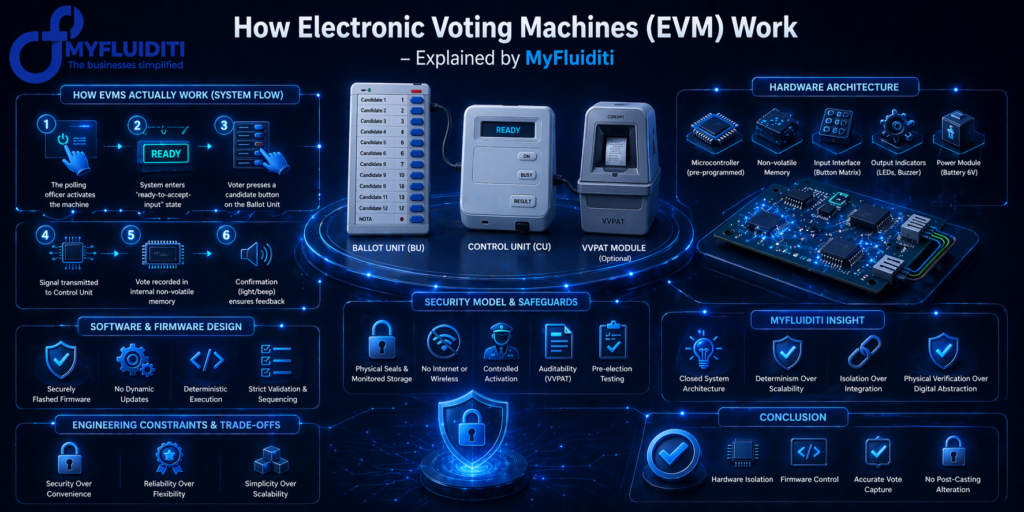
Introduction In the evolution of electoral systems, Electronic Voting Machines (EVMs) represent a shift from manual, error-prone ballot methods to deterministic, embedded-system-driven voting infrastructure. Designed for accuracy, speed, and operational efficiency, EVMs are widely used in India to ensure reliable vote capture and counting. At MyFluiditi, we studied the architecture and working principles of EVMs from both a hardware engineering and software systems standpoint to understand how such a critical, trust-sensitive system is built and validated. What is an EVM? An Electronic Voting Machine is a standalone embedded system designed specifically to record votes securely without relying on network connectivity. It primarily consists of two tightly coupled modules: These units are connected via a secure cable, ensuring controlled communication between input (voter action) and storage (vote recording). How EVMs Actually Work (System Flow) From a systems engineering perspective, the EVM follows a controlled event-driven workflow: This process ensures one vote per activation cycle, eliminating duplication or invalid entries. At MyFluiditi, our analysis highlights that this is essentially a finite state machine (FSM) implementation, where transitions are strictly controlled and externally gated by the polling officer. Hardware Architecture: How the Board is Built EVM hardware is not a general-purpose computing system. It is a purpose-built embedded device, optimized for reliability and tamper resistance. Core hardware components include: Key engineering decisions observed by MyFluiditi: Additionally, EVMs are designed to function without electricity using battery power, increasing deployment flexibility in remote regions. Software & Firmware Design Unlike modern applications, EVMs do not run complex operating systems. Instead, they operate on firmware-level logic embedded into microcontrollers. Software characteristics: From MyFluiditi’s research perspective, this resembles safety-critical systems design (similar to avionics or industrial controllers), where: Security Model and Safeguards Security in EVMs is not purely software-based; it is multi-layered across hardware, process, and governance. Key safeguards include: These mechanisms collectively reduce risks such as unauthorized access, duplication of votes, or external manipulation. MyFluiditi’s evaluation suggests that EVM security relies heavily on “air-gapped architecture + procedural integrity”, rather than cryptographic complexity alone. Engineering Constraints and Design Trade-offs Electronic Voting Machines are intentionally designed with strict constraints to maximize reliability and security, which naturally introduces several trade-offs. Instead of using connected or feature-rich systems, EVMs operate as isolated, purpose-built devices. This lack of connectivity significantly enhances security by eliminating remote attack surfaces, but it also means there is no capability for real-time monitoring or remote diagnostics. Similarly, the use of simple, deterministic firmware ensures consistent and predictable behavior, reducing the chances of software failure; however, it limits flexibility for upgrades or feature expansion. From a hardware and operational standpoint, EVMs rely heavily on physical control mechanisms such as manual activation by polling officers and sealed units to enforce trust. While this strengthens procedural integrity and reduces digital vulnerabilities, it introduces dependency on human processes and strict administrative handling. In summary, the design philosophy reflects a clear prioritization: This balance ensures that the system remains robust and trustworthy, even if it sacrifices modern capabilities commonly seen in connected digital systems. MyFluiditi Insight: Why This Design Still Works During our research, MyFluiditi observed that EVMs follow a “closed system architecture” model. Unlike modern cloud or distributed systems, they prioritize: This makes them uniquely robust in environments where trust, auditability, and simplicity are more critical than speed or connectivity. Conclusion Electronic Voting Machines are not just devices, they are carefully engineered embedded systems built to operate under strict constraints of security, reliability, and transparency. From hardware-level isolation to firmware-driven control logic, every component is optimized to ensure that each vote is captured accurately and cannot be altered post-casting. From MyFluiditi’s research standpoint, EVMs demonstrate how well-designed minimal systems can outperform complex architectures in high-stakes environments. As digital systems continue to evolve, the principles behind EVM design simplicity, determinism, and controlled execution remain highly relevant for building secure and trustworthy technology solutions.
Custom Software Development Services for Modern Businesses
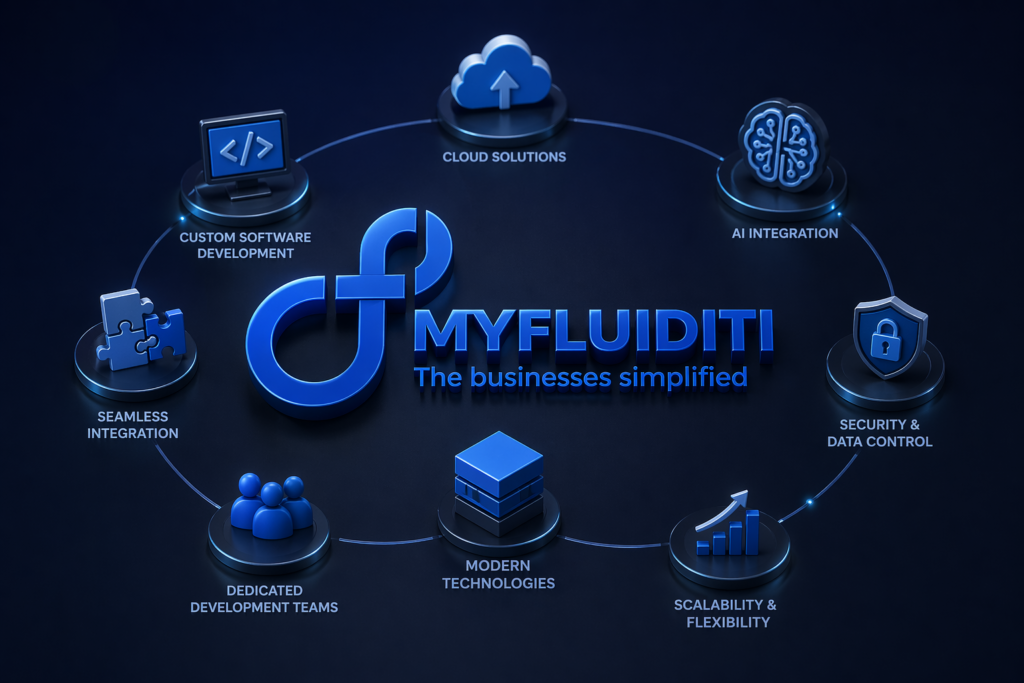
Introduction In today’s digital-first world, businesses rely heavily on technology to streamline operations, enhance customer experiences, and stay competitive. As industries evolve, generic software solutions often fall short in meeting unique business requirements, leading to the growing demand for custom software development. Organizations are now shifting towards tailored solutions that align with their workflows and long-term goals. Following a structured and scalable approach similar to leading companies in the industry, MyFluiditi helps businesses build customized, high-performance applications designed for growth and efficiency. Understanding Custom Software Development Custom software development is the process of designing and building applications specifically tailored to a business’s needs. Unlike off-the-shelf solutions, custom software provides flexibility, scalability, and better integration with existing systems. At MyFluiditi, development goes beyond just writing code. It involves understanding business challenges, user expectations, and future scalability requirements. This ensures that every solution delivered is not only functional but also aligned with business objectives. Why Businesses Are Moving Towards Custom Solutions As businesses grow, they often face challenges such as system limitations, lack of flexibility, and integration issues with existing tools. Custom software addresses these problems by offering solutions designed specifically for the organization. Some key reasons businesses are adopting custom software include: MyFluiditi works closely with clients to identify gaps in their current systems and develop solutions that improve efficiency and productivity while supporting long-term growth. Our Development Approach at MyFluiditi A well-defined development process plays a crucial role in delivering high-quality software. At MyFluiditi, we follow a structured approach that ensures transparency and efficiency throughout the project lifecycle. We begin by analyzing business requirements and defining clear objectives. This is followed by designing scalable architectures and implementing agile development methodologies. Continuous testing and feedback ensure that the final product meets both technical and business expectations. Our approach focuses on collaboration, allowing clients to stay involved at every stage. From initial planning to deployment and ongoing support, MyFluiditi ensures a seamless and result-driven development process. Technologies Driving Modern Software Development Modern applications are powered by advanced technologies that enhance performance, scalability, and user experience. Businesses today are leveraging cloud computing, artificial intelligence, and modern frameworks to stay competitive. At MyFluiditi, we integrate these technologies into every solution we build. Whether it’s implementing cloud infrastructure for scalability or using AI to enhance application capabilities, our focus is on delivering innovative and future-ready solutions. How MyFluiditi Helps Businesses Succeed MyFluiditi provides end-to-end IT solutions that support businesses at every stage of their digital journey. Our services are designed to deliver measurable results and long-term value. We help businesses: By combining technical expertise with a business-focused approach, MyFluiditi enables organizations to transform their ideas into powerful digital solutions. Benefits of Custom Software Development Custom software offers several advantages that make it a preferred choice for modern businesses. It allows organizations to create solutions that are tailored to their needs while ensuring better performance and scalability. With MyFluiditi, businesses benefit from improved efficiency, faster development cycles, and solutions that are built to adapt to future requirements. This ensures long-term sustainability and competitive advantage in the market. Conclusion Custom software development has become essential for businesses aiming to innovate and grow in a competitive digital landscape. As organizations continue to evolve, the need for scalable and flexible solutions will only increase. By partnering with MyFluiditi, businesses gain access to a team that understands both technology and business strategy. We deliver solutions that not only solve current challenges but also prepare organizations for future growth. In an era where technology drives success, choosing the right development partner can make all the difference and MyFluiditi is committed to helping businesses achieve that success.
How to Choose the Right Ecommerce Web Development UK Partner

Launching or upgrading an online store requires more than just a passing knowledge of web design. It demands a strategic approach to technology, user experience, and market dynamics. For businesses operating in Britain, finding a team that understands local consumer behavior, regulatory requirements, and cutting-edge technology is essential. Your choice of agency will directly impact your conversion rates, operational efficiency, and long-term scalability. This guide breaks down exactly how to evaluate potential agencies, why artificial intelligence is changing the game, and what technical criteria matter most. By the end of this post, you will know exactly how to select an Ecommerce Web Development UK partner that aligns with your business goals and technical needs. Understanding the UK Digital Retail Landscape British consumers expect fast, seamless, and highly personalized shopping experiences. They demand transparent shipping options, secure payment gateways, and intuitive mobile interfaces. If your online store fails to meet these expectations, shoppers will quickly move to competitors. Investing in professional Ecommerce Web Development UK services ensures your platform meets these high standards. A specialized agency understands local preferences, such as the popularity of specific payment methods like Apple Pay, Google Pay, and localized Buy Now, Pay Later (BNPL) services like Clearpay or Klarna. They also understand the nuances of integrating local shipping providers like Royal Mail, DPD, and Evri directly into your checkout process. When you start navigating the Ecommerce Web Development UK market, you will find hundreds of agencies claiming to offer the best services. However, true expertise goes beyond basic template customization. You need a partner capable of building robust, scalable architectures that can handle high traffic volumes during peak seasons like Black Friday or Boxing Day sales. Core Criteria for Evaluating an Agency Your search for an Ecommerce Web Development UK partner should focus on several critical areas. Do not settle for a team that only knows how to install plugins. Look for engineers and strategists who understand the underlying architecture of modern commerce. Technical Expertise and Modern Tech Stacks The foundation of any successful online store is its technology stack. Legacy platforms often struggle to keep up with modern performance requirements. When defining what makes an Ecommerce Web Development UK agency stand out, look at their technical capabilities. Do they build monolithic structures, or do they understand composable commerce? Headless commerce architecture—where the frontend user interface is decoupled from the backend ecommerce logic—provides unparalleled flexibility. This approach allows you to deliver lightning-fast page load speeds, which are crucial for both user experience and search engine rankings. Ensure your potential partner has deep experience with modern frameworks like React, Vue.js, or Next.js, alongside robust backend solutions. The Power of AI in Retail As an AI web app development company, we at MyFluiditi understand that artificial intelligence is no longer a futuristic concept—it is a current necessity. The core of any successful Ecommerce Web Development UK project now involves some level of AI integration. AI-driven solutions provide a massive competitive edge. They enable advanced product recommendations, predictive inventory management, and intelligent search functionalities. Machine learning algorithms can analyze a user’s browsing behavior in real-time, displaying products most likely to result in a conversion. Furthermore, AI-powered chatbots can handle customer service inquiries 24/7, reducing operational costs while improving customer satisfaction. When evaluating an agency, ask them specifically how they leverage AI to boost sales and streamline operations. Portfolio and Proven Track Record Never hire an agency without thoroughly reviewing their past work. An experienced Ecommerce Web Development UK team will gladly share detailed case studies. Look beyond the visual design of their past projects. Ask for metrics regarding page speed improvements, conversion rate increases, and backend integration success. If they built a complex integration between an ecommerce platform and an enterprise resource planning (ERP) system, ask them how they handled data synchronization. Essential Questions to Ask Your Provider When interviewing an Ecommerce Web Development UK provider, you need to ask pointed questions to gauge their true capabilities. Use this checklist during your initial consultations: How do you approach mobile optimization? Mobile commerce accounts for a massive percentage of UK sales. Your partner must use a mobile-first design philosophy. What is your process for integrating third-party APIs? Your store will likely need to connect with accounting software, CRM systems, and marketing automation tools. How do you handle data migration? If you are moving from an existing platform, data migration is critical. Ask how they ensure zero data loss regarding customer accounts, order history, and SEO rankings. Do you build custom AI solutions? Standard plugins often lack the customization needed for unique business models. AI-driven Ecommerce Web Development UK solutions require custom algorithms tailored to your specific product catalog. Security, Compliance, and Data Protection British businesses face strict regulatory requirements regarding consumer data. The standard for Ecommerce Web Development UK compliance involves strict adherence to the General Data Protection Regulation (GDPR). Your development partner must understand how to implement proper data consent mechanisms, secure data storage, and compliant marketing opt-ins. Furthermore, payment security is non-negotiable. Ensure the agency has a proven track record of building PCI-DSS compliant checkout flows. They should implement robust security measures, including web application firewalls, regular vulnerability scanning, and secure authentication protocols to protect your business and your customers from cyber threats. Scalability: Building for Future Growth A common mistake businesses make is building a store that fits their current needs but fails to accommodate future growth. Your platform should scale seamlessly as your product catalog expands and your traffic increases. This requires a scalable hosting environment, often utilizing cloud infrastructure like AWS or Google Cloud. It also requires an optimized database structure. Ask your agency how they load-test their applications. They should be able to simulate high-traffic events to ensure your site will not crash when you run a major marketing campaign. Post-Launch Support and Maintenance A successful launch is only the beginning. Software requires continuous updates, security patches, and performance optimizations. Expert Ecommerce Web Development UK maintenance is vital for the long-term health of