Blockchain Beyond Cryptocurrency: Real Business Applications
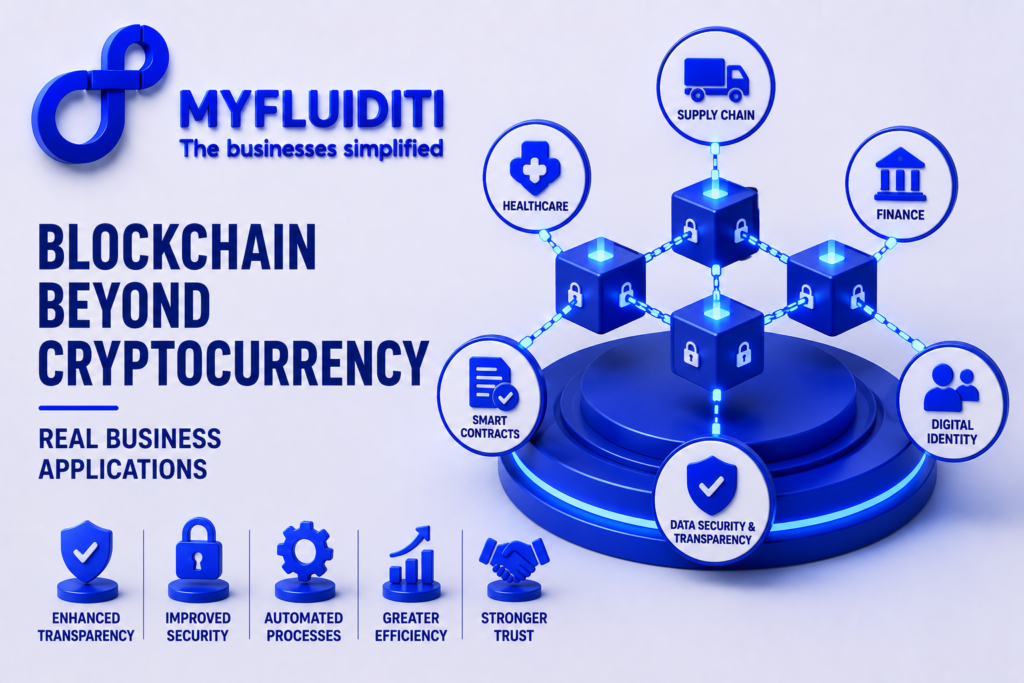
Introduction When people hear the term blockchain, cryptocurrency is often the first thing that comes to mind. While digital currencies introduced blockchain technology to the world, its true potential extends far beyond cryptocurrencies. Today, organizations across industries are leveraging Blockchain Technology to improve transparency, strengthen security, automate business processes, reduce fraud, and build trust across complex digital ecosystems. As businesses continue accelerating their digital transformation initiatives, blockchain is emerging as a powerful technology for creating secure, decentralized, and highly efficient business operations. From supply chain management and healthcare to finance, manufacturing, logistics, and government services, blockchain is revolutionizing the way organizations store, verify, and exchange information. At MyFluiditi, we help businesses unlock the full potential of blockchain by developing scalable, secure, and customized blockchain solutions that solve real-world business challenges and drive long-term innovation. Understanding Blockchain Technology Blockchain is a decentralized digital ledger that securely records transactions across multiple computers in a network. Unlike traditional databases controlled by a single authority, blockchain distributes data across multiple participants, ensuring that records remain transparent, tamper-resistant, and verifiable. Every transaction is encrypted, time-stamped, and linked to previous records, creating an immutable chain of information that cannot easily be altered or manipulated. This unique architecture provides organizations with enhanced security, improved accountability, and greater operational transparency. MyFluiditi develops blockchain-powered business solutions that enable organizations to securely manage digital assets, streamline operations, and improve trust across interconnected business networks. Why Businesses Are Adopting Blockchain Beyond Cryptocurrency Modern enterprises manage vast amounts of sensitive data across multiple systems, partners, and stakeholders. Traditional processes often involve manual verification, fragmented databases, lengthy approvals, and limited visibility into business operations. Blockchain addresses these challenges by creating a single source of truth where authorized participants can securely access, validate, and share information in real time. This significantly reduces administrative overhead, eliminates data inconsistencies, and enhances collaboration across organizations. Businesses adopting blockchain solutions gain greater operational efficiency, improved compliance, stronger data integrity, and reduced dependency on intermediaries. MyFluiditi works with organizations to identify blockchain opportunities that align with strategic objectives while delivering measurable business value. Transforming Supply Chain Management Supply chain management is one of the most impactful areas where blockchain technology delivers tangible business benefits. Modern supply chains involve manufacturers, suppliers, logistics providers, distributors, retailers, and customers, making transparency and traceability critical. Blockchain enables organizations to track products from origin to destination, providing real-time visibility into every stage of the supply chain. Businesses can verify product authenticity, monitor shipments, reduce counterfeit risks, improve inventory management, and strengthen supplier accountability. This level of transparency increases customer trust while improving operational efficiency. MyFluiditi develops blockchain-enabled supply chain solutions that help organizations create secure, transparent, and resilient logistics ecosystems. Enhancing Data Security and Digital Trust Data security remains a top priority for organizations operating in today’s digital environment. Cyber threats, unauthorized access, and data manipulation continue to challenge businesses across industries. Blockchain enhances cybersecurity by encrypting transactions, distributing records across decentralized networks, and preventing unauthorized modifications to stored information. Since every transaction is validated through consensus mechanisms, businesses gain higher levels of data integrity and trust compared to conventional systems. MyFluiditi integrates blockchain technology with modern cybersecurity practices to help organizations protect sensitive information while building secure digital infrastructures capable of supporting future growth. Smart Contracts for Business Automation One of the most transformative features of blockchain is the ability to execute Smart Contracts. Smart contracts are self-executing digital agreements that automatically perform predefined actions when specified conditions are met. This eliminates the need for manual intervention, reduces paperwork, accelerates approvals, and minimizes operational errors. Organizations can automate financial transactions, vendor agreements, insurance claims, procurement processes, compliance verification, and contract management through secure blockchain-based workflows. By implementing intelligent automation, MyFluiditi enables businesses to improve efficiency while reducing operational costs and administrative complexity. Blockchain in Financial Services Financial institutions are increasingly adopting blockchain technology to improve transaction security, reduce processing times, and lower operational costs. Traditional banking systems often involve multiple intermediaries, lengthy settlement periods, and higher transaction fees. Blockchain simplifies financial operations by enabling secure peer-to-peer transactions, faster cross-border payments, digital identity verification, fraud prevention, and transparent audit trails. These capabilities improve customer experiences while strengthening regulatory compliance and financial security. MyFluiditi develops enterprise blockchain solutions that help financial organizations modernize digital services while maintaining the highest standards of security and reliability. Revolutionizing Healthcare Data Management Healthcare organizations generate large volumes of sensitive patient information that must remain secure, accurate, and accessible only to authorized users. Blockchain technology enables healthcare providers to maintain tamper-proof electronic health records, securely exchange patient information, improve interoperability between healthcare systems, and strengthen regulatory compliance. Patients gain greater control over their medical data while healthcare providers improve collaboration and treatment accuracy. MyFluiditi helps healthcare organizations leverage blockchain to build secure digital healthcare ecosystems that improve patient outcomes and operational efficiency. Enabling Secure Digital Identity Management Digital identity has become increasingly important as businesses expand online services and remote operations. Traditional identity management systems remain vulnerable to credential theft, identity fraud, and unauthorized access. Blockchain enables decentralized identity verification, allowing individuals to securely manage and share verified digital credentials without relying on centralized databases. Organizations benefit from stronger authentication, improved privacy protection, and reduced identity-related fraud. MyFluiditi designs blockchain-based identity management solutions that strengthen access control while simplifying secure digital interactions across enterprise environments. Accelerating Digital Transformation Through Blockchain Blockchain is becoming an essential technology for organizations pursuing Digital Transformation, Artificial Intelligence (AI), Internet of Things (IoT), cloud computing, and enterprise automation. By integrating blockchain with existing business applications, organizations can create highly secure, transparent, and intelligent digital ecosystems. Whether supporting IoT device authentication, AI-driven data verification, secure cloud transactions, or enterprise workflow automation, blockchain provides a trusted foundation for emerging technologies. MyFluiditi develops integrated blockchain solutions that connect seamlessly with ERP platforms, CRM systems, cloud infrastructure, and enterprise applications, enabling businesses to innovate with confidence. Why Choose MyFluiditi for Blockchain Solutions Implementing successful blockchain solutions requires expertise in distributed ledger technologies, enterprise architecture, cybersecurity, cloud computing, software
API Development and Integration: Connecting Modern Business Systems
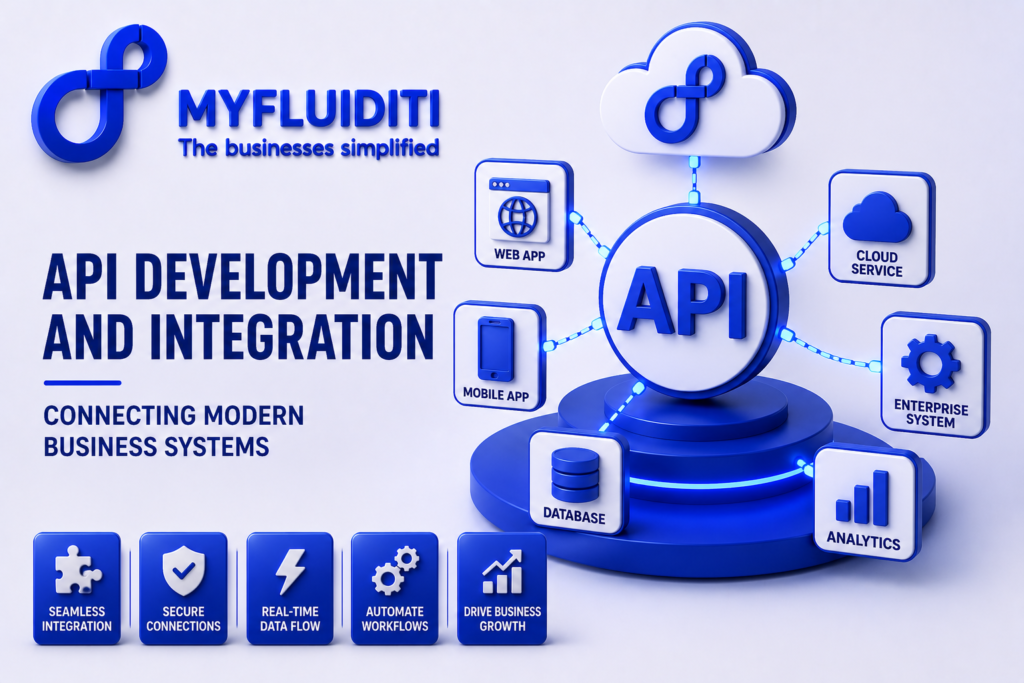
Introduction In today’s fast-paced digital economy, businesses rely on multiple software applications to manage operations, customer relationships, finance, marketing, logistics, human resources, and communication. However, when these systems operate in isolation, organizations face challenges such as duplicate data, manual processes, delayed decision-making, and reduced productivity. To remain competitive, businesses need seamless connectivity between their applications, platforms, and data sources. This is where API Development and Integration plays a crucial role. Application Programming Interfaces (APIs) enable different software systems to communicate securely and exchange data in real time, creating a unified digital ecosystem that enhances efficiency, improves customer experiences, and accelerates innovation. At MyFluiditi, we help organizations build scalable API solutions that simplify complex integrations, automate workflows, and enable connected digital enterprises ready for future growth. Understanding API Development and Integration An Application Programming Interface (API) is a set of protocols and standards that allows different software applications to communicate and share information efficiently. APIs act as secure bridges between systems, enabling organizations to integrate enterprise applications, cloud platforms, mobile apps, websites, databases, payment gateways, third-party services, IoT devices, and business intelligence tools. Instead of replacing existing software investments, API integration connects them into a centralized ecosystem where information flows seamlessly across the organization. MyFluiditi designs secure, scalable, and high-performance APIs that empower businesses to improve collaboration, eliminate data silos, and maximize operational efficiency. Why API Integration Matters for Modern Businesses Modern organizations depend on multiple digital platforms to deliver products and services. Customer information may reside in a CRM system, financial records in ERP software, marketing campaigns in automation platforms, and operational data across cloud applications. Without integration, employees spend valuable time manually transferring information between systems, increasing the risk of errors and reducing productivity. API integration enables real-time communication across applications, ensuring accurate data, faster business processes, and better decision-making. Businesses can automate repetitive tasks, improve operational visibility, and create consistent customer experiences across every digital touchpoint. MyFluiditi helps organizations implement intelligent API strategies that connect critical business systems while supporting long-term digital transformation initiatives. Enhancing Customer Experiences Through Connected Systems Customers expect fast, personalized, and consistent experiences across websites, mobile applications, customer portals, and digital service platforms. APIs enable businesses to synchronize customer data across multiple systems, allowing support teams, sales professionals, and service representatives to access accurate information instantly. Real-time integration also enables secure payment processing, appointment scheduling, order tracking, inventory availability, personalized recommendations, and omnichannel communication. These capabilities improve customer satisfaction while increasing engagement and loyalty. MyFluiditi develops customer-centric API solutions that create seamless digital experiences while enabling organizations to respond more quickly to evolving customer expectations. Streamlining Business Operations with API Automation One of the greatest advantages of API integration is its ability to automate business workflows. Instead of relying on manual processes, APIs allow systems to exchange information automatically, reducing administrative effort and improving operational accuracy. Businesses can automate invoice generation, customer onboarding, inventory updates, employee management, shipping notifications, financial reporting, and countless other business functions. Automation not only improves productivity but also reduces operational costs while minimizing human error. MyFluiditi works closely with organizations to identify automation opportunities and implement API-driven workflows that simplify operations and improve business performance. Enabling Cloud Integration and Digital Transformation As organizations increasingly adopt cloud computing, hybrid infrastructures, and SaaS applications, seamless integration has become essential for business success. APIs enable secure communication between on-premises systems and cloud-based platforms, allowing businesses to modernize technology without disrupting existing operations. Whether integrating cloud ERP systems, CRM platforms, analytics solutions, collaboration tools, or enterprise applications, APIs provide the flexibility needed to support digital transformation. MyFluiditi specializes in cloud-native API development that enables businesses to connect legacy systems with modern technologies while creating scalable and future-ready digital environments. Improving Data Accessibility and Business Intelligence Data is one of the most valuable resources within any organization, but its true value depends on accessibility and accuracy. API integration enables businesses to consolidate information from multiple sources into centralized dashboards, analytics platforms, and business intelligence solutions. Decision-makers gain real-time visibility into operational performance, customer behavior, financial metrics, inventory levels, and business trends without relying on disconnected reports. By providing accurate, up-to-date information, APIs enable faster and more informed business decisions. MyFluiditi develops integrated data ecosystems that empower organizations to transform fragmented information into meaningful insights that support strategic growth. Strengthening Security and Compliance As businesses exchange increasing volumes of sensitive information, API security has become a top priority. Modern APIs incorporate advanced authentication mechanisms, encryption protocols, token-based authorization, access controls, and continuous monitoring to ensure secure communication between systems. Properly designed APIs protect customer information, financial transactions, healthcare records, and confidential business data while supporting compliance with industry standards and regulatory requirements. MyFluiditi follows industry best practices for secure API architecture, implementing robust security frameworks that protect enterprise systems against evolving cyber threats while maintaining high performance and reliability. Supporting Innovation Through Scalable API Architecture Technology continues to evolve rapidly, and businesses require flexible digital infrastructures capable of supporting future innovation. APIs provide modular architectures that allow organizations to introduce new applications, services, and technologies without redesigning existing systems. Whether integrating Artificial Intelligence (AI), Machine Learning, IoT platforms, automation tools, or emerging digital services, APIs provide the foundation for scalable business growth. Organizations that adopt API-first strategies can innovate faster, launch new products more efficiently, and respond quickly to changing market demands. MyFluiditi builds scalable API ecosystems that enable continuous innovation while ensuring long-term business agility. Industry Applications of API Development and Integration API integration is transforming industries by enabling secure, real-time communication across complex digital ecosystems. Healthcare organizations integrate electronic health records, patient portals, and telemedicine platforms to improve care delivery. Financial institutions connect banking systems, payment gateways, fraud detection platforms, and mobile applications to deliver secure financial services. Retail businesses synchronize inventory, eCommerce platforms, customer loyalty programs, and logistics providers to improve shopping experiences. Manufacturing companies integrate production systems, supply chain platforms, and IoT devices to optimize operational efficiency, while logistics organizations use APIs for fleet management, warehouse automation, shipment tracking, and
Zero Trust Security: Protecting Modern Digital Enterprises
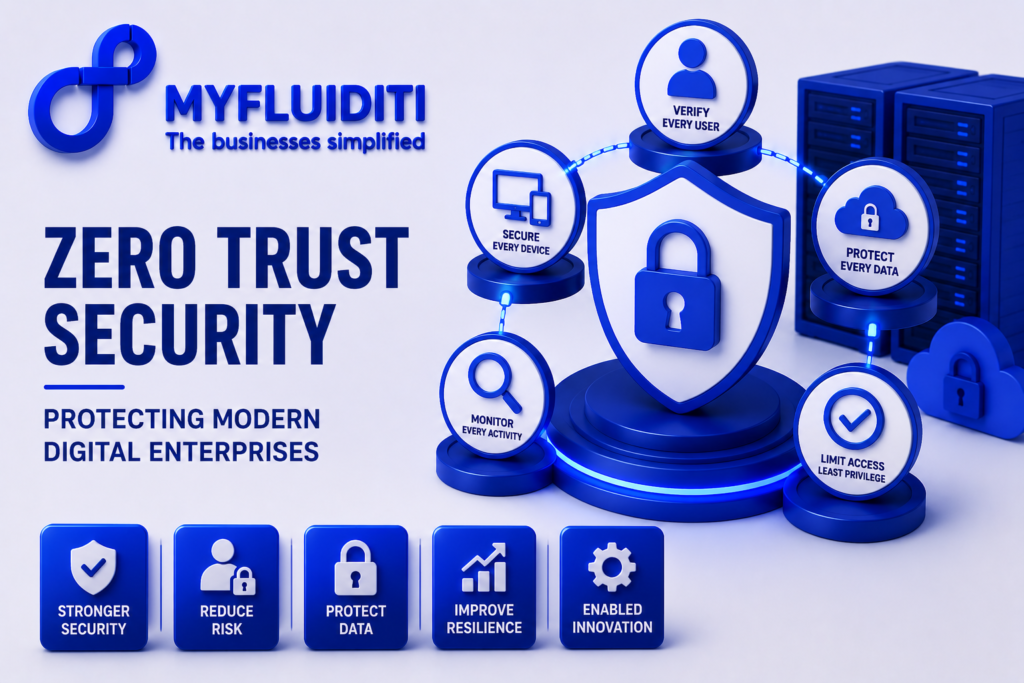
Introduction As businesses accelerate their digital transformation initiatives, the cybersecurity landscape has become increasingly complex. Organizations are embracing cloud computing, hybrid work environments, SaaS applications, mobile devices, and Internet of Things (IoT) technologies to improve efficiency and innovation. However, these advancements have also expanded the attack surface, making traditional perimeter-based security models less effective. Cybercriminals continue to exploit vulnerabilities through ransomware, phishing attacks, insider threats, credential theft, and sophisticated malware campaigns. In this evolving environment, organizations need a modern security framework that continuously verifies every user, device, and application before granting access. This is where Zero Trust Security has become the foundation of enterprise cybersecurity. Built on the principle of “Never Trust, Always Verify,” Zero Trust enables businesses to strengthen security, reduce cyber risks, and protect critical digital assets. At MyFluiditi, we help organizations implement intelligent Zero Trust Security solutions that safeguard business operations while enabling secure digital innovation. Understanding Zero Trust Security Zero Trust Security is a modern cybersecurity framework that assumes no user, device, or application should be trusted automatically, regardless of whether the request originates inside or outside the corporate network. Every access request is continuously authenticated, authorized, and validated using multiple security controls before access is granted. Unlike traditional security models that rely on network boundaries, Zero Trust focuses on identity verification, least-privilege access, continuous monitoring, endpoint security, and real-time threat detection. As organizations adopt cloud-native infrastructures and distributed workforces, Zero Trust has become an essential strategy for protecting sensitive business information. MyFluiditi designs customized Zero Trust architectures that align with business objectives while strengthening enterprise-wide security. Why Zero Trust Matters for Modern Digital Enterprises Today’s organizations operate across multiple cloud platforms, remote offices, mobile devices, third-party integrations, and digital ecosystems. Employees access business applications from different locations using various devices, while customers expect seamless digital experiences. This level of connectivity creates new security challenges that traditional firewalls alone cannot address. Zero Trust Architecture minimizes these risks by verifying every access request and continuously monitoring user behavior, device health, and application activity. Businesses adopting Zero Trust gain stronger protection against unauthorized access, insider threats, credential compromise, and data breaches while maintaining operational flexibility. MyFluiditi helps enterprises modernize their security posture with scalable Zero Trust strategies that support secure growth without disrupting business operations. Strengthening Identity and Access Management Identity has become the new security perimeter in the digital era. Protecting user identities is critical because compromised credentials remain one of the leading causes of cyberattacks. Zero Trust enhances Identity and Access Management (IAM) by implementing multi-factor authentication, role-based access control, adaptive authentication, single sign-on, and continuous identity verification. Users receive access only to the resources necessary for their responsibilities, significantly reducing unnecessary privileges that attackers often exploit. MyFluiditi integrates advanced identity management solutions that ensure employees, contractors, partners, and customers can securely access business applications while minimizing security risks. Securing Cloud Environments and Remote Workforces Cloud adoption and hybrid work have transformed how businesses operate, but they have also introduced new cybersecurity challenges. Employees frequently access enterprise applications from home networks, personal devices, and public internet connections. Zero Trust protects cloud environments by continuously validating user identity, device security, application integrity, and network context before granting access. Organizations can confidently adopt cloud security, remote collaboration platforms, and SaaS applications without compromising sensitive business information. MyFluiditi develops secure cloud architectures that combine Zero Trust principles with modern cloud technologies, ensuring organizations maintain productivity while protecting valuable digital assets. Preventing Data Breaches and Cyber Threats Data has become one of the most valuable assets for modern organizations, making it a primary target for cybercriminals. Financial records, customer information, intellectual property, healthcare data, and operational systems require advanced protection against evolving threats. Zero Trust continuously monitors user activity, identifies abnormal behavior, and limits lateral movement within enterprise networks. Even if attackers gain initial access, they encounter multiple layers of verification that significantly reduce the potential impact of a breach. By combining AI-powered threat detection, behavioral analytics, endpoint protection, and real-time monitoring, MyFluiditi helps organizations proactively defend against ransomware, phishing attacks, insider threats, and advanced persistent threats. Supporting Regulatory Compliance and Data Privacy Businesses operating in regulated industries must comply with increasingly stringent security and privacy requirements. Standards such as GDPR, HIPAA, ISO 27001, PCI DSS, and other industry regulations require organizations to implement robust access controls, data protection measures, and continuous monitoring. Zero Trust Security supports compliance by enforcing strong authentication, maintaining detailed audit trails, protecting sensitive information, and ensuring only authorized individuals can access critical systems. MyFluiditi works with organizations to implement security frameworks that not only strengthen cybersecurity but also simplify compliance with industry regulations and governance requirements. Leveraging AI and Automation in Zero Trust Security Modern cybersecurity requires intelligent systems capable of responding to threats in real time. Artificial Intelligence (AI) and Machine Learning (ML) significantly enhance Zero Trust Security by continuously analyzing user behavior, detecting anomalies, identifying suspicious activities, and automating security responses. AI-powered security platforms can rapidly recognize emerging threats that traditional security tools may overlook. Automation also reduces response times, enabling organizations to contain incidents before they escalate into major business disruptions. MyFluiditi integrates AI-driven security analytics and intelligent automation into Zero Trust environments, helping businesses strengthen resilience while reducing operational complexity. Building a Resilient Cybersecurity Strategy Zero Trust is not a single technology but a comprehensive cybersecurity strategy that combines identity management, endpoint protection, network segmentation, encryption, cloud security, continuous monitoring, and threat intelligence into a unified security framework. Organizations implementing Zero Trust gain greater visibility across their digital infrastructure while reducing security gaps that attackers commonly exploit. Business resilience improves because security controls adapt dynamically as users, devices, and applications change over time. MyFluiditi partners with organizations to assess existing security environments, identify vulnerabilities, develop Zero Trust roadmaps, and implement scalable cybersecurity solutions that evolve alongside business growth. Why Choose MyFluiditi for Zero Trust Security Solutions Implementing Zero Trust Security requires deep expertise in cybersecurity, cloud computing, identity management, enterprise architecture, AI, and digital transformation. MyFluiditi delivers end-to-end cybersecurity solutions
Predictive Analytics: Turning Business Data into Competitive Advantage
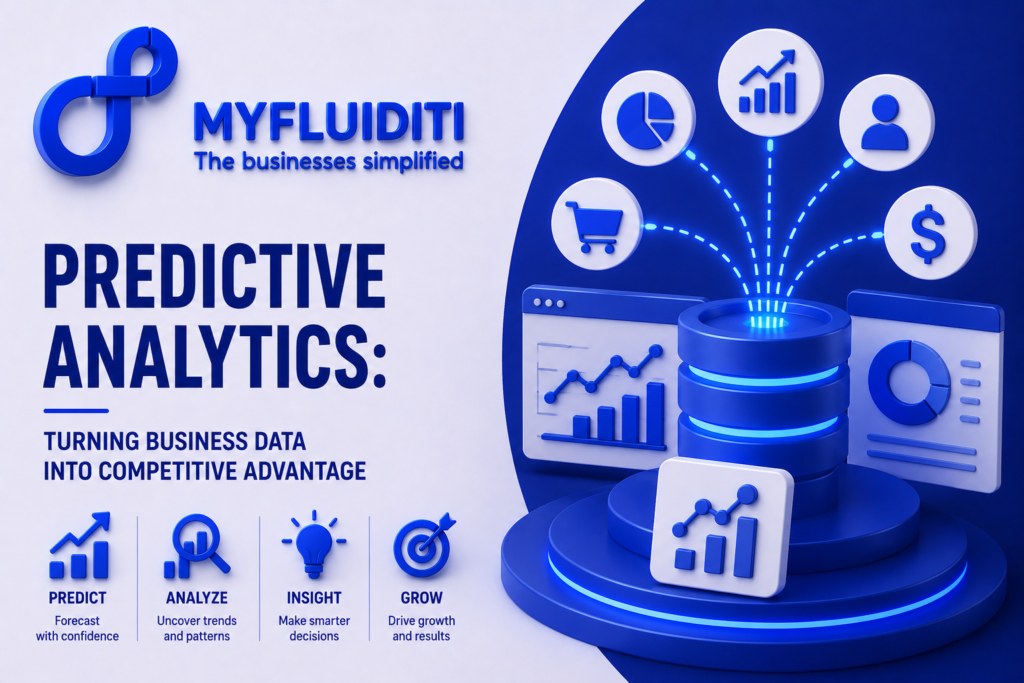
Introduction In today’s rapidly evolving digital economy, data has become one of the most valuable business assets. Every customer interaction, sales transaction, operational process, and digital engagement generates valuable information that can help organizations make smarter decisions. However, collecting data alone is not enough. The true competitive advantage comes from understanding what the data reveals about future trends and using those insights to drive proactive business decisions. This is where Predictive Analytics plays a transformative role. By combining historical data, Artificial Intelligence (AI), Machine Learning (ML), advanced statistical models, and real-time analytics, predictive analytics enables businesses to anticipate customer behavior, reduce operational risks, improve efficiency, and identify growth opportunities before competitors do. At MyFluiditi, we help organizations unlock the full potential of their data by developing intelligent predictive analytics solutions that support strategic decision-making and sustainable business growth. Understanding Predictive Analytics Predictive analytics is an advanced branch of data analytics that uses historical information, statistical algorithms, machine learning models, and data mining techniques to forecast future outcomes. Rather than reacting to events after they occur, businesses can make informed decisions based on likely future scenarios. Organizations across industries are using predictive analytics to optimize operations, improve customer experiences, forecast demand, prevent fraud, manage risks, and maximize profitability. As businesses continue generating larger volumes of structured and unstructured data, predictive analytics has become an essential component of modern digital transformation strategies. Unlike traditional reporting, which focuses on what has already happened, predictive analytics answers critical business questions such as what is likely to happen next, why it may happen, and what actions should be taken today to improve future outcomes. MyFluiditi works closely with organizations to build predictive models that align with business goals while transforming complex datasets into meaningful, actionable insights. Why Predictive Analytics Matters for Modern Businesses The modern business landscape is highly competitive, and organizations must make decisions faster than ever before. Market conditions change rapidly, customer expectations evolve continuously, and operational risks emerge unexpectedly. Businesses that rely solely on historical reports often struggle to respond quickly to changing conditions. Predictive analytics empowers organizations to move from reactive decision-making to proactive business planning by identifying future opportunities and potential challenges before they occur. Companies that successfully implement predictive analytics solutions can improve operational efficiency, optimize resource allocation, reduce unnecessary costs, increase customer satisfaction, strengthen supply chain management, and accelerate innovation. These advantages create measurable business value while helping organizations remain competitive in dynamic markets. At MyFluiditi, our predictive analytics frameworks are designed to help businesses improve performance through intelligent forecasting, automated insights, and data-driven decision support. Enhancing Customer Experience Through Predictive Intelligence Customer expectations continue to evolve as consumers demand personalized, seamless, and highly responsive experiences. Predictive analytics enables businesses to understand customer preferences, anticipate purchasing behavior, identify churn risks, and recommend products or services tailored to individual users. By analyzing customer interactions across multiple channels, organizations can deliver highly personalized experiences that improve engagement, increase loyalty, and maximize customer lifetime value. Retailers can recommend products before customers search for them, financial institutions can offer personalized financial services, healthcare providers can anticipate patient needs, and subscription businesses can identify customers who may be considering cancellation. These proactive strategies significantly improve customer satisfaction while increasing conversion rates. MyFluiditi develops customer intelligence platforms that combine predictive modeling with AI-driven personalization, helping businesses create meaningful customer experiences that drive long-term success. Improving Business Operations and Efficiency Operational efficiency remains a top priority for organizations seeking sustainable growth. Predictive analytics enables businesses to optimize inventory management, forecast demand, schedule resources more effectively, monitor equipment performance, and reduce operational downtime. Instead of relying on assumptions or manual estimates, businesses gain accurate forecasts that support better planning and faster decision-making. Manufacturers use predictive analytics to anticipate equipment failures before breakdowns occur. Logistics companies optimize delivery routes using real-time forecasting. Healthcare organizations improve patient scheduling and resource allocation, while financial institutions identify unusual transaction patterns that may indicate fraud. At MyFluiditi, predictive analytics solutions integrate seamlessly with enterprise systems, enabling organizations to automate workflows, improve operational visibility, and make data-backed business decisions. Reducing Business Risks with Predictive Analytics Risk management has become increasingly important in today’s uncertain business environment. Organizations face risks related to cybersecurity, financial operations, market volatility, supply chain disruptions, regulatory compliance, and customer behavior. Predictive analytics helps businesses identify potential risks early, allowing leadership teams to implement preventive measures before issues escalate. By continuously analyzing historical trends and real-time business data, predictive models can detect anomalies, identify unusual patterns, and forecast potential business disruptions. Financial institutions use predictive analytics for fraud detection, insurance companies assess claim risks more accurately, and retailers forecast demand fluctuations to avoid inventory shortages. MyFluiditi helps businesses implement predictive risk management solutions that improve resilience while supporting informed strategic planning. Leveraging AI and Machine Learning for Smarter Predictions The increasing adoption of Artificial Intelligence, Machine Learning, and cloud technologies has significantly enhanced the capabilities of predictive analytics. Modern predictive models continuously learn from new data, improving forecasting accuracy over time. Unlike static analytical models, AI-powered systems adapt to changing customer behaviors, market conditions, and operational environments without requiring constant manual intervention. Businesses leveraging AI-driven predictive analytics gain deeper insights into customer behavior, revenue forecasting, workforce planning, preventive maintenance, and operational optimization. By combining advanced algorithms with scalable cloud infrastructure, MyFluiditi delivers intelligent predictive solutions that enable organizations to make faster, more accurate, and more confident business decisions. Industry Applications of Predictive Analytics Predictive analytics is transforming virtually every industry by enabling organizations to make smarter, faster, and more strategic decisions. In healthcare, predictive models improve patient care by forecasting disease progression and optimizing treatment plans. In retail and eCommerce, businesses analyze buying patterns to personalize recommendations and optimize inventory management. Manufacturing companies predict equipment maintenance requirements to reduce downtime and improve productivity. Financial institutions use predictive analytics for credit scoring, fraud detection, and investment forecasting, while logistics organizations optimize delivery schedules, warehouse operations, and supply chain performance. Because every industry generates valuable business data, predictive analytics has
Why Every Business Needs a Mobile App Strategy
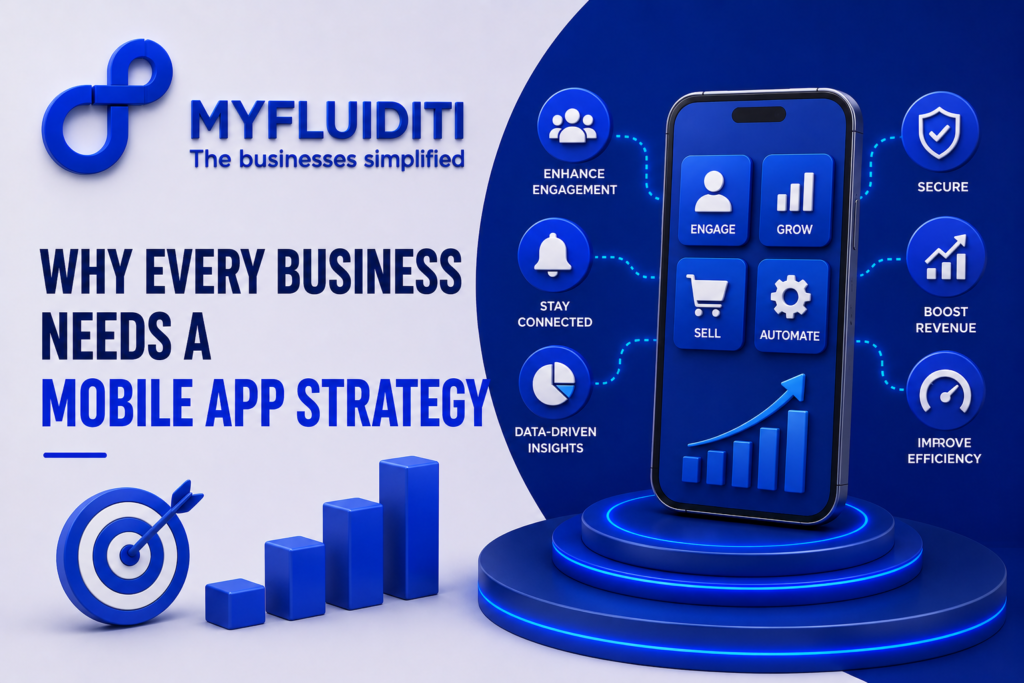
Introduction In today’s digital-first world, having a website alone is no longer enough to stay competitive. Customers expect businesses to provide fast, personalized, and convenient experiences that can be accessed anytime and anywhere. This is why having a mobile app strategy has become a business necessity rather than an option. Mobile applications help organizations improve customer engagement, streamline operations, increase brand visibility, and drive long-term growth. As smartphone usage continues to rise globally, businesses across industries are investing in custom mobile app development to strengthen customer relationships and gain a competitive edge. At MyFluiditi, we help businesses design, develop, and implement scalable mobile app strategies that align with their goals while delivering seamless digital experiences that create measurable business value. The Growing Importance of Mobile Applications Consumers spend a significant portion of their digital time using mobile applications instead of web browsers. Whether shopping online, booking services, managing finances, or communicating with businesses, mobile apps have become an essential part of everyday life. A well-designed mobile application enables businesses to stay connected with customers through instant notifications, personalized recommendations, secure transactions, and real-time support. Investing in mobile app development allows businesses to build stronger customer relationships while improving user satisfaction and brand loyalty. MyFluiditi develops feature-rich mobile applications that help organizations deliver exceptional digital experiences while supporting business growth. Enhancing Customer Engagement One of the biggest advantages of having a mobile app strategy is improved customer engagement. Mobile apps create direct communication channels between businesses and their customers through push notifications, loyalty programs, personalized offers, and in-app messaging. Unlike traditional marketing channels, mobile applications encourage continuous interaction, increasing customer retention and repeat purchases. Businesses that prioritize customer engagement through mobile technology often experience higher satisfaction rates and stronger brand recognition. At MyFluiditi, we build mobile applications that encourage meaningful customer interactions while helping businesses strengthen long-term relationships. Strengthening Brand Visibility A mobile application keeps your brand visible every time customers use their smartphones. Unlike websites that require users to open a browser and search for your business, mobile apps provide instant access with a single tap. Consistent visibility helps reinforce brand awareness while making it easier for customers to engage with products and services whenever they need them. Businesses with a strong mobile presence remain top-of-mind, increasing opportunities for conversions and customer loyalty. MyFluiditi creates intuitive mobile applications that represent your brand professionally while delivering a seamless user experience. Improving Customer Experience Today’s customers expect convenience, speed, and simplicity. A mobile app allows businesses to deliver personalized experiences through user profiles, saved preferences, secure payment gateways, real-time updates, and responsive customer support. These features eliminate unnecessary friction and make interactions more efficient. Providing an outstanding customer experience encourages repeat business while improving customer trust. MyFluiditi focuses on developing user-centric mobile applications that combine modern design with powerful functionality to maximize customer satisfaction. Increasing Sales and Revenue A well-planned mobile app strategy directly contributes to business growth by increasing customer conversions and sales opportunities. Mobile applications simplify the purchasing process through secure checkout systems, personalized product recommendations, subscription services, and digital payment options. Businesses can also leverage analytics to understand customer behavior and optimize marketing campaigns for better results. At MyFluiditi, we build mobile commerce solutions that help businesses attract more customers, increase revenue, and improve return on investment. Streamlining Business Operations Mobile applications are not limited to customer-facing services. Many organizations use custom applications to automate internal workflows, improve employee collaboration, manage inventory, track field operations, schedule appointments, and monitor business performance. Mobile technology enhances operational efficiency while reducing manual processes and administrative costs. Businesses adopting business process automation through mobile applications achieve greater productivity and faster decision-making. MyFluiditi develops custom mobile solutions that simplify business operations while supporting organizational efficiency. Leveraging Real-Time Data and Analytics Modern mobile applications provide businesses with valuable insights into customer behavior, purchasing patterns, application usage, and performance metrics. These analytics enable organizations to make informed business decisions, improve customer experiences, and optimize marketing strategies. Access to real-time analytics allows businesses to identify growth opportunities while continuously improving application performance. MyFluiditi integrates advanced analytics tools into mobile applications, enabling organizations to make smarter, data-driven decisions. Supporting Business Scalability As businesses grow, their technology must grow with them. Modern mobile applications are designed to scale alongside increasing customer demands, additional features, and expanding markets. Scalable architecture ensures applications remain reliable, secure, and high-performing regardless of business size. Whether serving hundreds or millions of users, businesses need mobile solutions capable of supporting future expansion. At MyFluiditi, we develop scalable mobile applications that evolve with changing business requirements while maintaining exceptional performance. Ensuring Security and Reliability Security is one of the most important considerations in mobile application development. Customers trust businesses with sensitive information including payment details, personal data, and account credentials. Modern applications must include secure authentication, encrypted communication, role-based access, regular security updates, and compliance with industry standards. A secure application strengthens customer confidence while protecting business data from cyber threats. MyFluiditi follows industry best practices to develop secure, reliable, and compliant mobile applications that safeguard both businesses and their customers. Future-Proofing Your Business Technology continues to evolve rapidly, and businesses that fail to adapt risk falling behind competitors. A strategic mobile app provides a foundation for integrating emerging technologies such as artificial intelligence, cloud services, Internet of Things (IoT), wearable devices, digital payments, and advanced analytics as business needs evolve. Organizations with a strong mobile strategy are better positioned to respond to changing customer expectations and market trends. MyFluiditi helps businesses build future-ready mobile applications that support innovation, flexibility, and long-term digital success. Why Choose MyFluiditi for Mobile App Development Building a successful mobile application requires more than technical expertise, it requires understanding business objectives, customer expectations, and industry trends. MyFluiditi offers end-to-end mobile app development services, including business consulting, UI/UX design, custom application development, API integration, testing, deployment, maintenance, and ongoing support. Our experienced development team works closely with businesses to create secure, scalable, and high-performance mobile applications tailored to unique business requirements.