Introduction
The adoption of Internet of Things (IoT) technologies is rapidly transforming enterprise learning and workforce development. Organizations across industries are investing in IoT education in enterprises to improve employee skills, accelerate digital transformation, enhance operational efficiency, and prepare teams for increasingly connected business environments. As businesses embrace Industry 4.0, smart devices, automation, and data-driven decision-making, educating employees about IoT technologies has become a strategic necessity rather than an optional initiative.
Modern enterprises require professionals who understand IoT infrastructure, connected devices, cloud platforms, cybersecurity, data analytics, and intelligent automation systems. Without proper training, organizations may struggle to maximize the value of their technology investments. At MyFluiditi, we help businesses build scalable digital transformation strategies by integrating IoT solutions, cloud technologies, AI systems, and enterprise training initiatives that empower organizations to adapt to evolving technological landscapes.
Understanding IoT Education in Enterprises
IoT education refers to structured learning programs that help employees understand how connected devices, sensors, networks, cloud platforms, and data analytics work together within enterprise ecosystems. These programs provide technical and operational knowledge that enables teams to manage, maintain, optimize, and innovate using IoT technologies.
As enterprises deploy smart manufacturing systems, connected logistics platforms, predictive maintenance solutions, and intelligent workplace environments, employee education becomes essential for ensuring successful implementation and adoption. At MyFluiditi, we assist organizations in building technology-driven ecosystems where workforce readiness aligns with business innovation goals.
The Financial Impact of IoT Education
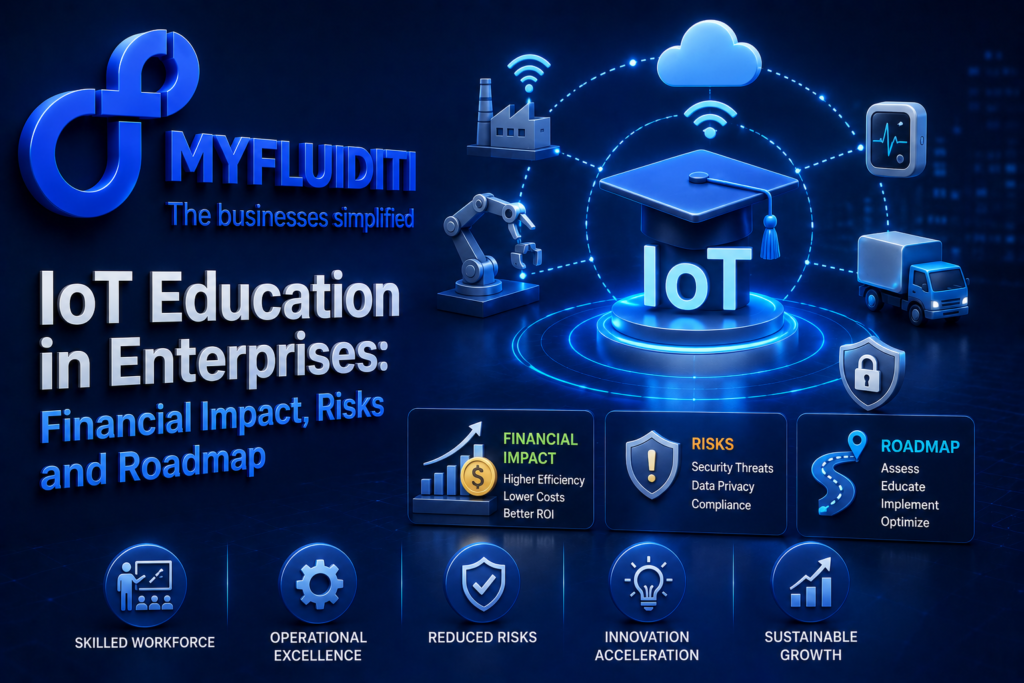
Investing in enterprise IoT training delivers measurable financial benefits across multiple areas of business operations. Organizations that educate employees on IoT technologies often experience higher productivity, reduced operational costs, improved asset utilization, and faster innovation cycles.
A well-trained workforce can identify opportunities for automation, improve equipment performance, optimize resource allocation, and leverage real-time data for better decision-making. Employees who understand IoT systems are also better equipped to troubleshoot issues, reducing downtime and minimizing disruptions.
At MyFluiditi, we help businesses align IoT adoption with measurable business outcomes by combining technology implementation with workforce enablement strategies. This integrated approach maximizes return on investment while accelerating digital maturity.
Another significant financial benefit comes from predictive maintenance and operational efficiency. Employees trained in IoT technologies can utilize sensor-generated data to identify potential equipment failures before they occur, reducing maintenance costs and preventing expensive production interruptions.
How IoT Education Supports Digital Transformation
Digital transformation requires more than technology deployment; it requires people who can effectively utilize that technology. Many organizations invest heavily in IoT infrastructure but fail to achieve expected outcomes due to knowledge gaps within their workforce.
IoT education programs help bridge this gap by enabling employees to understand connected systems, interpret real-time data, and participate in innovation initiatives. This improves adoption rates and ensures technology investments generate meaningful business value.
At MyFluiditi, we support organizations through comprehensive digital transformation initiatives that combine IoT consulting, cloud integration, automation strategies, and enterprise technology education. By aligning technology and talent development, businesses can accelerate transformation while reducing implementation challenges.
Risks Associated with IoT Education and Adoption
While IoT technologies offer substantial benefits, organizations must also address several risks associated with implementation and workforce training. One of the most significant concerns is cybersecurity.
Connected devices expand the enterprise attack surface, creating potential vulnerabilities if employees lack awareness of security best practices. Improper device management, weak authentication mechanisms, and inadequate monitoring can increase exposure to cyber threats.
At MyFluiditi, security is integrated into every IoT deployment strategy. We help organizations establish secure IoT architectures, implement access controls, and educate employees on cybersecurity best practices to reduce operational risks.
Another challenge involves data privacy and compliance. IoT systems generate vast amounts of information, including sensitive operational and customer data. Organizations must ensure employees understand regulatory requirements and data governance policies to maintain compliance and protect business-critical information.
Operational Challenges in Enterprise IoT Training
Many organizations face difficulties when developing effective IoT education programs. Rapid technological evolution can make training content outdated quickly, requiring continuous updates and skill development initiatives.
Additionally, employees often possess varying levels of technical expertise, making it difficult to design standardized learning experiences. Enterprises must create flexible training programs that address both foundational knowledge and advanced technical skills.
At MyFluiditi, we help organizations develop scalable learning frameworks that support ongoing skill development while aligning with evolving business objectives and technology roadmaps.
Resistance to change can also slow adoption efforts. Employees may be hesitant to embrace new technologies due to concerns about complexity or job displacement. Effective education programs should focus on demonstrating how IoT technologies enhance productivity and create opportunities for innovation rather than replacing human expertise.
Building a Successful IoT Education Roadmap
A successful IoT education roadmap begins with a clear understanding of business goals, technology initiatives, and workforce requirements. Organizations should identify the specific IoT capabilities needed to support operational objectives and develop training programs accordingly.
The first step involves assessing existing skill levels across departments. This helps organizations identify knowledge gaps and prioritize learning initiatives. Training programs should then be tailored to different roles, including technical teams, operations personnel, managers, and executive stakeholders.
At MyFluiditi, we help businesses create structured IoT adoption strategies that combine workforce development, technology deployment, cloud integration, and process optimization. Our roadmap-driven approach ensures organizations build both the technical infrastructure and human capabilities required for long-term success.
Practical learning experiences are equally important. Employees benefit from hands-on exposure to IoT devices, analytics platforms, cloud environments, and real-world use cases. Interactive training accelerates learning and improves retention compared to traditional classroom-based approaches.
The Role of Cloud and AI in Enterprise IoT Education
Modern IoT ecosystems increasingly rely on cloud computing, artificial intelligence, and advanced analytics. As a result, enterprise IoT education programs should include training on cloud-native architectures, data processing platforms, machine learning applications, and automation technologies.
Cloud platforms enable scalable IoT deployments by providing centralized data management, real-time analytics, and remote accessibility. AI enhances IoT capabilities by enabling predictive insights, intelligent automation, and anomaly detection.
At MyFluiditi, we develop integrated solutions that combine IoT development services, cloud infrastructure, AI implementation, and enterprise training programs. This holistic approach helps organizations maximize the value of connected technologies while preparing employees for future innovation.
Future Trends in Enterprise IoT Education
The future of IoT education in enterprises will be shaped by emerging technologies such as edge computing, digital twins, autonomous systems, advanced analytics, and AI-driven learning platforms. Organizations will increasingly adopt personalized learning experiences that adapt to employee roles, skill levels, and career objectives.
Virtual and augmented reality technologies may also play a larger role in technical training, providing immersive environments for learning complex IoT concepts and operational procedures. Continuous learning will become essential as technology evolves at an accelerating pace.
At MyFluiditi, we help organizations stay ahead of technological change by building future-ready digital ecosystems that support innovation, workforce development, and long-term business growth.
Conclusion
IoT education in enterprises is becoming a critical component of successful digital transformation strategies. Organizations that invest in workforce readiness can unlock greater value from their IoT initiatives, improve operational efficiency, reduce risks, and accelerate innovation.
While challenges related to cybersecurity, compliance, adoption, and skills development remain important considerations, a structured education roadmap can help organizations overcome these obstacles effectively. By combining technology implementation with continuous learning, businesses can create resilient and future-ready operations.
With MyFluiditi as a technology partner, enterprises can develop comprehensive IoT strategies that integrate connected technologies, cloud infrastructure, AI-powered analytics, and workforce education. The result is a smarter, more agile organization capable of thriving in an increasingly connected digital world.