Introduction to LMS Development
Digital learning has become an important part of education, corporate training, employee development, professional certification, and online skill development. Organizations need reliable digital platforms that can deliver courses, manage learners, track progress, conduct assessments, provide certifications, and generate meaningful learning insights. LMS Development enables organizations to create customized Learning Management Systems that bring these capabilities together within a centralized digital learning environment.
A modern Learning Management System is more than a platform for uploading videos and documents. It can connect learners, instructors, administrators, training managers, educational institutions, and business systems through a single platform. MyFluiditi provides LMS Development Services focused on creating scalable, secure, user-friendly, and business-specific learning platforms. Our approach begins with understanding the learning model, target users, content structure, business requirements, integrations, and future growth plans before designing the appropriate LMS architecture.
What Is LMS Development?
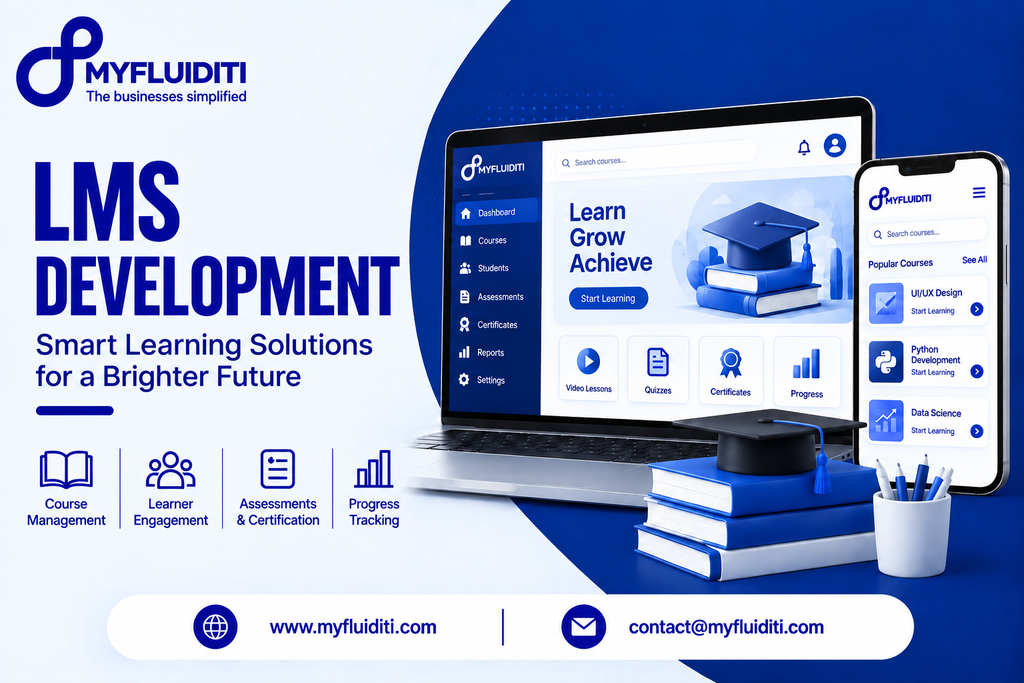
LMS development is the process of designing, developing, deploying, and maintaining a Learning Management System that enables organizations to manage digital learning and training activities. An LMS can provide course management, learner registration, content delivery, assessments, quizzes, assignments, certifications, progress tracking, instructor management, reporting, analytics, and administrative controls within one platform.
A custom LMS can be designed according to the specific learning requirements of an organization instead of forcing the organization to adapt its training process to a fixed platform. This makes Custom LMS Development valuable for EdTech companies, universities, schools, coaching institutes, professional training providers, enterprises, and organizations running employee learning and development programs.
Custom LMS Development Services
Every organization has a different learning model. An EdTech company may need a course marketplace and subscription system, while a corporate organization may require employee onboarding, compliance training, certification tracking, and HR integration. Educational institutions may require student management, instructor dashboards, assignments, examinations, and academic reporting.
MyFluiditi develops custom LMS software solutions around these specific requirements. Our team can design the learner experience, instructor workflows, administration modules, course architecture, assessment functionality, reporting system, and integration layer according to the organization’s objectives. This allows the LMS to evolve as the organization’s users, courses, content, and business requirements increase.
Learning Management System Software Development
Learning Management System software development involves building the technical foundation required to manage digital learning at scale. This includes frontend interfaces, backend application logic, databases, APIs, authentication, content management, analytics, administration systems, and integration capabilities.
At MyFluiditi, we focus on developing LMS software that combines usability with scalable architecture. Our engineers consider application performance, user roles, security, data management, responsive design, API communication, and future feature requirements while building the platform. This helps create a learning environment that can support both current training requirements and future expansion.
E-Learning Platform Development
An LMS is an important part of a broader e-learning ecosystem. E-Learning Platform Development can include course delivery, multimedia learning, virtual classrooms, assessments, certification, communication, learner engagement, analytics, and mobile access.
MyFluiditi helps organizations develop e-learning platforms that bring different learning activities into one connected environment. Depending on the requirements, the platform can support video lessons, downloadable resources, assignments, quizzes, examinations, learning paths, instructor interactions, progress tracking, and other digital learning workflows.
Online Learning Platform Development
The demand for online learning continues to create opportunities for organizations to deliver education and training beyond traditional physical environments. Online Learning Platform Development allows businesses and educational organizations to provide courses to learners across locations and devices.
MyFluiditi can develop online learning platforms with responsive web interfaces and mobile-friendly experiences so learners can access their content through desktops, tablets, and smartphones. The platform architecture can also be designed to support increasing numbers of learners, courses, instructors, and learning resources.
LMS Course Management
Course management is one of the core components of any Learning Management System. Administrators and instructors need to create courses, organize lessons, upload learning materials, define prerequisites, manage enrollment, update content, and monitor learner participation.
With LMS Course Management, MyFluiditi can create structured course management functionality that allows administrators and instructors to organize learning content efficiently. Courses can be divided into modules and lessons, while learners can follow defined learning paths based on their enrollment, role, skill level, or training requirements.
LMS Content Management
An effective learning platform needs a centralized system for managing educational content. Videos, documents, presentations, audio files, assignments, quizzes, downloadable resources, and other learning materials need to be organized in a way that makes content easy to manage and access.
MyFluiditi develops LMS Content Management Systems that allow authorized users to create, update, organize, and publish learning resources. Our development approach can also consider content access permissions, course structures, multimedia delivery, content versioning, and integration with external storage or content platforms where required.
LMS Student and Learner Management
Learner management is essential for understanding who is using the platform, what courses they have enrolled in, how they are progressing, and whether they have completed required learning activities. A centralized learner management system can simplify these processes for administrators and training teams.
MyFluiditi can develop LMS Student Management and Learner Management functionality that supports registration, profiles, enrollment, course assignments, learning progress, completion status, certifications, and user activity. Role-based access can ensure that learners, instructors, administrators, and managers receive access to the features relevant to their responsibilities.
Instructor and Trainer Management
Instructors and trainers require dedicated tools to create courses, manage lessons, evaluate learners, conduct assessments, provide feedback, and monitor class performance. An instructor dashboard can make these activities easier to manage from one location.
Our LMS development approach includes Instructor Management and Trainer Management functionality based on the organization’s requirements. MyFluiditi can create instructor dashboards, course authoring interfaces, assignment management, assessment tools, learner communication features, and performance reporting to support educators and training professionals.
LMS Assessment and Examination Development
Assessments help organizations measure learner understanding and evaluate training outcomes. A modern LMS can support quizzes, examinations, assignments, question banks, automated grading, manual evaluation, time-based tests, and performance analysis.
MyFluiditi develops LMS Assessment and Examination Systems that can be customized according to the learning model. Assessment workflows can include different question types, scoring rules, pass criteria, attempt limits, automated evaluation, instructor review, and result reporting. This enables organizations to create structured digital assessment experiences.
LMS Quiz and Question Bank Development
Online quizzes are commonly used for knowledge checks, practice assessments, certification exams, and course completion requirements. A centralized question bank can allow instructors and administrators to organize questions and reuse them across different assessments.
With LMS Quiz Development, MyFluiditi can create configurable quiz systems with question banks, scoring, randomized questions, time limits, multiple attempts, automated grading, and result tracking. The exact assessment logic can be adapted to the organization’s training or education requirements.
LMS Certification and Certificate Management
Certificates can provide learners with formal recognition after completing a course or training program. Organizations may require automatic certificate generation based on completion, assessment results, attendance, or other criteria.
MyFluiditi can develop LMS Certificate Management Systems that automate certificate generation and connect certification with defined completion rules. Businesses and educational institutions can create branded certificates, maintain certification records, and provide learners with access to their credentials through the platform.
LMS Progress Tracking and Learning Analytics
Understanding learner progress is essential for improving digital learning outcomes. Administrators and instructors need visibility into course completion, assessment results, learner engagement, training activity, and performance.
LMS Learning Analytics and Progress Tracking provide organizations with data that can help them understand how learners interact with their courses. MyFluiditi can build dashboards and reporting systems that present relevant learning information to administrators, instructors, managers, and other authorized users.
Corporate LMS Development
Companies increasingly use digital learning platforms for employee onboarding, professional development, compliance training, technical training, leadership programs, and continuous upskilling. A Corporate LMS can centralize these training activities and provide organizations with better visibility into employee learning.
MyFluiditi develops corporate learning management systems based on organizational training structures. Our team can integrate employee information, departments, roles, learning paths, certifications, reporting, and training workflows to create a centralized employee learning environment.
Employee Training and Learning Management
Employee training requires structured learning programs that can be assigned according to job roles, departments, experience levels, or business requirements. A custom LMS can automate many of these processes while providing managers with visibility into employee progress.
With Employee Training Software Development, MyFluiditi can create learning platforms that support onboarding, skills development, compliance programs, internal training, assessments, certification, and performance tracking. Integration with HR systems can further connect employee information with training activities.
EdTech LMS Development
EdTech companies require LMS platforms that can support learners while also providing strong business capabilities. An EdTech LMS may include course marketplaces, instructor management, subscriptions, payments, learner dashboards, assessments, certificates, content management, and analytics.
MyFluiditi helps EdTech businesses develop scalable LMS platforms that can serve as the core technology behind their digital education products. We can build the platform around the organization’s content model, learner journey, monetization strategy, branding, and technology roadmap.
School and University LMS Development
Educational institutions need learning platforms that support students, teachers, administrators, and academic workflows. A customized LMS can provide course delivery, assignments, examinations, student progress tracking, instructor management, academic resources, and communication capabilities.
MyFluiditi can develop School LMS and University LMS Solutions based on institutional requirements. The platform can be designed to integrate with existing student information systems, authentication platforms, academic databases, communication tools, and other educational technologies.
LMS Mobile App Development
Learners increasingly expect access to educational content from smartphones and tablets. An LMS mobile application can extend the learning experience beyond desktop environments and provide convenient access to courses, lessons, assessments, notifications, and progress information.
MyFluiditi can connect LMS Mobile App Development with the broader learning platform so that users can access relevant learning activities through mobile devices. Depending on requirements, mobile applications can be developed using technologies such as Flutter, React Native, Android, or iOS development frameworks.
LMS API Development and Integration
Modern LMS platforms often need to communicate with external systems such as HRMS, CRM, ERP, payment gateways, video conferencing platforms, authentication systems, analytics platforms, and mobile applications. APIs provide the communication layer required for these integrations.
MyFluiditi develops LMS API Integration Solutions that allow learning platforms to exchange relevant information with external applications. Our team can work on authentication, data synchronization, third-party APIs, webhooks, backend services, and integration architecture according to project requirements.
LMS Integration with HRMS and CRM
Corporate learning platforms often need employee and organizational information from HR systems, while training businesses may need customer information from CRM platforms. Connecting these systems can reduce duplicate data entry and improve workflow automation.
MyFluiditi can integrate LMS platforms with HRMS, CRM, ERP, and enterprise software systems to create connected learning environments. This allows organizations to align learner information, employee records, customer accounts, training assignments, and reporting within their broader technology ecosystem.
LMS Payment Gateway Integration
Commercial learning platforms may need secure online payment functionality for course purchases, subscriptions, memberships, bundles, and other monetization models. Payment gateway integration allows learners to complete transactions directly through the platform.
MyFluiditi can integrate payment gateways into LMS platforms based on the business model and target market. The platform can be designed to support relevant payment workflows while connecting successful transactions with course enrollment and learner account management.
AI-Powered LMS Development
Artificial intelligence is creating new possibilities for personalized and intelligent digital learning. AI can be used to support learning recommendations, content discovery, automated assistance, learner interactions, assessment support, and other intelligent workflows.
MyFluiditi combines AI, Generative AI, machine learning, and software engineering to help organizations explore AI-powered LMS capabilities. Depending on the use case, AI can support personalized learning paths, intelligent learning assistants, automated content workflows, question generation, knowledge retrieval, and learner support.
Personalized Learning and Adaptive Learning
Learners have different levels of knowledge, learning speeds, interests, and skill requirements. Personalized learning can help deliver content and recommendations that are more relevant to individual learners.
MyFluiditi can develop personalized learning and adaptive learning capabilities that use learner progress, assessment results, course activity, and defined learning objectives to create more customized learning experiences. These capabilities can be integrated into the LMS architecture according to the organization’s learning strategy.
LMS Gamification Development
Learner engagement can be supported through interactive learning experiences, progress indicators, achievements, challenges, rewards, badges, and other gamification concepts. LMS Gamification Development can make training platforms more interactive while giving learners visible milestones throughout their learning journey.
MyFluiditi can integrate gamification features into custom LMS platforms based on learner behavior and organizational objectives. Gamification can be designed around course completion, assessments, achievements, learning streaks, badges, or other measurable activities.
LMS Reporting and Dashboard Development
Administrators and training managers need actionable information to understand the effectiveness of learning programs. LMS dashboards can provide visibility into enrollment, completion rates, assessment performance, course activity, certifications, and learner engagement.
MyFluiditi develops LMS Reporting and Analytics Dashboards that present important learning information in an organized format. Reports can be customized for administrators, instructors, HR teams, managers, and business leaders depending on their information requirements.
Scalable LMS Architecture
As the number of learners and courses grows, the LMS needs to handle increasing traffic, content, transactions, and data without compromising performance. Scalability should therefore be considered during the initial architecture and development process.
Our team at MyFluiditi focuses on scalable LMS development by considering application architecture, database design, APIs, cloud infrastructure, caching, content delivery, security, and performance requirements. Cloud technologies such as AWS and Azure can be incorporated where they are appropriate for the project’s infrastructure needs.
Secure Learning Management System Development
LMS platforms can contain sensitive learner information, employee data, course content, assessment results, certificates, and business information. Security must therefore be considered throughout the application lifecycle.
MyFluiditi incorporates security considerations into LMS software development, including authentication, authorization, role-based access, secure APIs, data protection, application validation, and infrastructure security. The specific security architecture is designed according to the type of information handled and the organization’s requirements.
LMS Modernization and Migration
Organizations may already have an LMS but face limitations related to outdated technology, poor performance, restricted customization, integration problems, or difficult maintenance. In such situations, modernization or migration can provide a path toward a more flexible learning platform.
MyFluiditi can help businesses evaluate their existing LMS environment and plan LMS migration and modernization. Our team can work on data migration, content migration, system integration, application modernization, performance improvements, UI updates, and new functionality while focusing on business continuity.
LMS Maintenance and Support Services
Launching an LMS does not mean development is finished. New learning requirements, user feedback, security updates, integration changes, operating system updates, performance requirements, and feature requests can create the need for continuous technical support.
MyFluiditi provides LMS Maintenance and Support Services to help organizations manage their learning platforms after deployment. Our support can include bug fixing, performance optimization, application updates, security improvements, integration maintenance, feature enhancements, and ongoing technical development.
Our LMS Development Approach at MyFluiditi
At MyFluiditi, our LMS development process begins with understanding the organization’s learning objectives, users, content structure, training workflows, business model, integrations, and scalability requirements. We use this information to define the appropriate platform architecture and functionality rather than starting with a generic LMS template.
During development, our team focuses on user experience, application architecture, backend development, APIs, database design, security, testing, and performance. We work through structured development cycles so that the organization can review functionality and provide feedback throughout the project. After deployment, we can continue supporting the LMS through maintenance, optimization, feature development, and technology upgrades.
Technologies for LMS Development
Modern LMS development can involve a combination of frontend, backend, mobile, cloud, database, AI, and DevOps technologies. MyFluiditi works with technologies such as React, Angular, Node.js, Python, Java, .NET, Flutter, APIs, AWS, Azure, databases, AI, Generative AI, machine learning, and cloud infrastructure depending on the requirements of the learning platform.
The technology stack is selected according to the application’s functionality, scalability requirements, integration needs, performance expectations, security considerations, and long-term roadmap. This technology-focused approach helps create future-ready LMS software rather than a platform that only addresses immediate requirements.
Why Choose MyFluiditi for LMS Development?
Choosing an LMS development partner requires more than technical development capabilities. The partner needs to understand learning workflows, user experience, content management, assessments, analytics, integrations, scalability, and long-term platform maintenance.
MyFluiditi combines custom software development, AI, cloud, mobile development, API integration, DevOps, and QA capabilities to help organizations build comprehensive learning platforms. Whether you need a corporate LMS, EdTech platform, school LMS, university learning platform, employee training system, online course platform, or customized e-learning software, our team can work around your specific requirements.
Conclusion
LMS development enables organizations to transform traditional education and training into scalable digital learning experiences. A well-designed Learning Management System can centralize courses, learners, instructors, assessments, certifications, progress tracking, analytics, and integrations within one connected platform.
From custom LMS software development and e-learning platform development to corporate training, EdTech platforms, mobile learning applications, AI-powered learning, LMS integrations, analytics, security, migration, and ongoing support, organizations can build learning ecosystems that adapt to changing educational and business requirements.
MyFluiditi helps businesses, educational institutions, EdTech companies, and training organizations create custom LMS solutions designed around their learners, content, workflows, and growth objectives. Through modern software engineering, cloud technologies, AI capabilities, mobile development, integrations, and continuous technical support, we help turn LMS concepts into scalable digital learning platforms that are built for long-term growth.