Introduction to Progressive Web App Development
In today’s digital-first environment, users expect websites and applications to be fast, responsive, secure, and easy to access from any device. Businesses are therefore looking for modern solutions that combine the reach of a website with the engaging experience of a mobile application. Progressive Web App Development (PWA Development) provides an effective way to achieve this goal by creating web applications that deliver an app-like experience directly through a browser. Progressive Web Apps can be responsive, installable, fast, linkable, and capable of supporting offline experiences depending on their implementation.
A Progressive Web App allows businesses to provide customers with a seamless digital experience without requiring users to begin with a traditional app-store download. A well-designed PWA can work across smartphones, tablets, desktops, and other supported devices while maintaining a consistent user experience. For startups, ecommerce companies, SaaS businesses, enterprises, and service providers, PWA development services can provide a scalable approach to delivering modern digital products while maintaining the discoverability and accessibility of the web.
What Is a Progressive Web App?
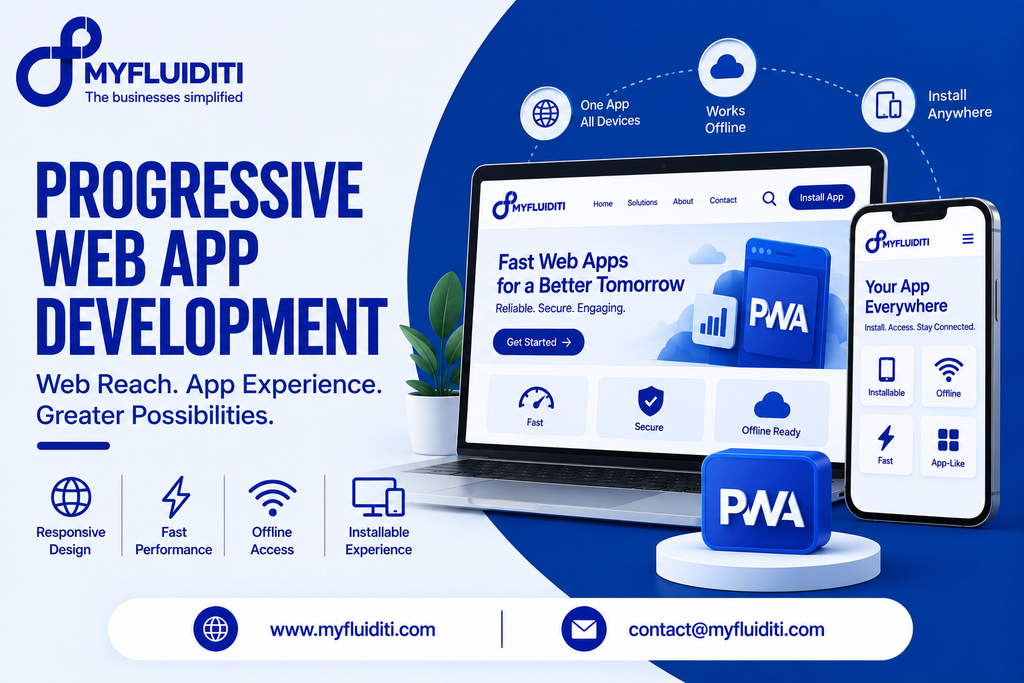
A Progressive Web App is a web application built using modern web technologies that can provide functionality commonly associated with mobile applications. Unlike a conventional website, a PWA can support features such as installation on compatible devices, offline experiences, background capabilities, and an app-like interface. At the same time, it remains accessible through a web browser and can use individual URLs for pages and content.
The foundation of a PWA commonly includes technologies such as service workers, web app manifests, responsive design, HTTPS, caching strategies, and modern JavaScript frameworks. These technologies work together to improve reliability, performance, and usability. However, simply converting a website into a PWA does not automatically guarantee strong SEO performance. Search-friendly rendering, crawlable content, meaningful URLs, structured content, and performance optimization remain important parts of successful PWA implementation.
Why Progressive Web App Development Matters for Businesses
Businesses increasingly need digital experiences that work smoothly across different devices and network conditions. Traditional websites may provide reach but can lack some of the engagement characteristics users expect from applications. Native mobile applications can provide rich experiences but require platform-specific development, maintenance, updates, and distribution. Progressive Web App Development offers another approach by combining web accessibility with selected app-like capabilities.
With a PWA, users can discover a business through a web search, open the application through a link, interact with responsive interfaces, and, where supported, install the experience for easier future access. This creates a connected journey between search, website engagement, and application-like usage. For businesses focused on customer engagement, ecommerce, SaaS, booking platforms, content platforms, and on-demand services, this approach can help create a more consistent digital presence.
Key Features of Progressive Web Apps
One of the major characteristics of a PWA is responsive design. A properly developed progressive web application should adapt its layout, navigation, content, and interactions to different screen sizes. This enables users to access the same digital experience through mobile phones, tablets, laptops, and desktop computers. Responsive implementation is especially important because users may interact with the same business through different devices throughout their customer journey.
Another important capability is offline and low-connectivity support. Service workers can help manage caching and network requests so that applications can provide useful experiences even when connectivity is limited. Depending on the application’s architecture, selected resources and functionality can remain available without an active internet connection. This can be particularly valuable for businesses whose customers operate in environments with inconsistent network access.
Installability is another important part of the PWA experience. A compatible PWA can be installed so users can access it more like an application while still being built on web technologies. PWAs can also use deep links and individual URLs, allowing users to share specific pages and enabling search engines to discover publicly accessible content when the application is properly implemented for crawling and indexing.
Progressive Web App Development and SEO
PWA SEO is an important consideration when developing a progressive web application. A PWA should not sacrifice search visibility simply because it provides an app-like experience. Search engines need access to meaningful content, crawlable links, stable URLs, and appropriate rendering. JavaScript-heavy applications require careful technical implementation so that important content is available to search engines.
At MyFluiditi, we approach PWA development with both user experience and digital visibility in mind. Our development process can incorporate responsive architecture, SEO-friendly page structures, performance optimization, clean URLs, appropriate metadata, and search-accessible content. This helps businesses build a progressive web application that is not only visually engaging but also structured for discoverability.
Performance is another important part of modern PWA development services. Fast loading, responsive interactions, optimized assets, effective caching, and efficient code can contribute to a better user experience. Businesses should also evaluate performance using appropriate tools and real-world testing rather than assuming that simply using PWA technology guarantees high performance.
Benefits of Custom PWA Development
Custom PWA development enables businesses to create applications around their specific workflows, customers, products, and business objectives. Instead of forcing business processes into a generic platform, a custom progressive web application can be designed around the functionality that users actually need. This can include customer portals, ecommerce experiences, booking systems, dashboards, SaaS products, internal business applications, marketplaces, and on-demand platforms.
A PWA can also provide a unified development approach for businesses that want to reach users across multiple platforms. Because the application is based on web technologies, businesses can create a common experience across supported browsers and devices instead of maintaining completely separate web experiences for every platform. This can simplify parts of development and maintenance while still allowing progressive enhancement for supported capabilities.
How MyFluiditi Approaches Progressive Web App Development
At MyFluiditi, we focus on understanding the business requirement before selecting the right application architecture. Our approach starts with understanding the target audience, business objectives, required features, user journeys, performance expectations, integrations, security requirements, and scalability needs. Based on these requirements, we plan a PWA solution that balances functionality, usability, performance, and long-term maintainability.
Our development approach can include responsive frontend development, backend API integration, database connectivity, authentication, third-party integrations, cloud deployment, performance optimization, testing, and ongoing improvements. Depending on the project requirements, modern technologies such as React, Angular, Node.js, Python, Java, cloud platforms, APIs, and other web technologies can be incorporated into the solution.
Building Fast and Responsive PWA Experiences
Performance is central to a successful progressive web application. Users expect pages to load quickly and interactions to respond smoothly, particularly when accessing applications through mobile networks. MyFluiditi focuses on optimizing application architecture, frontend assets, API communication, caching strategies, responsive layouts, and other performance factors that influence the overall user experience.
A well-engineered PWA should also provide a consistent experience across different browsers and devices. Browser compatibility testing, responsive testing, accessibility considerations, and performance validation help identify issues before the application reaches a wider audience. Modern PWA guidance also emphasizes adapting applications to different browsers and devices while maintaining accessible and usable experiences.
Secure and Scalable Progressive Web Applications
Security is essential when building any modern web application, particularly when the application handles customer accounts, transactions, business information, or sensitive data. Secure PWA development requires HTTPS, secure authentication, appropriate authorization, protected APIs, safe data handling, and regular testing of application components.
Scalability is equally important for growing businesses. A PWA should be designed so that its infrastructure and application architecture can support increasing traffic, users, transactions, and integrations. MyFluiditi can help businesses develop scalable web applications with suitable backend architecture, APIs, cloud infrastructure, databases, monitoring, and optimization strategies based on project requirements.
PWA Development for Different Industries
Progressive Web Apps can be applied across multiple industries and business models. Ecommerce businesses can use PWAs to create fast product discovery and shopping experiences. SaaS companies can develop browser-based platforms with app-like interfaces. Healthcare organizations can use web applications for portals and service workflows, while education businesses can provide accessible learning platforms.
Similarly, logistics, travel, finance, real estate, food delivery, media, retail, and professional service companies can explore PWA solutions for customer-facing applications and internal business systems. The right implementation depends on the business process, target users, required integrations, security requirements, device capabilities, and expected application behavior.
Progressive Web Apps vs Traditional Mobile Apps
Progressive Web Apps and native mobile applications serve different technical and business requirements. Native applications can provide deep access to platform-specific capabilities, while PWAs provide the broad accessibility of the web combined with selected app-like functionality. A PWA can be accessed through a URL and can support installation on compatible devices, making it suitable for businesses that prioritize web reach and cross-device accessibility.
The decision between a PWA and native application should therefore be based on the product’s requirements rather than choosing one technology universally. If a business needs strong web discoverability, cross-platform accessibility, rapid distribution, and an app-like web experience, Progressive Web App Development may be an appropriate option. If the product requires extensive platform-specific capabilities, a native or hybrid approach may be more suitable.
Why Choose MyFluiditi for PWA Development?
Choosing the right technology partner is important when developing a business-critical web application. MyFluiditi combines software development, mobile application development, web development, cloud technologies, AI, data engineering, and other digital capabilities to support modern product development. Our team focuses on creating solutions that align technology with business requirements rather than developing features without a clear purpose.
From initial planning and architecture to development, testing, deployment, and ongoing optimization, MyFluiditi can support businesses through the complete PWA development lifecycle. Our focus is on building applications that are responsive, scalable, secure, performance-oriented, and designed around real user needs.
The Future of Progressive Web App Development
The demand for fast, accessible, and engaging digital experiences continues to shape modern application development. Progressive Web Apps provide businesses with a way to combine web accessibility with app-like capabilities while maintaining a single web-based product experience. As businesses continue to prioritize mobile users, performance, accessibility, and digital engagement, PWA technology remains a practical option for many types of applications.
The future of PWA development will also be influenced by advancements in web APIs, browser capabilities, cloud infrastructure, AI integration, automation, and modern frontend frameworks. Businesses can use these technologies to create increasingly intelligent and personalized digital experiences while maintaining the flexibility of the web.
Conclusion
Progressive Web App Development provides businesses with a modern approach to building fast, responsive, accessible, and engaging digital applications. By combining web reach with capabilities such as installation, responsive interfaces, offline experiences, deep linking, and performance optimization, PWAs can support a wide range of business use cases. However, successful PWA development requires more than simply adding app-like functionality to a website. Performance, security, accessibility, responsive design, SEO, scalability, and maintainability must all be considered throughout the development lifecycle.
With MyFluiditi, businesses can transform their digital ideas into scalable progressive web applications designed around their users and business objectives. From custom PWA development and responsive web application development to API integration, cloud deployment, performance optimization, and ongoing support, MyFluiditi helps businesses build modern digital experiences that are ready for today’s users and tomorrow’s growth.