Introduction
Launching a startup comes with uncertainty, limited resources, and the constant pressure to validate ideas quickly. This is why building a Minimum Viable Product (MVP) has become one of the most effective approaches for startups seeking rapid market validation. An MVP allows businesses to launch with essential features, gather real user feedback, reduce development risks, and accelerate time-to-market without investing heavily in a full-scale product.
Successful startups understand that the goal is not to build a perfect product from day one. Instead, the focus is on solving a core problem for users while collecting valuable insights for future improvements. At MyFluiditi, we help startups transform innovative ideas into scalable digital products through MVP development services, product strategy consulting, AI-powered solutions, and custom software development. Our structured approach enables startups to validate concepts faster and build products that align with market needs.
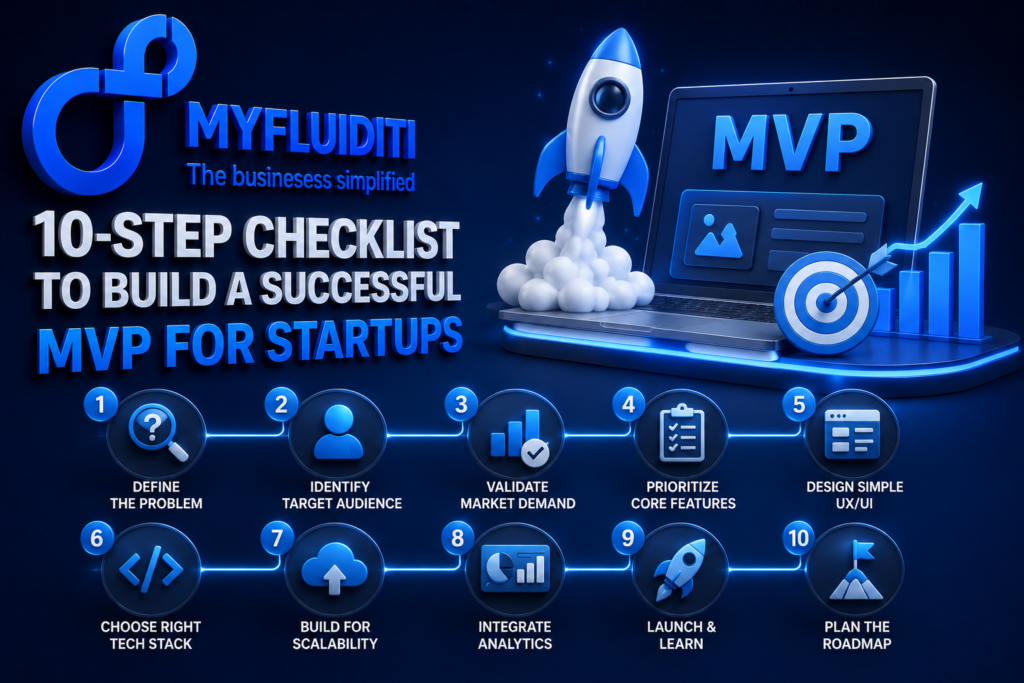
Step 1: Clearly Define the Problem You Are Solving
Every successful MVP begins with a clearly defined problem. Before writing a single line of code, startups must understand the specific challenge their product aims to address.
Many startups fail because they focus on features rather than customer problems. The most successful products solve a genuine pain point experienced by a target audience. At MyFluiditi, we work closely with founders to identify market gaps, user challenges, and business opportunities before beginning product development.
A strong problem statement provides the foundation for every future product decision.
Step 2: Identify Your Target Audience
Understanding your audience is critical when building an MVP for startups. Different users have different expectations, behaviors, and needs.
Startups should define who their ideal customers are, what problems they face, and how they currently solve those challenges. User research helps prioritize features that provide the highest value during the MVP phase.
At MyFluiditi, we use customer discovery workshops, user persona development, and market analysis to ensure products are designed around real customer needs rather than assumptions.
Step 3: Validate Market Demand
Before investing heavily in development, startups should validate whether there is genuine demand for the solution.
Market validation can involve customer interviews, surveys, competitor analysis, landing pages, and prototype testing. Gathering early feedback helps confirm that users are willing to adopt the solution.
A validated idea significantly reduces product risk and increases the chances of long-term success. MyFluiditi helps startups conduct market validation exercises that support informed product development decisions.
Step 4: Prioritize Core Features Only
One of the biggest mistakes startups make is attempting to build too many features during the MVP stage.
An MVP should focus only on the essential functionality required to solve the primary problem. Additional features can be added later based on user feedback and business priorities.
Key MVP priorities often include:
- Core user functionality
- Basic user authentication
- Essential workflows
- Performance and usability
- Initial analytics tracking
At MyFluiditi, we help startups identify high-impact features that deliver maximum value while keeping development lean and efficient.
Step 5: Design a Simple and User-Friendly Experience
Even the most innovative product can struggle if users find it difficult to navigate.
User experience plays a major role in MVP success. Clean interfaces, intuitive navigation, and streamlined workflows help improve engagement and user retention.
A successful MVP does not need complex visual designs, but it must provide a smooth and enjoyable experience. MyFluiditi’s UI/UX specialists focus on creating intuitive digital experiences that encourage user adoption and product growth.
Step 6: Choose the Right Technology Stack
The technology stack chosen during MVP development can significantly impact scalability, performance, and future expansion.
Startups should select technologies that support rapid development while remaining flexible enough to accommodate future growth. Modern frameworks, cloud infrastructure, and scalable architectures help ensure long-term success.
At MyFluiditi, we leverage technologies such as React, Next.js, Flutter, Node.js, AWS, Azure, and AI-powered development tools to build future-ready MVPs that can evolve alongside business requirements.
Step 7: Build for Scalability from Day One
Although an MVP focuses on speed, scalability should never be ignored.
Products that gain traction quickly often face performance challenges if scalability is not considered during development. Startups should adopt architectures that support future growth without requiring complete redevelopment.
MyFluiditi helps startups implement cloud-native architecture, microservices, and scalable infrastructure solutions that support both immediate product launches and long-term expansion.
Step 8: Integrate Analytics and Feedback Mechanisms
Data is one of the most valuable assets for any startup.
An MVP should include analytics tools that track user behavior, engagement patterns, conversion rates, and feature usage. These insights help founders make informed decisions about future development priorities.
User feedback mechanisms such as surveys, ratings, and support channels provide additional visibility into customer needs.
At MyFluiditi, we integrate analytics and reporting capabilities that enable startups to continuously improve their products based on real-world usage data.
Step 9: Launch Quickly and Learn Continuously
The purpose of an MVP is learning, not perfection.
Startups that spend too much time refining products before launch often miss valuable opportunities to gather user feedback. A faster launch enables businesses to validate assumptions and identify improvement opportunities sooner.
Successful startup teams embrace continuous iteration by releasing updates, testing new features, and responding to customer insights.
MyFluiditi follows an agile development approach that enables startups to launch efficiently while maintaining flexibility for ongoing enhancements.
Step 10: Plan the Product Roadmap
An MVP is only the beginning of the product journey.
After launch, startups should develop a roadmap outlining future features, improvements, scaling strategies, and growth objectives. Product evolution should be driven by user feedback, business goals, and market trends.
A clear roadmap helps startups allocate resources effectively while maintaining focus on long-term success.
At MyFluiditi, we support startups beyond the MVP stage by providing product scaling, AI integration, cloud transformation, and ongoing development services that help businesses grow confidently.
How MyFluiditi Helps Startups Build Successful MVPs
Building an MVP requires a combination of technical expertise, business strategy, and market understanding. MyFluiditi provides end-to-end MVP development services that help startups move from idea validation to product launch efficiently.
Our services include product discovery, market validation, UI/UX design, custom software development, cloud architecture, AI integration, testing, deployment, and post-launch support. By combining technology with business-focused execution, we help startups reduce risk and accelerate growth.
Whether you’re building a SaaS platform, mobile application, AI-powered solution, marketplace, or enterprise product, MyFluiditi delivers scalable MVP solutions designed for long-term success.
Conclusion
Building a successful Minimum Viable Product is one of the most important steps in a startup’s journey. By focusing on customer problems, validating market demand, prioritizing essential features, and leveraging scalable technology, startups can significantly improve their chances of success.
Following this 10-step MVP development checklist helps businesses reduce risk, gather valuable feedback, and accelerate product-market fit. At MyFluiditi, we help startups transform innovative ideas into scalable digital products through strategic planning, agile development, and modern technology solutions.
The startups that succeed are not always the ones with the biggest budgets. They are often the ones that learn the fastest, adapt quickly, and build products that solve real customer problems. With the right MVP strategy and the right technology partner, businesses can create a strong foundation for sustainable growth and long-term innovation.