Introduction
As businesses accelerate their digital transformation initiatives, the demand for scalable, resilient, and cloud-native applications continues to grow. Traditional monolithic applications often struggle to support rapid innovation, high availability, and evolving customer expectations. This is why organizations across industries are increasingly adopting Microservices Architecture Design on Azure to build flexible, secure, and highly scalable software solutions. By breaking large applications into smaller, independently deployable services, businesses can improve development speed, enhance system reliability, and support continuous innovation. At MyFluiditi, we help enterprises design, develop, and optimize Azure-based microservices architectures that enable faster software delivery, seamless scalability, and long-term business growth.
Understanding Microservices Architecture on Azure
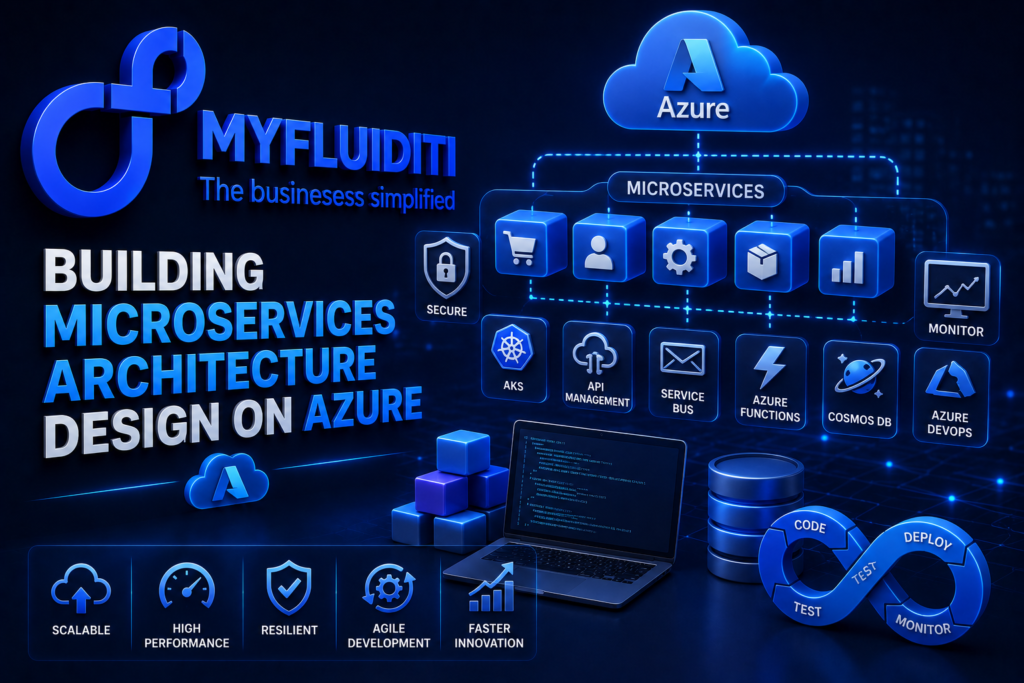
A microservices architecture is a software design approach where applications are built as a collection of loosely coupled services that communicate through APIs and messaging systems. Each service is responsible for a specific business function and can be developed, deployed, updated, and scaled independently. Microsoft Azure provides a comprehensive ecosystem of cloud services that support microservices development, including Azure Kubernetes Service (AKS), Azure Service Fabric, Azure API Management, Azure Functions, Azure Container Apps, and Azure DevOps. These services help organizations build highly available and fault-tolerant applications capable of handling dynamic workloads. At MyFluiditi, we leverage Azure’s cloud-native capabilities to create robust microservices environments tailored to specific business requirements.
Why Businesses Are Moving to Azure Microservices
Modern organizations require technology platforms that can adapt quickly to changing market demands. Monolithic systems often create bottlenecks that slow development cycles, increase maintenance complexity, and limit scalability. Azure microservices architecture eliminates these challenges by enabling teams to work independently across services while supporting continuous integration and continuous deployment. Businesses benefit from faster product releases, improved application performance, reduced downtime, and better resource utilization. MyFluiditi helps organizations modernize legacy applications by transitioning them into scalable Azure microservices ecosystems that improve agility and operational efficiency.
Core Components of Azure Microservices Architecture
Successful microservices implementation requires a well-designed cloud infrastructure. Azure offers multiple services that work together to support distributed application development. Azure Kubernetes Service (AKS) provides container orchestration and automated scaling capabilities, while Azure API Management acts as a centralized gateway for managing service communication. Azure Service Bus and Azure Event Grid enable reliable messaging and event-driven architectures. Azure Monitor and Application Insights provide real-time observability, helping teams track performance and troubleshoot issues proactively. At MyFluiditi, we design integrated Azure architectures that combine these services to deliver high-performance and resilient enterprise applications.
Benefits of Building Microservices on Azure
One of the primary advantages of microservices is scalability. Individual services can scale independently based on workload demands, ensuring optimal resource utilization and cost efficiency. Azure’s cloud infrastructure supports automatic scaling, enabling applications to handle traffic spikes without impacting performance. Another major benefit is fault isolation. If one service encounters an issue, other services continue functioning normally, improving overall system reliability. Cloud-native microservices on Azure also support faster deployments, allowing development teams to release updates without affecting the entire application. MyFluiditi helps businesses leverage these benefits through customized Azure cloud strategies and microservices implementation frameworks.
Azure Kubernetes Service for Microservices Deployment
Containerization plays a critical role in modern microservices development. Azure Kubernetes Service (AKS) simplifies container orchestration by automating deployment, scaling, and management of containerized applications. AKS supports high availability, load balancing, automated updates, and resource optimization, making it one of the most popular platforms for enterprise microservices. At MyFluiditi, we design AKS-based architectures that enable businesses to achieve operational consistency, faster deployments, and improved infrastructure management while reducing operational overhead.
Event-Driven Architecture and Microservices
Many modern applications rely on event-driven architecture to improve responsiveness and scalability. Azure provides powerful messaging and event management services such as Azure Event Grid, Azure Service Bus, and Azure Event Hubs. These technologies enable microservices to communicate asynchronously, reducing dependencies and improving system flexibility. Event-driven systems support real-time data processing, workflow automation, and intelligent application behavior. MyFluiditi helps organizations build event-driven microservices ecosystems that enhance business agility and improve customer experiences through real-time processing capabilities.
Security Best Practices for Azure Microservices
Security is a critical consideration when designing distributed systems. Microservices environments often involve multiple APIs, containers, databases, and cloud services that require comprehensive protection. Azure provides advanced security capabilities including Azure Active Directory, Managed Identities, Key Vault, network security groups, and encryption services. These tools help organizations implement secure authentication, authorization, and data protection strategies. At MyFluiditi, security is embedded into every stage of the development lifecycle. We implement DevSecOps practices, API security frameworks, identity management solutions, and compliance-focused architectures that protect business-critical applications and sensitive data.
DevOps and Continuous Delivery in Azure
The success of microservices architecture depends heavily on automation. Azure DevOps enables organizations to implement CI/CD pipelines, infrastructure automation, automated testing, and deployment workflows. By automating repetitive processes, businesses can improve software quality, reduce deployment risks, and accelerate delivery cycles. At MyFluiditi, we integrate Azure DevOps, Infrastructure as Code (IaC), and cloud automation tools to create efficient software delivery pipelines that support rapid innovation and operational excellence.
Monitoring and Observability for Azure Microservices
Managing multiple services requires complete visibility into system performance and health. Azure provides comprehensive monitoring solutions including Azure Monitor, Application Insights, Log Analytics, and distributed tracing capabilities. These tools help organizations identify bottlenecks, optimize resource utilization, and resolve issues proactively. Real-time monitoring and observability are essential for maintaining service reliability in large-scale microservices environments. MyFluiditi develops intelligent monitoring frameworks that provide actionable insights, improve system performance, and support business continuity.
How MyFluiditi Helps Businesses Build Azure Microservices Solutions
At MyFluiditi, we specialize in designing and implementing scalable cloud-native architectures that align with business goals and digital transformation strategies. Our Azure microservices development services include architecture consulting, cloud migration, containerization, Kubernetes implementation, API development, DevOps automation, cloud security, and ongoing optimization. We work closely with organizations to modernize legacy systems, improve application performance, and create future-ready digital platforms. By combining cloud engineering expertise with business-focused technology strategies, MyFluiditi helps enterprises unlock the full potential of Azure microservices architecture.
Future Trends in Azure Microservices Architecture
The future of cloud-native development will be shaped by serverless computing, AI-powered automation, edge computing, container orchestration, and platform engineering. Organizations will increasingly adopt intelligent cloud architectures that support autonomous scaling, predictive monitoring, and self-healing infrastructure. Azure continues to expand its cloud ecosystem with advanced AI, analytics, and automation capabilities that enhance microservices development. Businesses that invest in modern Azure architectures today will be better positioned to compete in a rapidly evolving digital economy. MyFluiditi remains committed to helping organizations adopt emerging technologies and build scalable cloud ecosystems that drive innovation and sustainable growth.
Conclusion
Building Microservices Architecture Design on Azure provides organizations with the flexibility, scalability, and resilience needed to succeed in today’s digital-first environment. By leveraging Azure’s cloud-native services, businesses can accelerate software delivery, improve system reliability, strengthen security, and optimize operational efficiency. Successful implementation requires strategic planning, robust architecture design, automation, and continuous monitoring. With MyFluiditi as a technology partner, organizations can confidently build secure, scalable, and future-ready Azure microservices solutions that support innovation, enhance customer experiences, and drive long-term business success.