Introduction – Transform Your Business with AI Development Services
Artificial Intelligence is transforming how businesses operate, interact with customers, analyse information, and make decisions. From automating repetitive business activities to developing intelligent applications, AI technologies help organisations improve productivity, reduce operational complexity, and create better digital experiences. Choosing the right AI Development Company in Chennai enables businesses to adopt these technologies through customised solutions aligned with their operational goals.
MyFluiditi provides AI-focused development services designed to help startups, SMEs, and enterprises implement intelligent digital solutions. Our approach combines Artificial Intelligence, Machine Learning, Generative AI, Natural Language Processing, Deep Learning, Computer Vision, and AI-powered automation to develop applications that address real business challenges.
As businesses across Chennai and India increasingly adopt intelligent technologies, the demand for scalable and practical AI solutions continues to grow. Whether you are planning an AI-powered application, developing an intelligent chatbot, integrating AI into existing business software, or automating complex workflows, MyFluiditi helps transform business requirements into technology-driven solutions.
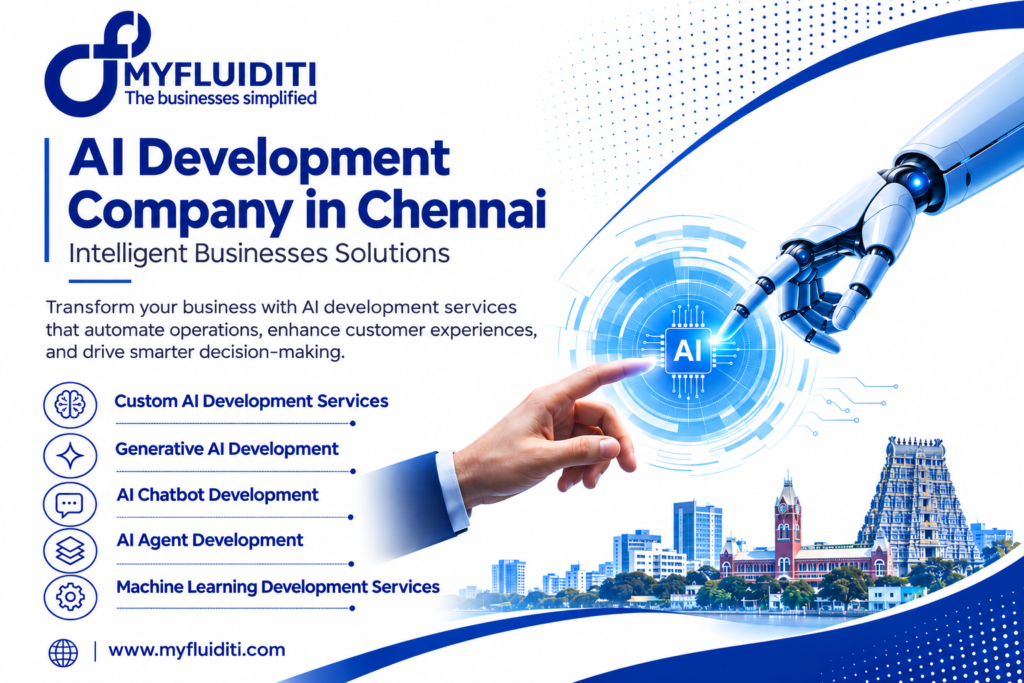
Artificial Intelligence Development Services for Businesses
AI development services involve designing, developing, integrating, and maintaining intelligent applications that can process information, identify patterns, understand user interactions, and support automated decision-making. Businesses can use AI to improve customer service, optimise internal processes, analyse large datasets, and develop new digital products.
MyFluiditi focuses on developing customised Artificial Intelligence solutions based on business requirements, application complexity, available data, and expected outcomes. Our development approach covers AI consulting, solution architecture, model selection, application development, system integration, testing, deployment, and continuous improvement.
Custom AI Development Services
Custom AI development helps businesses implement intelligent features that address their specific operational requirements. Instead of relying entirely on generic AI tools, organisations can develop applications tailored to their workflows, data sources, and business objectives.
Custom AI solutions can include intelligent recommendation engines, automated document processing, predictive analytics, customer behaviour analysis, conversational interfaces, and AI-powered business applications.
These solutions can be integrated with existing enterprise applications, databases, websites, mobile applications, and cloud environments to improve functionality and operational efficiency.
Generative AI Development
Generative AI development enables applications to create and process content such as text, images, summaries, code, and conversational responses using advanced AI models. Businesses can use Generative AI to improve content workflows, automate information processing, and build interactive digital experiences.
Our Generative AI development services can include custom AI applications, large language model integration, AI-powered content generation, document summarisation, knowledge assistants, and intelligent conversational platforms.
Generative AI can support customer service, marketing, education, healthcare administration, enterprise knowledge management, and other business functions. The solution architecture can incorporate relevant business data, access controls, and validation mechanisms to improve response relevance and reliability.
AI Chatbot Development
AI chatbot development helps businesses provide automated customer interactions through websites, mobile applications, messaging platforms, and internal business systems.
Modern AI chatbots use Natural Language Processing and language models to understand user questions, identify intent, retrieve relevant information, and generate contextual responses.
Our AI chatbot solutions can include customer support automation, lead qualification, product assistance, appointment scheduling, FAQ automation, multilingual communication, and internal employee support.
Businesses can integrate AI chatbots with CRM systems, customer databases, helpdesk applications, and other platforms to create more connected customer experiences.
AI Agent Development
AI agent development focuses on creating intelligent systems capable of understanding instructions, planning tasks, interacting with connected tools, and executing defined workflows with appropriate supervision.
Unlike conventional chatbots that primarily respond to questions, AI agents can perform multi-step activities based on configured permissions and business rules.
Custom AI agents can support document analysis, workflow coordination, customer query management, data retrieval, report preparation, internal knowledge access, and repetitive administrative tasks.
AI agent development can incorporate tool calling, API integrations, contextual memory, workflow orchestration, and human approval mechanisms to support controlled automation.
Machine Learning Development Services
Machine Learning development helps applications identify patterns in historical data and generate predictions or classifications based on learned relationships.
Our machine learning development approach can include predictive modelling, classification systems, recommendation algorithms, anomaly detection, demand forecasting, and customer behaviour analysis.
Businesses can use machine learning to identify potential risks, understand purchasing patterns, improve operational planning, and support data-driven decisions.
Deep Learning Development
Deep Learning development uses multi-layer neural networks to process complex datasets and identify patterns that may be difficult to detect through traditional programming methods.
Deep learning applications can support image classification, speech recognition, natural language understanding, object detection, and advanced predictive analysis.
These technologies are particularly useful for organisations working with large volumes of images, audio, video, text, and other complex data formats.
Natural Language Processing Development
Natural Language Processing (NLP) enables software applications to understand, analyse, classify, and process human language.
NLP development services can include text classification, sentiment analysis, named entity recognition, language translation, document understanding, text summarisation, and conversational AI.
Businesses can use NLP to analyse customer feedback, automate support ticket classification, extract information from documents, and develop intelligent search applications.
Computer Vision Development
Computer Vision development enables software systems to interpret and analyse images and videos using AI models.
Computer vision solutions can include image recognition, object detection, facial analysis where appropriate, quality inspection, visual monitoring, document image processing, and automated image classification.
These applications can support manufacturing, healthcare administration, retail, logistics, security operations, and other industries that rely on visual information.
Speech Recognition Development
Speech Recognition development enables applications to convert spoken language into digital text and process voice-based instructions.
AI-powered speech solutions can support voice assistants, automated call processing, speech-to-text transcription, voice search, meeting transcription, and conversational voice interfaces.
Integration with NLP and conversational AI technologies can help businesses create applications that understand spoken requests and provide relevant responses.
AI Consulting Services
AI consulting services help businesses identify suitable opportunities for artificial intelligence adoption before investing in full-scale development.
The consulting process can include business requirement analysis, AI readiness assessment, use-case identification, data evaluation, technology recommendations, feasibility analysis, and implementation planning.
AI consulting helps organisations understand which processes can benefit from automation, what data is required, which models are appropriate, and how an AI solution can integrate with existing systems.
Industry-Specific AI Development Solutions
Different industries face different operational challenges, data requirements, customer expectations, and technology limitations. Industry-focused AI development helps organisations implement solutions that address these specific requirements.
AI in Healthcare
AI in healthcare supports intelligent applications for medical administration, healthcare data analysis, patient communication, and operational workflows.
Healthcare AI solutions can include medical document processing, appointment assistance, healthcare chatbots, clinical data analysis, medical image analysis, and administrative workflow automation.
AI applications in healthcare should be designed with appropriate privacy controls, data protection practices, security measures, and qualified professional oversight. AI-generated outputs should not replace clinical judgement.
AI in Finance and Banking
AI in finance and banking helps financial organisations analyse transactions, identify unusual patterns, improve customer interactions, and automate administrative processes.
AI-powered financial applications can include fraud detection, transaction monitoring, credit risk analysis, financial forecasting, intelligent customer support, and document verification.
Machine learning models can analyse historical transaction patterns and help identify activities that require additional review.
AI-Powered E-Commerce Development
AI-powered e-commerce solutions help online businesses improve product discovery, personalise shopping experiences, and optimise digital sales operations.
Features can include intelligent product recommendations, customer behaviour analysis, AI shopping assistants, automated product categorisation, visual product search, and demand forecasting.
Integration with inventory management, customer databases, and e-commerce platforms can create a more personalised shopping experience.
AI-Powered Education Solutions
AI-powered education solutions help educational institutions and training organisations improve learning experiences through intelligent digital applications.
Solutions can include personalised learning recommendations, AI tutoring assistants, automated assessment support, student performance analysis, learning content generation, and intelligent learning management systems.
These capabilities help educators organise learning resources and understand student progress while keeping teachers involved in important educational decisions.
AI-Powered Fleet Management
AI-powered fleet management combines predictive analytics, vehicle data, and intelligent monitoring to improve transportation and fleet operations.
AI applications can support route optimisation, vehicle performance monitoring, fuel consumption analysis, predictive maintenance, driver behaviour analysis, and delivery planning.
Businesses can use these capabilities to improve fleet visibility and make more informed operational decisions.
AI Travel Solutions
AI travel solutions help travel companies develop personalised services and simplify travel-related operations.
Applications can include intelligent travel recommendations, itinerary generation, booking assistance, conversational travel chatbots, customer preference analysis, and dynamic recommendation systems.
AI integration can help travel platforms provide relevant suggestions based on destination preferences, travel history, and customer requirements.
AI in the Dating Industry
AI in dating applications can improve user experiences through personalised recommendations, preference matching, profile assistance, and content moderation support.
AI-powered dating platforms can use recommendation algorithms to identify compatible user preferences and improve discovery experiences. Privacy, consent, transparency, and responsible moderation are essential considerations.
AI-Powered Telecom Solutions
AI in telecommunications helps service providers improve customer support, network monitoring, service operations, and usage analysis.
AI applications can include customer service chatbots, network anomaly detection, predictive maintenance, customer churn prediction, and intelligent support ticket classification.
These solutions can help telecom businesses identify service issues and improve operational visibility.
AI in the Oil and Gas Industry
AI in oil and gas supports operational analysis, equipment monitoring, predictive maintenance, and industrial data processing.
AI-powered applications can analyse equipment performance, identify unusual operating conditions, forecast maintenance requirements, and support operational planning.
Combining machine learning with industrial IoT data can provide additional insights into equipment and infrastructure performance.
AI in Media and Entertainment
AI in media and entertainment helps organisations manage digital content, personalise recommendations, automate content classification, and improve audience engagement.
Solutions can include content recommendation engines, media search, video analysis, speech transcription, automated tagging, and audience behaviour analytics.
These applications can support streaming platforms, digital publishers, production companies, and entertainment businesses.
AI in the Car Rental Industry
AI in car rental applications can improve booking management, customer communication, fleet utilisation, and demand forecasting.
AI features can include vehicle recommendations, automated booking assistance, pricing analysis, customer support chatbots, and predictive maintenance.
Rental businesses can use these capabilities to improve vehicle availability management and customer experience.
AI in Fantasy Sports
AI in fantasy sports applications can support player statistics analysis, performance insights, personalised recommendations, and match-related information processing.
Machine learning models can evaluate historical performance data and generate statistical insights to help users understand player and team trends. Outputs should be presented as estimates rather than guaranteed predictions.
AI in Taxi Booking Applications
AI in taxi booking solutions can support intelligent ride matching, estimated demand analysis, route recommendations, customer support automation, and driver allocation.
AI-powered features can help taxi platforms improve operational coordination and provide more responsive booking experiences.
AI in Real Estate
AI in real estate applications can improve property discovery, customer engagement, property recommendations, and market data analysis.
Solutions can include intelligent property search, recommendation engines, automated lead qualification, property document processing, virtual assistants, and customer behaviour analysis.
These features help property businesses organise information and provide more relevant property suggestions.
AI Parking Finder Solutions
AI parking finder solutions can help drivers identify available parking locations through connected data, intelligent search, and location-based application features.
AI capabilities can support parking availability prediction, image-based vehicle detection, occupancy analysis, and parking recommendation systems when connected to suitable sensor or camera infrastructure.
AI for Insurance Solutions
AI for insurance helps organisations improve claims processing, document verification, customer communication, and risk analysis.
AI-powered insurance applications can include claims document extraction, fraud pattern identification, policy information assistants, customer service chatbots, and underwriting support.
Human review and appropriate regulatory controls remain important for decisions that affect insurance eligibility, pricing, and claims outcomes.
AI in Logistics
AI in logistics helps businesses improve transportation planning, warehouse operations, delivery coordination, and supply chain visibility.
Applications can include route optimisation, demand forecasting, shipment tracking analysis, warehouse automation, document processing, and predictive delivery planning.
AI integration with logistics management platforms can help organisations identify operational inefficiencies and improve resource allocation.
AI Integration and Enterprise Automation
AI delivers greater business value when it works with existing applications and operational systems. Instead of developing isolated AI tools, organisations can integrate intelligent capabilities into their current digital infrastructure.
AI Integration with Existing Business Applications
AI integration connects intelligent models and automation capabilities with existing CRM, ERP, HRMS, e-commerce, accounting, and enterprise applications.
API integration, database connectivity, authentication systems, and workflow automation can help businesses use AI features within their existing software environment.
AI-Powered Workflow Automation
AI workflow automation combines artificial intelligence with business process automation to reduce repetitive manual activities.
Applications can automate document classification, information extraction, email categorisation, customer query routing, report preparation, and internal approval workflows.
Human approval can be incorporated wherever decisions require additional verification or accountability.
Retrieval-Augmented Generation (RAG) Development
Retrieval-Augmented Generation (RAG) allows AI applications to retrieve relevant information from approved business documents, databases, and knowledge repositories before generating responses.
RAG-based systems can support internal knowledge assistants, document search, enterprise chatbots, customer support applications, and technical documentation platforms.
This approach helps AI applications provide answers grounded in an organisation’s available information, with source references where implemented.
AI-Powered Business Intelligence
AI-powered business intelligence combines data analysis, machine learning, and reporting technologies to help organisations understand operational performance.
Applications can include sales forecasting, customer segmentation, performance analysis, anomaly identification, and predictive dashboards.
AI Technologies, Models, and Development Frameworks
Choosing the appropriate AI technology depends on application requirements, data availability, infrastructure, security, and expected performance.
The AI development ecosystem can include the following technologies:
Programming Languages: Python, JavaScript, and other suitable programming languages for AI application development, backend integration, and data processing.
Machine Learning Frameworks: TensorFlow, PyTorch, and Scikit-learn for developing, training, evaluating, and deploying machine learning models.
Generative AI and LLM Technologies: GPT, Claude, Gemini, Llama, and other suitable large language models for conversational applications, content generation, and intelligent information processing.
AI Development Frameworks: LangChain, LlamaIndex, and other orchestration frameworks for connecting language models with data sources, tools, and application workflows.
Natural Language Processing: NLP libraries and language processing frameworks for text analysis, classification, information extraction, and language understanding.
Vector Databases: Pinecone, Weaviate, Qdrant, and pgvector for storing and retrieving vector representations used in semantic search and RAG applications.
Cloud Infrastructure: AWS, Microsoft Azure, and Google Cloud for deploying, managing, and scaling AI-powered applications.
Technology selection should be based on the project requirements rather than choosing a framework simply because it is widely used.
Our AI Development Process
A structured development methodology helps transform business requirements into reliable AI applications. Our approach focuses on technical feasibility, solution design, model evaluation, integration, and continuous optimisation.
1. Business Requirement Analysis
We begin by understanding business objectives, operational challenges, target users, and the expected role of artificial intelligence within the application.
2. AI Feasibility and Data Assessment
The available data, infrastructure, privacy requirements, and technical limitations are evaluated to determine whether the proposed AI solution is practical and suitable.
3. AI Architecture and Model Selection
Suitable AI models, development frameworks, databases, APIs, and deployment environments are identified based on the application’s functional and technical requirements.
4. AI Model Development and Integration
The selected models and AI components are configured, developed, or integrated into the application. This stage can include prompt engineering, model fine-tuning where appropriate, data processing, and API development.
5. Application Development and Testing
AI functionality is integrated with the frontend, backend, databases, and existing business systems. Testing evaluates response quality, accuracy, security, performance, and application behaviour.
6. Deployment and Performance Monitoring
The completed application is deployed in the selected environment. Monitoring helps evaluate model performance, identify unexpected behaviour, and determine when updates or improvements are required.
7. Continuous Optimisation and Maintenance
AI systems require ongoing evaluation as business data, user behaviour, and operational requirements change. Continuous improvements help maintain application quality and relevance.
Benefits of AI Development for Businesses in Chennai and India
AI adoption provides businesses with opportunities to improve operational efficiency and develop new digital capabilities.
Business Process Automation: AI helps automate repetitive activities, reduce manual effort, and simplify everyday workflows.
Improved Customer Experience: AI chatbots, virtual assistants, and recommendation engines support more personalised and responsive customer interactions.
Data-Driven Decision-Making: Machine learning and predictive analytics help organisations identify patterns and gain insights from business data.
Operational Efficiency: AI-powered applications can streamline document processing, reporting, customer support, and internal coordination.
Scalable Digital Applications: AI capabilities can be integrated into web applications, mobile apps, SaaS platforms, and enterprise systems.
Personalised User Experiences: Recommendation systems and intelligent interfaces can adapt application experiences to individual user preferences.
Better Information Management: NLP, semantic search, and document intelligence can help organisations access and process large volumes of information.
Why Choose MyFluiditi for AI Development in Chennai?
Selecting an experienced technology partner is important when planning AI adoption. Businesses need more than an AI model; they need an application that integrates with existing systems, supports actual workflows, and can be maintained as requirements evolve.
MyFluiditi combines AI engineering capabilities with software development, application architecture, and enterprise integration expertise.
Our approach focuses on:
Business-Focused AI Solutions: Development is aligned with business requirements, operational challenges, and expected application outcomes.
Custom AI Application Development: Solutions can be designed around specific workflows, industry requirements, and user expectations.
Modern AI Technologies: Suitable AI models, machine learning frameworks, and cloud technologies are selected according to project needs.
Enterprise Application Integration: AI capabilities can be connected with existing software, APIs, databases, and business applications.
Scalable Development Architecture: Applications are planned to support changing workloads, additional features, and future business expansion.
Security-Conscious Implementation: Data access, authentication, privacy controls, and appropriate security practices are considered throughout development.
End-to-End Development Support: Support can cover consulting, planning, development, integration, deployment, and ongoing improvements.
Based in Chennai, MyFluiditi works with businesses seeking AI development services in Chennai and digital transformation solutions across India and international markets.
Frequently Asked Questions About AI Development Services
What does an AI development company do?
An AI development company designs, builds, integrates, and maintains intelligent software applications using technologies such as Machine Learning, Generative AI, Deep Learning, NLP, and Computer Vision. These applications help businesses automate workflows, analyse information, improve customer experiences, and support decision-making.
What AI development services does MyFluiditi provide?
MyFluiditi’s AI service portfolio covers AI development, AI chatbot development, Generative AI, AI agent development, Deep Learning, Speech Recognition, Computer Vision, NLP, Machine Learning, AI consulting, and industry-specific AI solutions.
How much does AI development cost in Chennai?
The cost of AI development in Chennai depends on project complexity, application features, data requirements, model selection, integration needs, security requirements, and deployment infrastructure. A basic AI chatbot generally requires a different investment from a custom enterprise AI platform. Requirement analysis and technical planning help establish a suitable project scope and estimate.
How long does it take to develop an AI application?
AI development timelines depend on the type of application, data availability, model complexity, integration requirements, and testing scope. A small proof of concept may take less time than a complete enterprise AI application. Development schedules are generally established after evaluating the project requirements.
What is the difference between Artificial Intelligence and Machine Learning?
Artificial Intelligence is a broader field focused on developing systems that perform tasks requiring capabilities associated with human intelligence. Machine Learning is a subset of AI that enables systems to learn patterns from data and improve their performance on specific tasks without explicitly programming every decision rule.
What is Generative AI and how can businesses use it?
Generative AI is a category of artificial intelligence that creates new content, including text, images, code, and other outputs based on learned patterns. Businesses can use it for content generation, document summarisation, customer support, knowledge management, software development assistance, and intelligent business applications.
Can AI be integrated into existing business software?
Yes. AI can be integrated into existing CRM, ERP, HRMS, e-commerce platforms, websites, mobile applications, and enterprise software through APIs, database connectivity, and application integration. The exact approach depends on the existing system architecture and integration capabilities.
What is an AI agent and how is it different from a chatbot?
An AI chatbot primarily communicates with users by responding to questions and instructions. An AI agent can go further by planning tasks, using connected tools, accessing authorised information, and executing multi-step workflows. AI agents can include conversational interfaces but require appropriate permissions, monitoring, and human oversight.
Is AI suitable for small businesses and startups?
Yes. Small businesses and startups can use AI for customer support, lead management, document processing, content workflows, recommendation systems, and business analytics. Starting with a clearly defined use case can help organisations evaluate the benefits before expanding AI adoption.
Which industries can benefit from AI development?
Healthcare, finance, banking, insurance, retail, e-commerce, education, logistics, manufacturing, real estate, travel, telecommunications, and media businesses can benefit from AI applications. The most suitable solution depends on industry-specific processes and available data.
Does AI development require large amounts of data?
Not every AI application requires a large custom dataset. Some solutions can use existing language models, approved business documents, or pretrained models. Other applications, particularly specialised predictive models, may require suitable historical datasets. Data quality and relevance are often as important as data volume.
What is RAG in AI development?
Retrieval-Augmented Generation is an AI architecture that retrieves relevant information from external knowledge sources before generating a response. It is useful for enterprise knowledge assistants, document search, internal support systems, and AI chatbots that need to answer questions using business-specific information.
Can AI applications support Indian languages?
AI applications can be developed to support Indian languages such as Tamil, Hindi, Telugu, Kannada, and Malayalam, depending on the selected models and available language resources. Tamil and English conversational applications can be particularly useful for businesses serving customers in Chennai and across Tamil Nadu. Language accuracy should be tested using real user samples.
How is data security maintained in AI applications?
AI applications should incorporate appropriate authentication, role-based access, encryption, data handling policies, monitoring, and secure integration practices. Deployment architecture and model selection should also reflect the organisation’s privacy and regulatory requirements.
Build Intelligent Business Solutions with MyFluiditi
Artificial Intelligence is creating new opportunities for businesses to improve efficiency, automate complex processes, and develop more intelligent digital products. Choosing the right AI Development Company in Chennai helps organisations move beyond experimentation and implement practical AI solutions that support their business objectives.
MyFluiditi helps businesses explore and develop custom AI applications, Generative AI platforms, AI chatbots, intelligent agents, Machine Learning systems, Computer Vision applications, and industry-specific AI solutions.
Whether you are a startup planning an AI-powered product, an enterprise looking to automate business operations, or an established organisation exploring AI integration, our team can help you identify suitable technologies and plan your development requirements.
Ready to bring AI into your business?
Connect with MyFluiditi to discuss your project, explore AI development opportunities, and build intelligent digital solutions for your business in Chennai and across India.
Contact MyFluiditi: https://myfluiditi.com/contact
Email: contact@myfluiditi.com