Introduction to MyFluiditi Software Development Services
At MyFluiditi, we understand that technology has become essential to how businesses operate, communicate with customers, manage information, and improve productivity. From startups developing their first digital product to established enterprises modernizing their operations, organizations need software that supports their business objectives and changing requirements. Choosing the right Software Development Company in India helps businesses transform ideas into practical digital solutions through structured planning, modern technologies, and customized development.
As a software development company in India, MyFluiditi works with businesses seeking practical, reliable digital solutions. India has become an important destination for software development, offering access to technology professionals, diverse development capabilities, and flexible project engagement models. Businesses across India look for software solutions that can improve operational efficiency, simplify workflows, strengthen customer experiences, and support long-term digital growth.
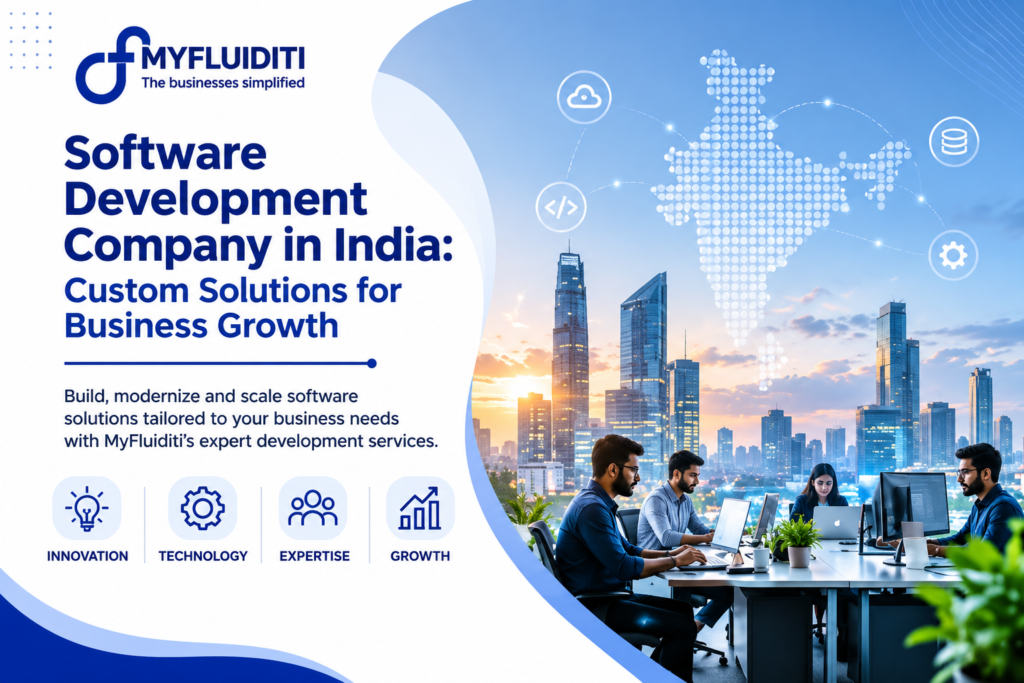
Modern software development services in India include custom software development, SaaS application development, Point of Sale (POS) systems, Enterprise Resource Planning (ERP) solutions, Learning Management Systems (LMS), and software maintenance. Each solution addresses different business requirements, from automating daily operations to building scalable digital products.
MyFluiditi is a software development company in India providing solutions focused on business functionality, application requirements, and practical digital transformation. Whether you are planning a new software product, improving an existing application, or connecting different business systems
MyFluiditi Guide to Software Development Services in India
What Is Software Development?
At MyFluiditi, software development follows the process of planning, designing, programming, testing, deploying, and maintaining applications that solve specific problems or support business activities. It involves understanding user requirements, selecting suitable technologies, developing application features, and ensuring that the final product works as expected.
Software can be developed for different environments, including web browsers, desktop systems, mobile devices, cloud platforms, and enterprise networks. The development approach depends on the application’s purpose, expected users, technical complexity, and integration requirements.
What Is Custom Software Development?
Custom software development involves creating applications according to the specific needs of a business rather than relying entirely on ready-made software. It allows organizations to define their own features, workflows, user roles, integrations, and reporting requirements.
For example, a retail company may need software that connects billing with inventory management, while an educational institution may require a platform for student registration, online courses, and assessments. Custom development makes it possible to build functionality around these operational needs.
Why Businesses Need Software Development Services
At MyFluiditi, we help businesses assess where custom software can simplify operations. Businesses often manage different activities through separate tools, spreadsheets, and manual processes. As operations grow, disconnected systems can create information gaps, repetitive work, and difficulties in tracking performance.
A suitable software solution can centralize information, automate routine activities, connect departments, and improve access to business data. It can also support customer engagement, reporting, sales management, and internal coordination.
Software Development for Startups, SMEs, and Enterprises
Startups may need a Minimum Viable Product (MVP) to test a business idea and understand user requirements. Small and medium-sized businesses may require customized systems to manage customers, sales, inventory, and daily operations. Enterprises often need integrated platforms that connect multiple departments and support complex workflows.
A reliable development strategy considers the current business stage while allowing the application to evolve as requirements change.
MyFluiditi Custom Software Development Services
Business Software Development
Business software helps organizations manage everyday operations through structured digital applications. Depending on the business model, the application may include customer management, employee records, billing, reporting, task tracking, inventory, and workflow automation.
MyFluiditi develops custom business software around an organization’s processes, helping employees complete tasks through a more organized system.
Enterprise Software Development
Enterprise software supports organizations that manage multiple departments, users, and business operations. It can connect finance, sales, procurement, inventory, human resources, customer management, and reporting functions.
A well-designed enterprise application requires structured architecture, appropriate access permissions, database planning, and integration capabilities. These features help maintain consistent information and support coordination across different business units.
Web-Based Software Development
Web-based software applications operate through internet browsers and allow authorized users to access features from supported devices. Examples include customer portals, employee dashboards, online management systems, booking applications, and administrative platforms.
Businesses can use web applications to provide centralized access to information without requiring every user to install separate software. Responsive interfaces and secure authentication help make these applications convenient for different user groups.
Software Product Development
Software product development involves creating digital products intended for customers, organizations, or a defined user market. The process includes product discovery, feature planning, interface design, application architecture, development, testing, and deployment.
A product-focused development approach considers user requirements, market needs, performance expectations, and future improvements. It helps businesses transform an initial idea into a functional and maintainable software product.
Application Modernization
Older applications may experience performance limitations, outdated technology, compatibility problems, or difficulties connecting with modern systems. Application modernization focuses on improving existing software through updated architecture, framework migration, interface improvements, and integration changes.
The modernization strategy should consider the condition of the current application, existing data, business continuity, and the impact of changing technology.
MyFluiditi SaaS Development Services
What Is SaaS Development?
Software as a Service (SaaS) development involves building software applications that users access through the internet. SaaS platforms are commonly offered through subscriptions, licensing plans, or usage-based pricing models.
Instead of managing individual installations, users access a centrally maintained application. SaaS products are used for customer relationship management, project management, accounting, business analytics, online education, and productivity applications.
Custom SaaS Application Development
Custom SaaS application development focuses on building a platform around a specific product idea or business requirement. It may include user registration, account management, subscription features, dashboards, notifications, reporting, and administrative controls.
The development process should identify the target audience, core product functionality, user journey, and expected business model before implementation begins.
Multi-Tenant SaaS Architecture
Multi-tenant architecture allows multiple customers to use a shared software platform while keeping their data and account information logically separated. It can simplify centralized application management and support consistent software updates.
Tenant isolation, authentication, data permissions, and database design are important considerations when developing a multi-tenant application. The architecture should match the platform’s security and scalability requirements.
SaaS Subscription and Billing Management
SaaS platforms often require subscription plans, recurring billing, payment processing, account upgrades, renewals, and cancellation management. These features help businesses manage customer access and commercial operations.
A well-designed subscription workflow should communicate plan details clearly and provide users with convenient account management options. Payment integrations should be implemented according to the selected provider’s supported features and security requirements.
SaaS Integration and Scalability
SaaS applications may need to connect with payment gateways, CRM platforms, email services, analytics tools, and external APIs. These integrations allow information to move between systems and support connected digital workflows.
Scalable application architecture helps accommodate growing user numbers, increasing data volumes, and new product features. Performance monitoring, cloud infrastructure, and database optimization are important parts of SaaS development.
MyFluiditi POS Software Development Services
What Is POS Software?
Point of Sale (POS) software development involves creating applications that manage sales transactions and related business activities. Retail stores, supermarkets, restaurants, and service businesses use POS systems to process payments, generate invoices, track products, and maintain sales records.
A customized POS application can be designed around the organization’s billing process, product categories, payment methods, and inventory requirements.
Retail POS Software Development
Retail POS applications help stores manage billing, product details, discounts, returns, customer information, and sales transactions. Features may include barcode scanning, product search, receipt generation, tax calculations, and sales reports.
Connecting POS transactions with inventory records can help businesses maintain more accurate stock information. The system should be designed around the store’s product structure and daily billing workflow.
Restaurant POS Software Development
Restaurants require POS functionality that supports menu management, order processing, billing, payment handling, and transaction tracking. Depending on operational requirements, the system may also include table management, kitchen order communication, takeaway orders, and customer records.
A restaurant POS interface should make it easy for staff to manage orders and process transactions. The selected features should match the restaurant’s service model and operational setup.
POS Inventory and Sales Management
Inventory management helps businesses monitor available stock, product movement, and sales-related updates. When POS software is connected with inventory functionality, product quantities can be updated based on completed transactions.
Sales reporting can provide information about revenue, product performance, transaction volumes, and business activity. These reports help managers review operations and make informed decisions.
POS Payment and Business Integration
POS applications may connect with payment terminals, accounting tools, inventory platforms, and customer management systems. Integration requirements depend on the business’s existing technology environment and selected payment providers.
Secure transaction handling, access controls, and reliable data synchronization should be considered during development.
MyFluiditi ERP Development Services
What Is ERP Software Development?
Enterprise Resource Planning (ERP) software development focuses on creating systems that connect different business operations through a centralized platform. ERP applications can manage finance, inventory, procurement, sales, human resources, production, and reporting.
Businesses use ERP systems to improve information sharing and coordinate processes across departments. MyFluiditi provides ERP Development services for organizations looking to build customized enterprise resource planning solutions.
Custom ERP Software Development
Custom ERP development creates a system based on an organization’s internal processes and operational requirements. Instead of adapting every department to a standard application, businesses can define modules, approval workflows, reports, and user permissions according to their needs.
For example, a manufacturing company may need production planning, raw material tracking, inventory management, and purchase order processing. A distribution business may prioritize warehouse management, sales orders, delivery tracking, and financial operations.
ERP Modules and Business Functions
ERP systems can include finance and accounting, inventory management, procurement, sales management, human resources, customer management, and reporting modules.
Businesses can implement the modules required for their current operations and expand the system as new requirements arise. Centralized data management helps different departments work with consistent business information.
ERP Integration with Existing Systems
ERP applications may need to connect with CRM systems, POS platforms, e-commerce websites, accounting software, and external business services. Integration helps reduce repeated data entry and improves information flow between connected applications.
A successful integration plan should consider API compatibility, data formats, authentication, synchronization, error handling, and access permissions.
Cloud-Based ERP Development
Cloud-based ERP applications allow authorized employees to access business information through supported internet-connected devices. They can be useful for organizations operating across different offices, locations, or distributed teams.
Cloud ERP development should consider hosting infrastructure, data security, user access, backups, performance monitoring, and business continuity requirements.
MyFluiditi LMS Development Services
What Is a Learning Management System?
A Learning Management System (LMS) is a software platform used to create, organize, deliver, and track learning and training activities. Educational institutions, corporate training departments, professional organizations, and online learning providers use LMS platforms to manage digital education.
An LMS can provide course management, learner registration, instructor accounts, assessments, learning resources, and progress tracking. MyFluiditi offers LMS Development services for customized learning management requirements.
Custom LMS Platform Development
A custom LMS platform can be designed according to the requirements of an educational institution or organization. It may include student registration, instructor dashboards, course creation, learning materials, assessments, certificates, and administrative controls.
Role-based access helps administrators, instructors, and learners use the features relevant to their responsibilities. The platform should also provide convenient navigation across supported devices.
Online Course and Content Management
Course management functionality allows instructors and administrators to organize lessons, documents, videos, assignments, and other learning resources. Courses can be divided into modules or learning paths according to the training structure.
A practical content management interface makes it easier to publish new materials, update existing lessons, and organize learning resources.
Assessment and Progress Tracking
LMS applications can include quizzes, assignments, examinations, certificates, and learner progress reports. These features help instructors evaluate participation and monitor course completion.
Reporting dashboards can display learner activity, assessment performance, and training progress. The selected reporting functionality should match the institution’s or organization’s learning objectives.
Corporate Training and Employee Learning
Organizations can use LMS platforms for employee onboarding, compliance training, professional development, and internal knowledge sharing.
A corporate LMS can centralize training materials and provide managers with information about employee participation and course completion. Integration with HR systems may also be considered where it supports the organization’s workflow.
MyFluiditi Software Maintenance and Support Services
Why Software Maintenance Is Important
Software maintenance involves updating, monitoring, troubleshooting, and improving applications after deployment. Even well-developed applications require ongoing technical attention as business requirements, operating environments, and security expectations change.
Regular maintenance helps keep software functional and reduces the risk of unresolved technical issues.
Bug Fixing and Technical Troubleshooting
Software bugs can affect application features, user interfaces, integrations, and data processing. Technical troubleshooting identifies the source of an issue and determines the appropriate correction.
After fixes are implemented, testing helps confirm that the affected functionality works correctly and that changes have not introduced additional problems.
Software Updates and Version Upgrades
Applications may require framework updates, dependency upgrades, database improvements, and compatibility changes. Regular technical reviews help identify outdated components and areas that require improvement.
Version upgrades should be planned carefully, particularly when the application supports important business operations or depends on third-party integrations.
Performance Optimization
Performance optimization focuses on improving application responsiveness and resource usage. It may include database query improvements, code optimization, caching, image optimization, and server configuration reviews.
Monitoring application performance helps identify bottlenecks and supports a better user experience as the number of users and amount of data increase.
Security Updates and Backup Management
Software maintenance should include appropriate security reviews, access control checks, dependency updates, and backup procedures. These activities help protect applications and business information.
Backup frequency and recovery planning should be based on the importance of the application and the organization’s operational requirements.
Ongoing Application Support
Ongoing support helps businesses address technical questions, application errors, integration issues, and new functionality requirements after launch. Support arrangements should clearly define the scope of work, response expectations, and maintenance responsibilities.
Regular communication between the development team and business stakeholders helps prioritize improvements and maintain application reliability.
MyFluiditi Software Development Technologies and Technical Architecture
Frontend Development Technologies
Frontend development focuses on the interface users see and interact with when accessing an application. It includes page layouts, navigation, forms, dashboards, buttons, and interactive components.
HTML, CSS, JavaScript, and modern frontend frameworks are commonly used to build responsive interfaces. Technology selection depends on the application’s design complexity, performance requirements, and development environment.
Backend Development Technologies
Backend development manages application logic, authentication, database communication, business rules, and server-side processing. It connects the user interface with databases and external services.
The backend architecture should support maintainability, security, performance, and future application improvements. The selected programming language and framework should be appropriate for the project requirements.
Database Development and Management
Databases store application information such as user accounts, customer records, transactions, inventory, course materials, and business reports. A suitable database structure helps applications organize, retrieve, and update information efficiently.
Database planning should consider data relationships, access permissions, expected data volumes, backup requirements, and future scalability.
API Development and Third-Party Integration
Application Programming Interfaces (APIs) allow software applications to communicate with external platforms and services. APIs can connect ERP systems with accounting tools, POS applications with inventory platforms, and SaaS products with payment services.
Secure API integration requires appropriate authentication, data validation, error handling, and synchronization. These considerations help maintain reliable communication between connected applications.
Cloud Infrastructure and Software Deployment
Cloud infrastructure can support software hosting, application deployment, data storage, and computing resources. The right environment depends on application size, user traffic, availability expectations, and security needs.
Deployment planning should include environment configuration, testing, backups, monitoring, and release management.
Software Testing and Quality Assurance
Quality assurance helps verify that software functions according to its requirements. Testing may include unit testing, integration testing, system testing, usability testing, performance testing, and user acceptance testing.
A structured testing process helps identify defects before deployment and improves the reliability of the application.
MyFluiditi Software Development Solutions for Different Industries in India
Healthcare Software Development
Healthcare organizations may require software for appointment scheduling, patient administration, billing, reporting, and internal workflows. Healthcare applications should be designed with suitable privacy, security, and regulatory considerations.
The selected functionality should reflect the organization’s processes and applicable healthcare requirements.
Banking and Financial Software Development
Financial organizations may require software for transaction management, customer accounts, financial reporting, payment processing, and operational automation.
Security, data accuracy, auditability, and reliable integrations are important considerations. Application architecture should reflect the organization’s services and applicable financial regulations.
Retail and E-Commerce Software Development
Retail businesses use software to manage product information, inventory, billing, customer records, and online orders. POS applications and ERP integrations can connect store operations with wider business processes.
Custom software can support multiple sales channels and help businesses manage product and transaction information more efficiently.
Education and E-Learning Software Development
Educational institutions and training providers may require student management platforms, LMS applications, online assessment systems, and digital learning portals.
A customized learning platform can help organize course materials, manage users, and track learner progress through a centralized system.
Manufacturing and Logistics Software Development
Manufacturing and logistics companies often manage production schedules, raw materials, inventory, procurement, warehouse operations, and deliveries.
ERP applications can connect these activities and provide a more organized view of business operations. Custom software can also address specialized workflows that standard applications may not fully support.
Real Estate and Property Management Software
Real estate companies may require applications for property listings, customer enquiries, rental management, document tracking, and reporting.
Custom software can help organize property information and support communication between agents, customers, and internal teams.
Technology and SaaS Businesses
Technology companies and SaaS providers need software that supports product functionality, customer accounts, integrations, reporting, and platform administration.
Custom application development can help businesses create digital products and improve existing platforms according to customer feedback and changing market needs.
MyFluiditi Software Development Process
Requirement Analysis and Project Discovery
At MyFluiditi, each project begins with understanding the business objective, target users, current systems, and required software functionality. Requirement analysis helps identify the project scope and essential features.
Clear documentation provides a reference for design, implementation, testing, and future improvements.
Project Planning and Solution Architecture
After requirements are identified, the development approach is planned around the application architecture, technology stack, database structure, integrations, and expected delivery stages.
The architecture should support current requirements while considering future scalability, security, and maintenance.
UI/UX Design and Prototyping
The design stage focuses on how users interact with the application. Wireframes and prototypes help organize screens, navigation, forms, dashboards, and important user actions before development begins.
A user-focused interface makes the software easier to understand and use.
Software Development and Integration
Developers build the application frontend, backend, database, and required features. External integrations are implemented according to the approved technical requirements.
Development can be divided into manageable stages so that functionality can be reviewed and tested throughout the project.
Testing and Quality Assurance
Testing checks application functionality, performance, usability, security, and compatibility. The testing approach depends on the software type and its operational requirements.
Identifying issues before deployment helps improve software reliability and reduce launch-related problems.
Deployment and Launch
Deployment involves preparing the production environment, configuring application settings, migrating approved data where necessary, and making the software available to intended users.
A planned launch should include final testing, access configuration, backup arrangements, and application monitoring.
Maintenance and Continuous Improvement
Software development continues after launch. Applications may require updates, bug fixes, performance improvements, and new features as business requirements evolve.
Ongoing maintenance helps keep the software aligned with user needs and operational objectives.
Why Choose MyFluiditi as Your Software Development Partner in India?
Access to Software Development Expertise
India has an established technology services ecosystem covering custom application development, web platforms, enterprise systems, cloud technologies, and software product engineering.
Businesses can evaluate development partners according to their technical capabilities, relevant project experience, communication practices, and ability to support specific requirements.
Flexible Development Engagement Models
Different projects require different delivery arrangements. Some businesses need a defined project scope and deliverables, while others require continuous development support.
Fixed-scope development can be suitable when requirements are clearly documented. Dedicated development arrangements may be appropriate for ongoing product development or projects with changing priorities.
Cost and Resource Planning
Software development costs depend on application complexity, features, technology selection, integration requirements, testing scope, and maintenance expectations.
Businesses should compare proposals based on deliverables, technical quality, communication, and long-term value rather than choosing a development partner based only on the lowest initial price.
Collaboration Across Locations and Time Zones
Businesses working with an India-based development partner may operate from different cities or countries. Clear communication, documented requirements, planned meetings, and regular progress updates help coordinate project activities.
A well-defined delivery process makes it easier to review milestones and manage decisions across distributed teams.
Long-Term Software Maintenance
A development partner should also consider what happens after the application is launched. Software updates, technical support, bug fixing, and future improvements are important parts of the application’s lifecycle.
Discussing maintenance expectations early helps businesses plan for long-term application reliability.
How to Choose the Right Software Development Company in India
Review Technical Expertise
Evaluate whether the company has experience with the software category you need. SaaS platforms, POS applications, ERP systems, and LMS solutions involve different technical and operational considerations.
The development partner should be able to explain the proposed architecture, technology choices, integration approach, and maintenance requirements.
Understand the Development Process
A reliable development process should include requirement analysis, planning, design, development, testing, deployment, and support. Ask how project milestones are defined and how changes to requirements are managed.
Clear processes help reduce misunderstandings and keep the project focused.
Evaluate Communication and Project Management
Communication is important throughout software development. Businesses should understand how they will receive progress updates, review completed features, share feedback, and raise technical concerns.
Regular communication helps ensure that the final application remains aligned with business expectations.
Check Security and Data Protection Practices
Software applications may process customer details, employee records, payment information, and confidential business data. Discuss authentication, access permissions, encryption, backup arrangements, and security testing where relevant.
The development approach should also consider applicable legal and industry requirements.
Consider Scalability and Post-Launch Support
The selected software should be able to accommodate future users, features, integrations, and data growth where required. Ask about maintenance options, technical documentation, handover, and future development support.
A long-term approach helps protect the value of the software investment.
MyFluiditi Software Development FAQs
What Does a Software Development Company in India Do?
A software development company plans, designs, develops, tests, deploys, and maintains software applications. Its services may include custom software, web applications, SaaS platforms, POS systems, ERP solutions, LMS platforms, and application maintenance.
The exact services depend on the company’s technical capabilities and project focus.
How Much Does Custom Software Development Cost in India?
The cost of custom software development in India depends on application complexity, number of features, technology selection, integrations, design requirements, testing, and ongoing maintenance.
A basic application with limited functionality generally requires a different development scope from a large enterprise platform. Businesses should define their requirements before requesting a detailed estimate.
How Long Does It Take to Develop Custom Software?
The development timeline depends on project scope, feature complexity, integrations, design requirements, and testing needs. A smaller application may require fewer development stages, while a complex ERP or SaaS platform may need a longer implementation process.
A project plan should establish milestones and priorities after the requirements have been reviewed.
What Is the Difference Between Custom Software and Ready-Made Software?
Ready-made software provides predefined features designed for a broad group of users. Custom software is developed around a particular organization’s workflows, requirements, and integration needs.
Businesses should select the option that best matches their operational requirements, available budget, and long-term plans.
What Is the Difference Between SaaS and Traditional Software?
Traditional software may require installation and management within a user’s or organization’s environment. SaaS applications are accessed through the internet and are commonly managed through centralized hosting and subscription models.
The appropriate option depends on the product’s usage, infrastructure, security, and business model.
Can Software Be Integrated with Existing Business Systems?
Yes. Software can often be connected with existing applications through APIs, database integration, or supported connectors. Common integrations include payment gateways, accounting platforms, CRM systems, ERP applications, and e-commerce tools.
Integration feasibility depends on the available interfaces, technical compatibility, and security requirements of the connected systems.
Does Software Development Include Maintenance?
Software maintenance can be included as a separate service or as part of an agreed post-launch support arrangement. It may cover bug fixing, updates, troubleshooting, performance improvements, and technical changes.
The maintenance scope should be clearly defined before the project is completed.
Why Work with an India-Based Software Development Partner?
Businesses may choose an India-based development partner for access to software engineering capabilities, flexible project arrangements, and support for different application requirements.
The selection should be based on technical expertise, communication, project transparency, security practices, and the ability to deliver and maintain the required solution.
MyFluiditi Software Engineering Capabilities
MyFluiditi works across custom software solutions, web application development, enterprise application development, SaaS product development, POS system development, ERP solutions, LMS platforms, API integrations, cloud-based applications, database design, software testing, and post-launch maintenance. The right combination of services depends on each organization’s workflows, users, technical environment, security needs, and long-term objectives.
Build Your Software Solution with MyFluiditi
Whether you are planning custom business software, a SaaS product, a POS application, an ERP platform, or a Learning Management System, MyFluiditi can help you evaluate the development approach that fits your requirements. choosing the right development approach is an important step toward achieving your digital goals.
MyFluiditi helps businesses across India explore and develop software solutions based on their application requirements and operational needs. From new software development to ongoing application maintenance, connect with the team to discuss your project and identify a suitable development approach.
Visit MyFluiditi: https://myfluiditi.com/
Contact Us: https://myfluiditi.com/contact
Email: contact@myfluiditi.com