Introduction to AI-Powered Fleet Management
In today’s rapidly evolving transportation and logistics industry, businesses need smarter ways to manage vehicles, drivers, routes, fuel consumption, and daily operations. Traditional fleet management methods often rely on manual tracking, disconnected systems, and reactive maintenance, making it difficult to control operating costs and maintain productivity. AI-Powered Fleet Management is transforming these operations by combining artificial intelligence, machine learning, GPS tracking, predictive analytics, and automation to create more intelligent and connected fleet operations. From logistics companies and transportation providers to delivery services, rental businesses, and enterprises with large vehicle networks, AI Fleet Management Solutions help organizations improve visibility, optimize resources, enhance driver safety, and make data-driven decisions. At MyFluiditi, we help businesses explore and develop intelligent software solutions that connect fleet operations with modern technologies, supporting better efficiency, scalability, and long-term digital growth.
What Is AI-Powered Fleet Management?
AI-Powered Fleet Management Software is a technology-driven system that uses artificial intelligence and real-time operational data to manage vehicles, monitor driver performance, optimize routes, predict maintenance requirements, and analyze fleet productivity. Unlike traditional fleet management systems that primarily record vehicle locations and trip details, AI-enabled platforms can analyze historical and live data to identify patterns, detect unusual activity, and support more informed operational decisions. By integrating GPS devices, vehicle sensors, telematics, cloud platforms, and intelligent analytics, businesses can manage their fleets through a centralized digital environment. Artificial Intelligence in Fleet Management can support route planning, fuel monitoring, driver behavior analysis, vehicle utilization, maintenance forecasting, and fleet performance reporting. These capabilities help businesses move from reactive fleet operations toward proactive, data-driven fleet management.
Why Businesses Need AI Fleet Management Software
Managing a fleet involves several interconnected responsibilities, including scheduling vehicles, assigning drivers, tracking deliveries, monitoring fuel expenses, maintaining vehicle health, and ensuring regulatory compliance. Without a connected system, these tasks can create delays, inconsistent records, unnecessary expenses, and limited operational visibility. AI Fleet Management Software Development helps businesses bring these processes together through automation, real-time monitoring, and intelligent recommendations. Fleet managers can identify underutilized vehicles, evaluate route efficiency, monitor unexpected fuel consumption, and respond to potential maintenance issues earlier. Businesses can also use fleet analytics to understand operational performance across locations and departments. By adopting Custom Fleet Management Software, organizations can build technology around their own workflows instead of depending entirely on generic tools that may not meet their operational requirements.
Custom AI-Powered Fleet Management Software Development
Every fleet business has different requirements based on vehicle types, service locations, delivery schedules, operational scale, and customer expectations. Custom AI-Powered Fleet Management Software Development enables businesses to create a platform tailored to their fleet operations and business goals. A custom solution can combine vehicle tracking, driver management, dispatch workflows, maintenance schedules, expense management, reporting, and AI-based decision support in one connected application. The platform can also support multiple branches, vehicle categories, user roles, and operational teams. At MyFluiditi, we focus on understanding business requirements before shaping a suitable software solution, helping organizations plan the necessary features, integrations, and architecture for their fleet management requirements.
AI-Based Vehicle Tracking and Real-Time Fleet Monitoring
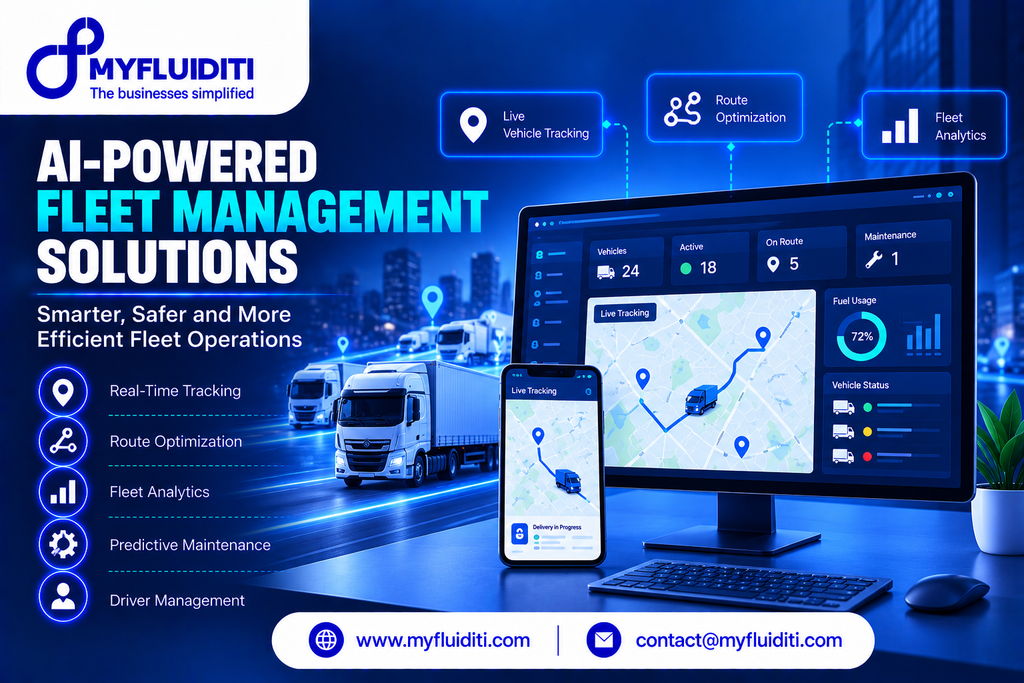
Real-time visibility is a fundamental requirement for modern transportation operations. AI-Based Vehicle Tracking Software combines GPS data, vehicle telematics, and intelligent analytics to help fleet managers understand vehicle locations, movement patterns, trip progress, and operational status. A centralized fleet monitoring dashboard can display active vehicles, completed journeys, route deviations, unexpected stops, and other relevant information. When supported by appropriate data sources, intelligent systems can identify unusual movement patterns and generate alerts for review. Real-Time Fleet Monitoring Solutions can improve coordination between drivers, dispatch teams, managers, and customers while reducing dependence on repeated phone calls and manual status updates. By integrating tracking capabilities into a custom fleet platform, businesses can strengthen operational visibility and respond more effectively to changing conditions.
AI-Powered Route Optimization and Intelligent Dispatch
Route planning directly affects delivery schedules, fuel usage, driver productivity, and customer satisfaction. AI-Powered Route Optimization uses relevant information such as traffic conditions, delivery windows, vehicle capacity, road restrictions, and planned stops to help identify efficient routes. Depending on available integrations and data quality, route optimization systems can recommend alternative journeys when disruptions occur or priorities change. Intelligent dispatch capabilities can also help assign vehicles and drivers according to location, availability, workload, and delivery requirements. Fleet Route Optimization Software supports logistics providers, courier companies, transportation businesses, and last-mile delivery services in improving journey planning and managing multiple destinations more effectively. MyFluiditi can help businesses plan custom software integrations and intelligent workflows that connect routing, scheduling, and fleet operations within a unified platform.
Predictive Maintenance and Vehicle Health Monitoring
Unexpected vehicle breakdowns can lead to delayed deliveries, higher repair expenses, disrupted schedules, and reduced fleet availability. AI-Powered Predictive Maintenance uses historical maintenance records, mileage, operating conditions, sensor readings, and other available vehicle data to identify patterns that may indicate potential maintenance needs. Rather than depending only on fixed service intervals, businesses can use predictive insights alongside preventive maintenance schedules to plan inspections and repairs more effectively. Fleet Maintenance Management Software can organize service histories, maintenance reminders, repair records, component replacements, and vehicle availability. When integrated with compatible telematics or diagnostic systems, vehicle health monitoring can provide additional information for maintenance planning. These capabilities help businesses take a proactive approach to vehicle management while supporting longer-term asset performance.
AI-Based Fuel Management and Cost Optimization
Fuel is a significant operating expense for many transportation and logistics businesses. Poor route planning, excessive idling, inefficient driving patterns, and inconsistent fuel records can make it difficult to identify where money is being lost. AI-Powered Fuel Management Software can analyze fuel consumption, mileage, trip information, and available vehicle data to highlight unusual patterns and potential inefficiencies. Fleet managers can compare fuel performance across vehicles, drivers, routes, and operating periods to understand where improvements may be possible. Fleet Cost Optimization Solutions can also combine fuel records with maintenance expenses, tolls, repair costs, and other operational data to provide a clearer picture of fleet expenditure. With reliable data and appropriate integrations, intelligent analytics can support more informed decisions about fuel efficiency, resource allocation, and cost control.
Driver Behavior Analysis and Fleet Safety
Driver behavior has a direct influence on road safety, vehicle condition, fuel consumption, and overall operational efficiency. AI-Based Driver Behavior Monitoring can analyze available telematics data, such as speeding events, harsh braking, rapid acceleration, and extended idling, to identify patterns that may require attention. When compatible cameras and computer vision technologies are used, additional driver or road-event analysis may be possible, subject to privacy requirements and local regulations. Fleet Driver Performance Analytics can help managers review driving patterns, identify training opportunities, and develop more consistent safety procedures. A well-designed system should support fair evaluation, transparent policies, and human oversight rather than treating automated scores as definitive judgments. By integrating driver analytics with fleet management software, businesses can improve visibility into safety-related performance and encourage responsible driving practices.
Fleet Management Dashboard and Business Intelligence
A centralized dashboard allows fleet managers to understand operational performance without gathering information from multiple disconnected systems. AI-Powered Fleet Management Dashboards can bring together vehicle status, trip history, delivery progress, maintenance schedules, fuel consumption, driver activity, and operating expenses. Business intelligence tools can transform this information into reports, trends, and performance indicators that support better planning. Fleet Analytics and Reporting Software can help organizations evaluate vehicle utilization, average trip duration, delivery performance, maintenance expenditure, and cost per trip or distance travelled. AI-generated summaries and recommendations may further simplify reporting when supported by accurate and relevant data. MyFluiditi can help businesses plan dashboards and reporting workflows that make operational information easier to understand and use across management, dispatch, and finance teams.
AI-Powered Fleet Scheduling and Vehicle Utilization
Efficient scheduling helps organizations use their existing vehicles and drivers more effectively. Intelligent Fleet Scheduling Software can consider vehicle availability, driver assignments, maintenance status, delivery priorities, and operational capacity when supporting scheduling decisions. By examining utilization patterns, AI Fleet Optimization Solutions can help businesses identify vehicles that remain idle for extended periods or routes that consistently require additional resources. This information can support better vehicle allocation, workload planning, and fleet expansion decisions. For organizations operating across several branches, a centralized scheduling platform can improve coordination and help standardize workflows. The final scheduling approach should account for driver working-hour restrictions, safety requirements, vehicle suitability, and real-world operating conditions.
Fleet Management Mobile App Development
Fleet operations frequently take place on the road, at warehouses, at delivery locations, and across multiple service areas. Fleet Management Mobile App Development gives drivers, supervisors, and fleet managers access to relevant information while away from their desks. A driver application may support trip assignments, navigation, delivery updates, expense submissions, document uploads, and proof of delivery. A manager application may provide vehicle status, alerts, maintenance information, and operational reports. Custom Fleet Management Mobile Applications can also support push notifications and secure communication between drivers and dispatch teams. Depending on business requirements, applications can be developed for Android, iOS, or cross-platform environments and connected to a shared backend. Offline capabilities may also be considered for operations in areas with unreliable connectivity.
Fleet Management Web Application Development
A web-based fleet platform provides a centralized interface for managing vehicles, users, routes, reports, and business processes. Fleet Management Web Application Development can include administrative dashboards, vehicle records, trip planning, driver management, maintenance workflows, document storage, and analytics. Role-based access controls help ensure that drivers, dispatchers, managers, and administrators can access information appropriate to their responsibilities. Custom Fleet Management Web Software can also support multiple locations, business units, and customer-facing tracking portals. With responsive design and a well-planned backend architecture, the platform can make essential fleet information available across different devices while maintaining consistent workflows.
AI-Powered Fleet Management for Logistics and Transportation
Logistics and transportation companies manage complex networks of vehicles, routes, drivers, customers, and delivery deadlines. AI Fleet Management Solutions for Logistics can help coordinate these activities by connecting route planning, shipment status, vehicle availability, fuel information, and delivery reporting. Integration with transportation management systems and warehouse management software can reduce duplicate data entry and improve coordination between logistics functions. Fleet Management Software for Transportation Companies can also support dispatch planning, trip history, delivery notifications, and operational analytics. For last-mile delivery providers, route optimization and real-time tracking can help improve visibility into delivery progress. The value of AI depends on the reliability of operational data, suitable integrations, and how effectively recommendations fit actual business processes.
AI Fleet Management for Car Rental and Leasing Businesses
Car rental and leasing companies must manage vehicle availability, reservations, service schedules, customer records, and vehicle utilization. AI-Powered Fleet Management for Car Rental Businesses can connect vehicle status with booking systems, maintenance workflows, and operational reporting. Intelligent analytics may help identify demand patterns, underutilized vehicles, and maintenance requirements using appropriate historical and live data. Car Rental Fleet Management Software can also support vehicle allocation, inspection records, rental schedules, and location-based visibility. When integrated with booking and customer management applications, fleet software can help rental businesses coordinate operations more consistently while improving their understanding of vehicle performance and utilization.
IoT Integration and Connected Fleet Management
The Internet of Things plays an important role in connected fleet operations by enabling vehicles and compatible devices to share operational information. IoT-Based Fleet Management Solutions can integrate GPS trackers, telematics devices, fuel sensors, diagnostic systems, and other supported hardware to collect useful vehicle data. This information can feed into cloud platforms and analytics systems for monitoring and reporting. IoT Fleet Tracking Software can help businesses understand vehicle movement, mileage, operating conditions, and selected performance indicators, depending on the available equipment. Combining IoT with artificial intelligence can support predictive maintenance, anomaly detection, and more informed operational planning. MyFluiditi can help businesses evaluate software requirements for connecting IoT data sources, APIs, analytics, and fleet management dashboards.
Cloud-Based Fleet Management Software
Cloud technology enables fleet businesses to access operational information across locations without depending entirely on locally installed systems. Cloud-Based Fleet Management Software can provide centralized data storage, web access, application integrations, and flexible infrastructure to support changing business requirements. A well-designed cloud platform can scale as the number of vehicles, users, transactions, and connected data sources grows. Scalable Fleet Management Solutions should also consider data protection, backup strategies, monitoring, access controls, and disaster recovery. Depending on business needs, the architecture may use cloud services, APIs, databases, and analytics components to connect different operational functions. Cloud deployment decisions should account for data sensitivity, expected usage, integration requirements, and ongoing infrastructure costs.
Fleet Management API Integration and Workflow Automation
Fleet operations often depend on multiple software systems, including accounting platforms, enterprise resource planning systems, customer relationship management tools, transport management applications, mapping services, and payment systems. Fleet Management API Integration enables these applications to exchange information and reduce disconnected workflows. For example, trip data may connect with billing systems, vehicle information may synchronize with maintenance applications, and delivery updates may feed into customer portals. Fleet Management Workflow Automation can help streamline routine processes such as maintenance reminders, document-expiry notifications, trip status updates, and report generation. Integration requirements should be carefully planned to ensure secure data exchange, consistent records, and reliable error handling across connected systems.
AI-Powered Fleet Management for Enterprise Businesses
Large organizations may operate fleets across several regions, business units, warehouses, or service locations. These environments require consistent operational standards, centralized reporting, and flexible access management. Enterprise Fleet Management Software Development can support multi-location operations, complex approval workflows, advanced reporting, system integrations, and customized user permissions. AI-enabled analytics can help enterprises evaluate fleet utilization, operational expenditure, maintenance patterns, and service performance across locations. A modular architecture can allow businesses to introduce additional capabilities as their needs evolve. For enterprise projects, MyFluiditi can help plan custom software development around business processes, integration needs, scalability, and long-term maintainability.
AI Fleet Management Solutions for Startups and Growing Businesses
Startups and growing transportation businesses may need a fleet management platform that can launch with essential capabilities and expand over time. Fleet Management MVP Development provides a way to validate the core product before investing in a larger system. An initial version may focus on vehicle records, GPS integration, trip management, driver assignments, maintenance reminders, and basic reporting. Advanced features such as AI route recommendations, predictive analytics, and automated dispatch can be introduced as the platform collects sufficient data and operational requirements become clearer. Custom Fleet Management App Development for Startups can help founders build a solution aligned with their target market, service model, and growth plans without introducing unnecessary complexity at the beginning.
Fleet Data Security, Privacy, and Compliance
Fleet management platforms may process vehicle locations, driver information, trip records, customer details, and operational documents. Fleet Management Software Security should therefore be considered throughout the development process. Appropriate measures may include secure authentication, role-based permissions, encryption where suitable, audit logs, controlled data access, backups, and ongoing security testing. Businesses using driver monitoring or location data should also consider applicable privacy obligations, data retention policies, employee transparency, and local regulations. Secure Fleet Management Solutions need a clear approach to data governance, third-party integrations, and incident response. Security and compliance requirements should be defined according to the business’s operating regions, data types, and contractual responsibilities.
AI and Machine Learning in Fleet Management
Artificial intelligence can support fleet operations by identifying patterns in large volumes of vehicle, route, maintenance, and driver data. Machine Learning for Fleet Management may be used for demand forecasting, maintenance prediction, route recommendations, fuel anomaly detection, and vehicle utilization analysis when suitable data is available. AI models can help uncover relationships that are difficult to identify through manual reporting alone, but their accuracy depends on data quality, model evaluation, and changing operating conditions. Predictive Fleet Analytics should be validated against real-world results and monitored over time to ensure that recommendations remain useful. Human oversight remains important for safety-critical decisions, operational exceptions, and situations where the system has incomplete or uncertain information.
How MyFluiditi Does AI-Powered Fleet Management
At MyFluiditi, we approach AI-Powered Fleet Management Development by focusing on business objectives, operational workflows, technical requirements, and the data needed to support intelligent features. We begin by understanding how a business manages its vehicles, drivers, trips, maintenance, fuel expenses, and reporting. Based on these requirements, our team can plan a suitable software architecture covering the web application, mobile application, backend services, database, APIs, cloud infrastructure, and relevant third-party integrations. Where appropriate, we can incorporate AI and machine learning capabilities for analytics, prediction, and decision support. We also consider security, performance, usability, testing, and future scalability so that the proposed solution aligns with the business’s practical needs.
How MyFluiditi Helps Businesses with AI Fleet Management Solutions
Our goal is to help businesses turn complex fleet workflows into connected digital experiences. Through Custom AI Software Development, web and mobile application development, API integration, and scalable technology solutions, we can help organizations plan systems that improve visibility and simplify fleet administration. Businesses may require a dedicated fleet dashboard, a driver application, a vehicle tracking interface, an automated maintenance workflow, or a more comprehensive fleet management platform. We work toward matching the solution scope to those requirements rather than assuming that every business needs the same features. Our broader software engineering capabilities can also support integration with existing systems, ongoing improvements, and the addition of new functionality as operational needs change.
Technologies Used in AI-Powered Fleet Management Development
Modern AI Fleet Management Software Development can involve a combination of frontend frameworks, backend technologies, databases, cloud infrastructure, AI services, and external integrations. Depending on project requirements, the technology stack may include React or Angular for web interfaces, Node.js, Python, Java, or .NET for backend services, and databases such as MySQL, PostgreSQL, or MongoDB. AI and machine learning components may use Python-based frameworks and data processing tools, while cloud infrastructure may involve AWS, Microsoft Azure, or other suitable platforms. GPS services, mapping APIs, IoT devices, telematics systems, notification services, and analytics tools can connect fleet data with operational workflows. The final stack should be selected according to performance requirements, existing systems, team capabilities, security needs, and long-term maintenance considerations.
The Future of AI-Powered Fleet Management
The future of AI-Powered Fleet Management Solutions will continue to develop through improvements in machine learning, connected vehicle technology, automation, and real-time analytics. Fleet operators may increasingly use predictive maintenance insights, intelligent dispatch, dynamic route recommendations, automated reporting, and AI-assisted operational planning. Electric vehicle fleets can also benefit from software that connects charging schedules, energy consumption, battery information, and vehicle availability when supported by appropriate data sources. As connected systems become more sophisticated, integration and responsible data management will remain essential. Businesses that invest in flexible, secure, and scalable fleet technology can build a stronger foundation for adapting to changing transportation requirements and customer expectations.
Conclusion
AI-Powered Fleet Management is becoming an important part of digital transformation for logistics companies, transportation providers, delivery businesses, rental operators, and enterprises managing vehicle fleets. By combining artificial intelligence, GPS tracking, route optimization, predictive maintenance, driver analytics, fuel management, IoT integration, and cloud-based software, organizations can improve operational visibility and make better-informed decisions. The most effective solution is one that aligns with real business workflows, uses reliable data, and can evolve as requirements change. MyFluiditi helps businesses explore and develop custom technology solutions through software engineering, AI integration, web and mobile application development, and scalable architecture. With the right AI Fleet Management Software Development strategy, businesses can work toward more efficient fleet operations, improved resource utilization, and sustainable long-term growth.