AI-Powered Taxi Booking Solutions for Smarter Urban Mobility
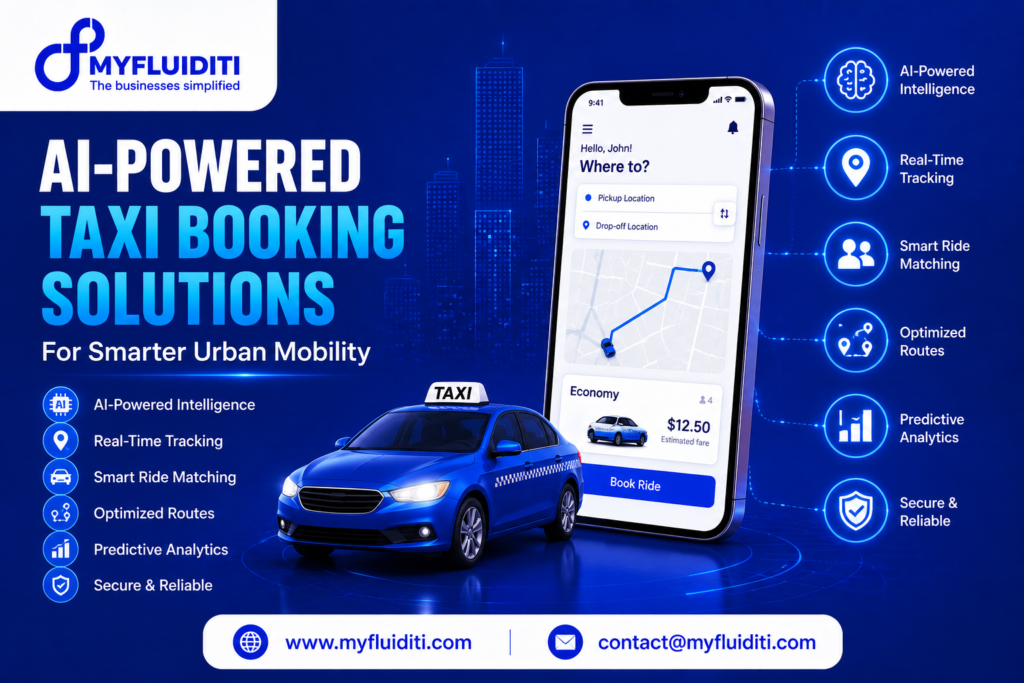
Introduction Urban transportation is evolving rapidly as growing cities, changing passenger expectations, and advances in digital technology reshape how people move from one place to another. Customers increasingly expect transportation services to provide instant booking, accurate location tracking, transparent pricing, secure payments, and reliable communication through a convenient mobile experience. Traditional taxi operations that depend heavily on phone-based bookings and manual dispatch can struggle to meet these expectations at scale. AI-Powered Taxi Booking Solutions combine Artificial Intelligence, real-time GPS technology, automation, cloud computing, mobile applications, and data analytics to create smarter transportation ecosystems. At MyFluiditi, we help taxi operators, mobility startups, and transportation businesses develop intelligent taxi booking platforms that connect passengers, drivers, and administrators while improving operational visibility and supporting scalable urban mobility. Understanding AI-Powered Taxi Booking Solutions An AI-powered taxi booking solution is a digital platform that manages interactions between passengers, drivers, dispatch teams, and business administrators while using intelligent technologies to improve selected processes. A complete Taxi Booking App Development ecosystem can include passenger applications, driver applications, administrative dashboards, GPS integration, ride management, payment gateways, notifications, reporting, and analytics. Artificial Intelligence can enhance these capabilities by analyzing trip information, demand patterns, driver availability, and operational data. MyFluiditi develops customized taxi booking solutions based on each business model, helping transportation companies move from fragmented processes toward connected digital operations. How Artificial Intelligence Is Transforming Taxi Booking Artificial Intelligence can add a layer of intelligence to traditional transportation platforms by analyzing large volumes of operational and customer data. AI in taxi booking can support demand forecasting, intelligent ride matching, estimated arrival calculations, customer support automation, route recommendations, and operational analytics. Instead of relying entirely on manual decisions, taxi businesses can use data-driven insights to support dispatch and resource planning. MyFluiditi helps organizations identify practical AI use cases and integrate them into taxi booking platforms where they can improve passenger experience and operational efficiency. Intelligent Ride Matching and Dispatch Efficient dispatch is one of the most important elements of a taxi booking platform. When a passenger requests a ride, the system needs to identify suitable available drivers based on factors such as location, availability, service type, and operational rules. Intelligent dispatch systems can automate much of this process and help reduce unnecessary coordination. AI-enabled matching can also use relevant historical and real-time information to support more efficient ride allocation. MyFluiditi develops automated dispatch workflows that connect passenger requests with driver applications and administrative systems, helping transportation businesses manage bookings more effectively. Real-Time GPS Tracking for Connected Mobility Location technology is central to modern taxi booking experiences. Passengers want visibility into the location of their assigned vehicle and estimated arrival, while drivers need accurate pickup and destination information. Businesses also benefit from greater visibility across active trips and vehicle operations. Real-time GPS tracking enables these connected experiences by integrating mapping and location capabilities into the platform. MyFluiditi develops taxi booking solutions with location-based functionality that helps passengers, drivers, and administrators access relevant trip information throughout the ride journey. AI-Based Route Optimization Traffic congestion, road conditions, distance, and travel time can significantly influence urban transportation. Intelligent routing technologies can analyze available information to recommend suitable routes based on current conditions and application requirements. AI-powered route optimization can support drivers in making more informed navigation decisions while helping passengers receive better trip estimates. MyFluiditi integrates mapping, location services, and intelligent technologies into mobility applications to create connected navigation experiences designed around practical transportation requirements. Predictive Demand Analysis for Better Resource Planning Passenger demand can vary significantly according to time, location, weather, events, working patterns, and other factors. Understanding these patterns can help transportation businesses plan driver availability and service coverage more effectively. Predictive analytics for transportation can analyze historical trip data and other relevant information to identify recurring demand patterns. MyFluiditi helps businesses create analytics environments that transform operational data into useful insights, supporting more informed planning and helping taxi operators understand how demand changes across their service areas. Creating a Seamless Passenger Experience Technology adoption depends heavily on usability. Passengers expect a taxi booking application to make registration, location selection, ride booking, driver tracking, payment, and support simple and intuitive. Complicated interfaces or unnecessary steps can create friction in the customer journey. MyFluiditi combines UI/UX design with mobile application development to create passenger-focused experiences that prioritize convenience, clarity, and accessibility. Our approach helps businesses develop taxi booking applications that make essential transportation services easy to access across compatible mobile devices. Building an Efficient Driver Application Drivers are equally important to the success of a taxi booking ecosystem. A well-designed driver application should make it easy to manage ride requests, navigation, trip status, earnings information, and relevant communication. Clear interfaces can reduce unnecessary interaction with the device while helping drivers manage their work more efficiently. MyFluiditi develops dedicated driver applications as part of custom taxi booking software, connecting driver workflows with passenger requests and administrative operations within a unified platform. Secure and Convenient Digital Payments Modern passengers increasingly expect convenient payment options as part of the booking experience. Integrating payment gateways allows taxi platforms to support suitable digital transaction methods based on the target market and business model. Payment functionality must also be implemented with appropriate security practices and reliable transaction workflows. Secure payment integration can simplify the passenger journey while helping businesses centralize transaction records. MyFluiditi integrates payment capabilities into taxi booking applications based on specific operational requirements, creating smoother digital payment experiences for passengers and businesses. AI Chatbots for Customer Support Taxi platforms may receive repetitive customer questions related to booking status, payment issues, trip information, account access, and service availability. AI-powered chatbots can support customer service by addressing common requests and directing customers toward relevant information. More complex issues can be escalated to human support teams when required. MyFluiditi helps businesses integrate conversational AI capabilities into mobility platforms, creating customer support experiences that combine automation with appropriate human assistance. Cloud-Based Taxi Booking Solutions Transportation applications may experience significant changes in usage throughout the day or during special events and
AI Development Services for Building Intelligent Business Solutions

Introduction Artificial Intelligence is rapidly becoming a core technology for businesses seeking to improve efficiency, automate processes, understand data, enhance customer experiences, and create new digital capabilities. Organizations across industries are moving beyond experimental AI projects and exploring practical ways to integrate intelligent technologies into everyday business operations. From predictive analytics and intelligent automation to conversational AI, machine learning, and generative AI, businesses now have opportunities to solve complex challenges faster and make better-informed decisions. AI Development Services help organizations transform these opportunities into practical, scalable solutions designed around specific business requirements. At MyFluiditi, we help businesses identify meaningful AI opportunities, develop customized intelligent applications, integrate AI into existing systems, and build scalable technology foundations that support continuous innovation and long-term digital growth. Understanding AI Development Services AI development services involve designing, developing, integrating, deploying, and maintaining software solutions powered by Artificial Intelligence technologies. Depending on business requirements, these solutions can incorporate Machine Learning, Natural Language Processing, computer vision, predictive analytics, generative AI, intelligent automation, recommendation systems, or conversational interfaces. Unlike generic software solutions, AI applications can analyze information, identify patterns, generate insights, and support increasingly intelligent workflows. MyFluiditi works with organizations to understand their operational challenges and determine where AI capabilities can deliver practical business value before developing solutions aligned with their technology environment and strategic objectives. Why Businesses Are Investing in Artificial Intelligence Modern businesses generate enormous amounts of information through customer interactions, enterprise applications, websites, transactions, operational systems, and connected devices. However, data alone does not create business value. Organizations need technologies capable of transforming information into useful insights and actions. Artificial Intelligence solutions can help businesses analyze complex datasets, automate repetitive processes, identify patterns, personalize customer experiences, and support faster decision-making. MyFluiditi helps organizations move from disconnected data and manual processes toward intelligent digital environments where AI complements existing teams, applications, and business processes. Custom AI Development for Unique Business Challenges Every organization has different workflows, data sources, customers, operational requirements, and strategic priorities. For this reason, a one-size-fits-all AI solution may not address every business challenge effectively. Custom AI Development Services enable businesses to build intelligent solutions around their specific requirements. This can include intelligent document processing, recommendation systems, forecasting applications, automated customer support, anomaly detection, workflow intelligence, or specialized AI-enabled business applications. At MyFluiditi, we focus on understanding the problem first and then selecting appropriate AI technologies, helping organizations avoid implementing AI simply because it is trending. AI-Powered Business Process Automation Repetitive manual activities can reduce productivity and increase operational complexity. Combining Artificial Intelligence with Business Process Automation allows organizations to create workflows capable of processing information, classifying requests, extracting data, routing activities, generating responses, and supporting business decisions. Intelligent automation can be applied across finance, customer service, sales, marketing, HR, operations, and other departments. MyFluiditi develops AI-enabled automation solutions that connect business applications and workflows, helping organizations reduce repetitive effort while improving process consistency and operational visibility. Generative AI for Modern Business Applications Generative AI Development is creating new possibilities for how businesses interact with information and customers. Generative AI applications can support content assistance, knowledge discovery, document summarization, conversational experiences, information retrieval, software development workflows, and internal productivity tools. Businesses can also connect generative AI capabilities with enterprise information and existing applications to create more context-aware solutions. MyFluiditi helps organizations explore practical generative AI use cases and develop applications that integrate intelligent capabilities with business workflows while considering security, governance, accuracy, and appropriate human oversight. Machine Learning for Predictive Business Insights Machine learning enables software systems to identify patterns in historical data and use those patterns to support predictions or classifications. Businesses can apply Machine Learning Development to areas such as demand forecasting, customer segmentation, churn analysis, risk identification, recommendation engines, operational forecasting, and predictive maintenance. The effectiveness of these solutions depends heavily on data quality, appropriate model selection, validation, and continuous monitoring. MyFluiditi helps organizations evaluate their data and develop machine learning solutions designed around clearly defined business outcomes rather than technology alone. AI and Data Analytics for Better Decision Making Business leaders need reliable information to make informed strategic and operational decisions. Traditional reporting explains what has already happened, while advanced analytics and AI can help organizations identify patterns and explore potential future outcomes. AI-powered analytics can support forecasting, anomaly detection, customer analysis, operational intelligence, and performance monitoring. MyFluiditi helps businesses integrate analytics with AI capabilities, creating dashboards and intelligent data environments that make complex information easier to understand and use for decision-making. Conversational AI and Intelligent Customer Support Customers increasingly expect businesses to provide convenient and responsive digital communication. Conversational AI can support customer interactions through intelligent chatbots, virtual assistants, and automated service interfaces capable of handling common questions and guiding users toward relevant information. These solutions can complement customer service teams by managing routine requests while escalating more complex situations to human representatives. MyFluiditi develops conversational experiences designed around actual customer journeys and integrates them with relevant business systems to create more connected service environments. AI-Powered Customer Experience and Personalization Personalized digital experiences can help businesses deliver information, products, services, and recommendations that are more relevant to individual customers. AI systems can analyze behavioral patterns, transaction histories, preferences, and engagement data to support AI-driven personalization. E-commerce platforms can provide product recommendations, digital services can adapt content, and CRM systems can support more contextual customer interactions. MyFluiditi helps organizations integrate AI capabilities into customer-facing platforms while aligning personalization with business objectives, user experience, and responsible data practices. Integrating AI with Existing Business Systems Many organizations already rely on ERP platforms, CRM systems, cloud applications, databases, analytics tools, websites, and custom enterprise software. Replacing these systems may be unnecessary when AI can be integrated into existing technology environments. AI integration services enable businesses to introduce intelligent capabilities through APIs, cloud services, data pipelines, and customized application layers. MyFluiditi helps organizations connect AI solutions with existing digital ecosystems, allowing businesses to modernize functionality while protecting the value of previous technology investments. Cloud-Based AI Development for Scalability Artificial Intelligence workloads can
Building Scalable Progressive Web Apps for Modern Businesses
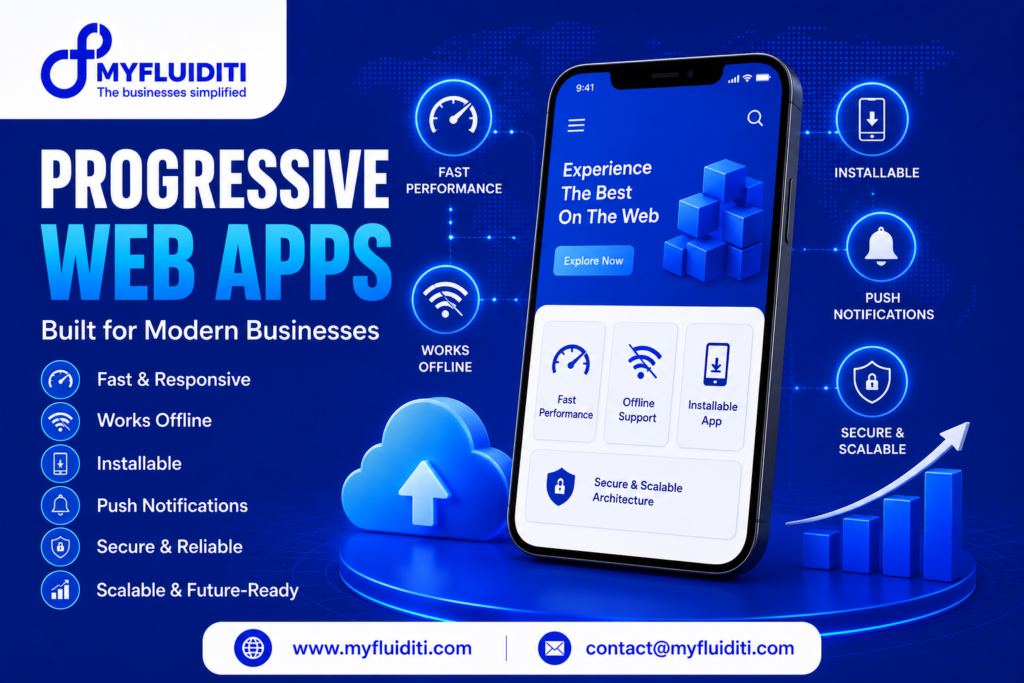
Introduction Modern businesses operate in a digital environment where customers expect applications to be fast, responsive, reliable, and accessible across multiple devices. Traditional websites can sometimes struggle to deliver the seamless interaction users have come to expect from mobile applications, while native app development can require separate development efforts for different platforms. Progressive Web Apps (PWA) provide an effective approach by combining the accessibility of the web with many app-like capabilities. PWAs can help businesses deliver responsive digital experiences, improve performance, support offline functionality, and increase customer engagement without requiring users to follow a traditional app-store installation process. At MyFluiditi, we help businesses design and develop scalable Progressive Web Apps that combine modern web technologies, user-focused design, secure architecture, and performance optimization to support evolving digital requirements and long-term business growth. Understanding Progressive Web Apps A Progressive Web App is a web application built using modern web technologies to provide an experience that can feel closer to a native mobile application. PWAs are designed to work across compatible browsers and devices while providing capabilities such as installability, responsive interfaces, offline or limited-connectivity support, and push notifications where platform support allows. Technologies such as service workers, web app manifests, secure HTTPS connections, and caching strategies form an important part of many PWA implementations. MyFluiditi develops Progressive Web Apps around specific business requirements, ensuring that functionality, usability, scalability, and performance are considered throughout the development lifecycle. Why Modern Businesses Are Adopting PWA Development Customers increasingly interact with businesses through smartphones and mobile browsers, making mobile experience an important part of digital strategy. Slow loading times, complicated navigation, and poor responsiveness can create friction and reduce engagement. PWA development helps businesses create faster and more consistent experiences across supported devices without necessarily maintaining completely separate web and native application experiences. MyFluiditi helps organizations evaluate where Progressive Web App technology fits within their digital strategy and develops solutions that support convenient access, improved usability, and efficient application management. Building Scalable PWA Architecture Scalability is essential for businesses expecting growth in users, transactions, content, services, or geographic reach. A Progressive Web App should be designed with an architecture capable of evolving as business requirements change. Modular application structures, efficient APIs, cloud infrastructure, database optimization, caching, and appropriate front-end architecture can all contribute to scalability. Scalable Progressive Web Apps allow organizations to introduce new functionality and support increasing demand without unnecessarily rebuilding the entire digital platform. At MyFluiditi, we focus on creating flexible technology foundations that help applications evolve alongside business growth. Delivering Fast and Responsive User Experiences Application speed can significantly influence how users perceive and interact with a digital platform. Customers expect pages, product information, dashboards, and interactive features to respond quickly, particularly on mobile devices. Performance-conscious Progressive Web App development can use optimized assets, intelligent caching, efficient code delivery, and appropriate loading strategies to improve responsiveness. MyFluiditi incorporates performance considerations throughout design and development, helping businesses create digital experiences that remain efficient across different devices and network conditions. Creating Mobile-First Digital Experiences For many businesses, mobile devices represent a major customer touchpoint. A mobile-first development approach begins by designing experiences around smaller screens, touch interactions, and essential user journeys before adapting them for larger displays. Mobile-first PWA development helps create interfaces that remain intuitive and accessible across smartphones, tablets, laptops, and desktops. MyFluiditi combines responsive design principles with user experience strategy to create Progressive Web Apps that provide consistent functionality while adapting effectively to different screen sizes. Offline Functionality and Reliable Access One of the valuable characteristics associated with Progressive Web Apps is their ability to support certain functionality during unstable or unavailable network conditions. Service workers and caching strategies can allow selected resources or previously accessed information to remain available depending on the application’s requirements. This can be useful for businesses serving customers in environments where connectivity is inconsistent. MyFluiditi designs offline-capable web applications based on practical business needs, identifying which resources and interactions should remain available while maintaining appropriate synchronization and data management when connectivity returns. Improving Customer Engagement with App-Like Features Progressive Web Apps can provide features that encourage customers to return and interact with a business more frequently. Depending on browser and operating-system support, capabilities can include home-screen installation, push notifications, full-screen experiences, background processes, and other app-like interactions. These features can help organizations create more convenient digital journeys without requiring every customer to download a conventional native application. MyFluiditi develops engagement-focused PWA experiences that prioritize useful functionality rather than adding features that do not contribute to customer or business value. PWA Development and Search Visibility Unlike many experiences contained primarily within native applications, Progressive Web Apps remain web-based and can be designed with search visibility in mind. Strong technical foundations such as crawlable content, logical information architecture, responsive design, appropriate metadata, internal linking, and optimized performance can support broader SEO strategies. However, PWA technology alone does not guarantee stronger rankings. MyFluiditi combines modern web development with SEO-conscious architecture to help businesses create digital platforms that are both user-friendly and technically structured for search discoverability. Cloud Infrastructure for Scalable Progressive Web Apps Cloud technology can provide the infrastructure flexibility needed to support growing Progressive Web Apps. As user demand changes, organizations may need additional computing resources, storage, database capacity, monitoring, backups, and content delivery capabilities. Cloud-based PWA development can help businesses create flexible environments that adapt to changing workloads. MyFluiditi helps organizations align application architecture with appropriate cloud infrastructure, creating technology environments designed to support performance, reliability, and future expansion. Integrating Progressive Web Apps with Business Systems Modern applications often need to communicate with CRM platforms, ERP systems, payment gateways, inventory solutions, analytics platforms, marketing technologies, and other business applications. API integration enables Progressive Web Apps to exchange information with these systems and create connected customer journeys. For example, an e-commerce PWA may need to communicate with inventory, payment, order management, and customer relationship systems simultaneously. MyFluiditi develops integration architectures that help businesses connect their PWAs with existing technology ecosystems while reducing unnecessary information silos. PWA Development for
On-Demand Solutions: Transforming the Way Modern Businesses Operate
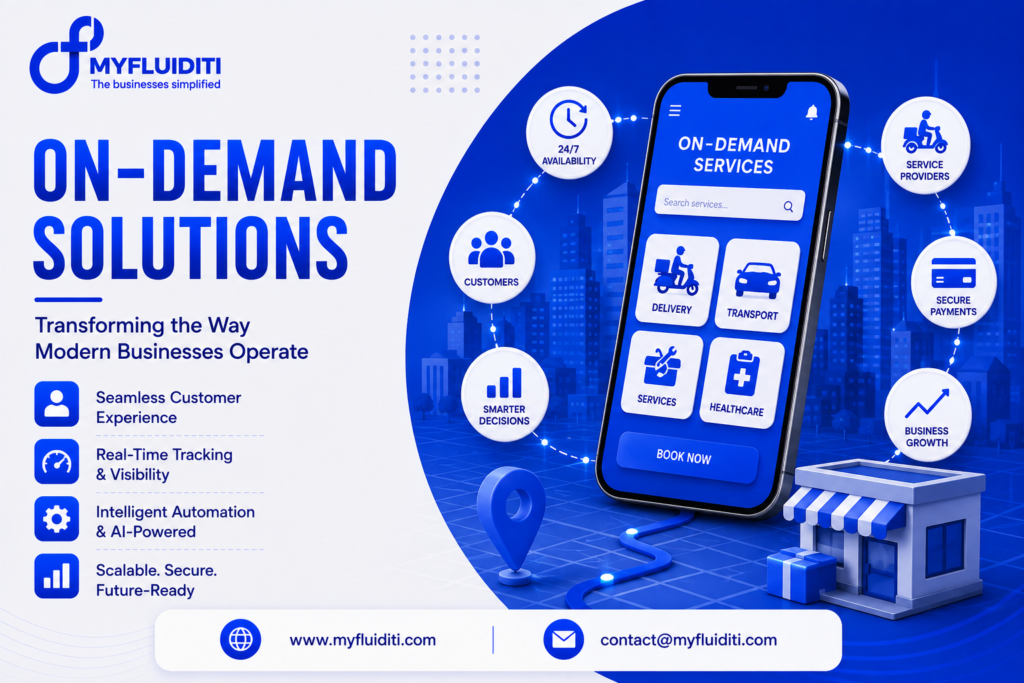
Introduction The modern digital economy has fundamentally changed how customers interact with businesses and access products and services. Consumers increasingly expect speed, convenience, personalization, and real-time accessibility, whether they are ordering food, booking transportation, scheduling healthcare services, hiring professionals, shopping online, or requesting home services. These changing expectations have accelerated the adoption of On-Demand Solutions, enabling businesses to connect customers with products and services quickly through intelligent digital platforms. By combining mobile applications, cloud technologies, Artificial Intelligence, automation, real-time tracking, secure payments, and data analytics, on-demand platforms are transforming traditional business models into faster and more customer-centric digital ecosystems. At MyFluiditi, we help organizations develop scalable on-demand solutions designed to simplify service delivery, improve customer experiences, optimize operations, and create new opportunities for sustainable business growth. Understanding On-Demand Solutions On-Demand Solutions are digital platforms designed to connect customers with products, services, or professionals whenever they need them. These solutions typically bring customers, service providers, administrators, payment systems, and business operations together within a connected technology ecosystem. Instead of relying on lengthy manual processes, customers can discover services, place requests, schedule appointments, make payments, track progress, and communicate through digital interfaces. MyFluiditi develops customized on-demand platforms that align technology with specific business models, helping organizations deliver convenient digital experiences while improving operational control and service efficiency. Why On-Demand Solutions Are Transforming Modern Businesses Traditional business models often depend on fixed operating processes, manual coordination, telephone bookings, and disconnected systems. Modern customers expect greater flexibility and faster access to services. On-demand technology helps bridge this gap by enabling businesses to provide services through websites, mobile applications, customer portals, and integrated digital platforms. Real-time availability, instant communication, automated notifications, digital payments, and service tracking can make customer journeys more convenient and transparent. MyFluiditi helps businesses modernize traditional service models through on-demand technology that connects customers, employees, service providers, and business systems more efficiently. Creating Seamless Customer Experiences Customer experience is at the center of successful on-demand platforms. Users expect simple registration, intuitive navigation, fast search, transparent pricing, convenient booking, secure payments, real-time updates, and responsive customer support. Every unnecessary step can create friction and potentially affect customer engagement. A carefully designed on-demand customer experience simplifies the complete journey from initial discovery to service completion. At MyFluiditi, we combine UI/UX design with modern application development to create intuitive digital experiences that make it easier for customers to discover, request, and manage services across different devices. On-Demand Mobile App Development Mobile technology is one of the primary drivers behind the growth of the on-demand economy. Smartphones provide customers with convenient access to services regardless of their location. On-Demand App Development can include customer applications, service-provider applications, administrative dashboards, booking functionality, notifications, digital payments, location-based capabilities, and real-time communication. MyFluiditi develops responsive and scalable mobile solutions tailored to individual business requirements, helping organizations create connected experiences for customers and service teams while maintaining centralized operational visibility. Business Process Automation for Faster Service Delivery Behind every successful on-demand experience is a network of business processes that must work efficiently. Manual assignment, scheduling, invoicing, status updates, customer communication, and reporting can become difficult to manage as transaction volumes increase. Business Process Automation enables organizations to streamline these repetitive activities and create more consistent workflows. MyFluiditi integrates automation into on-demand platforms to help businesses manage service requests, notifications, approvals, payments, customer communication, and operational workflows more efficiently while reducing unnecessary manual intervention. Real-Time Tracking and Visibility Customers increasingly expect visibility after placing a request. Depending on the business model, real-time tracking can allow users to monitor deliveries, appointments, service professionals, orders, or request status. Businesses can also benefit from centralized dashboards that provide operational visibility across ongoing transactions and service activities. Real-time tracking solutions can improve transparency while helping businesses coordinate resources more effectively. MyFluiditi integrates appropriate tracking and status-management capabilities into on-demand platforms, enabling organizations to create more transparent and connected service experiences. AI-Powered On-Demand Solutions Artificial Intelligence is creating new opportunities to make on-demand platforms more intelligent and responsive. AI-powered on-demand solutions can support personalized recommendations, customer assistance, intelligent search, demand forecasting, service matching, automated communication, and operational analytics. AI can analyze customer behavior and historical information to help businesses understand demand patterns and improve decision-making. MyFluiditi helps organizations integrate AI capabilities where they deliver practical value, enabling on-demand platforms to evolve from simple transaction systems into more intelligent digital ecosystems. Cloud Technology for Scalability Demand for digital services can fluctuate significantly depending on time, location, season, promotions, and customer behavior. Businesses therefore need infrastructure capable of supporting changing workloads without compromising performance. Cloud-based on-demand solutions provide flexible computing resources that can support growing users, transactions, applications, and data volumes. MyFluiditi develops cloud-enabled digital platforms designed with scalability and reliability in mind, helping businesses expand services and enter new markets while maintaining a technology foundation capable of supporting future growth. Secure and Convenient Digital Payments Payments are an essential part of many on-demand business models. Customers expect convenient and secure transaction experiences without being redirected through complicated processes. Integrating suitable payment gateways can support different payment methods while helping businesses manage transaction workflows more efficiently. Security, encryption, authentication, and responsible data handling are important considerations throughout payment integration. MyFluiditi builds secure payment integration into on-demand platforms based on project requirements, helping businesses create smoother transaction experiences while maintaining appropriate security practices. Data Analytics for Smarter Business Decisions Every interaction within an on-demand platform can generate useful operational information. Businesses may gain insights into customer preferences, service demand, transaction activity, geographic trends, provider performance, conversion patterns, and customer engagement. On-demand analytics can transform this information into actionable insights that support operational planning and business decisions. MyFluiditi integrates dashboards, analytics, and reporting capabilities into digital platforms so organizations can monitor relevant performance indicators, understand customer behavior, and continuously improve their services based on data. Personalization and Customer Engagement Customers are more likely to engage with digital platforms that understand their preferences and make interactions relevant. Personalized recommendations, location-aware services, customized communication, saved preferences, and targeted offers can improve
Cloud Modernization: Building Scalable and Future-Ready Businesses
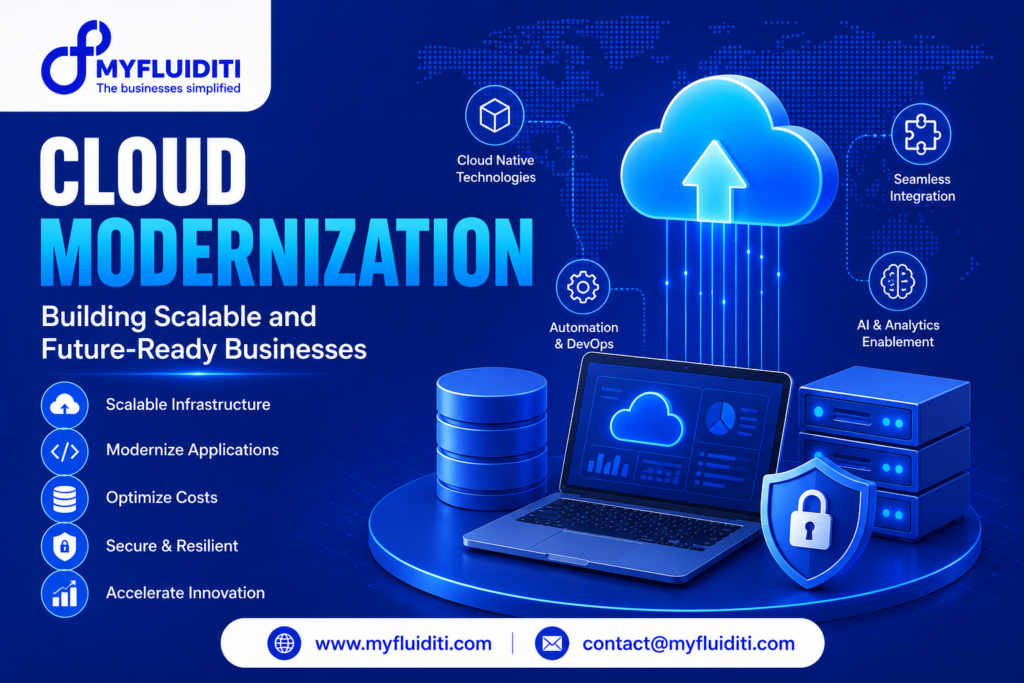
Introduction The rapid evolution of digital technology is changing how organizations operate, serve customers, manage data, and compete in global markets. Businesses relying on aging infrastructure and legacy applications often face rising maintenance costs, limited scalability, integration challenges, slower application performance, and difficulty adopting emerging technologies. Cloud Modernization provides a strategic path for transforming these traditional environments into flexible, scalable, and efficient digital ecosystems. By modernizing applications, infrastructure, data platforms, and business processes through cloud technologies, organizations can improve agility, optimize costs, strengthen resilience, and accelerate innovation. At MyFluiditi, we help businesses plan and execute cloud modernization initiatives that align technology transformation with practical business objectives, creating a stronger foundation for long-term digital growth. Understanding Cloud Modernization Cloud modernization goes beyond simply transferring existing applications from physical servers to a cloud environment. It involves evaluating the complete technology ecosystem and determining how applications, infrastructure, databases, integrations, and workflows can be redesigned or optimized using modern cloud capabilities. A comprehensive cloud modernization strategy may involve application modernization, infrastructure modernization, cloud-native development, API integration, containerization, automation, data modernization, and managed cloud services. MyFluiditi works with organizations to understand their current technology landscape and identify modernization opportunities that can improve performance, scalability, maintainability, and business efficiency. Why Businesses Need Cloud Modernization Traditional IT environments can become increasingly difficult and expensive to maintain as businesses grow. Legacy systems may depend on outdated technologies, require specialized maintenance, and struggle to integrate with modern applications. These limitations can slow innovation and make it harder for organizations to respond to changing customer expectations. Cloud transformation helps businesses create technology environments capable of adapting to new requirements more efficiently. MyFluiditi helps organizations modernize their digital foundations by identifying technology bottlenecks, improving system architecture, and implementing cloud solutions designed to support changing business requirements. Building Scalable Business Infrastructure Scalability is one of the most important advantages of modern cloud environments. Traditional infrastructure often requires businesses to estimate future capacity and invest in hardware before demand increases. Cloud platforms provide greater flexibility by allowing computing, storage, and application resources to scale according to changing workloads. This can help organizations support growing customer bases, expanding operations, seasonal demand, and new digital services more efficiently. Through scalable cloud infrastructure, MyFluiditi helps businesses create environments that can adapt as operational requirements evolve without requiring constant infrastructure redesign. Modernizing Legacy Applications Legacy applications can remain essential to daily business operations even when the technologies supporting them have become outdated. Replacing every legacy application is not always practical, which makes application modernization an important part of cloud transformation. Depending on business and technical requirements, organizations may rehost, replatform, refactor, rebuild, or selectively replace existing applications. Application modernization can improve maintainability, integration capabilities, scalability, and overall application performance. MyFluiditi helps businesses evaluate existing applications and develop modernization approaches that minimize unnecessary disruption while preparing critical systems for future digital initiatives. Accelerating Innovation with Cloud-Native Technologies Modern cloud platforms provide access to technologies that can help development teams build, test, deploy, and improve applications more efficiently. Cloud-native development uses modern architectural approaches such as microservices, containers, APIs, serverless computing, DevOps practices, and automated deployment pipelines. These capabilities can enable businesses to introduce new functionality more rapidly while making applications easier to scale and maintain. At MyFluiditi, we help organizations adopt cloud-native approaches where they provide meaningful business and technical value, enabling teams to build flexible digital solutions that can evolve alongside changing requirements. Improving Business Agility Market conditions, customer expectations, and technology requirements can change quickly. Organizations need digital infrastructure that enables them to respond without lengthy hardware procurement or complex system modifications. Cloud computing solutions provide flexible resources that can support rapid experimentation, development, testing, and deployment. By modernizing infrastructure and applications, businesses can shorten development cycles and respond more effectively to emerging opportunities. MyFluiditi helps organizations create agile cloud environments that support continuous improvement and faster digital innovation. Optimizing Cloud Costs and Resources Moving to the cloud does not automatically guarantee lower technology costs. Without appropriate planning, organizations may maintain unused resources, select unsuitable configurations, or operate inefficient workloads. Effective cloud cost optimization requires continuous visibility into resource utilization, application performance, storage requirements, and infrastructure demand. MyFluiditi helps businesses evaluate cloud resources and align infrastructure consumption with operational requirements. Through better architecture, resource planning, automation, and ongoing optimization, organizations can improve the value generated from their cloud investments. Strengthening Cloud Security Security is a fundamental consideration in every modernization initiative. As businesses move applications and data into modern cloud environments, they need appropriate controls for identity, access, data protection, network security, monitoring, backups, and governance. A well-designed cloud security strategy can help organizations protect digital assets while maintaining the flexibility required for modern business operations. MyFluiditi incorporates security considerations throughout cloud modernization initiatives, helping businesses establish secure architectures, appropriate access controls, monitoring practices, and data protection mechanisms suited to their technology environments. Modernizing Data for Better Business Insights Modern businesses generate information through customer interactions, enterprise applications, digital platforms, operational systems, and connected technologies. Legacy data environments can make it difficult to consolidate and analyze this information efficiently. Cloud data modernization enables organizations to build scalable data platforms that support analytics, reporting, Artificial Intelligence, machine learning, and business intelligence initiatives. MyFluiditi helps businesses modernize data environments and connect information across systems, creating stronger foundations for data-driven decision-making and future intelligent applications. Enabling AI and Intelligent Automation Artificial Intelligence and automation are becoming increasingly important components of digital transformation, but these technologies depend on scalable computing resources and accessible, well-managed data. Cloud modernization creates an infrastructure foundation that can support AI-powered business solutions, machine learning models, intelligent automation, predictive analytics, and generative AI applications. MyFluiditi helps organizations connect cloud capabilities with AI and automation initiatives so businesses can streamline processes, analyze information more effectively, and explore new opportunities for intelligent digital services. Improving Integration Across Business Systems Businesses commonly use multiple platforms for CRM, ERP, finance, sales, marketing, customer support, analytics, and other operational activities. When these systems operate independently, information becomes fragmented and business