From Design to Deployment: Building a Successful Business Website
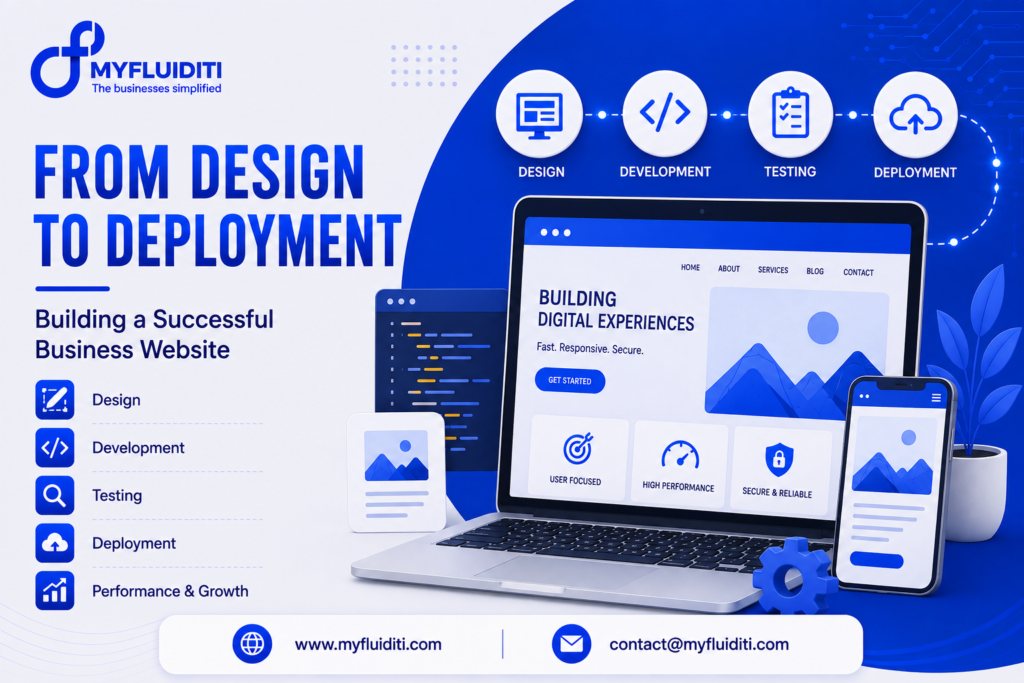
Introduction A business website has evolved from being a simple online presence into one of the most important digital assets for attracting customers, building credibility, generating leads, and supporting long-term growth. Today’s users expect websites to be fast, responsive, visually appealing, secure, and easy to navigate across every device. At the same time, businesses need websites that integrate with marketing platforms, analytics tools, CRM systems, payment solutions, and other digital technologies. Building an effective website therefore requires much more than attractive design. It requires a structured process that connects strategy, user experience, development, optimization, testing, and deployment. From Design to Deployment, every stage contributes to the performance and success of a modern business website. At MyFluiditi, we help organizations transform business ideas into scalable digital experiences through strategic website design and development solutions focused on performance, usability, security, and business growth. Understanding the Business Purpose of a Website Successful website development begins with understanding what the website needs to achieve. Different organizations may require websites for lead generation, brand awareness, online sales, customer support, appointment booking, service promotion, recruitment, or digital communication. Defining these objectives early helps determine the website structure, features, content strategy, technology, and user journey. MyFluiditi works closely with businesses to understand their goals, target audiences, industry requirements, and existing digital ecosystem before beginning development. This business-first approach helps ensure that the final website is not simply visually attractive but designed around measurable organizational objectives. Planning the Website Architecture Before visual design and development begin, businesses need a clear website architecture. Website architecture defines how pages, content, navigation, and functionality are organized to create an intuitive experience for visitors. A logical structure helps users quickly find relevant information while also making it easier for search engines to understand and crawl website content. Page hierarchy, navigation menus, internal linking, service pages, landing pages, and conversion paths should all be considered during planning. MyFluiditi helps organizations develop structured website frameworks that balance customer usability, business priorities, scalability, and search engine visibility. Creating a User-Centric UI/UX Design A website’s visual appearance creates an important first impression, but successful design goes beyond colors, graphics, and typography. UI/UX design focuses on how visitors interact with a website and how easily they can accomplish their goals. Clear navigation, readable content, logical layouts, accessible interfaces, consistent branding, and strategically positioned calls to action contribute to a better digital experience. MyFluiditi develops user-focused website designs that combine visual creativity with practical functionality, helping businesses create professional digital experiences that encourage visitors to explore, engage, and take meaningful actions. Responsive and Mobile-First Website Development Customers access websites through smartphones, tablets, laptops, desktops, and devices with different screen sizes. A website that performs well only on desktop can create frustrating experiences for mobile visitors and limit potential business opportunities. Responsive web development ensures layouts, images, navigation, and website functionality adapt smoothly across devices. A mobile-first approach considers smaller screens from the beginning of the design process rather than treating mobile compatibility as an afterthought. MyFluiditi builds responsive websites designed to provide consistent usability and performance across modern devices, helping businesses reach customers wherever digital interactions take place. Choosing the Right Technology Stack Technology choices can influence website performance, scalability, security, maintainability, and future development. Businesses need technologies that align with current requirements while remaining flexible enough to support future functionality. Depending on the project, this can involve content management systems, front-end frameworks, back-end technologies, databases, APIs, cloud infrastructure, and third-party integrations. MyFluiditi evaluates project requirements and selects appropriate development technologies to create reliable and maintainable website solutions. Our focus is on building technology foundations that support business objectives without introducing unnecessary complexity. Custom Website Development for Unique Business Needs Template-based websites can address basic requirements, but growing organizations often need functionality tailored to their specific processes and customer journeys. Custom website development enables businesses to create features, integrations, workflows, and user experiences around their individual requirements. This can include customer portals, booking functionality, interactive tools, dashboards, content platforms, product catalogs, lead management systems, and specialized integrations. MyFluiditi develops customized web solutions that provide businesses with greater flexibility and create digital experiences aligned with their brand and operational needs. Building Websites for Speed and Performance Website performance has a direct impact on user experience. Visitors are less likely to remain on slow or unresponsive pages, making performance optimization an important part of professional development. Efficient code, optimized images, appropriate caching, content delivery strategies, database optimization, and suitable hosting infrastructure can contribute to faster digital experiences. Website performance optimization should be considered throughout development rather than addressed only after launch. At MyFluiditi, we focus on performance-conscious development practices that help businesses deliver responsive and reliable experiences across devices. SEO-Friendly Website Development A professionally designed website delivers limited value if potential customers cannot discover it through search engines. SEO-friendly website development establishes the technical foundation required to support organic search visibility. Clean site architecture, mobile responsiveness, optimized page speed, descriptive URLs, appropriate heading structures, metadata, internal linking, structured content, and crawlability all influence how effectively search engines can understand a website. MyFluiditi incorporates SEO considerations throughout website development so businesses have a stronger technical foundation for content marketing, search optimization, and long-term organic growth. Creating Content That Supports Users and Search Engines Website content plays a central role in communicating business value while helping search engines understand page relevance. Effective content should clearly explain services, answer customer questions, demonstrate expertise, and guide users toward appropriate next steps. Instead of focusing solely on keyword frequency, businesses should develop useful content around genuine search intent and customer needs. SEO content strategy combines relevant keywords with clear, informative, and audience-focused communication. MyFluiditi helps organizations structure website experiences so content and design work together to support visibility, engagement, and conversion objectives. Integrating Business Systems and Digital Platforms Modern websites rarely operate independently. Businesses may need to connect websites with CRM systems, ERP platforms, payment gateways, marketing automation tools, analytics platforms, social media channels, customer support applications, or internal databases. API integration enables these
AI-Powered CRM: Transforming Customer Engagement with Intelligent Automation
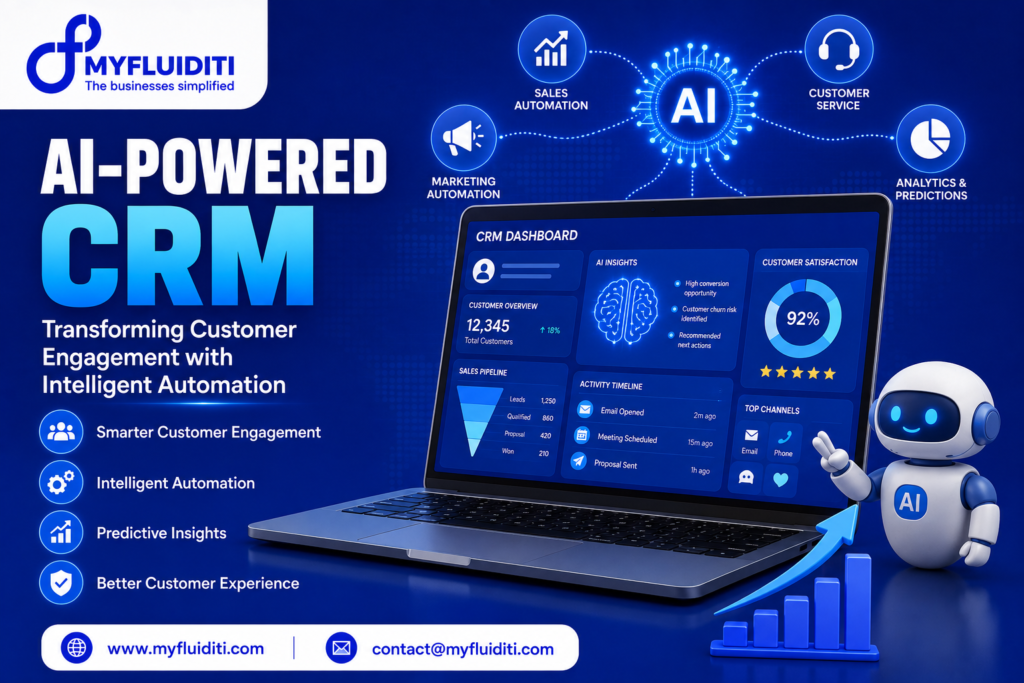
Introduction Customer relationships have become one of the most valuable drivers of business growth in today’s digital economy. Customers expect businesses to understand their needs, respond quickly, provide personalized experiences, and maintain consistent communication across every interaction. Traditional customer relationship management systems can organize customer information and track activities, but modern organizations increasingly need intelligent technologies that can turn customer data into meaningful actions. This is where AI-Powered CRM is transforming the way businesses manage customer relationships. By combining Customer Relationship Management with Artificial Intelligence, machine learning, predictive analytics, and intelligent automation, businesses can improve engagement, streamline sales processes, personalize marketing, and deliver more responsive customer service. At MyFluiditi, we help organizations develop and integrate intelligent CRM solutions designed to create connected customer experiences while improving operational efficiency and supporting sustainable business growth. Understanding AI-Powered CRM An AI-Powered CRM combines traditional CRM capabilities with Artificial Intelligence to help businesses understand customer behavior, automate routine activities, and make smarter decisions. Instead of functioning only as a database for customer information, an intelligent CRM can analyze interactions, identify patterns, prioritize opportunities, recommend actions, and support personalized communication. AI can process information from sales activities, marketing campaigns, customer service interactions, websites, emails, and other digital channels to create a more complete understanding of each customer. MyFluiditi helps businesses implement CRM solutions that bring customer data, automation, analytics, and intelligent capabilities together within a connected digital environment. Transforming Customer Engagement Through Artificial Intelligence Modern customer engagement requires more than sending generic messages to large audiences. Customers increasingly expect interactions that are relevant to their interests, requirements, and stage of the buying journey. Artificial Intelligence in CRM enables organizations to analyze customer preferences and previous interactions to deliver more contextual experiences. Intelligent CRM platforms can help businesses determine when to communicate, what information may be most relevant, and which channels are suitable for different customer segments. MyFluiditi supports businesses in creating customer-focused CRM environments that help sales, marketing, and service teams deliver more consistent and meaningful engagement throughout the customer lifecycle. Intelligent Automation for Greater Business Efficiency Repetitive administrative activities can consume significant time across sales, marketing, and customer service departments. CRM automation can streamline activities such as lead assignment, follow-up reminders, customer segmentation, data updates, workflow approvals, notifications, and routine communications. When Artificial Intelligence is added to these workflows, automation can become more adaptive and data-driven. At MyFluiditi, we help organizations identify repetitive CRM processes and develop intelligent automation workflows that reduce manual effort, improve consistency, and allow employees to concentrate on higher-value customer interactions and strategic activities. Smarter Lead Management and Sales Automation Generating leads is only the beginning of the sales process. Businesses also need to identify promising opportunities, maintain timely communication, and guide prospects efficiently through the sales funnel. AI-powered sales automation can analyze customer information, engagement signals, historical activity, and other relevant data to support lead prioritization and opportunity management. Sales teams can use these insights to focus their efforts more effectively and improve follow-up consistency. MyFluiditi helps organizations connect CRM platforms with sales workflows, analytics, and automation capabilities so teams gain better visibility into prospects, opportunities, and customer interactions. Personalized Marketing with AI-Powered CRM Personalization has become an important element of successful digital marketing. Instead of delivering the same campaign to every customer, businesses can use CRM data to create more targeted communication based on customer interests, behaviors, and engagement history. AI-driven customer personalization can support audience segmentation, campaign recommendations, personalized content, and automated customer journeys. MyFluiditi helps businesses integrate CRM and marketing technologies to create connected campaigns that use customer insights more effectively, enabling organizations to improve relevance while maintaining consistent communication across digital channels. Enhancing Customer Service and Support Customer service can significantly influence satisfaction, retention, and long-term brand relationships. AI-powered CRM systems can support service teams by organizing customer histories, categorizing requests, routing cases, suggesting relevant information, and automating routine responses. Intelligent chatbots and virtual assistants can also handle common customer inquiries while allowing support professionals to concentrate on complex issues that require human expertise. Through intelligent customer service automation, MyFluiditi helps organizations create more responsive support environments where teams have easier access to relevant customer information and can provide consistent experiences across multiple channels. Predictive Analytics for Better Customer Insights One of the strongest capabilities of Artificial Intelligence is its ability to identify patterns within large volumes of data. Predictive CRM analytics can help businesses better understand customer behavior, sales opportunities, engagement patterns, and potential risks. Instead of relying entirely on historical reporting, organizations can use predictive insights to support forward-looking decisions. MyFluiditi helps businesses integrate analytics and reporting capabilities into CRM environments, allowing decision-makers to transform customer data into actionable insights that can support sales planning, marketing optimization, customer engagement, and broader business strategies. Creating a Unified Customer View Customer information is often distributed across sales platforms, marketing tools, websites, customer support applications, ERP systems, and other business software. Disconnected data can make it difficult for employees to understand the complete customer journey. CRM integration connects these systems and creates a more unified view of customer information. Through API integration, cloud technologies, and customized data workflows, MyFluiditi helps organizations connect CRM platforms with existing business applications. This enables information to move more efficiently between departments and gives authorized teams access to relevant customer information when they need it. Improving Customer Retention and Loyalty Building long-term customer relationships is often as important as acquiring new customers. Intelligent CRM systems can help organizations monitor engagement patterns, understand customer preferences, identify service issues, and recognize opportunities for proactive communication. Businesses can use these insights to develop more relevant retention strategies and improve the overall customer experience. MyFluiditi helps organizations leverage customer relationship management solutions to create connected customer journeys that support stronger engagement, improved service consistency, and long-term customer value. AI-Powered CRM and Digital Transformation CRM is becoming an increasingly important part of broader digital transformation strategies. Modern businesses need sales, marketing, service, analytics, automation, and enterprise systems to work together rather than operating independently. AI-powered
Enterprise Resource Planning: The Foundation of Digital Transformation
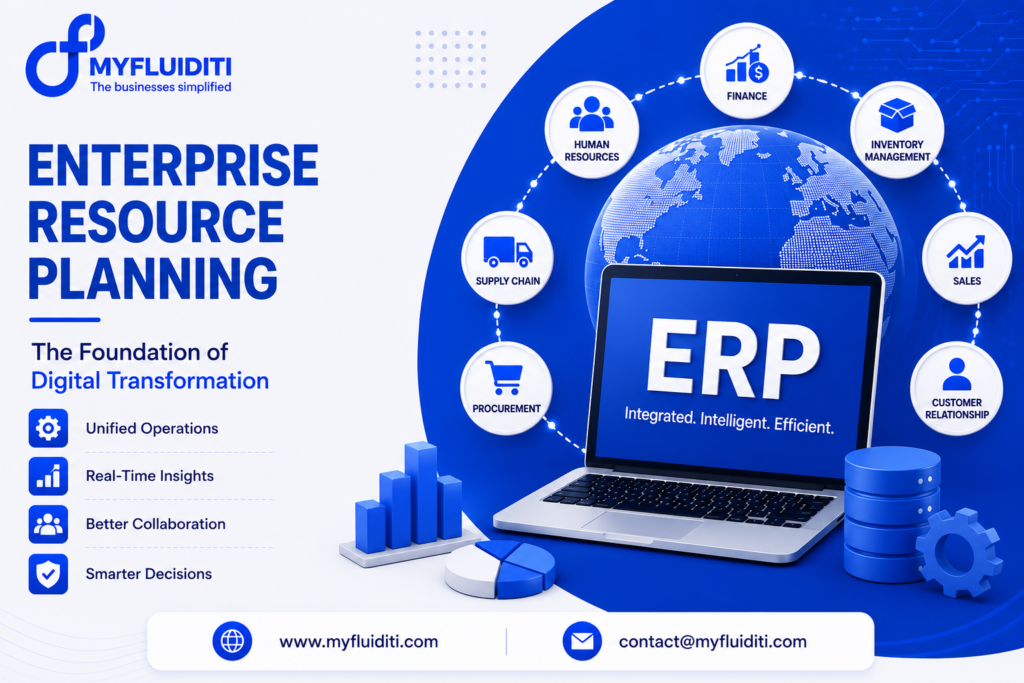
Introduction In today’s rapidly evolving business environment, organizations must embrace technology to remain competitive, improve operational efficiency, and deliver exceptional customer experiences. Managing disconnected systems, manual processes, and scattered business data often leads to inefficiencies, delayed decision-making, and increased operational costs. This is where Enterprise Resource Planning (ERP) plays a critical role. By integrating core business functions into a unified platform, ERP enables organizations to streamline operations, improve collaboration, and make data-driven decisions. As businesses accelerate their Digital Transformation initiatives, ERP has become the foundation for building agile, scalable, and intelligent enterprises. At MyFluiditi, we help organizations implement customized ERP solutions that simplify business processes, improve productivity, and support sustainable digital growth. Understanding Enterprise Resource Planning Enterprise Resource Planning (ERP) is an integrated software solution that connects essential business functions such as finance, human resources, procurement, inventory management, manufacturing, sales, customer relationship management, and supply chain operations into a single centralized system. Instead of operating through isolated applications, businesses gain real-time access to accurate information across departments, enabling better collaboration and faster decision-making. A modern ERP platform improves operational visibility while reducing redundancy and manual errors. MyFluiditi delivers scalable ERP solutions tailored to the unique operational requirements of businesses, helping organizations improve efficiency while supporting long-term business objectives. Why ERP Is the Foundation of Digital Transformation Digital transformation is not simply about adopting new technologies; it is about transforming business operations through intelligent systems and connected processes. ERP serves as the backbone of digital transformation by integrating people, processes, and technology into one unified ecosystem. Businesses can automate workflows, improve communication between departments, centralize business data, and gain actionable insights through real-time reporting. Organizations that implement ERP Software establish a strong digital foundation capable of supporting innovation, scalability, and continuous improvement. MyFluiditi works closely with businesses to modernize legacy systems through ERP implementation, enabling seamless digital transformation across the enterprise. Streamlining Business Operations One of the greatest advantages of Enterprise Resource Planning is its ability to streamline business operations. Manual processes often result in duplicated efforts, inconsistent data, and operational delays. ERP automates routine tasks such as purchase orders, invoicing, inventory tracking, payroll processing, financial reporting, and production planning, allowing employees to focus on higher-value activities. Improved workflow automation enhances productivity while reducing operational costs and human error. MyFluiditi develops ERP solutions that optimize business processes, improve operational efficiency, and create a connected working environment across every department. Improving Data Accuracy and Real-Time Visibility Modern businesses rely on accurate and timely information to make strategic decisions. ERP systems centralize organizational data into a single platform, eliminating inconsistencies caused by multiple disconnected databases. Executives and managers gain real-time visibility into financial performance, inventory levels, sales activities, customer information, procurement processes, and operational metrics through interactive dashboards and reporting tools. Better visibility enables organizations to identify opportunities, respond to market changes, and improve overall business performance. MyFluiditi helps organizations leverage ERP analytics and business intelligence capabilities to transform data into meaningful business insights. Enhancing Customer Experience Customer expectations continue to evolve, requiring businesses to deliver faster service, personalized experiences, and reliable order fulfillment. ERP improves customer satisfaction by connecting sales, inventory, production, logistics, and customer support into one integrated platform. Employees can access complete customer information, monitor order status, track inventory availability, and resolve issues more efficiently. This integrated approach improves response times while strengthening customer relationships. MyFluiditi enables businesses to build customer-focused ERP ecosystems that improve service quality and support long-term customer loyalty. ERP and Business Automation Business Automation is a key component of digital transformation, and ERP plays a central role in automating complex workflows across the organization. Automated approval processes, inventory replenishment, financial reconciliation, procurement management, payroll processing, and reporting reduce administrative effort while improving consistency and compliance. Organizations can eliminate repetitive tasks and increase operational agility through intelligent workflow automation. MyFluiditi integrates automation capabilities within ERP systems, helping businesses improve productivity while reducing manual intervention across multiple business functions. Cloud ERP for Greater Business Agility Cloud technology has transformed the way organizations deploy and manage ERP systems. Cloud ERP provides businesses with scalable infrastructure, remote accessibility, automatic software updates, enhanced security, and lower infrastructure costs. Employees can securely access critical business information from anywhere, supporting remote work and distributed teams. Cloud-based ERP solutions also enable organizations to expand operations without significant investments in hardware or IT infrastructure. MyFluiditi implements cloud ERP platforms that provide flexibility, scalability, and high availability while supporting the evolving needs of modern enterprises. ERP Integration Across Business Functions A successful ERP system connects every department into one unified digital environment. Finance teams gain accurate financial reporting, procurement teams manage supplier relationships efficiently, HR departments streamline employee management, sales teams improve customer interactions, and supply chain managers optimize inventory and logistics. This seamless integration eliminates information silos while improving collaboration across the organization. Businesses benefit from faster communication, improved operational coordination, and enhanced decision-making. MyFluiditi develops integrated ERP ecosystems that connect critical business applications, creating efficient and collaborative enterprise operations. ERP and Data-Driven Decision Making In today’s competitive marketplace, business success depends on making informed decisions based on reliable information. ERP systems provide comprehensive reporting, predictive analytics, KPI dashboards, financial forecasting, and operational insights that support strategic planning. Business leaders can identify trends, monitor performance, evaluate risks, and make proactive decisions using accurate real-time data. Advanced ERP analytics improve organizational agility while supporting continuous improvement initiatives. MyFluiditi empowers businesses with intelligent ERP reporting solutions that deliver actionable insights and support confident decision-making. Industry Applications of ERP Organizations across manufacturing, healthcare, retail, logistics, finance, education, construction, and professional services rely on ERP systems to improve operational performance and manage complex business processes. Manufacturing companies optimize production planning, retailers improve inventory management, healthcare organizations streamline patient administration, and logistics providers enhance supply chain visibility. Industry-specific ERP solutions enable businesses to address unique operational challenges while improving efficiency and customer satisfaction. MyFluiditi delivers customized ERP implementations designed to meet the requirements of diverse industries, ensuring every solution aligns with organizational goals and business processes. Why Businesses Choose
E-Commerce Development: Creating Seamless Online Shopping Experiences
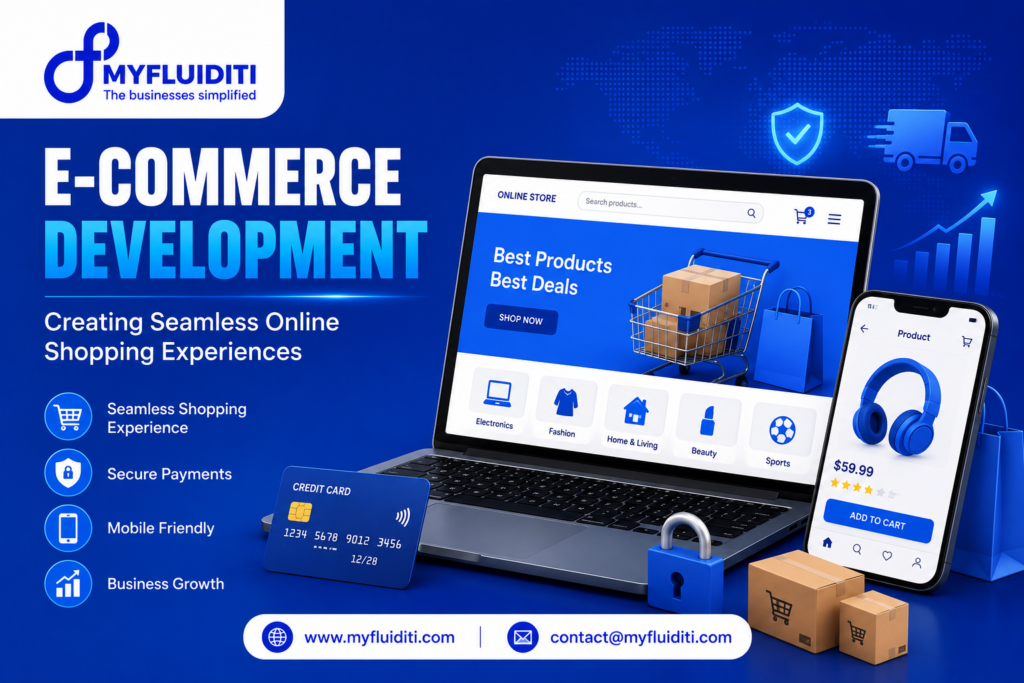
Introduction The rapid growth of digital commerce has transformed the way businesses connect with customers and sell products online. Consumers today expect fast, secure, and personalized shopping experiences that are accessible from any device, at any time. Businesses that invest in E-Commerce Development gain a competitive advantage by delivering intuitive online stores, streamlined purchasing journeys, and exceptional customer experiences. As online shopping continues to evolve, organizations must adopt scalable and technology-driven e-commerce solutions that enhance user satisfaction while driving business growth. At MyFluiditi, we help businesses build modern e-commerce platforms that combine innovation, performance, and security to create seamless online shopping experiences that maximize customer engagement and revenue. Understanding E-Commerce Development E-Commerce Development involves designing, developing, and optimizing digital platforms that enable businesses to sell products and services online efficiently. It includes responsive website development, secure payment gateway integration, inventory management, order processing, customer account management, mobile optimization, cloud infrastructure, and performance analytics. A well-developed e-commerce platform not only improves operational efficiency but also creates an engaging shopping experience that encourages customer loyalty and repeat purchases. MyFluiditi delivers customized e-commerce development solutions tailored to the unique goals of each business, ensuring scalability, flexibility, and long-term digital success. Why E-Commerce Development Matters Consumer buying behavior has shifted significantly toward digital channels, making online shopping an essential part of modern business strategies. Customers expect websites that load quickly, provide easy navigation, offer secure transactions, and deliver personalized recommendations. Businesses that fail to meet these expectations risk losing customers to competitors with superior digital experiences. Investing in custom e-commerce solutions enables organizations to improve customer satisfaction, expand market reach, increase online sales, and strengthen brand reputation. MyFluiditi works closely with businesses to develop future-ready e-commerce platforms that deliver exceptional shopping experiences while supporting sustainable business growth. Creating Seamless User Experiences A successful online store begins with a seamless user experience. Every stage of the customer journey from browsing products to completing checkout should be simple, intuitive, and engaging. Responsive layouts, fast page loading, optimized search functionality, clear product categorization, and user-friendly navigation significantly improve customer satisfaction. Businesses that prioritize user experience often achieve higher conversion rates and lower cart abandonment. MyFluiditi designs customer-centric e-commerce websites that focus on usability, accessibility, and performance, enabling businesses to deliver frictionless shopping experiences across desktop, tablet, and mobile devices. Mobile Commerce and Responsive Design With the growing number of consumers shopping through smartphones and tablets, mobile commerce has become a major driver of online retail success. Responsive e-commerce websites automatically adapt to different screen sizes, ensuring consistent functionality and an optimized browsing experience across all devices. Mobile-friendly checkout processes, simplified navigation, and fast-loading pages improve customer engagement while increasing conversion opportunities. MyFluiditi develops responsive e-commerce platforms that provide smooth shopping experiences regardless of the device customers choose, helping businesses capture the expanding mobile commerce market. Secure Payment Integration and Customer Trust Security remains one of the most important factors influencing online purchasing decisions. Customers expect secure payment gateways, encrypted transactions, fraud protection, and compliance with global security standards when shopping online. Reliable payment integration builds customer confidence while reducing transaction risks and improving overall business credibility. Businesses that prioritize online security create stronger customer relationships and encourage repeat purchases. At MyFluiditi, we implement secure payment gateway integrations and industry-standard security practices that protect sensitive customer information while ensuring safe and reliable online transactions. Personalization Through Artificial Intelligence Modern Artificial Intelligence technologies are transforming the e-commerce industry by delivering personalized shopping experiences tailored to individual customer preferences. AI-powered recommendation engines, intelligent search capabilities, personalized promotions, predictive analytics, and automated customer support improve user engagement while increasing average order value. Businesses that leverage AI can better understand customer behavior and provide relevant product recommendations that drive higher conversions. MyFluiditi integrates AI-powered features into e-commerce platforms, enabling businesses to deliver highly personalized experiences that strengthen customer loyalty and improve sales performance. Optimizing E-Commerce Performance Website speed and performance directly influence customer satisfaction and search engine rankings. Slow-loading websites often experience increased bounce rates and abandoned shopping carts, negatively affecting revenue. Performance optimization includes image compression, cloud hosting, content delivery networks, caching strategies, database optimization, and efficient coding practices. Businesses that maintain high-performing websites enjoy better user engagement and stronger search visibility. MyFluiditi develops optimized e-commerce solutions that deliver exceptional speed, reliability, and scalability while ensuring consistent performance during peak shopping periods. SEO for E-Commerce Success Building an online store is only the first step toward digital success. Businesses must also ensure their websites are discoverable through Search Engine Optimization (SEO). Optimized product pages, keyword-rich content, structured URLs, metadata optimization, schema markup, mobile responsiveness, and fast-loading websites contribute to improved search engine rankings and increased organic traffic. Higher visibility leads to greater customer acquisition and long-term business growth. MyFluiditi incorporates SEO best practices throughout the e-commerce development process, helping businesses improve online visibility while attracting qualified customers actively searching for their products and services. Integrating Digital Marketing with E-Commerce An effective e-commerce platform works best when integrated with a comprehensive Digital Marketing strategy. Social media marketing, content marketing, email campaigns, paid advertising, influencer partnerships, and search engine marketing drive traffic to online stores while increasing customer engagement. Data-driven marketing strategies enable businesses to target the right audience with personalized campaigns that improve conversion rates. MyFluiditi supports businesses by integrating digital marketing solutions with e-commerce platforms, creating connected customer journeys that maximize brand awareness, lead generation, and online sales. Supporting Business Growth Through Scalable Solutions As businesses grow, their e-commerce platforms must evolve to support increasing traffic, expanding product catalogs, multiple payment options, and international customers. Scalable architecture, cloud infrastructure, API integrations, inventory synchronization, and enterprise resource planning connectivity enable businesses to adapt quickly to changing market demands. MyFluiditi develops scalable e-commerce solutions that support long-term business expansion while maintaining operational efficiency and exceptional customer experiences across every stage of growth. Why Businesses Choose MyFluiditi Developing a successful e-commerce platform requires technical expertise, strategic planning, creative design, and continuous optimization. MyFluiditi provides end-to-end e-commerce development services including custom website development, UI/UX
Talent as a Service: Building Agile Teams for Business Growth
Introduction In today’s fast-paced digital economy, businesses must adapt quickly to changing market demands, emerging technologies, and evolving customer expectations. One of the biggest challenges organizations face is finding and retaining skilled professionals who can drive innovation and support business growth. Traditional hiring processes often involve lengthy recruitment cycles, high operational costs, and limited access to specialized talent. This is where Talent as a Service (TaaS) has emerged as a transformative workforce model. By providing businesses with on-demand access to highly skilled professionals, Talent as a Service enables organizations to build agile teams, accelerate project delivery, and scale operations efficiently. Companies that adopt this flexible talent strategy gain the ability to respond rapidly to business opportunities while optimizing costs and maintaining productivity. At MyFluiditi, we help businesses build high-performing agile teams through Talent as a Service solutions that connect organizations with experienced technology professionals who deliver measurable business value. Understanding Talent as a Service Talent as a Service (TaaS) is a modern workforce solution that provides businesses with flexible access to skilled professionals based on project requirements, business goals, and technology needs. Instead of relying solely on permanent hiring, organizations can engage specialized experts in software development, cloud engineering, Artificial Intelligence, cybersecurity, DevOps, business analytics, UI/UX design, quality assurance, and digital transformation. This approach enables companies to rapidly strengthen their workforce without the long-term commitments associated with traditional recruitment. MyFluiditi offers customized Talent as a Service solutions that align skilled professionals with business objectives, ensuring organizations have the expertise needed to execute projects successfully and drive continuous innovation. Why Talent as a Service Is Transforming Modern Businesses Business environments continue to evolve at an unprecedented pace, requiring organizations to remain flexible and adaptable. Hiring permanent employees for every specialized requirement is no longer practical for many businesses, especially when technology demands change rapidly. Talent as a Service provides organizations with immediate access to experienced professionals who can contribute from day one. Businesses benefit from faster hiring, improved project execution, reduced operational costs, and greater workforce flexibility. MyFluiditi helps organizations overcome talent shortages by delivering dedicated professionals who seamlessly integrate into existing teams while supporting strategic business initiatives. Building Agile Teams for Faster Innovation Agility has become one of the most valuable competitive advantages in today’s business landscape. Agile teams collaborate effectively, respond quickly to changing priorities, and deliver solutions through continuous improvement and iterative development. Talent as a Service enables organizations to assemble multidisciplinary teams with expertise across multiple technologies and business domains. Whether launching a new digital platform, implementing cloud infrastructure, developing enterprise software, or deploying AI-powered applications, businesses can quickly build the right team for the project. MyFluiditi provides experienced professionals who embrace agile methodologies, enabling organizations to accelerate innovation while maintaining quality, collaboration, and delivery excellence. Access to Global Technology Talent One of the greatest strengths of Talent as a Service is the ability to connect businesses with highly qualified professionals from around the world. Organizations gain access to specialists in software engineering, mobile application development, cloud computing, machine learning, cybersecurity, data analytics, API integration, automation, and enterprise architecture without geographical limitations. This global talent pool enables businesses to leverage the latest technologies and best practices while remaining competitive in rapidly evolving markets. MyFluiditi builds dedicated teams with the technical expertise and industry knowledge required to solve complex business challenges while supporting long-term digital transformation. Accelerating Digital Transformation Digital transformation requires organizations to implement advanced technologies while maintaining business continuity and operational efficiency. Talent as a Service enables businesses to access professionals with expertise in Artificial Intelligence, cloud computing, automation, business intelligence, and enterprise software development, accelerating the successful execution of digital initiatives. Organizations can modernize legacy systems, improve customer experiences, automate workflows, and develop scalable digital platforms without delays caused by recruitment challenges. MyFluiditi supports digital transformation by providing skilled technology experts who help businesses innovate faster while ensuring projects remain aligned with organizational goals. Cost Optimization and Workforce Flexibility Traditional recruitment involves significant investments in hiring, onboarding, training, employee benefits, and infrastructure. Talent as a Service reduces these costs by allowing organizations to engage professionals based on project duration and business requirements. Companies can scale teams up or down according to workload while maintaining full control over project execution and resource allocation. This flexible workforce model improves operational efficiency while maximizing return on investment. At MyFluiditi, we deliver cost-effective talent solutions that enable businesses to optimize workforce planning without compromising productivity, quality, or technical expertise. Driving Productivity Through Specialized Expertise Complex business projects require specialized knowledge that may not always be available within internal teams. Talent as a Service provides immediate access to professionals with extensive experience across diverse technologies and industries. Businesses benefit from faster problem-solving, improved project quality, reduced development risks, and enhanced collaboration. Skilled professionals contribute fresh perspectives, technical excellence, and industry best practices that accelerate business success. MyFluiditi carefully matches organizations with experts who possess the right skills, experience, and cultural fit to maximize project performance and deliver exceptional business outcomes. Supporting Business Scalability As organizations expand into new markets, launch innovative products, or adopt emerging technologies, workforce requirements change rapidly. Talent as a Service provides the flexibility needed to support business growth without long-term staffing constraints. Companies can quickly expand development teams, strengthen IT operations, improve customer support, or accelerate product development while maintaining operational efficiency. MyFluiditi enables businesses to scale confidently by providing reliable access to experienced professionals who support evolving business priorities and long-term strategic growth. Talent as a Service Across Industries Organizations across healthcare, finance, retail, manufacturing, logistics, education, telecommunications, and professional services are leveraging Talent as a Service to strengthen workforce capabilities and accelerate innovation. Whether developing enterprise applications, implementing cloud platforms, improving cybersecurity, managing AI initiatives, or supporting business analytics projects, businesses benefit from flexible access to specialized expertise. MyFluiditi partners with organizations across industries to deliver customized talent solutions that address unique business challenges while driving operational excellence and digital transformation. Why Businesses Choose MyFluiditi Building successful agile teams requires more than simply