Interview with CEO Charen Teja – Building MyFluiditi with Systems, Not Just Services (Part 1)
Introduction In today’s competitive technology landscape, the difference between companies that scale and those that stagnate often comes down to one factor: how well they execute systems, not just services. MyFluiditi has positioned itself uniquely by focusing on structured problem-solving rather than fragmented delivery. In this exclusive conversation, Charen Teja, CEO of MyFluiditi, shares insights into the company’s foundation, approach, and long-term vision. 1. What was the core idea behind starting MyFluiditi? Charen Teja:When I started MyFluiditi, the intention was very clear: businesses don’t fail because of lack of tools, they fail because systems don’t connect. Most companies invest heavily in technology, but everything operates in silos, creating inefficiencies at every stage. We wanted to change that. At MyFluiditi, the focus is on building connected systems where operations flow seamlessly, instead of breaking between departments or tools. The idea was never to become another service provider, but to become a problem-solving partner that simplifies complexity. That is why even though the name reflects our philosophy things should flow, not get stuck. 2. How do you position MyFluiditi in today’s competitive tech landscape? Charen Teja: In today’s market, many companies define themselves by services development, AI, marketing but clients are not looking for services, they are looking for results and measurable outcomes. At MyFluiditi, we position ourselves differently. We start with the business problem, not the solution. This allows us to understand what is actually limiting growth or efficiency, and then apply the right combination of technology and strategy. Our strength lies in thinking beyond tools and focusing on systems, which is why we are seen not just as a vendor, but as a long-term execution partner. 3. Many companies struggle with execution. How does MyFluiditi ensure consistency in delivery? Charen Teja: Execution problems usually come from lack of clarity and poorly defined workflows, not from lack of talent. At MyFluiditi, we address this at the foundation level. Every project is structured with clear stages, defined ownership, and measurable outcomes. There is no ambiguity about who is responsible for what. We also avoid unnecessary complexity; simple, well-designed systems outperform complicated ones in the long run. By ensuring that teams operate within a clear and structured framework, we maintain consistency without relying on constant supervision. 4. What role does AI play in MyFluiditi’s approach? Charen Teja:AI is powerful, but it is often misused as a trend rather than a solution. At MyFluiditi, we use AI with a clear purpose to improve efficiency, reduce manual effort, and enhance decision-making. We don’t treat AI as a separate layer; instead, we integrate it into workflows where it adds real value. Whether it is automation, analytics, or advanced testing approaches like agentic automation, everything is aligned with the system. Our approach is simple: AI should simplify operations, not complicate them. 5. What makes MyFluiditi different from other technology companies? Charen Teja: The biggest difference is how we think about problems. Most companies solve what is visible, but the real issues are usually hidden within the system. At MyFluiditi, we go deeper to identify root causes rather than surface-level symptoms. For example, if a business is struggling with growth, the issue may not be marketing it could be positioning, messaging, or internal inefficiencies. We focus on redesigning how systems work, not just delivering outputs. This is why our solutions create long-term impact instead of short-term fixes. 6. How do you build a strong team culture in MyFluiditi? Charen Teja: Culture is not something you define in documents, it is something you build through consistent systems and daily execution. At MyFluiditi, we focus on clarity, ownership, and continuous growth. Every team member understands their role and the impact of their work, which removes confusion and increases accountability. We also ensure that people have real ownership, not just responsibilities, which naturally drives performance. Growth is embedded into the work itself, so every project becomes an opportunity to improve. The result is an environment where people can perform without unnecessary pressure. 7. What is your long-term vision for MyFluiditi? Charen Teja: The long-term vision is to build MyFluiditi into a company that is known for solving complex problems in the simplest way possible. We are moving towards a future in which systems, AI, and human intelligence work together seamlessly to create efficient, scalable business operations. Our goal is not just to deliver services, but to build reliable systems that businesses can depend on for growth. Step by step, we are focusing on strengthening the foundation so that MyFluiditi becomes a trusted partner for companies looking to scale sustainably. Conclusion This conversation with Charen Teja highlights a clear shift in mindset from service delivery to system-driven execution. MyFluiditi’s approach, rooted in clarity, structured workflows, and deep problem-solving, positions it as more than just a technology company. It represents a model where efficiency, scalability, and simplicity coexist, enabling businesses to operate with confidence in an increasingly complex environment. In Part 2, we will explore deeper insights into scaling strategies, client success, and the evolving role of MyFluiditi in the AI-driven ecosystem.
MyFluiditi Partners with LG USA: A Strategic Collaboration Driving Digital Transformation and Innovation
Introduction In today’s rapidly evolving technology landscape, strategic partnerships are no longer optional; they are essential for scaling innovation and delivering real business outcomes. Organizations that succeed are those that combine deep technical expertise with global collaboration. Marking a significant milestone, MyFluiditi has officially partnered with LG (Life’s Good) USA, a global leader in technology and innovation. This collaboration represents a strong step forward in advancing digital transformation, AI-driven engineering, and enterprise technology solutions. A Strategic Collaboration with LG USA The partnership between MyFluiditi and LG USA is built on a shared vision of leveraging technology to create scalable, efficient, and future-ready systems. LG, known globally for its leadership in electronics, smart solutions, and enterprise innovation, brings a legacy of excellence. MyFluiditi complements this with its system-first approach to solving complex business challenges through technology, AI, and structured execution. This collaboration is not just about working together; it is about building integrated solutions that drive measurable impact across industries. Why This Partnership Matters in Today’s Market The global demand for digital transformation services is accelerating. Businesses are moving towards automation, AI integration, and scalable infrastructure to remain competitive. However, many organizations struggle with fragmented implementations. Tools exist, but systems don’t connect. This is where the MyFluiditi–LG collaboration becomes critical. By combining LG’s global scale and innovation capabilities with MyFluiditi’s expertise in building connected, system-driven solutions, the partnership aims to address one of the biggest gaps in the industry execution at scale. Driving AI-Driven Engineering and Innovation Artificial Intelligence is transforming how businesses operate, but its real value lies in practical implementation. Through this collaboration, MyFluiditi and LG will focus on: At MyFluiditi, AI is not treated as a trend; it is integrated into a larger system designed to improve efficiency and reduce operational friction. With LG’s technological ecosystem, this approach gains global scale and real-world application. Strengthening Enterprise Technology Solutions Modern enterprises require more than just software; they need end-to-end technology ecosystems that are secure, scalable, and adaptable. This partnership will enable: MyFluiditi’s ability to design structured workflows and connected systems ensures that these solutions are not just implemented, but also optimized for performance and scalability. Expanding Global Presence and Market Reach For MyFluiditi, this collaboration represents a strong expansion into the US market and global enterprise ecosystem. Working with LG USA opens opportunities to: This positions MyFluiditi as a trusted technology partner for organizations looking to scale internationally. A Milestone in MyFluiditi’s Growth Journey This collaboration marks more than just a partnership it represents a validation of MyFluiditi’s system-driven approach. From its foundation, MyFluiditi has focused on: Partnering with a global brand like LG reinforces this vision and demonstrates the real-world impact of this approach. What This Means for Clients and Businesses For clients and businesses, this partnership translates into: Organizations can now leverage the combined strengths of MyFluiditi and LG to accelerate growth and improve operational efficiency. Conclusion The collaboration between MyFluiditi and LG USA marks a significant step in shaping the future of digital transformation and AI-driven innovation. It reflects a broader shift in the industry from isolated service delivery to integrated, system-based execution. As businesses continue to navigate complexity, partnerships like this will play a crucial role in enabling scalable growth, operational efficiency, and long-term success. MyFluiditi’s journey is evolving, and this milestone is just the beginning of what lies ahead.
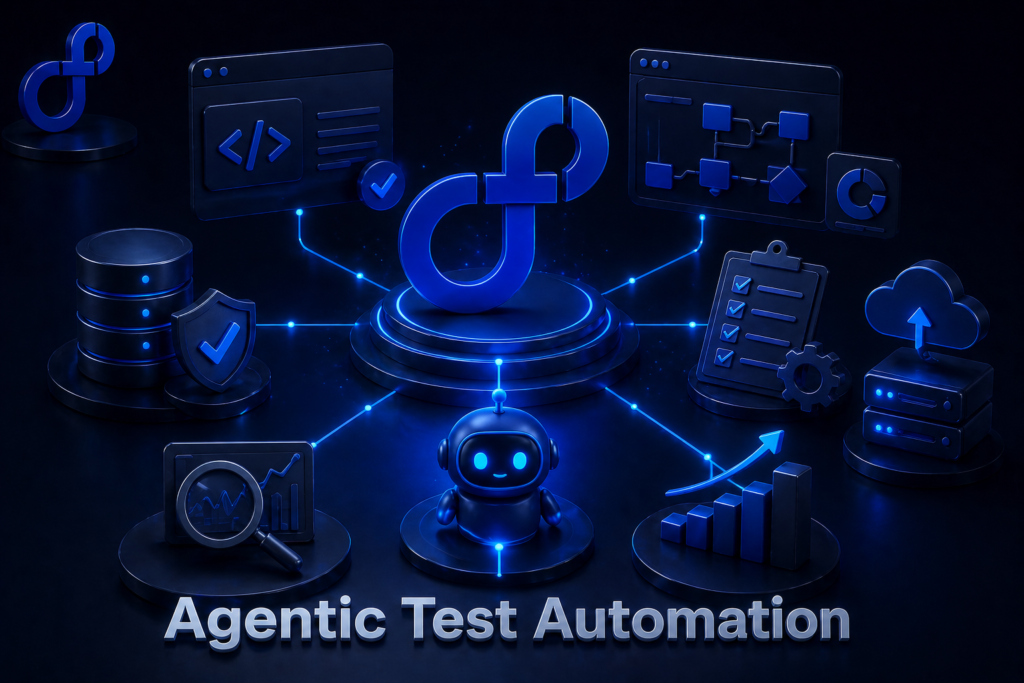
Agentic Test Automation – How MyFluiditi Is Redefining Testing in the AI Era
Introduction Software delivery has fundamentally changed. Development cycles are no longer measured in months they are compressed into days or even hours. With AI-assisted development accelerating code generation, the pressure on testing teams has increased significantly. Quality assurance is now caught between two competing demands: speed and reliability. Traditional testing approaches struggle to keep pace with this shift, often forcing teams into a trade-off between releasing faster and maintaining quality. Agentic test automation introduces a different paradigm. Instead of relying on manual scripting or static automation frameworks, it enables systems where intelligent agents actively generate, execute, and optimize tests. At MyFluiditi, this shift is not treated as an incremental improvement. It is approached as a fundamental redesign of how testing systems operate in modern software environments. A New Way of Testing Traditional testing workflows are inherently linear. Test cases are written, executed, and maintained manually or through semi-automated frameworks. This process becomes a bottleneck as systems scale. Modern development environments demand parallelism, adaptability, and speed. This is where agentic testing changes the model. Agentic test automation allows teams to generate complete, executable test cases using natural language inputs. Instead of writing scripts step by step, teams define intent what needs to be tested and the system handles execution. This approach significantly reduces manual effort while increasing output. Industry implementations have shown reductions in manual effort by up to 85% and substantial gains in productivity, enabling teams to align with AI-driven development speeds. At MyFluiditi, we extend this model by integrating domain-specific intelligence. Our systems are not just generating tests they understand workflows, business logic, and system dependencies. The Problem with Traditional Testing at Scale As organizations scale, testing complexity increases exponentially. Multiple applications, integrations, and environments create a fragmented testing landscape. QA teams often spend more time maintaining tests than creating new ones. Test scripts break frequently due to UI changes, data inconsistencies, or system updates. Maintenance becomes a continuous burden. At the same time, development teams are accelerating with AI-generated code. This creates a mismatch testing cannot keep up with development velocity. Traditional approaches, based on scripting and manual validation, are no longer sustainable. They introduce delays, increase risk, and reduce overall efficiency. At MyFluiditi, we identify this as a system design issue rather than a tooling problem. The goal is not to optimize testing steps, but to redesign testing as an intelligent, adaptive system. What Is Agentic Test Automation Agentic test automation introduces autonomous AI agents into the testing lifecycle. These agents are capable of understanding requirements, generating test cases, executing them, and continuously improving based on outcomes. Instead of static scripts, testing becomes a dynamic process. AI agents can analyze context, adapt to changes, and make decisions in real time. They operate as digital collaborators, handling repetitive and operational tasks while human teams focus on strategy and critical decision-making. This approach transforms testing from a reactive activity into a proactive system. At MyFluiditi, agentic testing is implemented as part of a broader intelligent workflow. Agents are orchestrated across the lifecycle from requirement analysis to test execution ensuring consistency and scalability. End-to-End Agentic Testing One of the major limitations of traditional automation is fragmented coverage. Different tools are used for different layers UI, API, database creating silos. Agentic testing eliminates this fragmentation by enabling end-to-end test generation and execution across systems. Modern implementations support enterprise technologies such as SAP, web applications, and complex integrations, allowing comprehensive coverage across the application landscape. At MyFluiditi, end-to-end testing is treated as a core capability. Our agentic systems map complete user journeys and business processes, ensuring that tests reflect real-world scenarios rather than isolated functions. This improves both coverage and reliability. Intelligent Reuse and Reduced Maintenance One of the biggest challenges in automation is test maintenance. As systems evolve, test scripts require constant updates, leading to inefficiencies. Agentic systems address this through intelligent reuse. Instead of recreating test components, agents analyze existing assets and adapt them for new scenarios. This reduces duplication and ensures consistency across test suites. At MyFluiditi, we enhance this capability by designing modular test architectures. Agents are trained to recognize reusable patterns, enabling faster test generation and significantly reducing maintenance overhead. The result is a system that scales without becoming brittle. Integration with AI-Driven Workflows Testing cannot operate in isolation. It must integrate seamlessly with the broader software delivery lifecycle. Modern agentic platforms are designed to work within centralized AI environments, where multiple agents collaborate across development, testing, and deployment workflows. This integration enables continuous testing where validation happens alongside development rather than after it. At MyFluiditi, we build testing systems that are deeply integrated with CI/CD pipelines and AI workflows. Testing is triggered automatically, adapts to changes in real time, and provides immediate feedback. This ensures that quality is maintained without slowing down delivery. Built for the Era of AI Agents Software systems are becoming increasingly complex, and traditional testing approaches are not equipped to handle this complexity. Agentic testing aligns with the broader shift toward AI-driven systems. It introduces a model where multiple agents collaborate to handle different aspects of testing generation, execution, analysis, and optimization. Research and real-world implementations show that multi-agent testing systems can significantly improve coverage, reduce invalid tests, and minimize manual effort. At MyFluiditi, we adopt a multi-agent architecture where each agent is specialized. Some focus on generating test cases, others on execution, and others on analyzing results. This creates a self-improving system where testing becomes more efficient over time. From Testers to Strategic Quality Engineers Agentic automation does not replace testers it changes their role. Instead of writing scripts and managing test cases, teams focus on defining quality strategies, identifying risks, and validating outcomes. AI agents handle the operational workload, allowing human expertise to be applied where it matters most. This shift increases both efficiency and effectiveness. At MyFluiditi, we actively design workflows that elevate the role of QA teams. By removing repetitive tasks, we enable teams to focus on high-impact areas such as system reliability, user experience, and risk
Why MyFluiditi Is a Great Place to Work – And Why People Choose to Stay

Introduction Workplaces are often evaluated through surface-level metrics, such as salary, perks, and flexibility. While these factors matter, they rarely determine long-term satisfaction. What truly defines a great workplace is how consistently it enables people to do meaningful work, grow in capability, and operate without unnecessary friction. Many organizations struggle with this alignment. Teams operate in silos, decision-making lacks clarity, and employees spend more time navigating internal complexity than solving real problems. At MyFluiditi, the approach is different. The focus is not on creating an environment that looks appealing from the outside, but on building systems that function effectively from within. This distinction is what shapes the employee experience and why people tend to stay. Clarity Over Chaos One of the most common sources of frustration in organizations is ambiguity. Unclear expectations, shifting priorities, and inconsistent direction create inefficiencies that compound over time. At MyFluiditi, clarity is treated as an operational requirement. Roles are well-defined, expectations are explicit, and objectives are aligned with business outcomes. This reduces cognitive overhead. Employees are not forced to interpret vague instructions or constantly recalibrate priorities. Instead, they can focus on execution and problem-solving. The result is a work environment where progress is measurable and direction is stable. Ownership Without Micromanagement Autonomy is often misunderstood. Many companies claim to offer ownership but retain control through excessive oversight. At MyFluiditi, ownership is structured, not superficial. Teams are given responsibility along with the context required to make decisions. This includes access to information, clear goals, and defined constraints. Managers operate as enablers rather than controllers. The emphasis is on outcomes, not activity tracking. This creates a balance where employees have the freedom to execute, while accountability remains intact. Work That Has Real Impact A recurring issue in many workplaces is the disconnect between effort and impact. Employees complete tasks without understanding how their work contributes to broader objectives. MyFluiditi addresses this by aligning individual contributions with system-level outcomes. Whether it is product development, design, or marketing, the connection between work and business value is explicit. This clarity changes how work is perceived. Tasks are not isolated deliverables; they are part of a larger system that drives measurable results. Employees experience a stronger sense of purpose because their work has a visible impact. Continuous Learning as a System Learning is often positioned as an optional benefit rather than a core function of the organization. At MyFluiditi, learning is embedded into the workflow. Projects are structured to expose teams to new challenges, technologies, and problem spaces. There is a strong emphasis on practical learning, understanding systems, solving real-world constraints, and improving decision-making capabilities. Instead of isolated training sessions, growth happens through execution. This approach ensures that learning is both relevant and immediately applicable. A Culture That Prioritizes Problem-Solving Many organizations fall into the pattern of prioritizing process over outcomes. Teams follow predefined steps without questioning whether those steps are effective. MyFluiditi operates with a problem-solving mindset. The focus is on identifying root causes and designing solutions that scale. This culture encourages analytical thinking. Employees are expected to question assumptions, propose alternatives, and improve existing systems. It is not about following instructions, it is about improving how work gets done. Minimal Bureaucracy, Maximum Efficiency As organizations grow, complexity often increases. Layers of approval, redundant processes, and communication gaps slow down execution. At MyFluiditi, unnecessary bureaucracy is actively avoided. Processes exist to support efficiency, not to create friction. Decision-making is streamlined. Communication is direct. Teams are structured to reduce dependencies and enable faster execution. This operational efficiency is a significant factor in employee satisfaction. Less friction means more time spent on meaningful work. Strong Alignment Between Teams Misalignment between teams is a common issue in growing companies. Different departments operate with conflicting priorities, leading to delays and rework. MyFluiditi addresses this through structured alignment. Teams operate within a shared framework, with clearly defined interfaces and responsibilities. This reduces conflicts and improves collaboration. Work flows more predictably, and dependencies are managed effectively. Employees benefit from a more cohesive work environment where coordination is straightforward. Leadership That Understands Systems Leadership plays a critical role in shaping workplace experience. In many organizations, decisions are made without a clear understanding of how systems interact. At MyFluiditi, leadership is closely involved in system design, how teams operate, how workflows are structured, and how decisions are made. This ensures that organizational design supports execution rather than hindering it. Employees experience fewer bottlenecks and more consistent direction because leadership decisions are grounded in operational reality. Recognition Based on Contribution Recognition systems often focus on visibility rather than actual contribution. This creates imbalance and reduces motivation. At MyFluiditi, recognition is tied to impact. Contributions that improve systems, solve complex problems, or drive measurable results are acknowledged. This creates a merit-based environment where effort and outcomes are aligned. Employees are incentivized to focus on meaningful work rather than performative activity. Stability With Growth Rapid growth can create instability if not managed correctly. Processes break down, priorities shift, and teams struggle to adapt. MyFluiditi approaches growth with structure. Systems are designed to scale, and changes are introduced in a controlled manner. This provides stability while still enabling expansion. Employees can grow within the organization without experiencing constant disruption. Why Employees Choose to Stay Employee retention is often a reflection of deeper organizational health. At MyFluiditi, people stay because the environment supports effective work. There is clarity in direction, ownership in execution, and consistency in how systems operate. The absence of unnecessary friction allows employees to focus on what matters solving problems, building systems, and delivering results. This creates a workplace that is not only productive but also sustainable. Conclusion A great workplace is not defined by isolated benefits or short-term incentives. It is defined by how well the organization functions as a system. MyFluiditi’s approach is grounded in this principle. By prioritizing clarity, ownership, efficiency, and continuous improvement, it creates an environment where employees can perform at their best. The result is a workplace where people do not just work
UX Mistakes in Regulated Software – And How MyFluiditi Solves Them
Introduction Designing software for regulated industries is not a conventional UX challenge. It operates under constraints that fundamentally reshape how products are built, used, and evolved. In environments such as healthcare, fintech, or compliance-heavy enterprise systems, every interaction carries implications beyond usability, impacting auditability, governance, and legal accountability. Many teams approach UX in these domains as a secondary layer, something to refine after compliance requirements are met. This assumption creates structural problems. As seen across regulated product design, treating regulation as an afterthought leads to brittle systems that are difficult to scale and maintain. At MyFluiditi, UX is not layered on top of compliance it is engineered alongside it. The difference is critical. Instead of designing interfaces that merely “work,” the focus shifts toward building systems that guide users toward correct, compliant behavior by design. This article examines the most common UX mistakes in regulated software and how a system-first, regulation-aware approach resolves them. Regulation Changes the Shape of UX One of the most fundamental mistakes teams make is assuming that UX principles remain unchanged across industries. In reality, regulation alters the nature of interaction design itself. Regulated software must support audit trails, enforce strict role-based actions, and preserve data lineage. These are not backend concerns alone; they directly influence how users interact with the system. When UX is designed without these constraints in mind, the result is often a mismatch between user flows and compliance requirements. Teams then attempt to retrofit controls, creating friction-heavy experiences. At MyFluiditi, UX architecture begins with regulatory constraints as primary inputs. Instead of adapting later, workflows are designed so that compliance becomes a natural outcome of user interaction. This reduces cognitive load while maintaining strict governance. The Failure of Compliance-First UX Another common mistake is overcorrecting in the opposite direction, designing purely for compliance. Compliance-first UX typically introduces excessive approvals, fragmented workflows, and rigid interfaces. While it satisfies regulatory checklists, it often degrades usability and slows down operations. This approach creates systems where users must constantly work around the interface rather than with it. Complexity shifts to the user, increasing the risk of errors. Effective UX in regulated systems does not prioritize compliance over usability. Instead, it integrates both. Research consistently shows that poor UX leads to inefficiencies and user frustration, even when systems technically meet requirements. MyFluiditi addresses this by embedding compliance into interaction logic. Rather than adding layers of control, we design flows where the correct action is the easiest action. This reduces friction while maintaining regulatory integrity. Lack of Decision Traceability In regulated environments, understanding what happened is not enough. Systems must also explain why it happened. A common UX failure is the absence of decision traceability. Users complete actions, but the system does not clearly record intent, context, or reasoning. This becomes a major issue during audits or investigations. Without clear traceability, organizations struggle to justify decisions. At MyFluiditi, traceability is treated as a UX problem, not just a data problem. Interfaces are designed to capture intent at the moment of action. Contextual metadata, decision logs, and structured workflows ensure that every action is explainable. This approach transforms audit readiness from a reactive process into a built-in capability. Poor Role and Permission Design Another recurring issue is overly flexible or poorly defined permission systems. In early-stage products, teams often prioritize speed and convenience, allowing broad access across users. While this simplifies development, it introduces risk as the system scales. Regulated software requires precise alignment between roles and responsibilities. Ambiguity in permissions leads to compliance violations and operational confusion. At MyFluiditi, role-based UX is tightly mapped to real-world responsibilities. Interfaces adapt based on user roles, exposing only relevant actions and data. This reduces error probability and reinforces accountability. The result is not just a safer system, but a clearer and more intuitive user experience. Ignoring Data Integrity and Context Data in regulated systems is not static it carries history, transformation, and intent. A common UX mistake is treating data as isolated values without context. Users see information, but lack visibility into where it came from or how it has changed. This undermines trust and creates operational risk. MyFluiditi solves this by designing for data lineage visibility. Interfaces provide contextual layers that show origin, transformations, and dependencies. Users can make informed decisions without leaving their workflow. This approach aligns UX with the fundamental requirement of regulated systems: preserving data integrity. UX That Allows Incorrect Behavior In many systems, incorrect actions are technically possible but discouraged through guidelines or training. This is a critical flaw. Regulated software should not rely on user discipline alone. The system itself must enforce correct behavior. Poor UX design often exposes too many options, unclear pathways, or ambiguous actions. This increases the likelihood of mistakes. At MyFluiditi, constraint-driven UX is applied. Interfaces are intentionally designed to limit invalid actions. Instead of relying on warnings, the system prevents incorrect paths altogether. This reduces error rates and improves overall system reliability. Weak Product Governance UX failures in regulated software are often symptoms of deeper governance issues. Without clear ownership, decision-making becomes fragmented. Teams introduce exceptions, workflows diverge, and inconsistencies accumulate over time. This leads to systems that are difficult to manage and even harder to scale. Strong governance ensures continuity across design, development, and compliance. It aligns teams around consistent principles and prevents drift. MyFluiditi integrates governance into the product lifecycle. From design systems to workflow definitions, every component is structured to maintain consistency across iterations. This allows organizations to evolve without losing control. Systems That Cannot Evolve A widespread misconception is that regulated software must sacrifice flexibility for safety. In practice, the opposite is true. Regulations change. Business models evolve. User expectations shift. Systems that are not designed for adaptability quickly become obsolete. Rigid UX architectures make it difficult to introduce updates without breaking compliance or usability. MyFluiditi addresses this through modular design and scalable architecture. Workflows are versioned, changes are controlled, and systems are built to evolve under constraint. This ensures long-term viability without compromising regulatory alignment.