Full Stack Development: Building Scalable, Secure, and High-Performance Web Applications
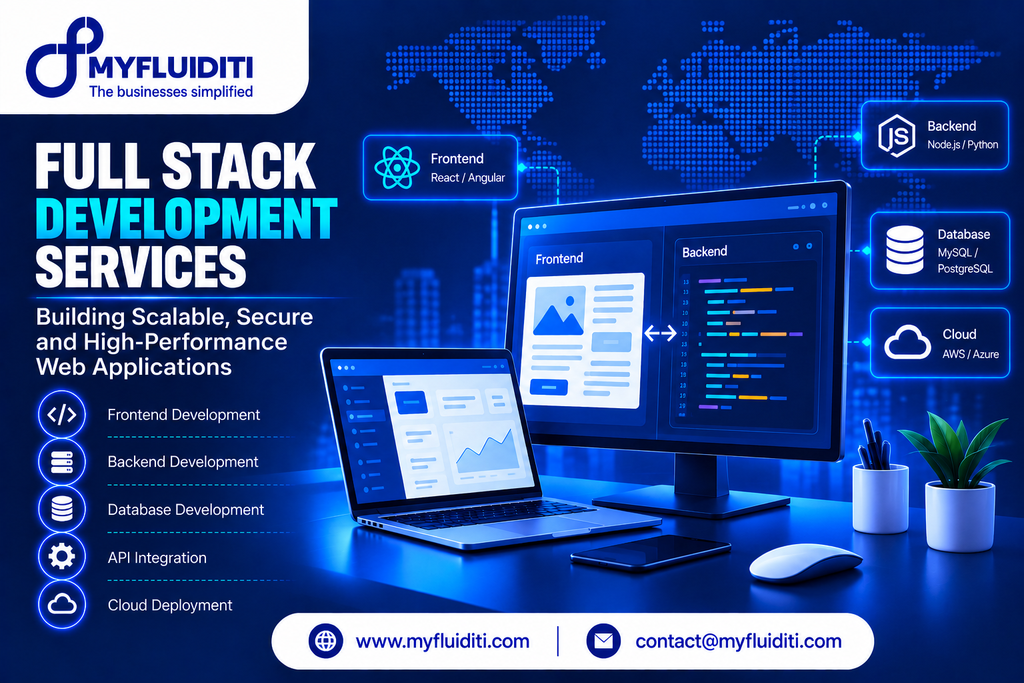
Introduction to Full Stack Development Modern businesses need digital applications that are more than visually attractive websites. They need powerful frontend interfaces, reliable backend systems, secure APIs, optimized databases, cloud infrastructure, and scalable architectures that can support growing users and business operations. Full Stack Development brings these essential layers together to create complete web applications and digital products that work as one connected technology ecosystem. From startup MVPs and SaaS platforms to enterprise applications, eCommerce platforms, customer portals, dashboards, marketplaces, and AI-powered solutions, full stack development provides an end-to-end approach to building modern digital products. A full stack development team can work across the frontend, backend, databases, APIs, integrations, security, deployment, and application infrastructure, helping businesses reduce technical gaps between different development layers. What Is Full Stack Development? Full stack development refers to the development of both the frontend and backend components of a web application, along with the databases, APIs, integrations, and supporting infrastructure required to run the application. The frontend is responsible for the interface users interact with, while the backend manages business logic, authentication, APIs, data processing, and communication with databases and external systems. Full stack web development connects these layers into a unified application architecture. Modern full stack solutions commonly include frontend frameworks such as React or Angular, backend technologies such as Node.js or Python, relational or NoSQL databases, REST or GraphQL APIs, cloud infrastructure, authentication, testing, and deployment. Why Businesses Need Full Stack Development Businesses increasingly depend on web applications to manage customers, employees, products, transactions, operations, data, and digital services. When frontend, backend, database, and infrastructure development are handled as disconnected components, integration problems and communication gaps can increase development complexity. Full stack development services provide a more connected development approach by allowing the technology team to understand the complete application architecture. This can help businesses create consistent frontend and backend integration, improve development efficiency, simplify maintenance, and build applications that are prepared for future scalability. Full Stack Web Development Services Full stack web development covers the complete lifecycle of a web application, from planning and architecture to development, testing, deployment, and ongoing improvement. It can include frontend development, backend development, database development, API development, third-party integrations, authentication, cloud deployment, DevOps, performance optimization, security, and application maintenance. MyFluiditi brings these capabilities together to help businesses build complete digital platforms instead of developing isolated technology components. Our approach focuses on understanding the business requirement first and then selecting the appropriate architecture, technologies, integrations, and development strategy. Frontend Development The frontend is the part of a web application that users see and interact with. A high-quality frontend needs to be responsive, fast, accessible, intuitive, and compatible across different browsers and devices. Our frontend development services use modern technologies such as React, Angular, JavaScript, HTML, and CSS to create responsive web interfaces, dashboards, portals, SaaS applications, eCommerce platforms, and enterprise applications. MyFluiditi focuses on creating frontend architectures that can communicate efficiently with backend APIs while maintaining performance and scalability. Backend Development The backend provides the business logic and technical functionality behind a web application. It manages user authentication, application workflows, data processing, APIs, database communication, notifications, transactions, permissions, and integrations. Backend development services can involve technologies such as Node.js, Python, Java, Spring Boot, .NET, and other server-side frameworks. MyFluiditi develops backend systems based on the application’s functional requirements, security needs, data architecture, performance expectations, and scalability goals. Database Design and Development A reliable database is an important foundation for any data-driven application. Poor database architecture can result in slow queries, inconsistent data, scalability problems, and application performance issues. Our database development services focus on designing appropriate database structures, relationships, queries, data models, indexing strategies, and optimization approaches. Depending on project requirements, applications can use technologies such as MySQL, PostgreSQL, MongoDB, SQL Server, or other database systems. MyFluiditi considers data architecture from the early stages of development so that the database can support both current application requirements and future growth. API Development and Integration Modern applications rarely operate independently. They often need to communicate with payment gateways, CRM platforms, ERP systems, cloud services, analytics platforms, authentication providers, mobile applications, and third-party software. API development services provide the communication layer between these systems. MyFluiditi can develop REST APIs, GraphQL APIs, custom APIs, and third-party API integrations that enable applications to exchange data securely and efficiently. APIs also make it easier to connect web applications with mobile apps, enterprise systems, SaaS platforms, and external services. Custom Web Application Development Every business has different workflows, users, data requirements, and operational processes. Standard software may not always provide the functionality required for a specific business model. Custom web application development allows businesses to build applications around their unique requirements. MyFluiditi can develop custom customer portals, business applications, dashboards, workflow platforms, booking systems, marketplaces, internal tools, and enterprise web applications using modern full stack technologies. SaaS Application Development Software as a Service has become a popular model for delivering digital products to businesses and consumers. SaaS applications require scalable architecture, secure authentication, user management, subscription functionality, dashboards, APIs, databases, and reliable cloud infrastructure. MyFluiditi provides SaaS development services covering product architecture, frontend development, backend development, database design, API development, authentication, subscription workflows, cloud deployment, and application scaling. Our full stack approach helps create SaaS products where the different technical layers are designed to work together. Full Stack Development for Startups Startups often need to move quickly from an idea to a working MVP while keeping the architecture flexible enough for future growth. Building the right technical foundation early can make it easier to add features, onboard users, integrate external services, and scale the product. MyFluiditi helps startups with MVP development, full stack web development, SaaS development, product engineering, API integration, cloud deployment, and application modernization. We focus on developing the core product first while keeping future scalability and maintainability in mind. Enterprise Full Stack Development Enterprise applications often involve complex business logic, multiple user roles, large datasets, integrations, security requirements, and connections to existing enterprise systems. Full stack development for enterprises therefore
Mobile App Maintenance Services: Keeping Your Mobile Applications Secure, Scalable, and High-Performing
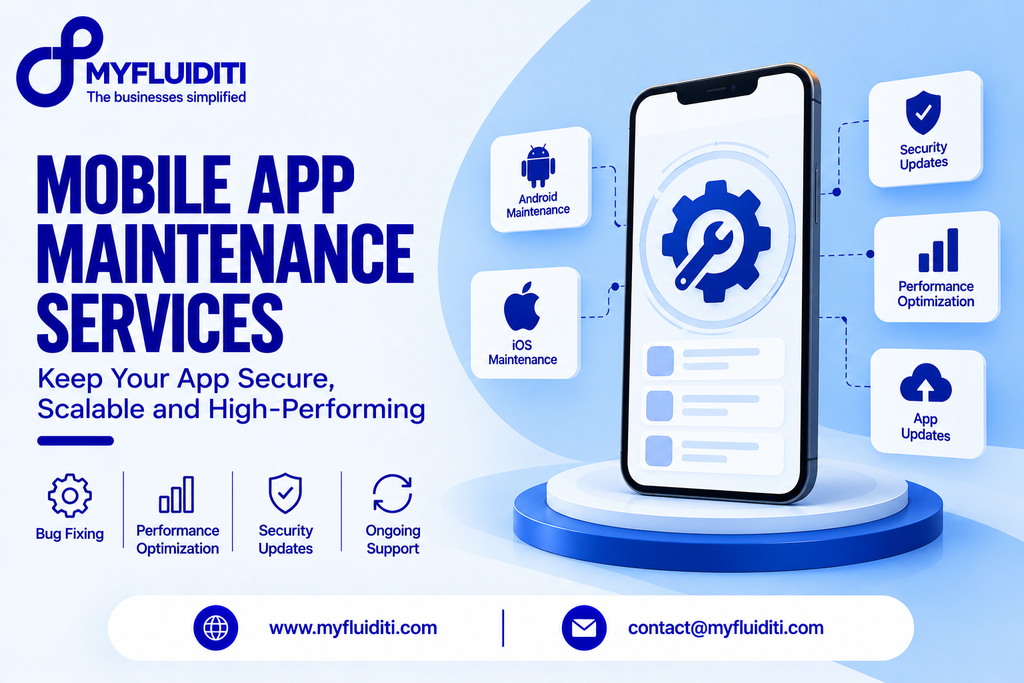
Introduction to Mobile App Maintenance Services Launching a mobile application is only the beginning of its lifecycle. Once an app is available to users, it needs continuous monitoring, updates, bug fixing, security improvements, performance optimization, and feature enhancements to remain reliable and competitive. Mobile App Maintenance Services help businesses keep their applications stable, secure, compatible with evolving mobile platforms, and aligned with changing customer expectations. Mobile applications operate in an environment that continuously changes with new operating system versions, mobile devices, APIs, SDKs, security requirements, cloud services, and third-party integrations. An application that performs well today can experience compatibility issues, crashes, security vulnerabilities, or performance degradation after technology updates. Professional mobile app maintenance and support helps businesses proactively manage these changes and maintain a high-quality digital experience. Industry mobile maintenance services commonly include bug fixing, performance optimization, OS compatibility updates, security patching, SDK updates, and ongoing application support. What Are Mobile App Maintenance Services? Mobile app maintenance services are ongoing technical services designed to keep an existing mobile application functional, secure, updated, optimized, and ready for future requirements. These services begin after the application has been developed and deployed and continue throughout its operational lifecycle. Mobile application maintenance can include bug fixing, crash resolution, performance optimization, security updates, operating system compatibility, API maintenance, third-party integration updates, database optimization, feature enhancements, application monitoring, testing, and release management. The objective is not simply to fix problems after they occur but to continuously improve the application’s reliability and ability to support business growth. Why Mobile App Maintenance Is Important Mobile applications are constantly exposed to changing technical and business conditions. New Android and iOS versions can introduce compatibility requirements, third-party APIs can change, SDKs can become outdated, security vulnerabilities can be discovered, and users can expect new features and better performance. Without regular app maintenance and support, businesses may experience application crashes, slow loading, broken integrations, outdated functionality, security risks, poor user experiences, and increasing technical debt. Regular maintenance allows organizations to identify issues earlier, keep applications updated, and improve the overall stability of their mobile products. Mobile App Bug Fixing and Crash Resolution Application bugs can negatively affect user experience and business operations. Issues may include application crashes, broken screens, login failures, payment errors, API problems, database errors, notification issues, device-specific problems, or unexpected application behavior. MyFluiditi provides mobile app bug fixing services by analyzing application behavior, identifying the root cause of issues, implementing fixes, and validating the changes through testing. Our approach focuses on resolving the immediate issue while also understanding why it occurred so that similar problems can be reduced in future releases. Mobile App Performance Optimization Application performance directly affects how users interact with a mobile product. Slow loading screens, delayed API responses, excessive memory usage, battery consumption, rendering issues, and inefficient background processes can create a poor application experience. Our mobile app performance optimization approach evaluates application performance across different areas, including frontend code, APIs, databases, network communication, images and assets, memory usage, and backend services. MyFluiditi helps optimize applications to improve responsiveness, stability, loading performance, and overall efficiency. Android App Maintenance Services Android applications need continuous maintenance because they operate across a wide range of devices, screen sizes, hardware configurations, Android versions, and manufacturers. Changes in Android platform requirements can also require application updates. Android app maintenance services can include compatibility updates, bug fixing, performance optimization, SDK updates, security patches, device compatibility testing, API maintenance, and feature enhancements. MyFluiditi helps businesses maintain Android applications so they remain functional and compatible as the Android ecosystem evolves. iOS App Maintenance Services iOS applications also require regular maintenance to remain compatible with new Apple operating system versions, devices, SDKs, APIs, and App Store requirements. Changes in the iOS ecosystem can affect application functionality, integrations, performance, and security. Our iOS app maintenance services cover bug fixing, performance optimization, compatibility updates, dependency updates, security improvements, API maintenance, testing, and release support. We help businesses maintain reliable iOS applications while supporting continuous improvements throughout the application lifecycle. Cross-Platform App Maintenance Businesses increasingly use cross-platform technologies such as Flutter and React Native to develop applications for multiple platforms. Although cross-platform development can streamline application development, these applications still require regular maintenance to manage framework updates, dependencies, platform changes, APIs, and device compatibility. MyFluiditi supports Flutter app maintenance and React Native app maintenance by addressing bugs, updating dependencies, improving performance, maintaining integrations, and supporting new application releases. This helps businesses maintain a consistent application experience across Android and iOS platforms. Mobile App Security Maintenance Mobile applications handle valuable information such as customer details, authentication credentials, payment information, business data, and application-specific content. Security maintenance is therefore an important part of the mobile application lifecycle. Mobile app security maintenance can include dependency updates, vulnerability fixes, secure authentication, API security, data protection, encryption, access control, and security-focused testing. MyFluiditi considers security requirements while maintaining applications and updating their technology components. Mobile App OS Compatibility Updates Operating systems continuously evolve, and application developers need to ensure that existing applications continue to work correctly after platform updates. Compatibility issues can affect application interfaces, APIs, permissions, background operations, notifications, device functionality, and third-party integrations. Our mobile app maintenance process includes iOS and Android compatibility updates to help applications remain aligned with changing platform requirements. Regular compatibility testing and technology updates can reduce the risk of application failures following major platform changes. Mobile App SDK and Dependency Updates Mobile applications frequently depend on third-party SDKs, frameworks, libraries, APIs, analytics tools, payment systems, maps, authentication services, and notification platforms. These dependencies can become outdated or change their implementation requirements. SDK and dependency maintenance helps ensure that applications continue to work correctly while reducing risks associated with outdated software components. MyFluiditi can review application dependencies, update required libraries, test compatibility, and address issues created by dependency changes. Third-Party API Integration Maintenance Mobile applications often depend on external APIs for payments, maps, authentication, analytics, social login, notifications, shipping, customer management, and other business functions. Changes to these external services can affect application functionality.
IT Consulting: Building Scalable, Secure, and Future-Ready Technology Solutions
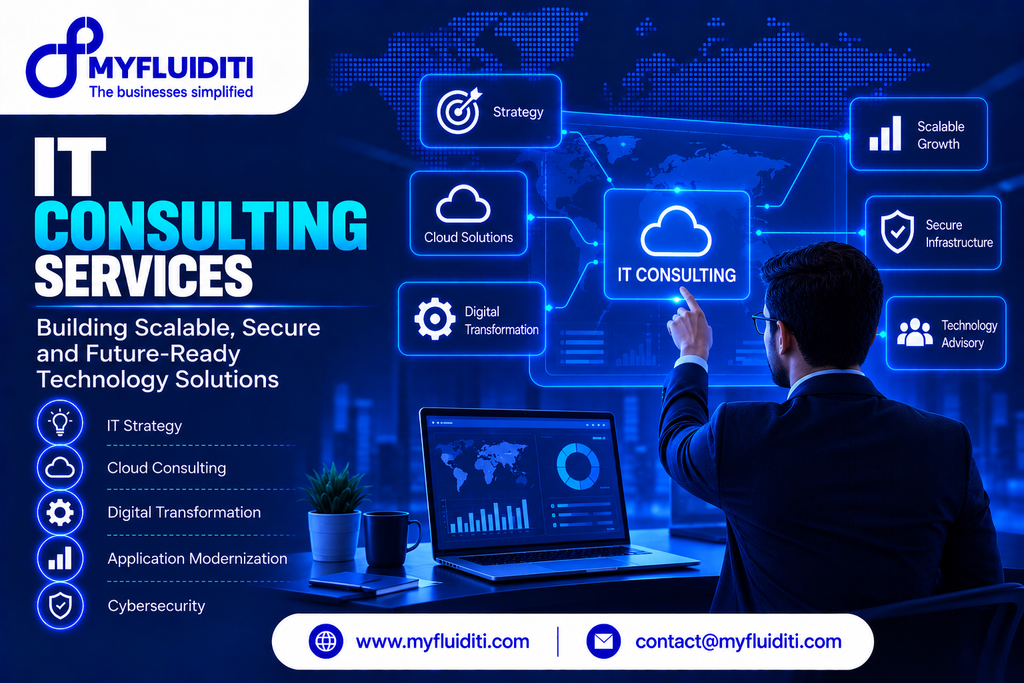
Introduction to IT Consulting Technology is now at the center of modern business operations, customer experiences, product development, data management, and business growth. As organizations adopt cloud computing, artificial intelligence, automation, enterprise applications, APIs, analytics, and digital platforms, managing technology effectively has become increasingly complex. IT Consulting helps businesses understand their technology requirements, solve existing IT challenges, improve their technology infrastructure, and create a clear strategy for long-term digital growth. A strong IT strategy connects technology investments with business objectives. It can help organizations evaluate their current IT environment, identify technology gaps, modernize legacy applications, improve system integration, strengthen security, optimize infrastructure, and prepare for emerging technologies. Modern technology consulting commonly covers strategy, architecture, cloud, infrastructure, digital transformation, application modernization, cybersecurity, and technology operations. What Is IT Consulting? IT consulting is a professional technology advisory service that helps organizations plan, manage, improve, and transform their IT environment. IT consultants analyze business requirements, existing applications, infrastructure, software, databases, integrations, security practices, and technology processes to identify areas that require improvement. IT consulting services can include IT strategy consulting, technology consulting, digital transformation consulting, enterprise architecture consulting, cloud consulting, cybersecurity consulting, application modernization, data consulting, IT infrastructure consulting, API integration, automation, and technology roadmap development. The objective is to help organizations make informed technology decisions while building scalable, secure, efficient, and future-ready IT environments. Why Businesses Need IT Consulting Services As organizations expand, their technology landscape often becomes more complicated. Businesses may use multiple applications, cloud platforms, databases, CRM systems, ERP platforms, APIs, SaaS solutions, security tools, and third-party services. If these technologies are not properly planned and integrated, businesses can experience technical debt, inefficient workflows, security risks, increasing infrastructure costs, poor application performance, and scalability challenges. IT consulting services provide businesses with a structured way to evaluate their current technology environment and identify opportunities for improvement. Instead of making technology investments based only on immediate requirements, organizations can develop a long-term technology strategy that considers scalability, security, performance, integration, cost, and future business needs. IT Strategy Consulting An effective IT strategy provides a clear direction for how technology should support business objectives. IT strategy consulting involves evaluating the current technology landscape, understanding business priorities, identifying technology gaps, and developing a roadmap for future improvements. At MyFluiditi, we approach IT strategy by first understanding the business problem and existing technology environment. We then evaluate the technical requirements and identify suitable solutions across software development, cloud, data, AI, cybersecurity, automation, and enterprise technologies. This helps organizations create a technology roadmap that connects business objectives with practical technology execution. Technology Consulting for Business Growth Technology should support business growth without creating unnecessary complexity. Technology consulting helps organizations evaluate their existing technology stack, identify opportunities for optimization, select suitable technologies, and design solutions that can support future requirements. MyFluiditi helps businesses connect technology decisions with their actual operational and growth objectives. Whether the requirement involves developing a new digital product, modernizing an existing application, migrating infrastructure, integrating enterprise systems, implementing AI, or improving IT operations, our approach focuses on creating technology solutions that can scale with the business. Digital Transformation Consulting Digital transformation consulting helps businesses modernize their operations, applications, processes, and technology infrastructure through digital technologies. Digital transformation can involve cloud adoption, application modernization, business process automation, AI implementation, data modernization, enterprise application integration, and development of new digital platforms. Successful transformation requires more than introducing new software. Businesses need to evaluate their existing processes, applications, data, architecture, security, and technology capabilities before defining a transformation roadmap. Technology strategy and digital transformation are closely connected because organizations need to align technology decisions with their broader business objectives. MyFluiditi helps businesses identify practical digital transformation opportunities and develop solutions that improve operational efficiency, technology scalability, automation, and digital customer experiences. IT Assessment and Technology Audit Before making major technology investments, organizations need a clear understanding of their existing IT environment. An IT assessment examines applications, infrastructure, databases, cloud platforms, integrations, technology stacks, security practices, and operational processes. Technology assessments can help identify outdated systems, technical debt, performance limitations, integration gaps, security concerns, redundant technologies, and scalability challenges. The findings can then be used to establish technology priorities and create a structured IT modernization roadmap. Enterprise Architecture Consulting Enterprise architecture provides a structured view of how business applications, data, infrastructure, integrations, and technology systems work together. As organizations grow, a well-planned architecture becomes increasingly important for scalability, interoperability, security, and efficient technology management. Enterprise architecture consulting can cover business architecture, application architecture, data architecture, integration architecture, technology architecture, API architecture, and cloud architecture. MyFluiditi helps organizations evaluate their existing architecture and design technology environments that can support current requirements while remaining flexible for future growth. Cloud Consulting Services Cloud computing has become an important part of modern IT environments. Organizations use cloud platforms to host applications, manage databases, store data, scale infrastructure, support remote operations, and deploy digital products. However, successful cloud adoption requires appropriate planning around architecture, security, migration, performance, governance, and cost. Cloud consulting services can include cloud readiness assessment, cloud strategy, cloud architecture, cloud migration planning, cloud modernization, cloud security, and cloud cost optimization. Cloud transformation practices commonly connect cloud strategy with architecture, migration, infrastructure resilience, and security. MyFluiditi helps organizations evaluate their cloud requirements and plan cloud solutions according to application architecture, workload requirements, scalability needs, data requirements, and long-term technology objectives. Cloud Migration Consulting Migrating applications and data from traditional infrastructure to the cloud requires careful planning. Businesses need to understand application dependencies, databases, infrastructure requirements, security considerations, performance expectations, and business continuity requirements before starting migration. Our cloud migration consulting approach focuses on understanding the existing environment and developing a suitable migration strategy. Depending on the application, migration may involve rehosting, refactoring, rearchitecting, rebuilding, or modernizing the existing solution for cloud-native environments. Application Modernization Consulting Legacy applications can become difficult to maintain when their frameworks, architecture, databases, or integrations no longer support modern business requirements. Application modernization helps organizations improve existing applications through technology upgrades, architecture changes, API integration,
ML Development Services: Building Intelligent Machine Learning Solutions for Business Growth
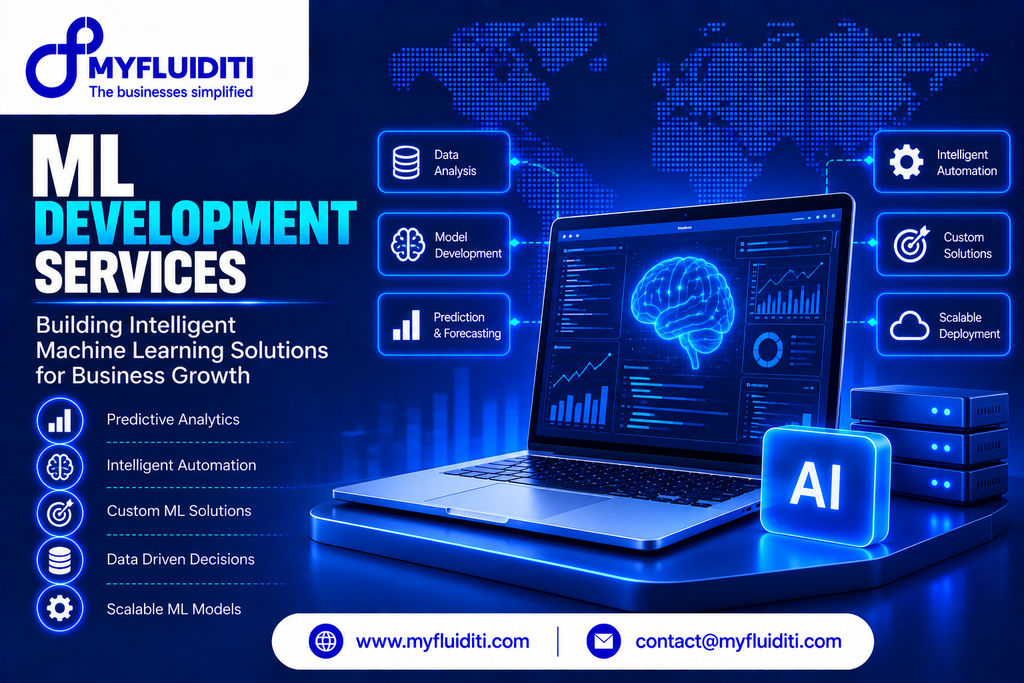
Introduction to ML Development Services Businesses generate enormous amounts of data through websites, mobile applications, customer interactions, transactions, enterprise systems, IoT devices, and digital platforms. The real value of this data comes from the ability to analyze it, identify patterns, make predictions, automate decisions, and improve business processes. ML Development Services help organizations transform business data into intelligent solutions that can support prediction, classification, recommendation, automation, anomaly detection, forecasting, and data-driven decision-making. Machine learning development goes beyond creating an experimental model. A successful machine learning solution needs reliable data, appropriate algorithms, model training, validation, deployment, integration, monitoring, and continuous improvement. MyFluiditi helps businesses move from machine learning ideas to practical solutions by combining machine learning engineering, AI development, data engineering, cloud technologies, and software development expertise. What Is Machine Learning Development? Machine learning development is the process of designing, developing, training, testing, deploying, and maintaining machine learning models that solve specific business problems. Instead of relying entirely on predefined rules, machine learning models can learn patterns from historical and real-time data and use those patterns to generate predictions, classifications, recommendations, or other outputs. Machine Learning Development Services can support use cases such as customer churn prediction, demand forecasting, fraud detection, recommendation engines, predictive maintenance, lead scoring, image classification, sentiment analysis, anomaly detection, document classification, and intelligent automation. The appropriate machine learning approach depends on the business objective, available data, model requirements, expected performance, and deployment environment. Custom Machine Learning Solutions Every business has different data, processes, customers, products, and operational challenges. Generic software may not always provide the intelligence required for a specific business problem. Custom Machine Learning Solutions allow organizations to build models around their own data and business objectives. At MyFluiditi, we begin by understanding the business problem before selecting a machine learning approach. Our team evaluates the available data, identifies useful variables, considers the desired prediction or outcome, and defines an appropriate technical strategy. This helps ensure that the ML solution is developed around a meaningful business requirement rather than simply adding machine learning technology without a clear purpose. Machine Learning Consulting Services Before developing a machine learning model, businesses need to understand whether their data and infrastructure are suitable for the intended use case. Machine learning consulting helps organizations identify opportunities, evaluate technical feasibility, understand data requirements, and establish a practical development roadmap. MyFluiditi provides Machine Learning Consulting Services to help businesses identify potential ML use cases and determine how machine learning can fit into their existing technology environment. Our team can assess data readiness, application architecture, integration requirements, scalability considerations, and potential implementation approaches before moving into full-scale development. Machine Learning Model Development Machine learning model development involves selecting algorithms, preparing data, training models, evaluating performance, tuning parameters, and selecting an appropriate model for deployment. The model needs to be tested against relevant datasets and business requirements before being integrated into a production environment. MyFluiditi provides Machine Learning Model Development Services for organizations that need customized predictive and intelligent capabilities. Depending on the use case, our engineers can work with supervised learning, unsupervised learning, deep learning, classification, regression, clustering, recommendation systems, time-series forecasting, and anomaly detection techniques. Supervised Machine Learning Development Supervised learning uses labeled datasets to train models for specific prediction or classification tasks. It can be applied when historical examples are available and the desired outcome is known. MyFluiditi can develop supervised machine learning models for applications such as customer churn prediction, sales forecasting, lead scoring, fraud classification, demand prediction, risk assessment, and other business use cases. The model development process can include data preparation, feature engineering, training, validation, testing, optimization, and production deployment. Unsupervised Machine Learning Development Unsupervised machine learning works with data where predefined labels may not be available. It can help organizations discover hidden patterns, groups, relationships, and unusual behavior within large datasets. Unsupervised Machine Learning Solutions can be useful for customer segmentation, behavioral analysis, clustering, anomaly detection, product grouping, and exploratory data analysis. MyFluiditi can design unsupervised learning solutions based on the structure of the available data and the business questions that need to be answered. Predictive Analytics and Machine Learning Predictive analytics uses historical and current information to estimate potential future outcomes. Machine learning can strengthen predictive analytics by identifying complex relationships and patterns within large datasets. MyFluiditi develops Predictive Analytics Solutions that can help businesses analyze customer behavior, demand patterns, operational data, sales information, financial data, and other business datasets. Predictive models can be integrated into dashboards, applications, APIs, or internal workflows so that predictions become part of everyday decision-making. Machine Learning for Business Intelligence Traditional business intelligence primarily focuses on understanding what has already happened through reports and dashboards. Machine learning can extend this capability by helping organizations estimate what may happen next or identify patterns that require attention. MyFluiditi can combine Machine Learning and Business Intelligence to create intelligent dashboards and analytical systems. Machine learning outputs can be incorporated into reporting environments to provide predictions, classifications, risk indicators, recommendations, and other data-driven insights alongside conventional business metrics. Machine Learning for Predictive Maintenance Unexpected equipment failures can create downtime, operational disruption, and maintenance costs. Machine learning can analyze historical equipment data, sensor information, usage patterns, and operational measurements to identify potential failure patterns. MyFluiditi can develop Predictive Maintenance Solutions using machine learning models that analyze relevant operational data. Depending on the use case, these solutions can support anomaly detection, failure prediction, equipment monitoring, and maintenance planning for industrial and connected systems. Machine Learning for Fraud Detection Fraud detection requires organizations to identify suspicious patterns within large volumes of transactions and activities. Machine learning can analyze historical transaction behavior and identify patterns that may indicate unusual or potentially fraudulent activity. With Machine Learning Fraud Detection, MyFluiditi can develop models that evaluate transaction data, behavioral patterns, risk signals, and other relevant features. These models can be integrated with existing applications and APIs to support automated risk scoring and fraud monitoring workflows. Machine Learning Recommendation Systems Recommendation engines help businesses provide personalized products, services, content, or information based
LMS Development: Building Scalable and Custom Learning Management Systems
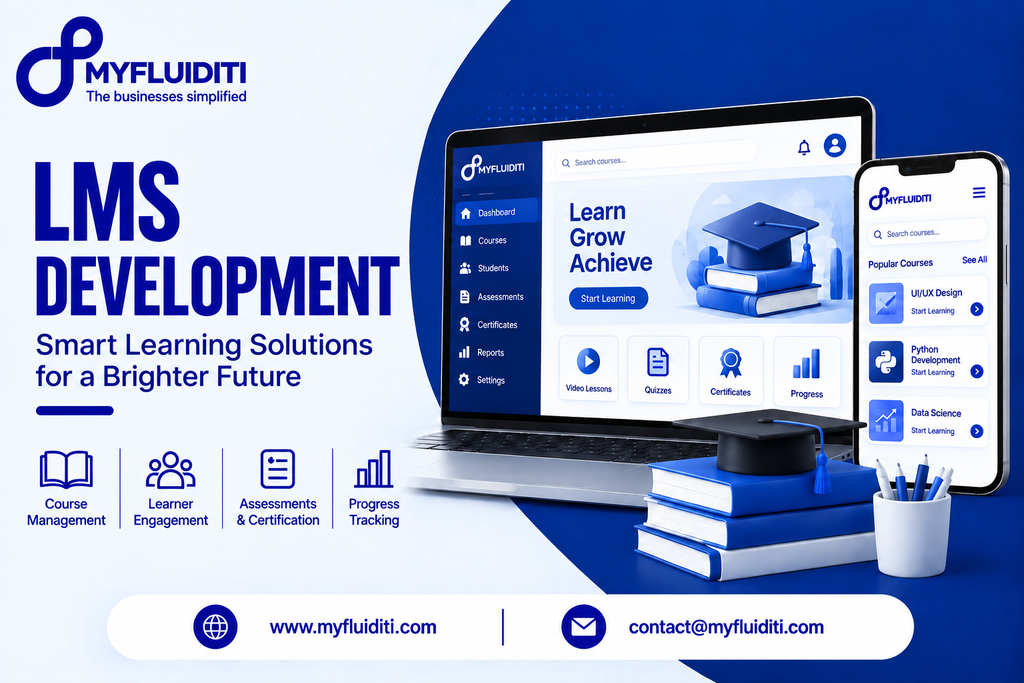
Introduction to LMS Development Digital learning has become an important part of education, corporate training, employee development, professional certification, and online skill development. Organizations need reliable digital platforms that can deliver courses, manage learners, track progress, conduct assessments, provide certifications, and generate meaningful learning insights. LMS Development enables organizations to create customized Learning Management Systems that bring these capabilities together within a centralized digital learning environment. A modern Learning Management System is more than a platform for uploading videos and documents. It can connect learners, instructors, administrators, training managers, educational institutions, and business systems through a single platform. MyFluiditi provides LMS Development Services focused on creating scalable, secure, user-friendly, and business-specific learning platforms. Our approach begins with understanding the learning model, target users, content structure, business requirements, integrations, and future growth plans before designing the appropriate LMS architecture. What Is LMS Development? LMS development is the process of designing, developing, deploying, and maintaining a Learning Management System that enables organizations to manage digital learning and training activities. An LMS can provide course management, learner registration, content delivery, assessments, quizzes, assignments, certifications, progress tracking, instructor management, reporting, analytics, and administrative controls within one platform. A custom LMS can be designed according to the specific learning requirements of an organization instead of forcing the organization to adapt its training process to a fixed platform. This makes Custom LMS Development valuable for EdTech companies, universities, schools, coaching institutes, professional training providers, enterprises, and organizations running employee learning and development programs. Custom LMS Development Services Every organization has a different learning model. An EdTech company may need a course marketplace and subscription system, while a corporate organization may require employee onboarding, compliance training, certification tracking, and HR integration. Educational institutions may require student management, instructor dashboards, assignments, examinations, and academic reporting. MyFluiditi develops custom LMS software solutions around these specific requirements. Our team can design the learner experience, instructor workflows, administration modules, course architecture, assessment functionality, reporting system, and integration layer according to the organization’s objectives. This allows the LMS to evolve as the organization’s users, courses, content, and business requirements increase. Learning Management System Software Development Learning Management System software development involves building the technical foundation required to manage digital learning at scale. This includes frontend interfaces, backend application logic, databases, APIs, authentication, content management, analytics, administration systems, and integration capabilities. At MyFluiditi, we focus on developing LMS software that combines usability with scalable architecture. Our engineers consider application performance, user roles, security, data management, responsive design, API communication, and future feature requirements while building the platform. This helps create a learning environment that can support both current training requirements and future expansion. E-Learning Platform Development An LMS is an important part of a broader e-learning ecosystem. E-Learning Platform Development can include course delivery, multimedia learning, virtual classrooms, assessments, certification, communication, learner engagement, analytics, and mobile access. MyFluiditi helps organizations develop e-learning platforms that bring different learning activities into one connected environment. Depending on the requirements, the platform can support video lessons, downloadable resources, assignments, quizzes, examinations, learning paths, instructor interactions, progress tracking, and other digital learning workflows. Online Learning Platform Development The demand for online learning continues to create opportunities for organizations to deliver education and training beyond traditional physical environments. Online Learning Platform Development allows businesses and educational organizations to provide courses to learners across locations and devices. MyFluiditi can develop online learning platforms with responsive web interfaces and mobile-friendly experiences so learners can access their content through desktops, tablets, and smartphones. The platform architecture can also be designed to support increasing numbers of learners, courses, instructors, and learning resources. LMS Course Management Course management is one of the core components of any Learning Management System. Administrators and instructors need to create courses, organize lessons, upload learning materials, define prerequisites, manage enrollment, update content, and monitor learner participation. With LMS Course Management, MyFluiditi can create structured course management functionality that allows administrators and instructors to organize learning content efficiently. Courses can be divided into modules and lessons, while learners can follow defined learning paths based on their enrollment, role, skill level, or training requirements. LMS Content Management An effective learning platform needs a centralized system for managing educational content. Videos, documents, presentations, audio files, assignments, quizzes, downloadable resources, and other learning materials need to be organized in a way that makes content easy to manage and access. MyFluiditi develops LMS Content Management Systems that allow authorized users to create, update, organize, and publish learning resources. Our development approach can also consider content access permissions, course structures, multimedia delivery, content versioning, and integration with external storage or content platforms where required. LMS Student and Learner Management Learner management is essential for understanding who is using the platform, what courses they have enrolled in, how they are progressing, and whether they have completed required learning activities. A centralized learner management system can simplify these processes for administrators and training teams. MyFluiditi can develop LMS Student Management and Learner Management functionality that supports registration, profiles, enrollment, course assignments, learning progress, completion status, certifications, and user activity. Role-based access can ensure that learners, instructors, administrators, and managers receive access to the features relevant to their responsibilities. Instructor and Trainer Management Instructors and trainers require dedicated tools to create courses, manage lessons, evaluate learners, conduct assessments, provide feedback, and monitor class performance. An instructor dashboard can make these activities easier to manage from one location. Our LMS development approach includes Instructor Management and Trainer Management functionality based on the organization’s requirements. MyFluiditi can create instructor dashboards, course authoring interfaces, assignment management, assessment tools, learner communication features, and performance reporting to support educators and training professionals. LMS Assessment and Examination Development Assessments help organizations measure learner understanding and evaluate training outcomes. A modern LMS can support quizzes, examinations, assignments, question banks, automated grading, manual evaluation, time-based tests, and performance analysis. MyFluiditi develops LMS Assessment and Examination Systems that can be customized according to the learning model. Assessment workflows can include different question types, scoring rules, pass