Laravel Development Services for Secure, Scalable, and High-Performance Web Applications
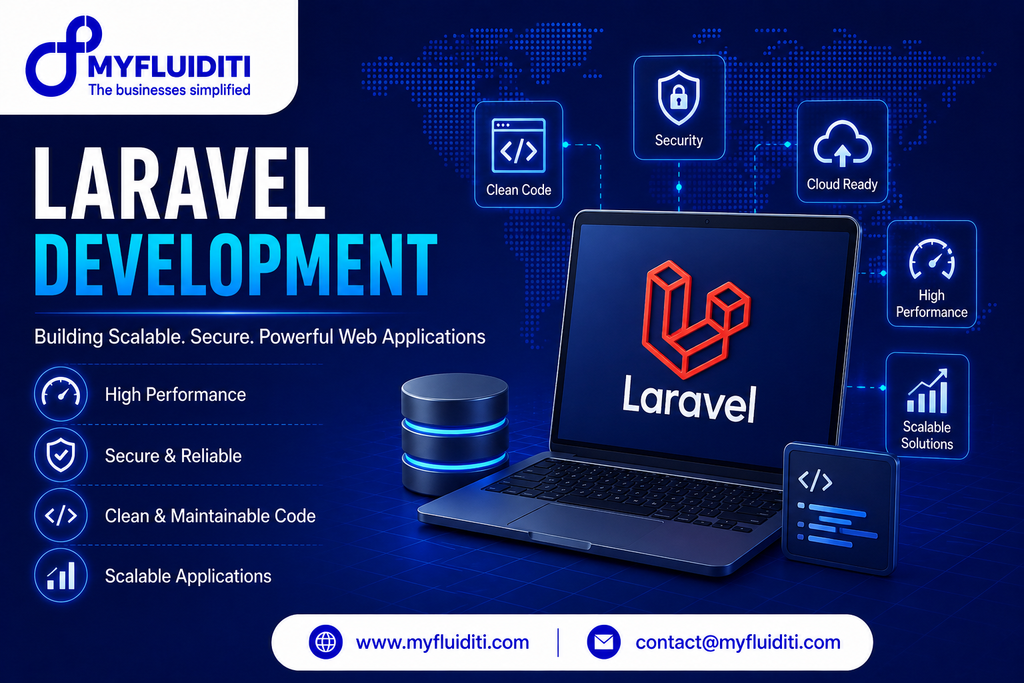
Introduction to Laravel Development In today’s competitive digital landscape, businesses need more than a basic website to establish a strong online presence. They need fast, secure, scalable, and flexible web applications that can support changing business requirements and deliver a smooth user experience. Laravel development has become a preferred choice for businesses looking to build modern web applications using the powerful PHP framework. With its clean architecture, efficient development environment, robust security features, and extensive ecosystem, Laravel enables businesses to create everything from corporate websites and eCommerce platforms to SaaS applications, customer portals, APIs, and enterprise-grade web solutions. At MyFluiditi, we combine Laravel expertise, modern development practices, and business-focused strategies to build digital solutions that are designed around your specific objectives. What Is Laravel Development? Laravel is a modern PHP framework designed to simplify and accelerate web application development while maintaining a strong foundation for performance, security, and scalability. Laravel web development follows the Model-View-Controller architecture, allowing development teams to organize application logic, database operations, and user interfaces efficiently. Its powerful routing system, Blade templating engine, Eloquent ORM, authentication capabilities, queue management, caching, and API development tools make Laravel suitable for applications of different sizes and complexities. For businesses, this means having a development framework that can support both a new digital product and the continuous growth of an existing platform. Why Choose Laravel for Web Development? Choosing the right framework can have a significant impact on the long-term success of a web application. Laravel provides developers with a structured environment that helps create maintainable and scalable applications without unnecessary complexity. Its built-in security mechanisms help protect applications against common web vulnerabilities, while its database tools simplify complex data operations. Laravel also provides powerful tools for routing, authentication, session management, caching, testing, and task scheduling. These capabilities make Laravel website development an effective option for businesses that require a reliable platform capable of evolving with their needs. MyFluiditi uses these Laravel capabilities to develop solutions that are not only functional but also prepared for future enhancements and integrations. Custom Laravel Web Development for Business Needs Every business has different processes, customers, workflows, and technology requirements, which is why a one-size-fits-all website may not deliver the expected results. Our custom Laravel development services focus on understanding your business requirements before designing the application architecture. Whether you need a custom business portal, marketplace, booking platform, CRM system, eCommerce application, SaaS product, or enterprise web application, MyFluiditi can develop a solution around your specific workflows. We focus on creating reusable, maintainable, and scalable application components so that your platform can continue to grow without requiring a complete rebuild whenever your business expands. Laravel Application Development for Scalable Platforms Modern businesses often experience changing customer expectations, increasing traffic, larger databases, and expanding functionality. A web application therefore needs an architecture that can handle growth efficiently. Laravel application development provides the flexibility required to build modular platforms that can be expanded as new requirements emerge. MyFluiditi approaches application development with scalability in mind, considering database architecture, API structure, caching, server performance, authentication, and future integrations from the early stages of development. This approach helps businesses build a strong technical foundation instead of continuously patching an application as it grows. Laravel eCommerce Development eCommerce businesses require more than attractive product pages. They need secure transactions, product management, customer accounts, order processing, inventory management, payment integrations, shipping workflows, and administrative controls. Laravel eCommerce development can provide a flexible foundation for creating customized online stores and commerce platforms. MyFluiditi can develop Laravel-powered eCommerce solutions tailored to your business model, allowing custom features and integrations to be incorporated according to your requirements. From product catalogs and shopping carts to payment gateways, order management, customer dashboards, and third-party integrations, we focus on creating an efficient digital commerce experience. Laravel API Development and Integration Modern applications rarely operate independently. Businesses frequently need to connect their websites with mobile applications, payment systems, CRMs, ERPs, analytics platforms, third-party services, and other business tools. Laravel API development enables applications to exchange information securely and efficiently through structured APIs. MyFluiditi develops API-driven Laravel solutions that support reliable communication between different systems while keeping scalability and security in consideration. Whether you require REST API development, third-party API integration, or backend services for a mobile application, Laravel can provide a strong foundation for connected digital ecosystems. Laravel SaaS Development Software-as-a-Service businesses require applications that can support multiple users, different access levels, subscription models, dashboards, billing systems, and continuous feature development. Laravel SaaS development offers the flexibility needed to build customized cloud-based platforms around specific business models. MyFluiditi helps businesses transform product ideas into scalable SaaS applications by combining Laravel development with appropriate database architecture, authentication, subscription management, APIs, and administrative functionality. We focus on creating a platform that can support new users, features, integrations, and business requirements as the SaaS product grows. Secure Laravel Web Applications Security is an essential part of modern web development, particularly for applications that process customer information, transactions, business data, or authentication credentials. Laravel includes several security-focused capabilities that help developers implement secure authentication, authorization, request validation, encrypted data handling, and protection against common application vulnerabilities. MyFluiditi incorporates security considerations throughout the development lifecycle rather than treating security as an afterthought. From secure user authentication and access controls to input validation and application configuration, we work toward creating secure Laravel applications that businesses can confidently operate. Laravel Website Performance Optimization Website performance directly influences user experience, engagement, and the overall effectiveness of a digital platform. Laravel provides several mechanisms that can support performance optimization, including caching, optimized database queries, route and configuration caching, queue processing, and efficient application architecture. MyFluiditi analyzes application performance and identifies areas where database queries, assets, server responses, or application logic can be improved. Our Laravel performance optimization approach focuses on creating fast-loading experiences while maintaining the functionality and scalability required by the business. Performance-conscious development can also support technical SEO by helping websites provide a better experience for users and search engines. SEO-Friendly Laravel Development Building
Flutter App Development for Building Scalable Cross-Platform Mobile Experiences
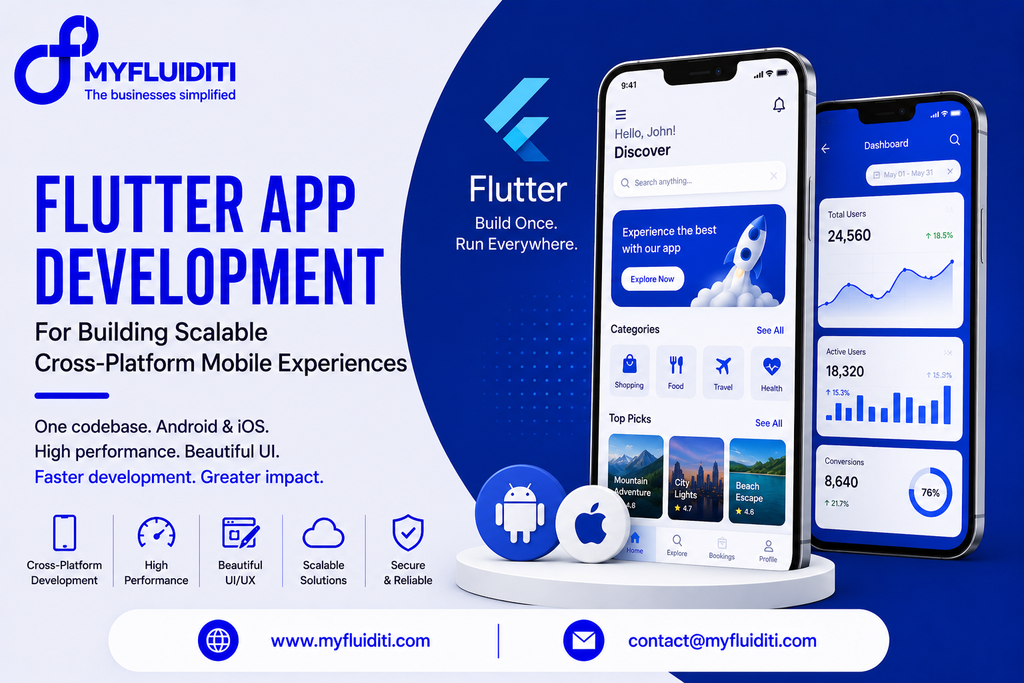
Introduction Mobile applications have become an essential part of modern digital business, helping companies connect with customers, deliver services, manage operations, and create new digital revenue opportunities. As businesses increasingly target both Android and iOS users, they need mobile solutions that balance performance, development efficiency, scalability, and user experience. Flutter app development offers a powerful cross-platform approach that enables businesses to create applications for multiple platforms while maintaining a consistent digital experience. At MyFluiditi, we help startups, enterprises, and growing businesses transform their mobile ideas into scalable applications using Flutter, modern backend technologies, UI/UX design, APIs, cloud infrastructure, and agile development practices. MyFluiditi’s existing mobile development approach includes Flutter alongside React Native, Swift, and Kotlin for modern application development. Understanding Flutter App Development Flutter is a cross-platform application framework that enables developers to create mobile applications for Android and iOS from a unified codebase. This approach can help businesses streamline development while maintaining a consistent application experience across platforms. Flutter app development services can be used for a wide range of digital products, including e-commerce applications, healthcare platforms, FinTech solutions, on-demand applications, social platforms, enterprise applications, and SaaS products. MyFluiditi uses Flutter as part of its cross-platform mobile technology expertise to help businesses develop applications that can evolve with changing product and customer requirements. Why Businesses Choose Flutter for Mobile Applications Developing separate applications for Android and iOS can require different development environments, resources, and maintenance processes. A cross-platform framework can help businesses reduce duplicated development effort and create a more unified product strategy. Cross-platform mobile app development is particularly valuable for startups and businesses that need to validate ideas, reach multiple platforms, and iterate quickly. MyFluiditi follows agile development practices and uses modern frameworks such as Flutter and React Native to support efficient mobile product development. Building High-Performance Mobile Experiences Performance plays an important role in mobile application success. Users expect applications to load quickly, respond smoothly, and provide reliable interactions. Flutter provides a foundation for creating responsive cross-platform applications, while proper architecture, optimized code, efficient APIs, and scalable backend infrastructure contribute to overall application performance. MyFluiditi focuses on high-performance mobile app development, combining application architecture, backend engineering, API integration, and performance optimization to create responsive digital products. Creating Consistent Android and iOS Experiences A consistent experience across Android and iOS helps businesses maintain their brand identity and provide familiar interactions to users regardless of their device. Flutter supports a shared development approach while allowing applications to address platform-specific requirements where necessary. Flutter cross-platform development can therefore help organizations maintain consistency while reaching users across multiple mobile environments. MyFluiditi combines Flutter development with UI/UX expertise to create intuitive mobile experiences that support consistent customer journeys. Custom Flutter App Development Every organization has unique business processes, customer requirements, and product objectives. Custom application development enables businesses to build functionality around their specific needs rather than adapting their operations to generic software. Custom Flutter app development can support applications ranging from startup MVPs to enterprise-grade digital platforms. MyFluiditi works with businesses to understand their product goals, user requirements, technical environment, and future roadmap before developing customized Flutter solutions. Flutter UI UX Design An application needs more than technical functionality to succeed. Users expect intuitive navigation, visually appealing interfaces, fast interactions, and simple workflows. Flutter UI UX design combines user-centered design principles with cross-platform application development to create engaging mobile experiences. MyFluiditi integrates UI/UX design into its development lifecycle, helping businesses create interfaces that are aligned with their brand identity while remaining easy for customers to navigate. Its broader mobile development approach emphasizes UI/UX, scalable applications, and full-cycle delivery. Flutter for Startup MVP Development Startups often need to validate their ideas quickly before investing in a full-scale product. A Minimum Viable Product can provide the essential functionality required to test an idea, gather user feedback, and identify product-market opportunities. Flutter MVP development can be a practical choice for startups targeting both Android and iOS because it supports a cross-platform development strategy. MyFluiditi helps startups prioritize essential features, build scalable foundations, and use agile development processes to move from concept toward launch efficiently. Flutter for E-Commerce Applications E-commerce businesses increasingly depend on mobile applications to provide convenient product discovery, shopping, payment, and order management experiences. Flutter can be used to create cross-platform shopping applications featuring product catalogs, search, filters, shopping carts, customer accounts, payment integrations, and order tracking. Flutter e-commerce app development can help businesses reach customers across Android and iOS while maintaining a consistent brand experience. MyFluiditi can connect Flutter applications with product databases, payment gateways, inventory systems, APIs, analytics platforms, and cloud services. Flutter for Healthcare Applications Healthcare organizations are increasingly adopting mobile applications for appointment management, telemedicine, patient engagement, remote monitoring, health information, and digital communication. Healthcare applications require careful attention to usability, security, data management, and integration. Flutter healthcare app development can provide a cross-platform approach for creating patient and healthcare-provider applications. MyFluiditi’s mobile development expertise spans healthcare and other industries, enabling businesses to create customized digital applications around their specific operational requirements. Flutter for FinTech Applications Financial technology applications require intuitive interfaces, reliable transaction workflows, secure authentication, and scalable infrastructure. Flutter can support mobile applications for digital payments, financial management, wallets, lending, investment platforms, and other FinTech use cases. Flutter FinTech app development can help organizations deliver consistent mobile experiences across platforms while integrating relevant financial APIs and backend systems. MyFluiditi combines mobile development, API integration, cloud technologies, AI, and security-focused engineering to support modern financial applications. Flutter for On-Demand Applications On-demand businesses need mobile applications capable of connecting customers with services efficiently. Taxi booking, food delivery, home services, logistics, healthcare, and other platforms can use mobile applications for bookings, payments, location tracking, notifications, communication, and service management. Flutter on-demand app development can provide a unified foundation for customer and service-provider applications. MyFluiditi develops customized on-demand solutions based on business workflows, customer journeys, operational requirements, and scalability goals. API Integration and Backend Development Modern mobile applications depend on backend systems to manage users, transactions, content, authentication, notifications,
Staff Augmentation vs In-House Hiring: Which Model Helps Businesses Scale Faster in 2026?
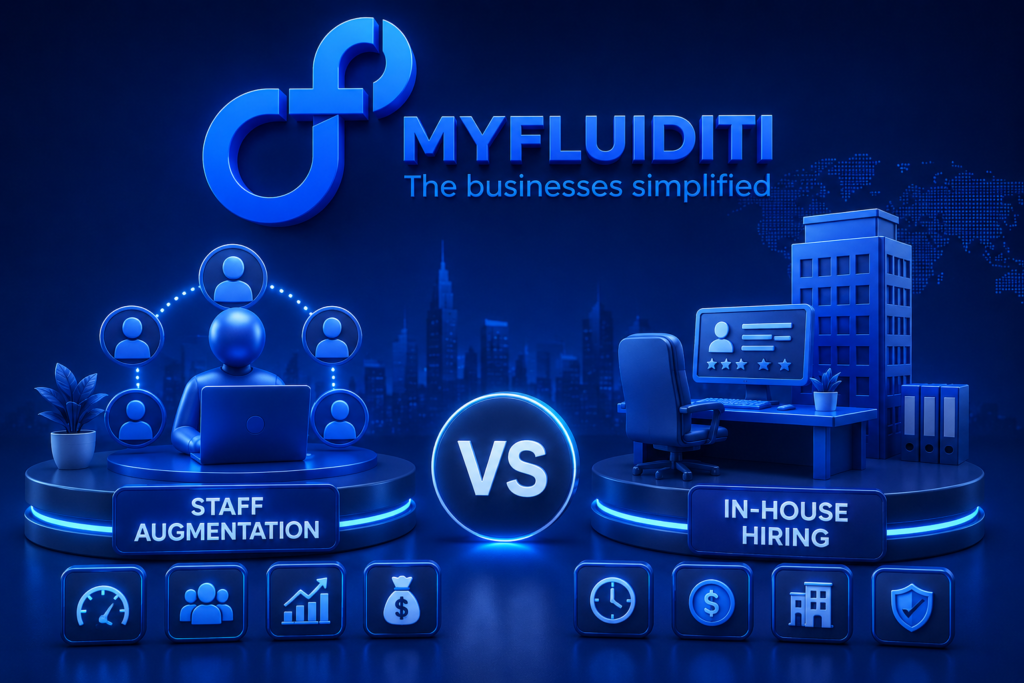
In today’s fast-moving digital economy, businesses are under constant pressure to innovate faster, launch products quicker, and optimize operational costs without compromising quality. Whether it’s a startup building its first SaaS platform or an enterprise scaling cloud infrastructure, one challenge remains the same: finding the right technology talent at the right time. This is where the debate between staff augmentation and in-house hiring becomes critical. Many businesses initially prefer building internal teams because it offers direct control and long-term stability. However, as competition increases and technology evolves rapidly, companies are discovering that traditional hiring models often slow down innovation due to recruitment delays, rising salaries, infrastructure expenses, and talent shortages. On the other hand, staff augmentation has emerged as a flexible and scalable alternative that allows businesses to quickly access experienced developers, cloud engineers, AI specialists, and software professionals without the overhead of permanent hiring. At MyFluiditi, businesses across the USA leverage modern staff augmentation services to accelerate software development, reduce hiring risks, and scale engineering operations efficiently. Understanding Staff Augmentation Staff augmentation is a hiring strategy where companies extend their internal team with external technology professionals on a temporary or project-based basis. Instead of spending months recruiting full-time employees, businesses can quickly onboard skilled developers and specialists based on project requirements. This model is especially popular in software development, AI engineering, cloud migration, DevOps, SaaS product development, and enterprise application modernization. Unlike outsourcing entire projects, staff augmentation gives businesses complete control over workflows, project management, and delivery processes while gaining access to specialized technical expertise. For growing companies, this creates a balance between flexibility and operational control. What Is In-House Hiring? In-house hiring refers to recruiting full-time employees who work directly under the company’s internal structure. These employees become part of the organization’s long-term workforce and contribute to ongoing business operations. Building an internal team can strengthen company culture, improve long-term collaboration, and create deeper organizational alignment. However, hiring internally often involves significant costs and long recruitment cycles. Businesses must invest in salaries, employee benefits, office infrastructure, training, HR operations, and retention strategies. In competitive technology markets like the United States, hiring experienced developers has become increasingly expensive and time-consuming. For startups and scaling businesses, this can slow down product launches and reduce operational agility. The Growing Challenges of In-House Hiring Technology recruitment in 2026 is more competitive than ever. Skilled software engineers, AI developers, and cloud architects are in high demand, making it difficult for companies to hire quickly. One major issue businesses face is the lengthy recruitment cycle. Hiring a qualified software engineer can take several weeks or even months. During this time, product roadmaps slow down, development timelines extend, and market opportunities may be lost. Another challenge is cost. Beyond salaries, companies must consider recruitment expenses, onboarding, training, employee benefits, taxes, hardware, software licenses, and workspace costs. For startups operating with limited budgets, these expenses can significantly impact scalability. Retention is another growing concern. Many businesses invest heavily in hiring and training employees only to lose them to competitors within a short period. As a result, companies are increasingly adopting flexible workforce models like staff augmentation to reduce hiring pressure and maintain development momentum. Why Businesses Are Choosing Staff Augmentation The biggest advantage of staff augmentation is speed. Instead of waiting months to build an internal team, businesses can onboard experienced developers within days or weeks. This allows companies to accelerate product development, meet tight deadlines, and respond quickly to market demands. Another major benefit is cost efficiency. Businesses only pay for the resources they need, when they need them. There are no long-term salary commitments, infrastructure investments, or recruitment overheads. This model also provides access to a global talent pool. Companies are no longer restricted to local hiring markets. They can work with experienced developers, cloud engineers, UI/UX designers, and AI specialists from across the world. At MyFluiditi, businesses gain access to highly skilled offshore development teams that integrate seamlessly with internal operations. This helps organizations scale engineering capacity while maintaining project transparency and delivery quality. Staff Augmentation vs In-House Hiring: Key Differences While both models aim to strengthen business operations, their approach and impact differ significantly. In-house hiring focuses on long-term workforce development. It is ideal for companies building permanent teams for ongoing operations and organizational growth. Staff augmentation, however, is designed for flexibility and scalability. It allows businesses to quickly fill skill gaps, handle temporary workloads, or accelerate product delivery without long-term commitments. In-house teams require substantial investments in recruitment, infrastructure, and employee management. Staff augmentation reduces these operational burdens while enabling faster execution. For businesses operating in fast-changing industries such as SaaS, AI, FinTech, healthcare technology, and cloud computing, agility has become more valuable than traditional hiring structures. When In-House Hiring Makes Sense Despite the advantages of staff augmentation, in-house hiring still plays an important role for many organizations. Companies building core leadership teams, managing sensitive intellectual property, or developing long-term internal operations often benefit from permanent employees. Internal teams can create stronger cultural alignment and provide continuity for ongoing business functions. However, even companies with strong internal engineering departments frequently use staff augmentation to support rapid scaling initiatives or specialized technology requirements. When Staff Augmentation Is the Better Choice Staff augmentation is particularly effective when businesses need: Startups often use staff augmentation to launch products quickly without building large internal teams. Enterprises use it to support digital transformation initiatives and accelerate software modernization projects. This model has become especially valuable for companies adopting AI automation, cloud infrastructure, and enterprise SaaS solutions. How MyFluiditi Helps Businesses Scale Efficiently At MyFluiditi, businesses gain access to scalable staff augmentation solutions tailored to modern software development needs. From dedicated software developers and AI engineers to cloud specialists and DevOps professionals, MyFluiditi helps companies expand their technical capabilities without the complexity of traditional hiring. The focus is not just on providing developers but on building high-performing engineering partnerships that align with business goals, delivery timelines, and scalability requirements. Whether a company needs a single developer,
From RPA and BPM to AI Agents: How MyFluiditi Is Shaping the Future of Intelligent Automation
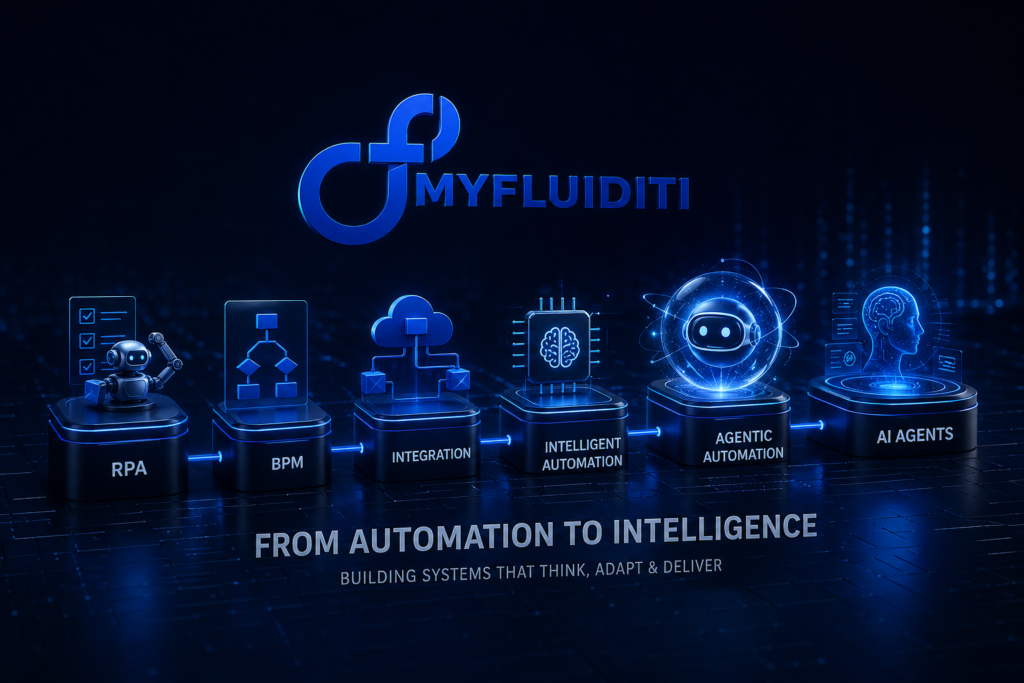
Introduction Automation has evolved significantly over the past decade. What began as simple task automation has now transformed into intelligent, adaptive systems capable of making decisions in real time. Businesses today are no longer asking whether to automate; they are asking how to automate at scale, intelligently, and sustainably. At MyFluiditi, we see automation not as a collection of tools, but as a connected system that evolves with business needs. From foundational technologies like RPA and BPM to the emergence of AI Agents, the journey of automation is now entering a new phase, one defined by intelligence, adaptability, and system-level thinking. Understanding the Foundations of Modern Automation Before exploring where automation is going, it’s important to understand where it started. Modern automation is built on several key components that continue to play a role even today. Robotic Process Automation (RPA) RPA was the first major step toward automation at scale. It uses software bots to handle repetitive, rule-based tasks such as data entry, invoice processing, and system updates. These bots mimic human interactions with systems, reducing manual effort and improving efficiency. While RPA delivers quick wins, it operates best in structured environments. At MyFluiditi, we use RPA as a foundational layer, but never as a standalone solution. Business Process Management (BPM) BPM focuses on designing and optimizing entire workflows rather than individual tasks. It ensures that processes are structured, compliant, and efficient across departments. This is where many organizations begin to see the bigger picture. However, without integration and intelligence, BPM alone cannot handle dynamic business environments. At MyFluiditi, BPM is integrated into end-to-end system design, ensuring workflows are not just defined but continuously improved. Integration and Connectivity (ESB & iPaaS) Automation cannot succeed without connectivity. Systems need to communicate seamlessly across platforms such as CRM, ERP, and cloud services. Technologies like ESB and iPaaS enable this by ensuring secure, real-time data flow between systems. MyFluiditi emphasizes this layer heavily because disconnected systems are the root cause of most inefficiencies in modern businesses. Intelligent Automation (IA) As automation matured, artificial intelligence was introduced to handle more complex tasks. Intelligent Automation combines RPA with AI to enable systems to analyze data, understand context, and make decisions. This marked a shift from rule-based execution to context-aware automation. At MyFluiditi, this is where automation starts becoming truly valuable when systems can adapt, not just execute. Digital Process Automation (DPA) DPA goes beyond automating tasks; it transforms entire processes into fully digital workflows. From onboarding to approvals, everything becomes streamlined and paperless. This aligns closely with MyFluiditi’s approach of re-engineering processes instead of simply automating them. The Shift Toward Agentic Process Automation As businesses scale, traditional automation begins to show limitations. Systems become complex, exceptions increase, and maintaining automation becomes expensive. This is where Agentic Process Automation (APA) emerges. APA combines RPA, BPM, AI, and integration into a unified framework that can handle multi-step, cross-functional processes with minimal human intervention. Instead of executing fixed instructions, systems begin to adapt based on context, data, and outcomes. At MyFluiditi, this transition is critical. We design automation systems where: This is not just automation, it is orchestrated intelligence. The Rise of AI Agents The next evolution in automation is AI Agents, autonomous systems capable of sensing, reasoning, and acting independently. Unlike traditional automation, AI Agents: These systems can handle complex workflows such as customer interactions, decision-making processes, and dynamic operations. They represent a shift from automation of tasks to automation of outcomes. Why AI Agents Are a Game-Changer Traditional automation systems are deterministic; they follow predefined rules. This works well for stable environments but breaks down in dynamic scenarios. AI Agents change this by introducing goal-driven execution. Instead of asking: “What steps should the system follow?” We now ask: “What outcome should the system achieve?” AI Agents then determine the best way to achieve that outcome. This results in: Research shows that AI-driven automation can significantly reduce exception handling and improve efficiency compared to traditional RPA systems. How MyFluiditi Helps Businesses Transition to AI-Driven Automation At MyFluiditi, we don’t just implement automation, we design intelligent systems that evolve with your business. Our approach includes: System-First Thinking We start by understanding the business problem, not the tool. This ensures automation is aligned with real outcomes. Integrated Architecture We connect RPA, BPM, AI, and data systems into a single, cohesive ecosystem. AI-Driven Execution We embed AI into workflows to enable decision-making, prediction, and adaptability. Scalable Automation Our solutions are designed to grow with your business, avoiding the common pitfalls of rigid automation systems. Continuous Optimization Automation is not a one-time implementation. We ensure systems learn, improve, and adapt over time. The Future of Automation Is System-Driven The future of automation is not about replacing humans, it is about enabling them to focus on higher-value work. AI Agents, combined with structured automation systems, will redefine how businesses operate. Organizations that adopt this approach will: At MyFluiditi, we are already building this future where systems, AI, and human intelligence work together seamlessly. Conclusion The journey from RPA to AI Agents is not a replacement, it is an evolution. Each layer of automation still matters, but the real transformation happens when they are connected into a unified, intelligent system. This is where most businesses struggle and where MyFluiditi makes the difference. By combining structured systems, AI-driven intelligence, and scalable architecture, MyFluiditi helps organizations move beyond fragmented automation to true digital transformation.The future is not just automated.It is intelligent, adaptive, and system-driven.
Why MyFluiditi Is a Great Place to Work – And Why People Choose to Stay
Introduction Workplaces are often evaluated through surface-level metrics, such as salary, perks, and flexibility. While these factors matter, they rarely determine long-term satisfaction. What truly defines a great workplace is how consistently it enables people to do meaningful work, grow in capability, and operate without unnecessary friction. Many organizations struggle with this alignment. Teams operate in silos, decision-making lacks clarity, and employees spend more time navigating internal complexity than solving real problems. At MyFluiditi, the approach is different. The focus is not on creating an environment that looks appealing from the outside, but on building systems that function effectively from within. This distinction is what shapes the employee experience and why people tend to stay. Clarity Over Chaos One of the most common sources of frustration in organizations is ambiguity. Unclear expectations, shifting priorities, and inconsistent direction create inefficiencies that compound over time. At MyFluiditi, clarity is treated as an operational requirement. Roles are well-defined, expectations are explicit, and objectives are aligned with business outcomes. This reduces cognitive overhead. Employees are not forced to interpret vague instructions or constantly recalibrate priorities. Instead, they can focus on execution and problem-solving. The result is a work environment where progress is measurable and direction is stable. Ownership Without Micromanagement Autonomy is often misunderstood. Many companies claim to offer ownership but retain control through excessive oversight. At MyFluiditi, ownership is structured, not superficial. Teams are given responsibility along with the context required to make decisions. This includes access to information, clear goals, and defined constraints. Managers operate as enablers rather than controllers. The emphasis is on outcomes, not activity tracking. This creates a balance where employees have the freedom to execute, while accountability remains intact. Work That Has Real Impact A recurring issue in many workplaces is the disconnect between effort and impact. Employees complete tasks without understanding how their work contributes to broader objectives. MyFluiditi addresses this by aligning individual contributions with system-level outcomes. Whether it is product development, design, or marketing, the connection between work and business value is explicit. This clarity changes how work is perceived. Tasks are not isolated deliverables; they are part of a larger system that drives measurable results. Employees experience a stronger sense of purpose because their work has a visible impact. Continuous Learning as a System Learning is often positioned as an optional benefit rather than a core function of the organization. At MyFluiditi, learning is embedded into the workflow. Projects are structured to expose teams to new challenges, technologies, and problem spaces. There is a strong emphasis on practical learning, understanding systems, solving real-world constraints, and improving decision-making capabilities. Instead of isolated training sessions, growth happens through execution. This approach ensures that learning is both relevant and immediately applicable. A Culture That Prioritizes Problem-Solving Many organizations fall into the pattern of prioritizing process over outcomes. Teams follow predefined steps without questioning whether those steps are effective. MyFluiditi operates with a problem-solving mindset. The focus is on identifying root causes and designing solutions that scale. This culture encourages analytical thinking. Employees are expected to question assumptions, propose alternatives, and improve existing systems. It is not about following instructions, it is about improving how work gets done. Minimal Bureaucracy, Maximum Efficiency As organizations grow, complexity often increases. Layers of approval, redundant processes, and communication gaps slow down execution. At MyFluiditi, unnecessary bureaucracy is actively avoided. Processes exist to support efficiency, not to create friction. Decision-making is streamlined. Communication is direct. Teams are structured to reduce dependencies and enable faster execution. This operational efficiency is a significant factor in employee satisfaction. Less friction means more time spent on meaningful work. Strong Alignment Between Teams Misalignment between teams is a common issue in growing companies. Different departments operate with conflicting priorities, leading to delays and rework. MyFluiditi addresses this through structured alignment. Teams operate within a shared framework, with clearly defined interfaces and responsibilities. This reduces conflicts and improves collaboration. Work flows more predictably, and dependencies are managed effectively. Employees benefit from a more cohesive work environment where coordination is straightforward. Leadership That Understands Systems Leadership plays a critical role in shaping workplace experience. In many organizations, decisions are made without a clear understanding of how systems interact. At MyFluiditi, leadership is closely involved in system design, how teams operate, how workflows are structured, and how decisions are made. This ensures that organizational design supports execution rather than hindering it. Employees experience fewer bottlenecks and more consistent direction because leadership decisions are grounded in operational reality. Recognition Based on Contribution Recognition systems often focus on visibility rather than actual contribution. This creates imbalance and reduces motivation. At MyFluiditi, recognition is tied to impact. Contributions that improve systems, solve complex problems, or drive measurable results are acknowledged. This creates a merit-based environment where effort and outcomes are aligned. Employees are incentivized to focus on meaningful work rather than performative activity. Stability With Growth Rapid growth can create instability if not managed correctly. Processes break down, priorities shift, and teams struggle to adapt. MyFluiditi approaches growth with structure. Systems are designed to scale, and changes are introduced in a controlled manner. This provides stability while still enabling expansion. Employees can grow within the organization without experiencing constant disruption. Why Employees Choose to Stay Employee retention is often a reflection of deeper organizational health. At MyFluiditi, people stay because the environment supports effective work. There is clarity in direction, ownership in execution, and consistency in how systems operate. The absence of unnecessary friction allows employees to focus on what matters solving problems, building systems, and delivering results. This creates a workplace that is not only productive but also sustainable. Conclusion A great workplace is not defined by isolated benefits or short-term incentives. It is defined by how well the organization functions as a system. MyFluiditi’s approach is grounded in this principle. By prioritizing clarity, ownership, efficiency, and continuous improvement, it creates an environment where employees can perform at their best. The result is a workplace where people do not just work