Introduction
In today’s competitive technology landscape, the difference between companies that scale and those that stagnate often comes down to one factor: how well they execute systems, not just services. MyFluiditi has positioned itself uniquely by focusing on structured problem-solving rather than fragmented delivery.
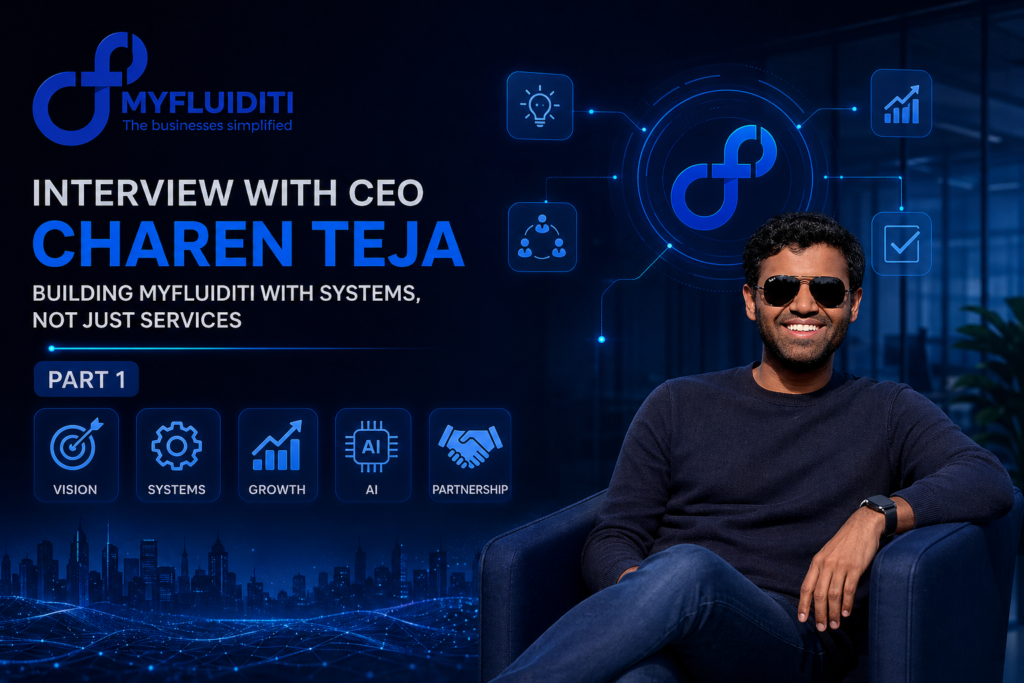
In this exclusive conversation, Charen Teja, CEO of MyFluiditi, shares insights into the company’s foundation, approach, and long-term vision.
1. What was the core idea behind starting MyFluiditi?
Charen Teja:
When I started MyFluiditi, the intention was very clear: businesses don’t fail because of lack of tools, they fail because systems don’t connect. Most companies invest heavily in technology, but everything operates in silos, creating inefficiencies at every stage. We wanted to change that. At MyFluiditi, the focus is on building connected systems where operations flow seamlessly, instead of breaking between departments or tools. The idea was never to become another service provider, but to become a problem-solving partner that simplifies complexity. That is why even though the name reflects our philosophy things should flow, not get stuck.
2. How do you position MyFluiditi in today’s competitive tech landscape?
Charen Teja:
In today’s market, many companies define themselves by services development, AI, marketing but clients are not looking for services, they are looking for results and measurable outcomes. At MyFluiditi, we position ourselves differently. We start with the business problem, not the solution. This allows us to understand what is actually limiting growth or efficiency, and then apply the right combination of technology and strategy. Our strength lies in thinking beyond tools and focusing on systems, which is why we are seen not just as a vendor, but as a long-term execution partner.
3. Many companies struggle with execution. How does MyFluiditi ensure consistency in delivery?
Charen Teja:
Execution problems usually come from lack of clarity and poorly defined workflows, not from lack of talent. At MyFluiditi, we address this at the foundation level. Every project is structured with clear stages, defined ownership, and measurable outcomes. There is no ambiguity about who is responsible for what. We also avoid unnecessary complexity; simple, well-designed systems outperform complicated ones in the long run. By ensuring that teams operate within a clear and structured framework, we maintain consistency without relying on constant supervision.
4. What role does AI play in MyFluiditi’s approach?
Charen Teja:
AI is powerful, but it is often misused as a trend rather than a solution. At MyFluiditi, we use AI with a clear purpose to improve efficiency, reduce manual effort, and enhance decision-making. We don’t treat AI as a separate layer; instead, we integrate it into workflows where it adds real value. Whether it is automation, analytics, or advanced testing approaches like agentic automation, everything is aligned with the system. Our approach is simple: AI should simplify operations, not complicate them.
5. What makes MyFluiditi different from other technology companies?
Charen Teja:
The biggest difference is how we think about problems. Most companies solve what is visible, but the real issues are usually hidden within the system. At MyFluiditi, we go deeper to identify root causes rather than surface-level symptoms. For example, if a business is struggling with growth, the issue may not be marketing it could be positioning, messaging, or internal inefficiencies. We focus on redesigning how systems work, not just delivering outputs. This is why our solutions create long-term impact instead of short-term fixes.
6. How do you build a strong team culture in MyFluiditi?
Charen Teja:
Culture is not something you define in documents, it is something you build through consistent systems and daily execution. At MyFluiditi, we focus on clarity, ownership, and continuous growth. Every team member understands their role and the impact of their work, which removes confusion and increases accountability. We also ensure that people have real ownership, not just responsibilities, which naturally drives performance. Growth is embedded into the work itself, so every project becomes an opportunity to improve. The result is an environment where people can perform without unnecessary pressure.
7. What is your long-term vision for MyFluiditi?
Charen Teja:
The long-term vision is to build MyFluiditi into a company that is known for solving complex problems in the simplest way possible. We are moving towards a future in which systems, AI, and human intelligence work together seamlessly to create efficient, scalable business operations. Our goal is not just to deliver services, but to build reliable systems that businesses can depend on for growth. Step by step, we are focusing on strengthening the foundation so that MyFluiditi becomes a trusted partner for companies looking to scale sustainably.
Conclusion
This conversation with Charen Teja highlights a clear shift in mindset from service delivery to system-driven execution. MyFluiditi’s approach, rooted in clarity, structured workflows, and deep problem-solving, positions it as more than just a technology company.
It represents a model where efficiency, scalability, and simplicity coexist, enabling businesses to operate with confidence in an increasingly complex environment.
In Part 2, we will explore deeper insights into scaling strategies, client success, and the evolving role of MyFluiditi in the AI-driven ecosystem.