Introduction
In today’s highly competitive digital landscape, businesses are under constant pressure to release applications faster without compromising quality, scalability, or user experience. Traditional monolithic architectures often slow down development cycles, create maintenance challenges, and make it difficult for engineering teams to adapt to changing business requirements. This is why Modular App Development has become one of the most effective software engineering strategies for organizations focused on speed, flexibility, and long-term scalability.
Modern technology companies, startups, and enterprises are increasingly adopting modular software architecture, component-based development, and scalable application frameworks to accelerate product delivery. Teams that consistently ship high-quality software at speed are structuring their codebases into independent, reusable modules that can be developed, tested, and deployed efficiently.
At MyFluiditi, we help businesses build scalable digital products using modern modular development practices, cloud-native architecture, DevOps automation, and AI-powered engineering solutions. Our approach enables organizations to reduce technical debt, improve collaboration, and accelerate software delivery while maintaining enterprise-grade reliability.
What Is Modular App Development?
Modular app development is a software architecture approach where applications are divided into smaller, self-contained modules that perform specific functions independently. Rather than building a single large codebase where every feature is tightly connected, modular architecture separates functionality into reusable components that can evolve independently.
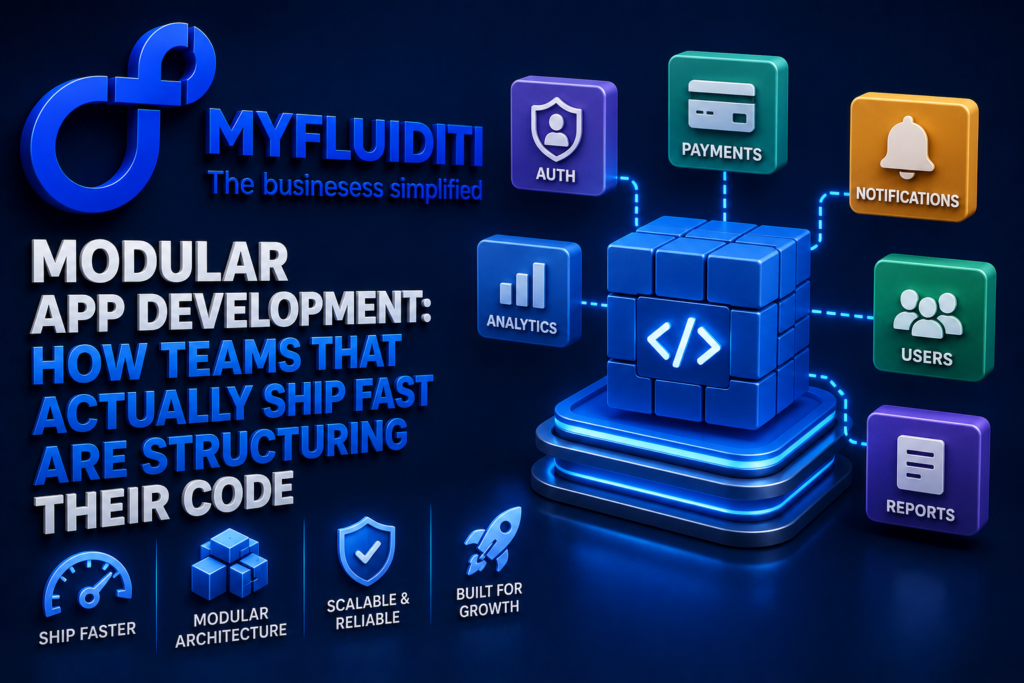
Each module handles a specific responsibility such as authentication, payments, notifications, analytics, user management, or reporting. These modules communicate through clearly defined interfaces, allowing developers to make changes without affecting the entire application.
At MyFluiditi, we design modular application architectures that improve maintainability, simplify scaling, and support faster product evolution. This approach allows businesses to introduce new features quickly while minimizing risks associated with large-scale code changes.
Why High-Performing Engineering Teams Prefer Modular Architecture
Teams that consistently deliver software faster understand that speed comes from structure, not shortcuts. As applications grow, monolithic systems become increasingly difficult to maintain. Small updates often require changes across multiple parts of the system, increasing testing complexity and deployment risks.
Modular software development solves these challenges by enabling teams to work independently on different parts of an application. Developers can build, test, and deploy modules without impacting unrelated functionality. This reduces bottlenecks, improves productivity, and supports continuous delivery practices.
At MyFluiditi, we implement modular architectures that allow engineering teams to scale efficiently while maintaining development velocity. By reducing dependencies between features, businesses can accelerate release cycles and respond faster to market demands.
Faster Development Through Independent Modules
One of the biggest advantages of modular app development is parallel development. Multiple teams can work on different modules simultaneously without creating conflicts in the codebase.
For example, while one team enhances user authentication, another can improve analytics functionality and a third can build new payment integrations. Since each module operates independently, development progresses faster and deployment becomes more predictable.
This approach is particularly valuable for organizations building enterprise applications, SaaS platforms, mobile apps, and AI-powered software solutions where frequent updates are essential for maintaining competitiveness.
At MyFluiditi, we help businesses implement modular development workflows that improve engineering efficiency while reducing release delays.
Improved Scalability and Performance
Modern digital products must handle growing user bases, increasing workloads, and evolving business requirements. Applications built using modular architecture are easier to scale because individual modules can be optimized independently.
Instead of scaling an entire application when only one component experiences high demand, businesses can allocate resources specifically to the modules that require additional capacity. This improves performance while reducing infrastructure costs.
Cloud-native application development, microservices architecture, and modular systems work together to create highly scalable software environments. MyFluiditi helps organizations leverage these technologies to build applications capable of supporting long-term growth.
Better Code Quality and Maintainability
As applications become more complex, maintaining clean and organized code becomes increasingly important. Modular architecture encourages developers to create smaller, focused codebases that are easier to understand, test, and maintain.
When bugs occur, developers can quickly identify the affected module rather than searching through a large interconnected system. This reduces troubleshooting time and improves software reliability.
At MyFluiditi, we follow modern software engineering best practices that emphasize clean architecture, reusable components, automated testing, and continuous improvement. This helps businesses maintain high-quality applications while reducing long-term maintenance costs.
Modular Development and DevOps Success
The success of DevOps, CI/CD pipelines, and continuous delivery practices depends heavily on architecture. Applications built with modular structures are naturally better suited for automated deployment workflows.
Because modules can be tested independently, development teams can automate quality assurance processes and deploy updates more frequently. Smaller deployments reduce risks, improve stability, and accelerate feature releases.
MyFluiditi integrates modular architecture with DevOps automation to help organizations achieve faster software delivery while maintaining governance, security, and operational reliability.
How MyFluiditi Builds Modular Applications
At MyFluiditi, we combine modular app development, cloud engineering, AI integration, and platform modernization to create future-ready software solutions. Our development process focuses on designing scalable architectures that support both current business needs and future growth.
We begin by identifying core business functions and organizing them into independent modules with clearly defined responsibilities. Each module is designed for reusability, scalability, and seamless integration within the broader ecosystem.
Our engineering teams leverage modern technologies such as React, Angular, Flutter, Node.js, AWS, Azure, and cloud-native infrastructure to deliver high-performance applications that evolve efficiently over time. By combining technical excellence with business strategy, MyFluiditi helps organizations accelerate innovation while maintaining software quality.
The Future of Modular Software Development
As businesses continue adopting AI-driven applications, cloud-native platforms, microservices, and digital transformation strategies, modular development will become even more important. Future software ecosystems will require greater flexibility, faster deployment cycles, and improved adaptability to changing market conditions.
Emerging trends such as AI-assisted development, platform engineering, composable applications, and intelligent automation are all strengthening the importance of modular architecture. Organizations that embrace modular development today will be better positioned to innovate rapidly while maintaining operational efficiency.
At MyFluiditi, we help businesses prepare for this future by building scalable software ecosystems designed for continuous growth, faster releases, and long-term success.
Conclusion
Modular App Development is transforming how modern engineering teams build and deliver software. By organizing applications into independent, reusable modules, businesses can improve scalability, accelerate development, enhance code quality, and reduce operational complexity.
Organizations that want to ship faster without sacrificing reliability need architectures that support agility, collaboration, and continuous innovation. This is where MyFluiditi delivers value by helping businesses design and implement modular software solutions that align with both technical and business goals.
As digital products become increasingly complex, modular architecture provides the foundation organizations need to innovate confidently, scale efficiently, and stay competitive in an ever-evolving technology landscape.