Artificial Intelligence: Driving Innovation Across Industries
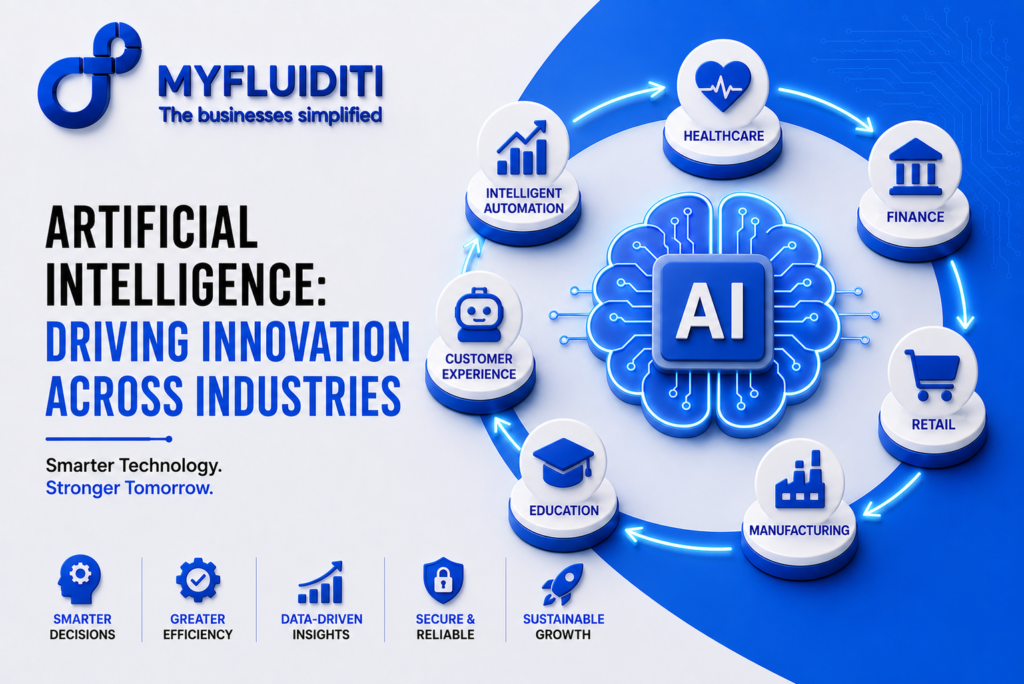
Introduction Artificial Intelligence (AI) is transforming the way businesses operate, compete, and innovate in today’s digital economy. Once considered a futuristic concept, Artificial Intelligence has become a powerful business technology that enables organizations to automate processes, improve decision-making, enhance customer experiences, and unlock new growth opportunities. Across industries such as healthcare, finance, manufacturing, retail, logistics, education, and telecommunications, AI is reshaping traditional business models by delivering smarter, faster, and more efficient solutions. Businesses that embrace AI-powered solutions gain a competitive advantage through increased productivity, data-driven insights, and continuous innovation. At MyFluiditi, we help organizations harness the power of Artificial Intelligence by developing intelligent solutions tailored to their business objectives, ensuring sustainable growth and long-term success. Understanding Artificial Intelligence Artificial Intelligence refers to computer systems that simulate human intelligence by learning from data, recognizing patterns, solving problems, and making informed decisions. AI technologies such as Machine Learning (ML), Natural Language Processing (NLP), computer vision, predictive analytics, and intelligent automation allow businesses to process large volumes of data with greater speed and accuracy than traditional methods. These technologies are transforming everyday business operations while enabling organizations to innovate at an unprecedented pace. MyFluiditi develops AI-driven applications that integrate seamlessly into existing business environments, helping companies improve efficiency while embracing digital innovation. AI Transforming Healthcare The healthcare industry is one of the biggest beneficiaries of Artificial Intelligence. AI assists healthcare providers in disease detection, medical imaging, predictive diagnostics, personalized treatment planning, patient monitoring, and hospital management. Intelligent systems can analyze vast amounts of medical data, helping physicians make faster and more accurate clinical decisions. AI also supports administrative automation, reducing paperwork and improving operational efficiency. MyFluiditi builds AI-powered healthcare solutions that improve patient care, optimize healthcare workflows, and support better clinical outcomes. Revolutionizing Financial Services Financial institutions are using AI solutions to strengthen fraud detection, automate customer service, improve credit risk assessment, optimize investment strategies, and enhance regulatory compliance. Intelligent algorithms monitor financial transactions in real time, identifying suspicious activities while minimizing operational risks. AI-powered virtual assistants and personalized financial recommendations improve customer satisfaction and operational efficiency. At MyFluiditi, we develop secure AI applications that help financial organizations improve decision-making while delivering reliable and efficient financial services. AI in Retail and eCommerce Retail businesses are leveraging Artificial Intelligence to deliver personalized shopping experiences, optimize inventory management, forecast customer demand, and automate customer support. AI-powered recommendation engines analyze customer preferences and purchasing behavior to suggest relevant products, increasing engagement and sales. Intelligent inventory systems reduce stock shortages while improving supply chain efficiency. MyFluiditi creates AI-driven retail solutions that help businesses improve customer experiences while maximizing operational performance and profitability. Enhancing Manufacturing Through AI Manufacturing companies are adopting AI-powered automation to improve production efficiency, quality control, equipment maintenance, and operational safety. Predictive maintenance uses AI to monitor machinery and identify potential failures before they occur, reducing downtime and maintenance costs. Computer vision systems inspect product quality with remarkable accuracy, ensuring consistent manufacturing standards. MyFluiditi develops intelligent manufacturing solutions that enhance productivity, optimize resources, and support smarter factory operations. Smarter Logistics and Supply Chain Management Modern supply chains generate enormous amounts of operational data. Artificial Intelligence enables businesses to analyze this information for demand forecasting, route optimization, warehouse automation, inventory planning, and real-time shipment tracking. AI improves logistics efficiency by reducing delivery times, lowering transportation costs, and enhancing supply chain visibility. MyFluiditi helps logistics and supply chain organizations implement AI-powered solutions that streamline operations while improving customer satisfaction. Improving Customer Experience with AI Customer expectations continue to rise across every industry. Businesses now use AI-powered customer engagement tools such as intelligent chatbots, virtual assistants, personalized recommendations, sentiment analysis, and predictive customer support to deliver faster and more meaningful interactions. AI enables businesses to understand customer behavior, anticipate needs, and provide personalized experiences across multiple digital channels. MyFluiditi develops intelligent customer engagement platforms that strengthen relationships, improve service quality, and increase customer loyalty. Intelligent Business Automation One of the most valuable applications of Artificial Intelligence is intelligent automation. Businesses can automate repetitive tasks such as document processing, invoice management, customer onboarding, workflow approvals, and reporting while improving speed and reducing human error. AI-driven automation enables employees to focus on strategic activities instead of routine administrative work. MyFluiditi builds automation solutions that combine AI with business workflows, enabling organizations to improve productivity, operational efficiency, and overall business performance. Data Analytics and Smarter Decision-Making Organizations generate massive volumes of business data every day. AI-powered analytics transforms this information into valuable business insights through predictive modeling, trend analysis, customer behavior forecasting, and real-time reporting. Businesses can make faster and more informed decisions while identifying opportunities for growth and operational improvement. At MyFluiditi, we integrate advanced analytics and AI capabilities into business applications, helping organizations turn complex data into actionable intelligence. AI Security and Ethical Considerations As AI adoption continues to expand, businesses must prioritize data privacy, cybersecurity, transparency, and responsible AI implementation. Secure AI systems protect sensitive information while ensuring compliance with industry regulations and ethical standards. Organizations should also implement governance frameworks that promote fairness, accountability, and explainability in AI-driven decision-making. MyFluiditi follows industry best practices to develop secure, reliable, and responsible AI solutions that businesses can trust. Why Businesses Choose MyFluiditi Successful AI implementation requires more than deploying intelligent algorithms—it requires strategic planning, industry expertise, seamless integration, and continuous optimization. MyFluiditi provides comprehensive AI development services, including AI consulting, machine learning solutions, predictive analytics, intelligent automation, chatbot development, computer vision, Natural Language Processing, API integration, cloud deployment, and ongoing support. Our experienced team works closely with clients to build scalable AI solutions that align with business goals while delivering measurable business value. The Future of Artificial Intelligence The future of Artificial Intelligence will continue to redefine industries through autonomous systems, generative AI, advanced robotics, edge AI, intelligent decision-making, and personalized digital experiences. Organizations that invest in AI today will be better equipped to innovate, improve operational efficiency, and remain competitive in an increasingly digital marketplace. Continuous advancements in AI technologies will create new opportunities for businesses to
From Search to Engagement: Building a Winning SEO Strategy
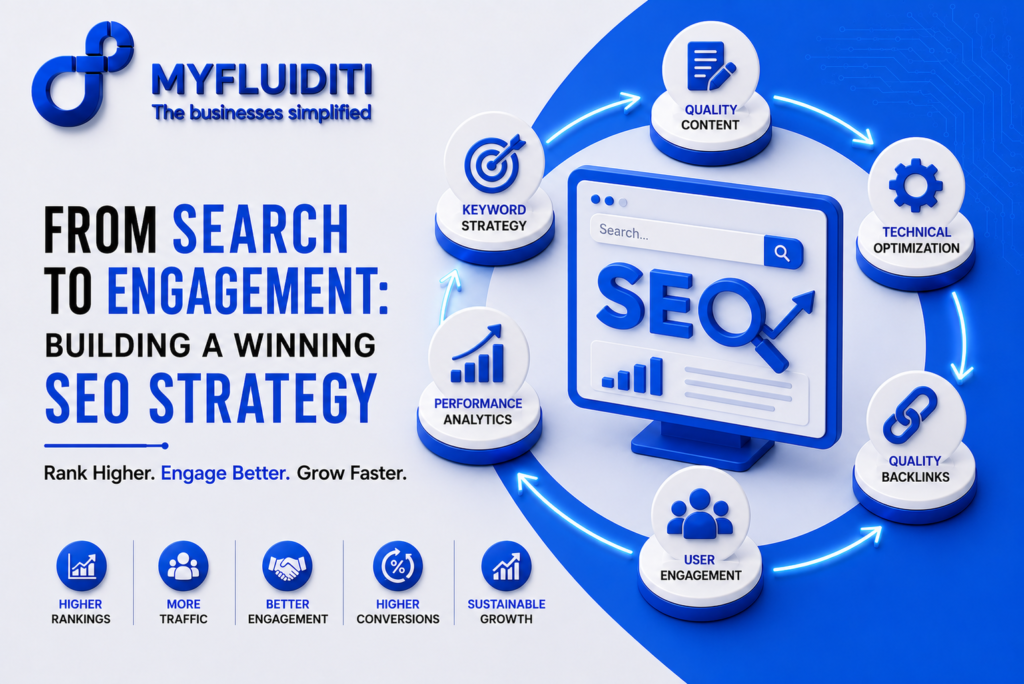
Introduction In today’s digital-first marketplace, having a website is only the beginning of a successful online presence. The real challenge lies in attracting the right audience and keeping them engaged long enough to convert into loyal customers. A strong SEO strategy is no longer just about ranking higher on search engines it is about creating meaningful user experiences that encourage engagement, build trust, and drive long-term business growth. Modern businesses that combine Search Engine Optimization (SEO) with high-quality content, technical excellence, and customer-focused strategies gain a significant competitive advantage. At MyFluiditi, we help businesses develop comprehensive SEO strategies that increase visibility, attract qualified traffic, and transform website visitors into engaged customers. Understanding Modern SEO Search Engine Optimization has evolved far beyond keyword placement and backlinks. Search engines now prioritize websites that provide valuable content, fast performance, mobile responsiveness, and exceptional user experiences. Businesses must optimize every aspect of their digital presence to meet both search engine requirements and customer expectations. A successful SEO strategy focuses on increasing organic visibility while ensuring visitors find relevant information that encourages interaction and builds confidence. MyFluiditi develops customized SEO solutions that combine technical optimization with strategic content to deliver measurable business results. Why SEO Matters for Business Growth Millions of online searches are performed every day by customers looking for products, services, and information. Businesses that appear on the first page of search results gain greater visibility, increased credibility, and higher website traffic. However, attracting visitors is only the first step. Effective Search Engine Optimization ensures businesses connect with the right audience while creating engaging digital experiences that encourage users to explore more pages, request services, or make purchases. At MyFluiditi, we create SEO strategies designed to generate sustainable organic growth while improving customer engagement. Creating High-Quality Content That Engages Content remains one of the strongest pillars of successful SEO. Informative, relevant, and well-structured content helps businesses answer customer questions while demonstrating industry expertise. Search engines reward websites that consistently publish valuable content, while users are more likely to stay longer, interact with pages, and return for future information. Strong content marketing improves both search rankings and user engagement by delivering value throughout the customer journey. MyFluiditi develops SEO-focused content strategies that attract search traffic while building meaningful customer relationships. Optimizing Technical SEO Behind every successful website is a strong technical foundation. Technical SEO ensures search engines can crawl, index, and understand website content efficiently. Fast loading speeds, mobile-friendly design, secure HTTPS connections, structured data, optimized images, and clean website architecture all contribute to higher search rankings and better user experiences. Technical optimization also reduces bounce rates and improves overall website performance. MyFluiditi performs comprehensive technical SEO audits and implements best practices that strengthen website performance and search visibility. Enhancing User Experience for Better Engagement Modern SEO is closely connected to user experience. Visitors expect websites to load quickly, navigate easily, and provide valuable information without unnecessary complexity. A positive user experience (UX) encourages visitors to spend more time on a website, interact with content, and complete desired actions. Search engines recognize these engagement signals when determining rankings. At MyFluiditi, we combine SEO with user-focused design principles to create digital experiences that improve both search performance and customer satisfaction. Keyword Strategy That Attracts the Right Audience Choosing the right SEO keywords is essential for attracting qualified traffic. Businesses must understand what their target audience is searching for and create content that answers those specific needs. Effective keyword research balances search volume, user intent, and competition while supporting long-term organic growth. Instead of focusing only on high-volume keywords, successful SEO strategies also target long-tail search terms that deliver highly relevant traffic. MyFluiditi develops data-driven keyword strategies that improve search rankings while connecting businesses with customers actively seeking their services. Building Authority Through Quality Backlinks Search engines view backlinks as indicators of trust and credibility. High-quality backlinks from authoritative websites strengthen domain authority and improve search engine rankings. However, successful link-building strategies prioritize relevance and quality over quantity. Businesses that consistently publish valuable content naturally attract links, increasing both visibility and credibility. MyFluiditi helps organizations build sustainable SEO strategies that enhance online authority while supporting long-term search performance. Measuring SEO Performance A successful SEO strategy requires continuous monitoring and optimization. Businesses should track organic traffic, keyword rankings, user engagement, bounce rates, conversion rates, and overall website performance. These insights help identify opportunities for improvement while ensuring marketing efforts deliver measurable business outcomes. At MyFluiditi, we provide detailed SEO analytics and reporting that enable businesses to make informed decisions and continuously refine their digital marketing strategies. SEO and Local Business Visibility For businesses serving specific geographic regions, Local SEO plays an important role in attracting nearby customers. Optimizing business profiles, local keywords, location pages, and customer reviews improves visibility in local search results. Businesses with strong local SEO strategies increase foot traffic, inquiries, and customer trust while strengthening their regional presence. MyFluiditi helps organizations implement local SEO strategies that improve visibility within their target markets. Why Businesses Choose MyFluiditi for SEO Building a successful SEO strategy requires technical expertise, market research, content planning, continuous optimization, and performance analysis. MyFluiditi offers end-to-end SEO services, including keyword research, technical SEO, on-page optimization, content marketing, link-building strategies, local SEO, website performance optimization, and ongoing analytics. Our experienced digital marketing team develops customized SEO solutions that align with business objectives while delivering sustainable organic growth and long-term customer engagement. The Future of SEO Search engine algorithms continue to evolve, placing greater emphasis on user intent, content quality, website performance, mobile experiences, and helpful information. Businesses that focus on delivering genuine value while maintaining strong technical optimization will continue to achieve higher search visibility. Future-ready SEO strategies combine technology, data, creativity, and customer-centric content to support lasting digital success. MyFluiditi stays ahead of industry trends, helping businesses adapt to evolving search engine requirements while maintaining a competitive online presence. Conclusion From Search to Engagement: Building a Winning SEO Strategy requires more than achieving high search rankings, it requires creating valuable digital
Unlocking Business Potential with Innovative Digital Solutions
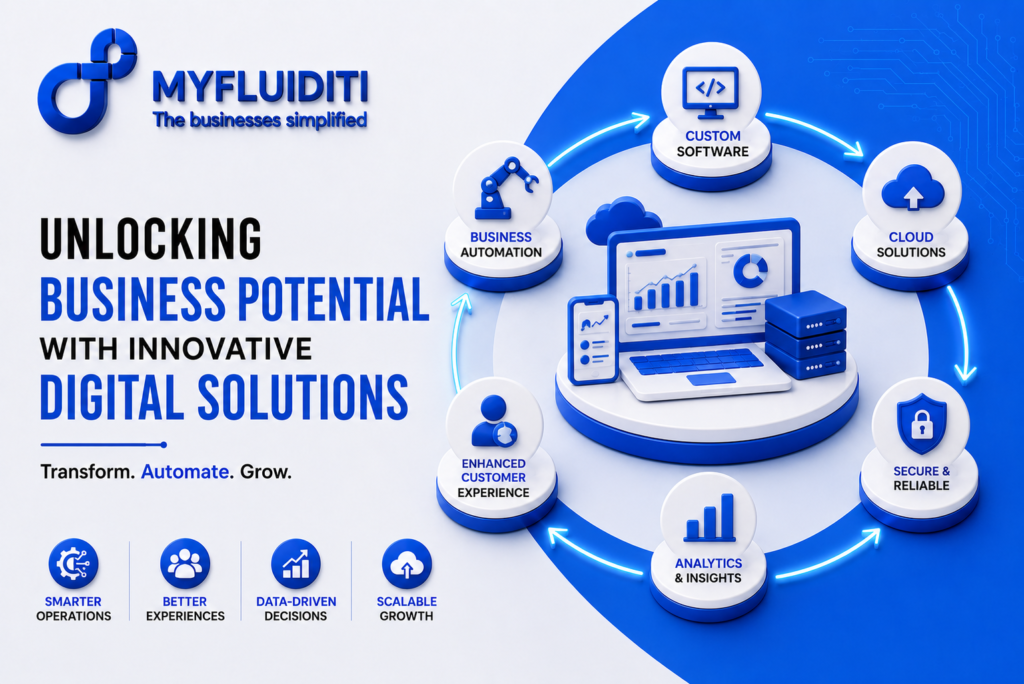
Introduction In today’s fast-paced digital economy, businesses must continuously evolve to remain competitive, improve customer experiences, and drive sustainable growth. Traditional business processes often struggle to keep up with changing market demands, increasing customer expectations, and rapid technological advancements. This is where Innovative Digital Solutions become essential. By integrating modern technologies, intelligent software, automation, cloud platforms, and data-driven strategies, organizations can streamline operations, improve efficiency, and unlock new growth opportunities. Businesses that embrace digital solutions are better positioned to innovate, scale, and succeed in an increasingly connected world. At MyFluiditi, we help organizations unlock their full potential by delivering customized digital solutions that transform ideas into measurable business outcomes. The Growing Importance of Digital Solutions Digital transformation is no longer limited to large enterprises. Businesses of every size are adopting digital business solutions to improve productivity, strengthen customer relationships, and increase operational efficiency. From custom software and mobile applications to cloud platforms and business automation, digital technologies are reshaping how organizations operate and compete. Companies that invest in modern digital solutions gain the flexibility to respond quickly to market changes while delivering exceptional customer experiences. MyFluiditi partners with businesses to develop innovative digital strategies that align technology with long-term business objectives. Building Smarter Business Operations One of the greatest advantages of digital solutions is the ability to simplify and optimize complex business processes. Manual tasks often consume valuable time, increase operational costs, and create opportunities for human error. Intelligent automation, integrated software platforms, and connected workflows eliminate repetitive processes while improving collaboration across departments. Businesses benefit from greater efficiency, faster decision-making, and improved productivity. At MyFluiditi, we design scalable digital ecosystems that automate workflows, integrate business systems, and enable organizations to operate more effectively. Enhancing Customer Experience Customer expectations continue to evolve as digital interactions become the standard across industries. Businesses must provide seamless, personalized, and convenient experiences through websites, mobile applications, customer portals, and online services. Digital customer experience has become a major factor influencing customer satisfaction and brand loyalty. Organizations that invest in user-focused digital platforms build stronger relationships while increasing customer retention. MyFluiditi develops intuitive digital solutions that prioritize user experience, ensuring every interaction strengthens customer engagement and business growth. Driving Innovation Through Custom Software Every business has unique challenges that cannot always be addressed by off-the-shelf software. Custom software development allows organizations to build technology tailored specifically to their operations, workflows, and business goals. Custom solutions improve flexibility, support future scalability, and integrate seamlessly with existing systems. Businesses gain complete control over their digital environment while improving overall performance. At MyFluiditi, our experienced development team creates customized software solutions designed to solve complex business challenges and deliver long-term value. Leveraging Cloud Technologies Modern cloud solutions provide businesses with secure, scalable, and flexible infrastructure that supports digital transformation initiatives. Cloud platforms enable organizations to access data from anywhere, improve collaboration, reduce infrastructure costs, and deploy applications more efficiently. Businesses also benefit from enhanced disaster recovery, automatic updates, and improved operational resilience. MyFluiditi helps organizations migrate to secure cloud environments while optimizing infrastructure for maximum performance, scalability, and business continuity. Business Automation for Greater Efficiency Automation has become one of the most valuable components of modern digital solutions. Business process automation reduces manual workloads, accelerates approvals, improves accuracy, and allows employees to focus on strategic initiatives rather than repetitive tasks. Automated workflows improve operational consistency while reducing costs and increasing productivity across departments. MyFluiditi develops intelligent automation solutions that simplify business operations and create connected workflows that enhance organizational performance. Data-Driven Decision Making Businesses generate enormous volumes of data every day. Without the right tools, valuable information often remains underutilized. Business intelligence and advanced analytics transform raw data into actionable insights that support smarter decision-making. Organizations can monitor performance, understand customer behavior, identify emerging trends, and optimize business strategies through real-time reporting and analytics. At MyFluiditi, we integrate powerful analytics capabilities into digital solutions, enabling businesses to make informed decisions that drive continuous improvement and sustainable growth. Strengthening Security and Reliability As organizations embrace digital transformation, protecting sensitive business and customer information becomes increasingly important. Secure digital solutions include advanced cybersecurity measures such as encryption, identity management, secure APIs, multi-factor authentication, access controls, and continuous monitoring. Strong security practices build customer trust while ensuring compliance with industry regulations. MyFluiditi follows security-first development practices to create reliable digital platforms that protect critical business assets without compromising performance. Supporting Scalable Business Growth Successful businesses need technology that grows alongside their operations. Modern digital solutions are designed with scalability in mind, allowing organizations to expand services, support increasing customer demand, and integrate new technologies without disrupting existing operations. Flexible digital platforms provide businesses with the ability to innovate continuously while adapting to changing market conditions. MyFluiditi develops scalable solutions that support long-term growth while ensuring consistent performance across every stage of business expansion. Digital Solutions Across Industries Organizations across healthcare, finance, retail, manufacturing, logistics, education, hospitality, and professional services are using innovative digital solutions to improve efficiency, increase customer satisfaction, and accelerate digital transformation. Whether developing enterprise software, customer portals, mobile applications, eCommerce platforms, workflow automation systems, or integrated cloud environments, businesses benefit from technology that aligns with their specific operational requirements. MyFluiditi works closely with organizations across industries to deliver customized digital solutions that solve real business challenges and create measurable value. Why Businesses Choose MyFluiditi Choosing the right technology partner is critical for successful digital transformation. MyFluiditi provides end-to-end digital solution services including business consulting, software development, mobile application development, cloud integration, UI/UX design, API development, automation, quality assurance, deployment, and ongoing support. Our collaborative approach ensures every solution is designed around business goals while delivering scalability, security, and long-term performance. By combining technical expertise with innovation, MyFluiditi helps businesses transform complex challenges into opportunities for sustainable growth. The Future of Digital Solutions The future of business will be driven by organizations that embrace innovation and continuously evolve with technology. Emerging advancements in automation, intelligent software, cloud computing, predictive analytics, connected platforms, and customer-centric digital experiences will continue
Cloud Infrastructure: The Foundation of Digital Transformation

Introduction In today’s fast-changing digital landscape, businesses need technology that is scalable, secure, and flexible to stay competitive. Traditional IT infrastructure often struggles to keep pace with growing business demands, increasing operational costs, and evolving customer expectations. This is where Cloud Infrastructure plays a vital role. It provides organizations with the foundation they need to modernize operations, improve collaboration, enhance security, and accelerate innovation. As digital transformation continues to reshape industries, businesses that adopt cloud infrastructure gain the agility and resilience required for long-term success. At MyFluiditi, we help organizations design, deploy, and manage modern cloud infrastructure solutions that support business growth while ensuring high performance and reliability. Understanding Cloud Infrastructure Cloud Infrastructure refers to the virtualized computing resources that power modern business applications and digital services. It includes servers, storage, networking, databases, virtualization technologies, and cloud management platforms delivered over the internet. Unlike traditional on-premise infrastructure, cloud environments provide businesses with on-demand access to computing resources without significant hardware investments. This flexibility enables organizations to scale operations efficiently while reducing maintenance costs. MyFluiditi develops customized cloud infrastructure solutions that align with business goals, ensuring seamless performance and operational excellence. Why Cloud Infrastructure Matters for Digital Transformation Digital transformation requires businesses to rethink how they operate, collaborate, and deliver value to customers. Modern organizations depend on connected systems, real-time data, and intelligent applications to remain competitive. Cloud infrastructure provides the technological backbone that supports these initiatives by enabling faster application deployment, seamless collaboration, secure data access, and business continuity. With MyFluiditi, businesses can modernize their IT environment through scalable cloud solutions that improve efficiency while preparing them for future growth. Scalability That Supports Business Growth One of the greatest advantages of cloud computing infrastructure is its ability to scale as business needs evolve. Whether handling seasonal demand, expanding into new markets, or launching new digital services, organizations can increase or decrease computing resources without investing in additional physical hardware. This flexibility improves operational efficiency while controlling infrastructure costs. MyFluiditi helps businesses build scalable cloud environments that grow alongside their operations, ensuring consistent performance during every stage of business expansion. Enhanced Business Agility Speed has become a competitive advantage in today’s digital economy. Businesses need the ability to develop, test, deploy, and update applications quickly. Cloud infrastructure solutions enable faster software deployment, continuous integration, and rapid innovation without disrupting existing operations. Organizations can respond to changing market conditions more efficiently while delivering improved customer experiences. MyFluiditi leverages modern cloud technologies to help businesses accelerate digital initiatives while maintaining stability and reliability. Improved Security and Compliance Security remains one of the most important considerations in digital transformation. Modern cloud infrastructure includes advanced security capabilities such as data encryption, identity and access management, multi-factor authentication, disaster recovery, continuous monitoring, and automated backups. These features help businesses protect sensitive information while meeting regulatory compliance requirements. MyFluiditi implements secure cloud architectures that safeguard business-critical data while ensuring compliance with industry standards and best practices. Cost Optimization Through Cloud Adoption Traditional IT infrastructure often requires significant investments in servers, networking equipment, software licenses, maintenance, and ongoing upgrades. Cloud infrastructure reduces these costs through flexible pricing models where businesses only pay for the resources they use. This approach minimizes capital expenditure while maximizing operational efficiency. At MyFluiditi, we help organizations optimize cloud spending through strategic resource planning, workload optimization, and cost-effective infrastructure management. Seamless Integration Across Business Systems Modern businesses rely on multiple applications to manage operations, including CRM platforms, ERP systems, customer portals, analytics tools, and mobile applications. Cloud infrastructure enables these systems to communicate seamlessly through secure APIs and integrated cloud services. This improves workflow automation, data consistency, and collaboration across departments. MyFluiditi develops cloud integration solutions that connect business applications into a unified digital ecosystem, improving productivity and operational visibility. Supporting Business Continuity and Disaster Recovery Unexpected disruptions can impact business operations and customer trust. Cloud infrastructure provides built-in redundancy, automated backups, failover capabilities, and disaster recovery solutions that minimize downtime and ensure business continuity. Organizations can recover quickly from technical failures while maintaining uninterrupted access to business-critical systems. MyFluiditi designs resilient cloud environments that keep businesses operational even during unexpected challenges. Data Analytics and Intelligent Decision-Making Cloud platforms enable businesses to collect, process, and analyze large volumes of data in real time. Advanced data analytics, reporting tools, and business intelligence solutions help organizations gain valuable insights into customer behavior, operational performance, and market trends. These insights support smarter business decisions and continuous improvement. MyFluiditi integrates analytics capabilities within cloud environments, empowering businesses to transform raw data into actionable intelligence. Cloud Infrastructure Across Industries From healthcare and finance to retail, manufacturing, logistics, education, and professional services, organizations across every industry are adopting cloud infrastructure solutions to improve efficiency and accelerate innovation. Cloud technology supports remote collaboration, secure information sharing, application modernization, workflow automation, and digital customer experiences. MyFluiditi delivers industry-specific cloud solutions tailored to each organization’s operational needs, helping businesses maximize the value of their digital transformation initiatives. Why Businesses Choose MyFluiditi Successful cloud transformation requires more than simply migrating applications to the cloud. It requires strategic planning, secure architecture, seamless integration, performance optimization, and ongoing management. MyFluiditi provides end-to-end cloud infrastructure services, including cloud consulting, infrastructure design, migration, application modernization, cloud security, API integration, monitoring, optimization, and continuous support. Our experienced team works closely with businesses to develop scalable and future-ready cloud environments that align with long-term business objectives. Conclusion Cloud Infrastructure has become the foundation of successful digital transformation, enabling businesses to improve agility, scalability, security, operational efficiency, and customer experience. Organizations that invest in modern cloud solutions gain the flexibility to innovate faster, optimize costs, strengthen business continuity, and respond quickly to changing market demands. At MyFluiditi, we empower businesses with secure, scalable, and high-performance cloud infrastructure solutions designed to support long-term digital success. From cloud migration and infrastructure modernization to integration and ongoing optimization, MyFluiditi helps organizations build a strong digital foundation that drives innovation, operational excellence, and sustainable business growth.
End-to-End Business Automation: Driving Efficiency at Every Step
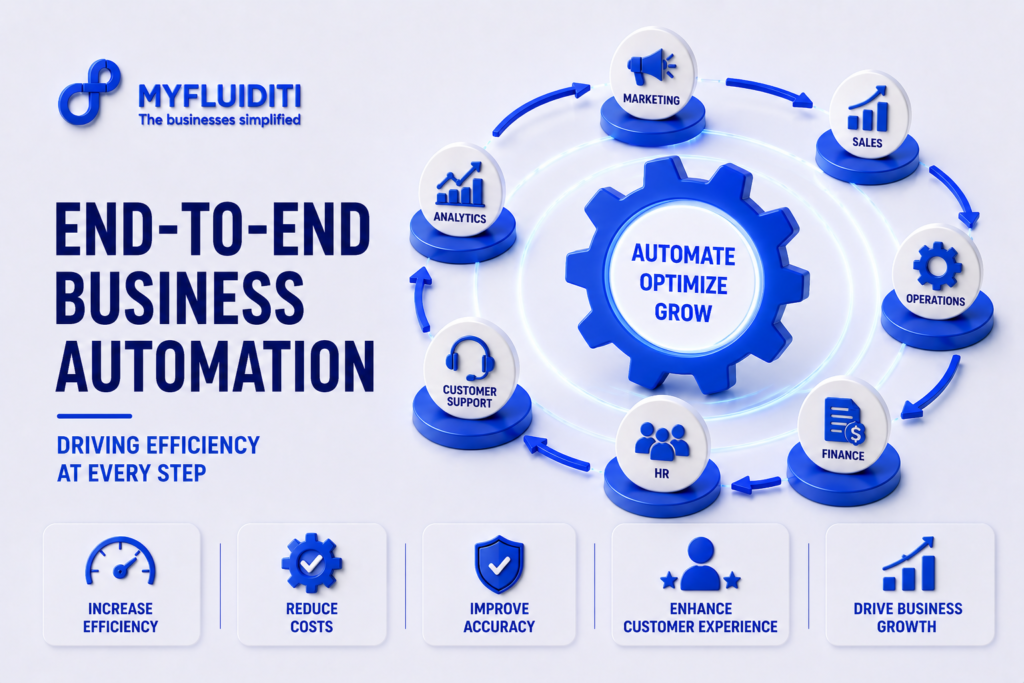
Introduction In today’s highly competitive business landscape, organizations are under constant pressure to improve productivity, reduce operational costs, and deliver exceptional customer experiences. Manual processes, disconnected systems, and repetitive tasks often slow down growth and create unnecessary bottlenecks. This is why End-to-End Business Automation has become a critical strategy for businesses looking to streamline operations and achieve sustainable success. By automating workflows across every department from sales and marketing to finance, HR, customer support, and supply chain companies can eliminate inefficiencies while improving accuracy and decision-making. Businesses that invest in business automation solutions are better positioned to scale faster, respond to market demands, and stay ahead of the competition. Understanding End-to-End Business Automation End-to-End Business Automation refers to the seamless automation of complete business processes rather than isolated tasks. Instead of automating a single activity, organizations connect every stage of their operations through intelligent workflows, cloud technologies, APIs, artificial intelligence, and real-time analytics. This creates a unified digital ecosystem where information flows effortlessly between departments without manual intervention. At MyFluiditi, we help businesses design automation strategies that integrate existing applications, optimize workflows, and create connected digital environments that improve operational efficiency from start to finish. Boosting Productivity Through Automation One of the biggest advantages of business process automation is increased productivity. Employees spend less time performing repetitive administrative work and more time focusing on innovation, customer engagement, and strategic decision-making. Automated workflows reduce human errors, accelerate approvals, improve communication, and ensure consistency across business operations. MyFluiditi develops intelligent automation platforms that simplify complex workflows while allowing organizations to monitor performance in real time through dashboards and actionable business insights. Improving Collaboration Across Business Functions Modern organizations also rely on workflow automation to improve collaboration across teams. Sales, finance, operations, marketing, and customer service often use different software platforms, creating data silos that delay business processes. End-to-end automation integrates these systems into a single connected environment, enabling seamless information sharing and faster decision-making. Through secure API integrations, cloud platforms, and customized automation solutions, MyFluiditi helps businesses connect their technology ecosystem while improving visibility across every operational stage. Enhancing Customer Experience with Automation Customer experience is another area where digital business automation delivers measurable value. Automated customer onboarding, instant notifications, personalized communication, intelligent chatbots, order tracking, payment processing, and customer support workflows significantly improve service quality. Businesses can respond faster, reduce waiting times, and provide consistent customer experiences across multiple digital channels. MyFluiditi builds automation solutions that help organizations strengthen customer relationships while increasing satisfaction and long-term loyalty. Automating Financial Operations Automation also transforms financial operations by simplifying invoice processing, payment approvals, expense management, compliance reporting, and financial reconciliation. Instead of relying on manual documentation, businesses gain real-time financial visibility and improved accuracy through automated processes. This reduces operational risks while supporting faster financial decision-making. MyFluiditi develops secure automation frameworks that improve financial workflows without disrupting existing enterprise systems. AI-Powered Intelligent Automation The integration of Artificial Intelligence (AI) with business automation takes efficiency to an entirely new level. AI-powered automation analyzes business data, predicts trends, identifies operational bottlenecks, and makes intelligent recommendations that support better business outcomes. Combined with machine learning and predictive analytics, automation becomes proactive rather than reactive. At MyFluiditi, we integrate AI capabilities into automation platforms, enabling organizations to automate smarter, optimize resources, and continuously improve operational performance. Cloud-Based Automation for Scalability Cloud technology has further accelerated the adoption of enterprise automation solutions. Cloud-based automation platforms offer scalability, flexibility, security, and remote accessibility, allowing businesses to manage operations from anywhere while reducing infrastructure costs. Organizations can rapidly expand automation across departments without investing heavily in new hardware. MyFluiditi delivers cloud-enabled automation solutions that support growing businesses with secure, scalable, and future-ready digital infrastructures. Ensuring Security and Compliance Security and compliance remain essential components of successful automation strategies. As automated systems handle sensitive business and customer information, organizations must ensure data protection, user authentication, access control, and regulatory compliance. Secure automation frameworks protect critical business assets while maintaining operational integrity. MyFluiditi follows industry best practices in cybersecurity, secure API integration, encryption, and compliance standards to ensure every automation solution remains reliable and protected. Real-Time Business Intelligence One of the most valuable outcomes of end-to-end automation is real-time business intelligence. Automated systems continuously collect operational data, generate reports, monitor key performance indicators, and provide valuable insights that support faster and more informed business decisions. Executives gain complete visibility into workflows, customer interactions, financial performance, and operational efficiency, enabling continuous optimization. Through intelligent dashboards and analytics solutions, MyFluiditi empowers organizations to make data-driven decisions that accelerate business growth. Automation Across Industries Every industry from healthcare and finance to retail, manufacturing, logistics, education, and professional services is embracing digital transformation through automation. Whether it’s managing customer relationships, optimizing inventory, streamlining supply chains, automating employee onboarding, or improving compliance processes, automation enables businesses to achieve higher efficiency while remaining agile in changing markets. MyFluiditi works closely with organizations to understand their unique challenges and deliver customized automation solutions that align with their business objectives. Conclusion As businesses continue to evolve in an increasingly digital world, automation is no longer a luxury, it has become a strategic necessity. Organizations that automate end-to-end processes experience greater efficiency, reduced operational costs, improved customer satisfaction, faster decision-making, and stronger competitive advantage. By combining advanced technologies, intelligent workflows, cloud platforms, and seamless system integration, MyFluiditi helps businesses unlock the full potential of automation while preparing them for long-term digital success. Investing in End-to-End Business Automation today enables organizations to build resilient, scalable, and future-ready operations that drive sustainable growth for years to come.