CRM and Marketing Automation: A Winning Combination
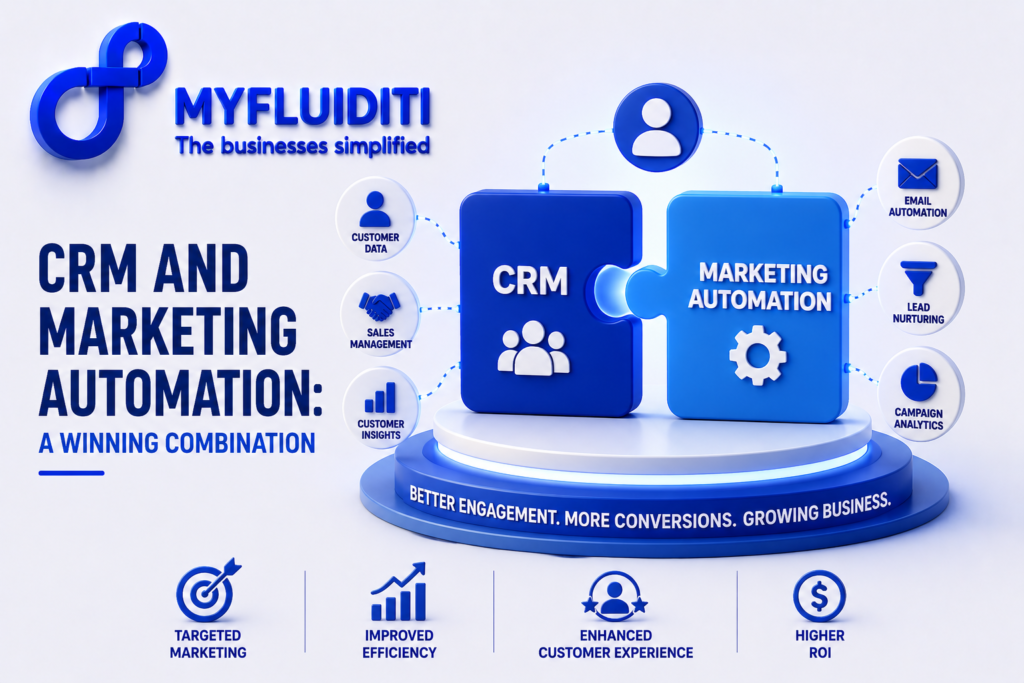
Introduction In today’s competitive digital marketplace, businesses need more than great products and services to succeed, they need meaningful customer relationships and efficient marketing processes. Customers expect personalized communication, timely responses, and seamless experiences across every touchpoint. Managing these expectations manually has become increasingly difficult as organizations grow and customer interactions multiply. This is where Customer Relationship Management (CRM) and Marketing Automation come together to create a powerful business solution. By integrating customer data with intelligent automation, businesses can streamline operations, improve customer engagement, generate qualified leads, and drive higher conversion rates. Together, CRM and marketing automation enable organizations to deliver personalized experiences while improving productivity and maximizing return on investment. At MyFluiditi, we help businesses implement integrated CRM and marketing automation solutions that simplify customer management, optimize marketing performance, and accelerate digital transformation. Understanding CRM and Marketing Automation A Customer Relationship Management (CRM) system serves as the central hub for managing customer interactions, sales activities, contact information, service requests, and business relationships. Marketing automation complements CRM by automating repetitive marketing tasks such as email campaigns, lead nurturing, customer segmentation, campaign scheduling, follow-ups, and performance tracking. When these technologies work together, businesses gain complete visibility into the customer journey while delivering personalized communication at every stage. Instead of operating separate sales and marketing processes, organizations create a connected ecosystem that improves collaboration, enhances customer experiences, and increases operational efficiency. MyFluiditi develops integrated CRM and automation solutions that align technology with business objectives to deliver measurable growth. Why CRM and Marketing Automation Work Better Together Sales and marketing teams share the common goal of acquiring and retaining customers, yet disconnected systems often create communication gaps, inconsistent customer experiences, and lost business opportunities. Integrating CRM with Marketing Automation ensures that customer data flows seamlessly between departments, enabling sales teams to access marketing insights while marketers gain visibility into sales activities. Every interaction from website visits and email engagement to purchases and support requests is automatically captured and analyzed. This unified approach allows businesses to deliver timely, relevant communication while improving collaboration across departments. MyFluiditi helps organizations eliminate operational silos by creating intelligent CRM ecosystems that connect sales, marketing, and customer service into a single digital platform. Enhancing Customer Engagement Through Personalization Modern customers expect businesses to understand their preferences, anticipate their needs, and deliver personalized experiences. CRM systems store valuable customer information, while marketing automation uses that data to create highly targeted campaigns based on behavior, demographics, interests, and purchasing history. Businesses can automatically deliver personalized emails, product recommendations, promotional offers, follow-up messages, and educational content at the right moment in the customer journey. This level of personalization improves engagement, strengthens customer relationships, and increases conversion rates. At MyFluiditi, we build customer-centric automation strategies that transform customer data into meaningful experiences that foster long-term loyalty. Improving Lead Generation and Lead Nurturing Generating leads is only the first step toward business growth. Converting prospects into loyal customers requires consistent communication, timely follow-ups, and personalized engagement. CRM and marketing automation work together to capture leads from websites, landing pages, social media platforms, webinars, and digital campaigns while automatically assigning them to appropriate sales workflows. Lead nurturing campaigns deliver relevant content based on customer interests and engagement levels, ensuring prospects remain connected throughout the buying process. By automating these interactions, businesses improve conversion rates while allowing sales teams to focus on high-value opportunities. MyFluiditi develops intelligent lead management systems that accelerate customer acquisition while improving marketing efficiency. Streamlining Sales and Marketing Operations Manual processes consume valuable time and often result in inconsistent customer experiences. CRM and marketing automation eliminate repetitive administrative tasks by automating campaign management, customer segmentation, appointment scheduling, follow-up reminders, sales notifications, reporting, and workflow approvals. Businesses gain greater operational efficiency while reducing human error and improving team productivity. Automated workflows also ensure that no customer inquiry or sales opportunity is overlooked. MyFluiditi helps organizations optimize business operations through intelligent workflow automation that increases efficiency while enhancing collaboration between marketing and sales teams. Leveraging Data-Driven Decision Making One of the greatest advantages of integrating CRM with marketing automation is access to real-time customer insights. Businesses can monitor campaign performance, lead quality, customer engagement, conversion rates, revenue attribution, and customer lifetime value through centralized analytics dashboards. These insights enable marketing teams to optimize campaigns, refine messaging, improve targeting, and allocate budgets more effectively. Sales teams gain visibility into customer behavior, allowing them to prioritize opportunities with the highest conversion potential. MyFluiditi integrates advanced analytics and business intelligence into CRM platforms, empowering organizations to make informed decisions based on accurate, real-time data. AI-Powered CRM and Marketing Automation Artificial Intelligence (AI) is transforming CRM and marketing automation by making customer engagement smarter, faster, and more personalized. AI-powered systems analyze customer behavior, predict purchasing intent, recommend next-best actions, automate customer segmentation, optimize campaign timing, and deliver intelligent insights that improve business performance. Chatbots provide instant customer support, predictive analytics forecast sales opportunities, and machine learning continuously improves campaign effectiveness. Businesses leveraging AI gain a competitive advantage through enhanced efficiency and improved customer experiences. MyFluiditi combines AI, automation, and CRM technologies to help organizations build intelligent customer engagement platforms that drive sustainable business growth. Supporting Business Growth Across Industries Organizations across industries are leveraging CRM and marketing automation to improve customer relationships and operational performance. Healthcare providers use automation to improve patient communication and appointment management. Financial institutions personalize customer interactions while streamlining service delivery. Retail businesses automate promotions, loyalty programs, and customer engagement. Manufacturing companies strengthen distributor relationships, while professional service firms improve client communication and lead management. Regardless of industry, integrated CRM and automation solutions enable organizations to deliver better customer experiences while improving business outcomes. MyFluiditi develops customized CRM and marketing automation platforms designed to address industry-specific challenges and support long-term growth. Why Choose MyFluiditi for CRM and Marketing Automation Implementing an effective CRM and marketing automation strategy requires expertise in customer experience, software integration, workflow optimization, cloud technologies, data analytics, and digital transformation. MyFluiditi provides end-to-end CRM consulting, implementation, customization, integration, and ongoing
Building a Strong Brand Through Social Media Marketing
Introduction In today’s digital-first world, social media has become much more than a communication platform it is one of the most powerful tools for building a recognizable and trusted brand. Businesses of every size are using platforms such as LinkedIn, Facebook, Instagram, X, and YouTube to connect with audiences, increase brand awareness, generate qualified leads, and strengthen customer relationships. A strong social media presence allows organizations to showcase their expertise, engage directly with customers, and create meaningful conversations that drive long-term business growth. However, achieving consistent results requires more than simply posting content. It demands a strategic approach built around Social Media Marketing, compelling storytelling, audience engagement, and data-driven decision-making. At MyFluiditi, we help businesses transform their social media channels into powerful marketing assets that enhance brand visibility, improve customer engagement, and accelerate digital growth. Understanding the Role of Social Media Marketing Social Media Marketing is the process of using social platforms to promote products, services, brand values, and business expertise while building meaningful relationships with target audiences. Unlike traditional marketing channels, social media enables two-way communication that allows businesses to interact with customers in real time. Through valuable content, consistent engagement, and personalized experiences, organizations can strengthen brand recognition while building credibility within their industries. As consumer behavior continues to evolve, businesses that invest in strategic social media marketing gain a significant competitive advantage. MyFluiditi develops customized social media strategies that align with business objectives, audience preferences, and long-term growth goals. Why Brand Building Matters in the Digital Era A strong brand is more than a memorable logo or attractive website. It represents the trust, credibility, and emotional connection customers develop with a business over time. In an increasingly competitive marketplace, consumers prefer brands that consistently deliver value, authenticity, and meaningful experiences. Social media provides businesses with an opportunity to demonstrate expertise, showcase company culture, highlight customer success stories, and communicate their unique value proposition. Businesses with strong online branding attract higher engagement, improve customer loyalty, and generate more qualified business opportunities. MyFluiditi helps organizations establish consistent digital branding that strengthens market presence and builds lasting customer relationships. Creating Meaningful Content That Builds Trust Content remains the foundation of successful social media marketing. Businesses that consistently publish informative, engaging, and relevant content position themselves as trusted industry leaders. Educational articles, thought leadership posts, customer success stories, videos, infographics, behind-the-scenes content, and industry insights all contribute to stronger audience engagement. High-quality content not only increases visibility but also improves credibility and encourages audiences to interact with the brand. At MyFluiditi, we develop content strategies that combine creativity with business objectives, ensuring every piece of content supports brand awareness, customer engagement, and lead generation. Engaging Audiences Through Authentic Communication Modern consumers expect businesses to be responsive, transparent, and authentic across digital channels. Social media enables organizations to build stronger relationships by engaging directly with customers through conversations, comments, polls, live sessions, and personalized interactions. Active engagement demonstrates that a business values customer feedback while strengthening trust and loyalty. Brands that consistently respond to questions, acknowledge customer concerns, and participate in meaningful discussions create stronger emotional connections with their audiences. MyFluiditi helps businesses develop engagement strategies that foster genuine relationships while improving customer satisfaction and brand perception. Leveraging Data-Driven Social Media Strategies Successful social media marketing goes beyond creativity, it relies heavily on analytics and performance measurement. Businesses must continuously monitor engagement rates, audience demographics, content performance, click-through rates, conversion metrics, and customer behavior to optimize marketing campaigns. Data-driven marketing enables organizations to understand what resonates with their audience, refine messaging, and allocate marketing budgets more effectively. MyFluiditi integrates advanced analytics and reporting into every social media strategy, helping businesses make informed decisions that maximize campaign performance and return on investment. Building Brand Authority Through Thought Leadership Establishing industry authority is one of the most valuable outcomes of effective social media marketing. Businesses that regularly share expert insights, market trends, innovation updates, and educational content position themselves as trusted advisors within their industries. Thought leadership builds credibility, attracts professional audiences, and creates opportunities for strategic partnerships and business growth. Consistent visibility across social platforms enhances brand reputation while encouraging long-term customer trust. MyFluiditi works closely with organizations to create thought leadership campaigns that elevate brand authority and establish a strong competitive presence in the digital marketplace. Integrating Social Media with Digital Marketing Social media performs best when integrated with broader Digital Marketing initiatives. SEO, content marketing, email campaigns, paid advertising, website optimization, and marketing automation all work together to create a seamless customer journey. Social media content drives traffic to websites, supports lead generation, improves search visibility, and strengthens customer engagement across multiple touchpoints. Businesses that adopt an integrated marketing strategy achieve greater consistency, stronger customer experiences, and higher conversion rates. MyFluiditi develops comprehensive digital marketing solutions that connect social media with enterprise marketing strategies to deliver measurable business outcomes. The Role of AI in Modern Social Media Marketing Artificial Intelligence (AI) is transforming social media marketing by enabling businesses to deliver personalized experiences, automate campaign management, optimize content scheduling, analyze customer sentiment, and predict audience behavior. AI-powered analytics provide valuable insights that help organizations improve targeting, increase engagement, and enhance campaign effectiveness. Businesses can create more relevant content, automate customer interactions, and identify emerging market trends with greater accuracy. MyFluiditi combines AI-driven marketing technologies with human creativity to help organizations execute smarter, faster, and more effective social media campaigns. Why Choose MyFluiditi for Social Media Marketing Building a successful social media presence requires strategic planning, creative storytelling, consistent execution, audience analysis, and continuous optimization. MyFluiditi offers end-to-end Social Media Marketing Services that help businesses strengthen their digital presence, increase brand awareness, generate qualified leads, and improve customer engagement. From content strategy and creative design to campaign management, paid advertising, analytics, and performance optimization, our team delivers customized marketing solutions tailored to each organization’s goals. By understanding industry trends, customer behavior, and evolving digital technologies, MyFluiditi creates scalable social media strategies that support sustainable business growth while helping organizations build trusted
Blockchain Beyond Cryptocurrency: Real Business Applications
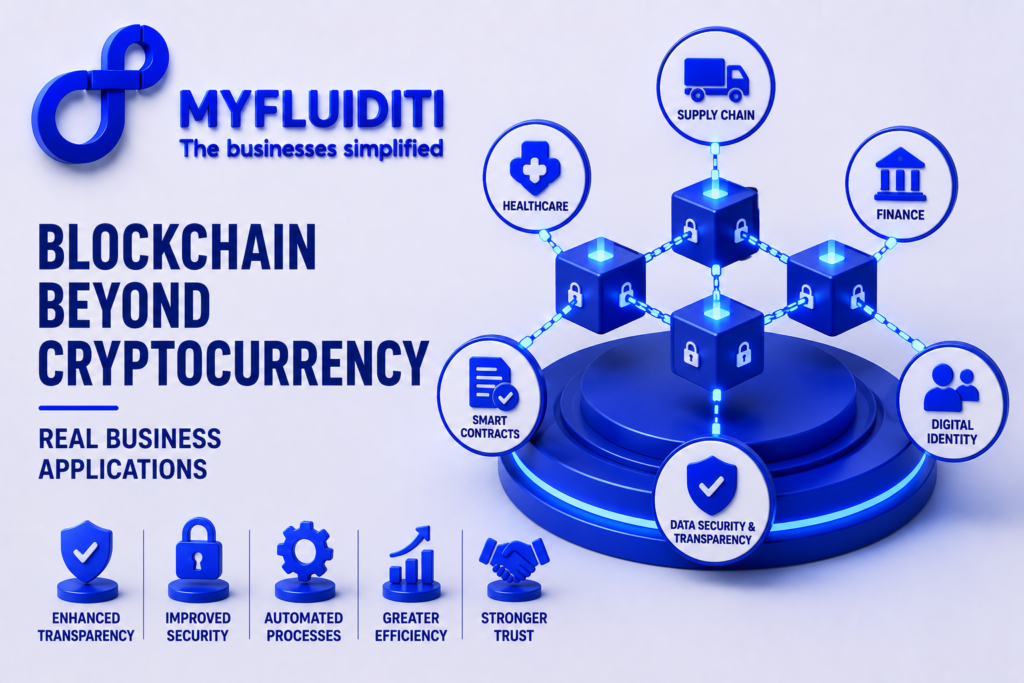
Introduction When people hear the term blockchain, cryptocurrency is often the first thing that comes to mind. While digital currencies introduced blockchain technology to the world, its true potential extends far beyond cryptocurrencies. Today, organizations across industries are leveraging Blockchain Technology to improve transparency, strengthen security, automate business processes, reduce fraud, and build trust across complex digital ecosystems. As businesses continue accelerating their digital transformation initiatives, blockchain is emerging as a powerful technology for creating secure, decentralized, and highly efficient business operations. From supply chain management and healthcare to finance, manufacturing, logistics, and government services, blockchain is revolutionizing the way organizations store, verify, and exchange information. At MyFluiditi, we help businesses unlock the full potential of blockchain by developing scalable, secure, and customized blockchain solutions that solve real-world business challenges and drive long-term innovation. Understanding Blockchain Technology Blockchain is a decentralized digital ledger that securely records transactions across multiple computers in a network. Unlike traditional databases controlled by a single authority, blockchain distributes data across multiple participants, ensuring that records remain transparent, tamper-resistant, and verifiable. Every transaction is encrypted, time-stamped, and linked to previous records, creating an immutable chain of information that cannot easily be altered or manipulated. This unique architecture provides organizations with enhanced security, improved accountability, and greater operational transparency. MyFluiditi develops blockchain-powered business solutions that enable organizations to securely manage digital assets, streamline operations, and improve trust across interconnected business networks. Why Businesses Are Adopting Blockchain Beyond Cryptocurrency Modern enterprises manage vast amounts of sensitive data across multiple systems, partners, and stakeholders. Traditional processes often involve manual verification, fragmented databases, lengthy approvals, and limited visibility into business operations. Blockchain addresses these challenges by creating a single source of truth where authorized participants can securely access, validate, and share information in real time. This significantly reduces administrative overhead, eliminates data inconsistencies, and enhances collaboration across organizations. Businesses adopting blockchain solutions gain greater operational efficiency, improved compliance, stronger data integrity, and reduced dependency on intermediaries. MyFluiditi works with organizations to identify blockchain opportunities that align with strategic objectives while delivering measurable business value. Transforming Supply Chain Management Supply chain management is one of the most impactful areas where blockchain technology delivers tangible business benefits. Modern supply chains involve manufacturers, suppliers, logistics providers, distributors, retailers, and customers, making transparency and traceability critical. Blockchain enables organizations to track products from origin to destination, providing real-time visibility into every stage of the supply chain. Businesses can verify product authenticity, monitor shipments, reduce counterfeit risks, improve inventory management, and strengthen supplier accountability. This level of transparency increases customer trust while improving operational efficiency. MyFluiditi develops blockchain-enabled supply chain solutions that help organizations create secure, transparent, and resilient logistics ecosystems. Enhancing Data Security and Digital Trust Data security remains a top priority for organizations operating in today’s digital environment. Cyber threats, unauthorized access, and data manipulation continue to challenge businesses across industries. Blockchain enhances cybersecurity by encrypting transactions, distributing records across decentralized networks, and preventing unauthorized modifications to stored information. Since every transaction is validated through consensus mechanisms, businesses gain higher levels of data integrity and trust compared to conventional systems. MyFluiditi integrates blockchain technology with modern cybersecurity practices to help organizations protect sensitive information while building secure digital infrastructures capable of supporting future growth. Smart Contracts for Business Automation One of the most transformative features of blockchain is the ability to execute Smart Contracts. Smart contracts are self-executing digital agreements that automatically perform predefined actions when specified conditions are met. This eliminates the need for manual intervention, reduces paperwork, accelerates approvals, and minimizes operational errors. Organizations can automate financial transactions, vendor agreements, insurance claims, procurement processes, compliance verification, and contract management through secure blockchain-based workflows. By implementing intelligent automation, MyFluiditi enables businesses to improve efficiency while reducing operational costs and administrative complexity. Blockchain in Financial Services Financial institutions are increasingly adopting blockchain technology to improve transaction security, reduce processing times, and lower operational costs. Traditional banking systems often involve multiple intermediaries, lengthy settlement periods, and higher transaction fees. Blockchain simplifies financial operations by enabling secure peer-to-peer transactions, faster cross-border payments, digital identity verification, fraud prevention, and transparent audit trails. These capabilities improve customer experiences while strengthening regulatory compliance and financial security. MyFluiditi develops enterprise blockchain solutions that help financial organizations modernize digital services while maintaining the highest standards of security and reliability. Revolutionizing Healthcare Data Management Healthcare organizations generate large volumes of sensitive patient information that must remain secure, accurate, and accessible only to authorized users. Blockchain technology enables healthcare providers to maintain tamper-proof electronic health records, securely exchange patient information, improve interoperability between healthcare systems, and strengthen regulatory compliance. Patients gain greater control over their medical data while healthcare providers improve collaboration and treatment accuracy. MyFluiditi helps healthcare organizations leverage blockchain to build secure digital healthcare ecosystems that improve patient outcomes and operational efficiency. Enabling Secure Digital Identity Management Digital identity has become increasingly important as businesses expand online services and remote operations. Traditional identity management systems remain vulnerable to credential theft, identity fraud, and unauthorized access. Blockchain enables decentralized identity verification, allowing individuals to securely manage and share verified digital credentials without relying on centralized databases. Organizations benefit from stronger authentication, improved privacy protection, and reduced identity-related fraud. MyFluiditi designs blockchain-based identity management solutions that strengthen access control while simplifying secure digital interactions across enterprise environments. Accelerating Digital Transformation Through Blockchain Blockchain is becoming an essential technology for organizations pursuing Digital Transformation, Artificial Intelligence (AI), Internet of Things (IoT), cloud computing, and enterprise automation. By integrating blockchain with existing business applications, organizations can create highly secure, transparent, and intelligent digital ecosystems. Whether supporting IoT device authentication, AI-driven data verification, secure cloud transactions, or enterprise workflow automation, blockchain provides a trusted foundation for emerging technologies. MyFluiditi develops integrated blockchain solutions that connect seamlessly with ERP platforms, CRM systems, cloud infrastructure, and enterprise applications, enabling businesses to innovate with confidence. Why Choose MyFluiditi for Blockchain Solutions Implementing successful blockchain solutions requires expertise in distributed ledger technologies, enterprise architecture, cybersecurity, cloud computing, software
API Development and Integration: Connecting Modern Business Systems
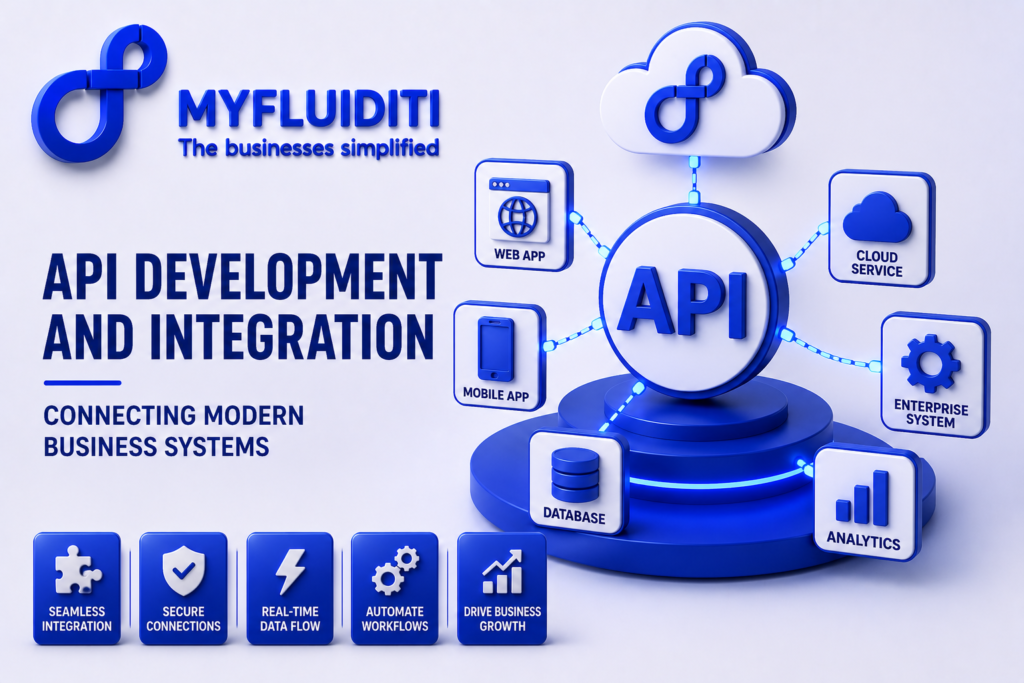
Introduction In today’s fast-paced digital economy, businesses rely on multiple software applications to manage operations, customer relationships, finance, marketing, logistics, human resources, and communication. However, when these systems operate in isolation, organizations face challenges such as duplicate data, manual processes, delayed decision-making, and reduced productivity. To remain competitive, businesses need seamless connectivity between their applications, platforms, and data sources. This is where API Development and Integration plays a crucial role. Application Programming Interfaces (APIs) enable different software systems to communicate securely and exchange data in real time, creating a unified digital ecosystem that enhances efficiency, improves customer experiences, and accelerates innovation. At MyFluiditi, we help organizations build scalable API solutions that simplify complex integrations, automate workflows, and enable connected digital enterprises ready for future growth. Understanding API Development and Integration An Application Programming Interface (API) is a set of protocols and standards that allows different software applications to communicate and share information efficiently. APIs act as secure bridges between systems, enabling organizations to integrate enterprise applications, cloud platforms, mobile apps, websites, databases, payment gateways, third-party services, IoT devices, and business intelligence tools. Instead of replacing existing software investments, API integration connects them into a centralized ecosystem where information flows seamlessly across the organization. MyFluiditi designs secure, scalable, and high-performance APIs that empower businesses to improve collaboration, eliminate data silos, and maximize operational efficiency. Why API Integration Matters for Modern Businesses Modern organizations depend on multiple digital platforms to deliver products and services. Customer information may reside in a CRM system, financial records in ERP software, marketing campaigns in automation platforms, and operational data across cloud applications. Without integration, employees spend valuable time manually transferring information between systems, increasing the risk of errors and reducing productivity. API integration enables real-time communication across applications, ensuring accurate data, faster business processes, and better decision-making. Businesses can automate repetitive tasks, improve operational visibility, and create consistent customer experiences across every digital touchpoint. MyFluiditi helps organizations implement intelligent API strategies that connect critical business systems while supporting long-term digital transformation initiatives. Enhancing Customer Experiences Through Connected Systems Customers expect fast, personalized, and consistent experiences across websites, mobile applications, customer portals, and digital service platforms. APIs enable businesses to synchronize customer data across multiple systems, allowing support teams, sales professionals, and service representatives to access accurate information instantly. Real-time integration also enables secure payment processing, appointment scheduling, order tracking, inventory availability, personalized recommendations, and omnichannel communication. These capabilities improve customer satisfaction while increasing engagement and loyalty. MyFluiditi develops customer-centric API solutions that create seamless digital experiences while enabling organizations to respond more quickly to evolving customer expectations. Streamlining Business Operations with API Automation One of the greatest advantages of API integration is its ability to automate business workflows. Instead of relying on manual processes, APIs allow systems to exchange information automatically, reducing administrative effort and improving operational accuracy. Businesses can automate invoice generation, customer onboarding, inventory updates, employee management, shipping notifications, financial reporting, and countless other business functions. Automation not only improves productivity but also reduces operational costs while minimizing human error. MyFluiditi works closely with organizations to identify automation opportunities and implement API-driven workflows that simplify operations and improve business performance. Enabling Cloud Integration and Digital Transformation As organizations increasingly adopt cloud computing, hybrid infrastructures, and SaaS applications, seamless integration has become essential for business success. APIs enable secure communication between on-premises systems and cloud-based platforms, allowing businesses to modernize technology without disrupting existing operations. Whether integrating cloud ERP systems, CRM platforms, analytics solutions, collaboration tools, or enterprise applications, APIs provide the flexibility needed to support digital transformation. MyFluiditi specializes in cloud-native API development that enables businesses to connect legacy systems with modern technologies while creating scalable and future-ready digital environments. Improving Data Accessibility and Business Intelligence Data is one of the most valuable resources within any organization, but its true value depends on accessibility and accuracy. API integration enables businesses to consolidate information from multiple sources into centralized dashboards, analytics platforms, and business intelligence solutions. Decision-makers gain real-time visibility into operational performance, customer behavior, financial metrics, inventory levels, and business trends without relying on disconnected reports. By providing accurate, up-to-date information, APIs enable faster and more informed business decisions. MyFluiditi develops integrated data ecosystems that empower organizations to transform fragmented information into meaningful insights that support strategic growth. Strengthening Security and Compliance As businesses exchange increasing volumes of sensitive information, API security has become a top priority. Modern APIs incorporate advanced authentication mechanisms, encryption protocols, token-based authorization, access controls, and continuous monitoring to ensure secure communication between systems. Properly designed APIs protect customer information, financial transactions, healthcare records, and confidential business data while supporting compliance with industry standards and regulatory requirements. MyFluiditi follows industry best practices for secure API architecture, implementing robust security frameworks that protect enterprise systems against evolving cyber threats while maintaining high performance and reliability. Supporting Innovation Through Scalable API Architecture Technology continues to evolve rapidly, and businesses require flexible digital infrastructures capable of supporting future innovation. APIs provide modular architectures that allow organizations to introduce new applications, services, and technologies without redesigning existing systems. Whether integrating Artificial Intelligence (AI), Machine Learning, IoT platforms, automation tools, or emerging digital services, APIs provide the foundation for scalable business growth. Organizations that adopt API-first strategies can innovate faster, launch new products more efficiently, and respond quickly to changing market demands. MyFluiditi builds scalable API ecosystems that enable continuous innovation while ensuring long-term business agility. Industry Applications of API Development and Integration API integration is transforming industries by enabling secure, real-time communication across complex digital ecosystems. Healthcare organizations integrate electronic health records, patient portals, and telemedicine platforms to improve care delivery. Financial institutions connect banking systems, payment gateways, fraud detection platforms, and mobile applications to deliver secure financial services. Retail businesses synchronize inventory, eCommerce platforms, customer loyalty programs, and logistics providers to improve shopping experiences. Manufacturing companies integrate production systems, supply chain platforms, and IoT devices to optimize operational efficiency, while logistics organizations use APIs for fleet management, warehouse automation, shipment tracking, and
Zero Trust Security: Protecting Modern Digital Enterprises
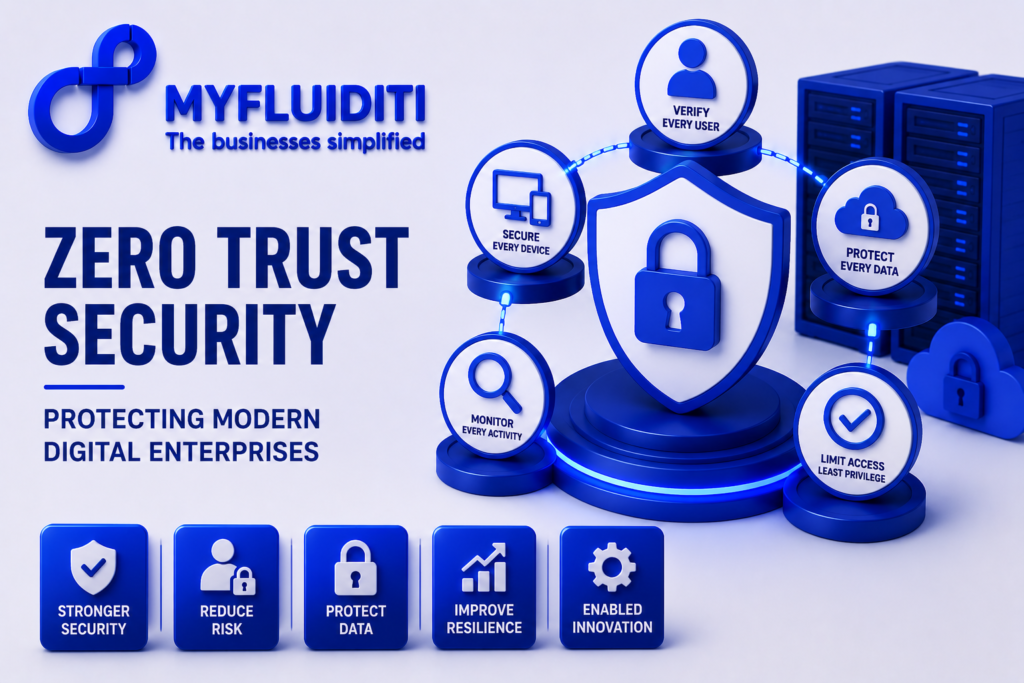
Introduction As businesses accelerate their digital transformation initiatives, the cybersecurity landscape has become increasingly complex. Organizations are embracing cloud computing, hybrid work environments, SaaS applications, mobile devices, and Internet of Things (IoT) technologies to improve efficiency and innovation. However, these advancements have also expanded the attack surface, making traditional perimeter-based security models less effective. Cybercriminals continue to exploit vulnerabilities through ransomware, phishing attacks, insider threats, credential theft, and sophisticated malware campaigns. In this evolving environment, organizations need a modern security framework that continuously verifies every user, device, and application before granting access. This is where Zero Trust Security has become the foundation of enterprise cybersecurity. Built on the principle of “Never Trust, Always Verify,” Zero Trust enables businesses to strengthen security, reduce cyber risks, and protect critical digital assets. At MyFluiditi, we help organizations implement intelligent Zero Trust Security solutions that safeguard business operations while enabling secure digital innovation. Understanding Zero Trust Security Zero Trust Security is a modern cybersecurity framework that assumes no user, device, or application should be trusted automatically, regardless of whether the request originates inside or outside the corporate network. Every access request is continuously authenticated, authorized, and validated using multiple security controls before access is granted. Unlike traditional security models that rely on network boundaries, Zero Trust focuses on identity verification, least-privilege access, continuous monitoring, endpoint security, and real-time threat detection. As organizations adopt cloud-native infrastructures and distributed workforces, Zero Trust has become an essential strategy for protecting sensitive business information. MyFluiditi designs customized Zero Trust architectures that align with business objectives while strengthening enterprise-wide security. Why Zero Trust Matters for Modern Digital Enterprises Today’s organizations operate across multiple cloud platforms, remote offices, mobile devices, third-party integrations, and digital ecosystems. Employees access business applications from different locations using various devices, while customers expect seamless digital experiences. This level of connectivity creates new security challenges that traditional firewalls alone cannot address. Zero Trust Architecture minimizes these risks by verifying every access request and continuously monitoring user behavior, device health, and application activity. Businesses adopting Zero Trust gain stronger protection against unauthorized access, insider threats, credential compromise, and data breaches while maintaining operational flexibility. MyFluiditi helps enterprises modernize their security posture with scalable Zero Trust strategies that support secure growth without disrupting business operations. Strengthening Identity and Access Management Identity has become the new security perimeter in the digital era. Protecting user identities is critical because compromised credentials remain one of the leading causes of cyberattacks. Zero Trust enhances Identity and Access Management (IAM) by implementing multi-factor authentication, role-based access control, adaptive authentication, single sign-on, and continuous identity verification. Users receive access only to the resources necessary for their responsibilities, significantly reducing unnecessary privileges that attackers often exploit. MyFluiditi integrates advanced identity management solutions that ensure employees, contractors, partners, and customers can securely access business applications while minimizing security risks. Securing Cloud Environments and Remote Workforces Cloud adoption and hybrid work have transformed how businesses operate, but they have also introduced new cybersecurity challenges. Employees frequently access enterprise applications from home networks, personal devices, and public internet connections. Zero Trust protects cloud environments by continuously validating user identity, device security, application integrity, and network context before granting access. Organizations can confidently adopt cloud security, remote collaboration platforms, and SaaS applications without compromising sensitive business information. MyFluiditi develops secure cloud architectures that combine Zero Trust principles with modern cloud technologies, ensuring organizations maintain productivity while protecting valuable digital assets. Preventing Data Breaches and Cyber Threats Data has become one of the most valuable assets for modern organizations, making it a primary target for cybercriminals. Financial records, customer information, intellectual property, healthcare data, and operational systems require advanced protection against evolving threats. Zero Trust continuously monitors user activity, identifies abnormal behavior, and limits lateral movement within enterprise networks. Even if attackers gain initial access, they encounter multiple layers of verification that significantly reduce the potential impact of a breach. By combining AI-powered threat detection, behavioral analytics, endpoint protection, and real-time monitoring, MyFluiditi helps organizations proactively defend against ransomware, phishing attacks, insider threats, and advanced persistent threats. Supporting Regulatory Compliance and Data Privacy Businesses operating in regulated industries must comply with increasingly stringent security and privacy requirements. Standards such as GDPR, HIPAA, ISO 27001, PCI DSS, and other industry regulations require organizations to implement robust access controls, data protection measures, and continuous monitoring. Zero Trust Security supports compliance by enforcing strong authentication, maintaining detailed audit trails, protecting sensitive information, and ensuring only authorized individuals can access critical systems. MyFluiditi works with organizations to implement security frameworks that not only strengthen cybersecurity but also simplify compliance with industry regulations and governance requirements. Leveraging AI and Automation in Zero Trust Security Modern cybersecurity requires intelligent systems capable of responding to threats in real time. Artificial Intelligence (AI) and Machine Learning (ML) significantly enhance Zero Trust Security by continuously analyzing user behavior, detecting anomalies, identifying suspicious activities, and automating security responses. AI-powered security platforms can rapidly recognize emerging threats that traditional security tools may overlook. Automation also reduces response times, enabling organizations to contain incidents before they escalate into major business disruptions. MyFluiditi integrates AI-driven security analytics and intelligent automation into Zero Trust environments, helping businesses strengthen resilience while reducing operational complexity. Building a Resilient Cybersecurity Strategy Zero Trust is not a single technology but a comprehensive cybersecurity strategy that combines identity management, endpoint protection, network segmentation, encryption, cloud security, continuous monitoring, and threat intelligence into a unified security framework. Organizations implementing Zero Trust gain greater visibility across their digital infrastructure while reducing security gaps that attackers commonly exploit. Business resilience improves because security controls adapt dynamically as users, devices, and applications change over time. MyFluiditi partners with organizations to assess existing security environments, identify vulnerabilities, develop Zero Trust roadmaps, and implement scalable cybersecurity solutions that evolve alongside business growth. Why Choose MyFluiditi for Zero Trust Security Solutions Implementing Zero Trust Security requires deep expertise in cybersecurity, cloud computing, identity management, enterprise architecture, AI, and digital transformation. MyFluiditi delivers end-to-end cybersecurity solutions