Predictive Analytics: Turning Business Data into Competitive Advantage
Introduction In today’s rapidly evolving digital economy, data has become one of the most valuable business assets. Every customer interaction, sales transaction, operational process, and digital engagement generates valuable information that can help organizations make smarter decisions. However, collecting data alone is not enough. The true competitive advantage comes from understanding what the data reveals about future trends and using those insights to drive proactive business decisions. This is where Predictive Analytics plays a transformative role. By combining historical data, Artificial Intelligence (AI), Machine Learning (ML), advanced statistical models, and real-time analytics, predictive analytics enables businesses to anticipate customer behavior, reduce operational risks, improve efficiency, and identify growth opportunities before competitors do. At MyFluiditi, we help organizations unlock the full potential of their data by developing intelligent predictive analytics solutions that support strategic decision-making and sustainable business growth. Understanding Predictive Analytics Predictive analytics is an advanced branch of data analytics that uses historical information, statistical algorithms, machine learning models, and data mining techniques to forecast future outcomes. Rather than reacting to events after they occur, businesses can make informed decisions based on likely future scenarios. Organizations across industries are using predictive analytics to optimize operations, improve customer experiences, forecast demand, prevent fraud, manage risks, and maximize profitability. As businesses continue generating larger volumes of structured and unstructured data, predictive analytics has become an essential component of modern digital transformation strategies. Unlike traditional reporting, which focuses on what has already happened, predictive analytics answers critical business questions such as what is likely to happen next, why it may happen, and what actions should be taken today to improve future outcomes. MyFluiditi works closely with organizations to build predictive models that align with business goals while transforming complex datasets into meaningful, actionable insights. Why Predictive Analytics Matters for Modern Businesses The modern business landscape is highly competitive, and organizations must make decisions faster than ever before. Market conditions change rapidly, customer expectations evolve continuously, and operational risks emerge unexpectedly. Businesses that rely solely on historical reports often struggle to respond quickly to changing conditions. Predictive analytics empowers organizations to move from reactive decision-making to proactive business planning by identifying future opportunities and potential challenges before they occur. Companies that successfully implement predictive analytics solutions can improve operational efficiency, optimize resource allocation, reduce unnecessary costs, increase customer satisfaction, strengthen supply chain management, and accelerate innovation. These advantages create measurable business value while helping organizations remain competitive in dynamic markets. At MyFluiditi, our predictive analytics frameworks are designed to help businesses improve performance through intelligent forecasting, automated insights, and data-driven decision support. Enhancing Customer Experience Through Predictive Intelligence Customer expectations continue to evolve as consumers demand personalized, seamless, and highly responsive experiences. Predictive analytics enables businesses to understand customer preferences, anticipate purchasing behavior, identify churn risks, and recommend products or services tailored to individual users. By analyzing customer interactions across multiple channels, organizations can deliver highly personalized experiences that improve engagement, increase loyalty, and maximize customer lifetime value. Retailers can recommend products before customers search for them, financial institutions can offer personalized financial services, healthcare providers can anticipate patient needs, and subscription businesses can identify customers who may be considering cancellation. These proactive strategies significantly improve customer satisfaction while increasing conversion rates. MyFluiditi develops customer intelligence platforms that combine predictive modeling with AI-driven personalization, helping businesses create meaningful customer experiences that drive long-term success. Improving Business Operations and Efficiency Operational efficiency remains a top priority for organizations seeking sustainable growth. Predictive analytics enables businesses to optimize inventory management, forecast demand, schedule resources more effectively, monitor equipment performance, and reduce operational downtime. Instead of relying on assumptions or manual estimates, businesses gain accurate forecasts that support better planning and faster decision-making. Manufacturers use predictive analytics to anticipate equipment failures before breakdowns occur. Logistics companies optimize delivery routes using real-time forecasting. Healthcare organizations improve patient scheduling and resource allocation, while financial institutions identify unusual transaction patterns that may indicate fraud. At MyFluiditi, predictive analytics solutions integrate seamlessly with enterprise systems, enabling organizations to automate workflows, improve operational visibility, and make data-backed business decisions. Reducing Business Risks with Predictive Analytics Risk management has become increasingly important in today’s uncertain business environment. Organizations face risks related to cybersecurity, financial operations, market volatility, supply chain disruptions, regulatory compliance, and customer behavior. Predictive analytics helps businesses identify potential risks early, allowing leadership teams to implement preventive measures before issues escalate. By continuously analyzing historical trends and real-time business data, predictive models can detect anomalies, identify unusual patterns, and forecast potential business disruptions. Financial institutions use predictive analytics for fraud detection, insurance companies assess claim risks more accurately, and retailers forecast demand fluctuations to avoid inventory shortages. MyFluiditi helps businesses implement predictive risk management solutions that improve resilience while supporting informed strategic planning. Leveraging AI and Machine Learning for Smarter Predictions The increasing adoption of Artificial Intelligence, Machine Learning, and cloud technologies has significantly enhanced the capabilities of predictive analytics. Modern predictive models continuously learn from new data, improving forecasting accuracy over time. Unlike static analytical models, AI-powered systems adapt to changing customer behaviors, market conditions, and operational environments without requiring constant manual intervention. Businesses leveraging AI-driven predictive analytics gain deeper insights into customer behavior, revenue forecasting, workforce planning, preventive maintenance, and operational optimization. By combining advanced algorithms with scalable cloud infrastructure, MyFluiditi delivers intelligent predictive solutions that enable organizations to make faster, more accurate, and more confident business decisions. Industry Applications of Predictive Analytics Predictive analytics is transforming virtually every industry by enabling organizations to make smarter, faster, and more strategic decisions. In healthcare, predictive models improve patient care by forecasting disease progression and optimizing treatment plans. In retail and eCommerce, businesses analyze buying patterns to personalize recommendations and optimize inventory management. Manufacturing companies predict equipment maintenance requirements to reduce downtime and improve productivity. Financial institutions use predictive analytics for credit scoring, fraud detection, and investment forecasting, while logistics organizations optimize delivery schedules, warehouse operations, and supply chain performance. Because every industry generates valuable business data, predictive analytics has
Why Every Business Needs a Mobile App Strategy
Introduction In today’s digital-first world, having a website alone is no longer enough to stay competitive. Customers expect businesses to provide fast, personalized, and convenient experiences that can be accessed anytime and anywhere. This is why having a mobile app strategy has become a business necessity rather than an option. Mobile applications help organizations improve customer engagement, streamline operations, increase brand visibility, and drive long-term growth. As smartphone usage continues to rise globally, businesses across industries are investing in custom mobile app development to strengthen customer relationships and gain a competitive edge. At MyFluiditi, we help businesses design, develop, and implement scalable mobile app strategies that align with their goals while delivering seamless digital experiences that create measurable business value. The Growing Importance of Mobile Applications Consumers spend a significant portion of their digital time using mobile applications instead of web browsers. Whether shopping online, booking services, managing finances, or communicating with businesses, mobile apps have become an essential part of everyday life. A well-designed mobile application enables businesses to stay connected with customers through instant notifications, personalized recommendations, secure transactions, and real-time support. Investing in mobile app development allows businesses to build stronger customer relationships while improving user satisfaction and brand loyalty. MyFluiditi develops feature-rich mobile applications that help organizations deliver exceptional digital experiences while supporting business growth. Enhancing Customer Engagement One of the biggest advantages of having a mobile app strategy is improved customer engagement. Mobile apps create direct communication channels between businesses and their customers through push notifications, loyalty programs, personalized offers, and in-app messaging. Unlike traditional marketing channels, mobile applications encourage continuous interaction, increasing customer retention and repeat purchases. Businesses that prioritize customer engagement through mobile technology often experience higher satisfaction rates and stronger brand recognition. At MyFluiditi, we build mobile applications that encourage meaningful customer interactions while helping businesses strengthen long-term relationships. Strengthening Brand Visibility A mobile application keeps your brand visible every time customers use their smartphones. Unlike websites that require users to open a browser and search for your business, mobile apps provide instant access with a single tap. Consistent visibility helps reinforce brand awareness while making it easier for customers to engage with products and services whenever they need them. Businesses with a strong mobile presence remain top-of-mind, increasing opportunities for conversions and customer loyalty. MyFluiditi creates intuitive mobile applications that represent your brand professionally while delivering a seamless user experience. Improving Customer Experience Today’s customers expect convenience, speed, and simplicity. A mobile app allows businesses to deliver personalized experiences through user profiles, saved preferences, secure payment gateways, real-time updates, and responsive customer support. These features eliminate unnecessary friction and make interactions more efficient. Providing an outstanding customer experience encourages repeat business while improving customer trust. MyFluiditi focuses on developing user-centric mobile applications that combine modern design with powerful functionality to maximize customer satisfaction. Increasing Sales and Revenue A well-planned mobile app strategy directly contributes to business growth by increasing customer conversions and sales opportunities. Mobile applications simplify the purchasing process through secure checkout systems, personalized product recommendations, subscription services, and digital payment options. Businesses can also leverage analytics to understand customer behavior and optimize marketing campaigns for better results. At MyFluiditi, we build mobile commerce solutions that help businesses attract more customers, increase revenue, and improve return on investment. Streamlining Business Operations Mobile applications are not limited to customer-facing services. Many organizations use custom applications to automate internal workflows, improve employee collaboration, manage inventory, track field operations, schedule appointments, and monitor business performance. Mobile technology enhances operational efficiency while reducing manual processes and administrative costs. Businesses adopting business process automation through mobile applications achieve greater productivity and faster decision-making. MyFluiditi develops custom mobile solutions that simplify business operations while supporting organizational efficiency. Leveraging Real-Time Data and Analytics Modern mobile applications provide businesses with valuable insights into customer behavior, purchasing patterns, application usage, and performance metrics. These analytics enable organizations to make informed business decisions, improve customer experiences, and optimize marketing strategies. Access to real-time analytics allows businesses to identify growth opportunities while continuously improving application performance. MyFluiditi integrates advanced analytics tools into mobile applications, enabling organizations to make smarter, data-driven decisions. Supporting Business Scalability As businesses grow, their technology must grow with them. Modern mobile applications are designed to scale alongside increasing customer demands, additional features, and expanding markets. Scalable architecture ensures applications remain reliable, secure, and high-performing regardless of business size. Whether serving hundreds or millions of users, businesses need mobile solutions capable of supporting future expansion. At MyFluiditi, we develop scalable mobile applications that evolve with changing business requirements while maintaining exceptional performance. Ensuring Security and Reliability Security is one of the most important considerations in mobile application development. Customers trust businesses with sensitive information including payment details, personal data, and account credentials. Modern applications must include secure authentication, encrypted communication, role-based access, regular security updates, and compliance with industry standards. A secure application strengthens customer confidence while protecting business data from cyber threats. MyFluiditi follows industry best practices to develop secure, reliable, and compliant mobile applications that safeguard both businesses and their customers. Future-Proofing Your Business Technology continues to evolve rapidly, and businesses that fail to adapt risk falling behind competitors. A strategic mobile app provides a foundation for integrating emerging technologies such as artificial intelligence, cloud services, Internet of Things (IoT), wearable devices, digital payments, and advanced analytics as business needs evolve. Organizations with a strong mobile strategy are better positioned to respond to changing customer expectations and market trends. MyFluiditi helps businesses build future-ready mobile applications that support innovation, flexibility, and long-term digital success. Why Choose MyFluiditi for Mobile App Development Building a successful mobile application requires more than technical expertise, it requires understanding business objectives, customer expectations, and industry trends. MyFluiditi offers end-to-end mobile app development services, including business consulting, UI/UX design, custom application development, API integration, testing, deployment, maintenance, and ongoing support. Our experienced development team works closely with businesses to create secure, scalable, and high-performance mobile applications tailored to unique business requirements.
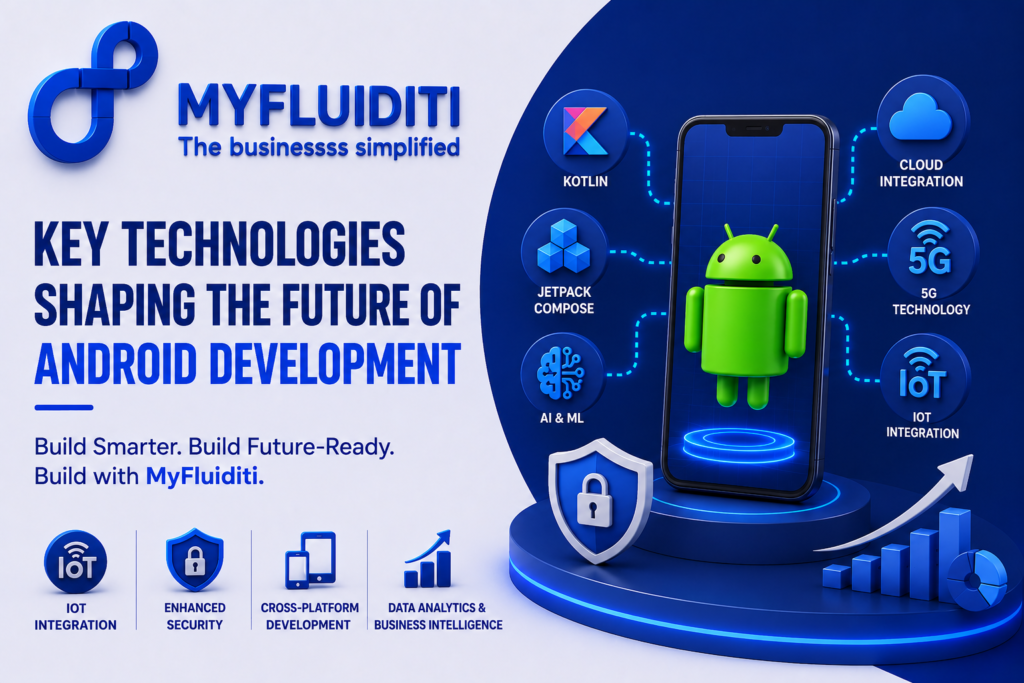
Key Technologies Shaping the Future of Android Development
Introduction Android continues to dominate the global mobile application market, powering billions of smartphones, tablets, wearable devices, smart TVs, and IoT solutions. As user expectations continue to rise, businesses must embrace modern Android development technologies that deliver faster performance, stronger security, seamless user experiences, and future-ready scalability. From AI-powered applications and cloud integration to 5G connectivity and cross-platform development, the Android ecosystem is evolving rapidly. Organizations that invest in advanced Android technologies gain a competitive advantage by delivering innovative digital experiences that drive customer engagement and business growth. At MyFluiditi, we help businesses build scalable, secure, and high-performing Android applications using the latest technologies and development frameworks that align with evolving market demands. The Evolution of Android Development Android development has transformed significantly over the past decade. Traditional mobile applications have evolved into intelligent digital platforms capable of supporting real-time analytics, cloud computing, mobile commerce, enterprise collaboration, and connected ecosystems. Modern businesses require applications that perform consistently across multiple devices while maintaining exceptional speed, security, and usability. Today’s Android app development focuses on creating seamless digital experiences that integrate advanced technologies without compromising user experience. MyFluiditi develops Android solutions that combine innovation with business strategy, helping organizations launch applications that are both user-centric and future-ready. Kotlin: The Preferred Language for Android Development One of the biggest technological advancements in Android development is the widespread adoption of Kotlin. Officially supported by Google, Kotlin has become the preferred programming language because of its concise syntax, improved safety features, and enhanced developer productivity. Compared to traditional Java development, Kotlin reduces coding complexity while improving application reliability and maintainability. Businesses adopting Kotlin benefit from faster development cycles, lower maintenance costs, and better overall application performance. At MyFluiditi, our Android developers leverage Kotlin to create robust applications that are scalable, efficient, and easier to maintain as businesses grow. Jetpack Compose Revolutionizing User Interfaces Creating engaging mobile experiences begins with exceptional user interface design. Jetpack Compose has modernized Android UI development by simplifying interface creation and reducing development time. Instead of relying on traditional XML layouts, developers can build responsive and interactive user interfaces using a modern declarative programming approach. This enables faster feature development, improved consistency, and enhanced application performance. MyFluiditi utilizes Jetpack Compose to build visually appealing Android applications that deliver smooth, intuitive, and engaging user experiences across smartphones, tablets, and foldable devices. Artificial Intelligence and Machine Learning Integration The future of Android applications is increasingly driven by Artificial Intelligence (AI) and Machine Learning (ML) capabilities. Intelligent mobile applications now provide personalized recommendations, predictive analytics, smart search, voice recognition, automated customer support, image processing, and fraud detection. AI enables businesses to improve customer engagement while automating complex business processes. At MyFluiditi, we integrate AI-powered capabilities into Android applications that enhance decision-making, improve operational efficiency, and deliver highly personalized user experiences across multiple industries. Cloud Integration for Scalable Mobile Applications Cloud technology has become an essential component of modern Android development. Applications connected to cloud platforms provide secure data storage, real-time synchronization, automatic backups, remote collaboration, and scalable infrastructure. Businesses benefit from greater flexibility while reducing infrastructure costs and improving system reliability. Cloud-enabled Android applications also support seamless integration with enterprise software, APIs, and third-party services. MyFluiditi develops cloud-connected Android solutions that ensure high availability, scalability, and business continuity for organizations operating in dynamic digital environments. 5G Technology Driving Faster Mobile Experiences The global rollout of 5G technology is transforming Android application capabilities by providing ultra-fast connectivity, lower latency, and improved network reliability. These advancements enable developers to create richer mobile experiences involving live streaming, augmented reality, virtual reality, IoT connectivity, multiplayer gaming, telemedicine, and real-time collaboration. Businesses can deliver more responsive applications that process large amounts of data almost instantly. At MyFluiditi, we build Android applications optimized for next-generation 5G networks, helping businesses take full advantage of enhanced mobile performance. Internet of Things (IoT) Integration The rapid expansion of Internet of Things (IoT) devices has opened new opportunities for Android applications across healthcare, manufacturing, logistics, retail, agriculture, transportation, and smart homes. Android applications now function as centralized control systems for connected devices, enabling real-time monitoring, remote management, predictive maintenance, and operational automation. Businesses leveraging IoT improve productivity while gaining valuable operational insights. MyFluiditi develops Android applications that integrate seamlessly with IoT ecosystems, enabling businesses to create intelligent connected solutions for modern industries. Enhanced Mobile Security As mobile applications handle increasingly sensitive customer information, mobile application security has become more critical than ever. Android developers now implement advanced authentication methods including biometric verification, multi-factor authentication, encrypted communication, secure APIs, data encryption, and compliance with international security standards. Strong security practices build customer trust while protecting valuable business data from cyber threats. MyFluiditi prioritizes security throughout every stage of Android application development to ensure applications remain reliable, compliant, and resilient against evolving security challenges. Cross-Platform Development and Business Agility While native Android applications continue to offer exceptional performance, many organizations seek faster deployment across multiple platforms. Modern frameworks such as Flutter enable businesses to develop applications that operate across Android and iOS using a shared codebase while maintaining excellent performance and user experience. Cross-platform development reduces development costs, shortens project timelines, and simplifies long-term maintenance. At MyFluiditi, we evaluate business requirements carefully before recommending native or cross-platform development strategies that maximize efficiency and return on investment. Data Analytics and Business Intelligence Modern Android applications generate valuable business insights through real-time analytics, user behavior tracking, performance monitoring, and customer engagement metrics. Businesses can leverage these insights to improve products, personalize experiences, optimize marketing campaigns, and enhance customer satisfaction. Data-driven decision-making allows organizations to continuously refine mobile applications based on actual user interactions. MyFluiditi integrates advanced analytics solutions into Android applications, empowering businesses with actionable intelligence that supports continuous improvement and long-term growth. The Role of User Experience in Android Success Technology alone does not guarantee application success. User experience remains one of the most important factors influencing customer satisfaction, engagement, and retention. Clean interface design, intuitive navigation, fast loading speeds, accessibility, responsive layouts, and consistent performance
From Clicks to Conversions: Building High-Performing Digital Marketing Campaigns
Introduction In today’s competitive online marketplace, attracting website visitors is only the first step toward business success. The real challenge lies in turning those visitors into loyal customers. This is where high-performing digital marketing campaigns make a significant impact. Businesses that combine strategic planning, engaging content, Search Engine Optimization (SEO), social media marketing, paid advertising, and data-driven insights can significantly improve conversion rates while maximizing return on investment. Modern digital marketing is no longer about generating clicks alone, it’s about creating meaningful customer journeys that drive measurable business growth. At MyFluiditi, we help businesses build customized digital marketing strategies that transform online traffic into valuable leads, long-term customers, and sustainable revenue. Understanding High-Performing Digital Marketing Campaigns A successful digital marketing campaign is built around clearly defined business objectives, audience insights, compelling messaging, and continuous optimization. Rather than focusing on isolated marketing channels, businesses today need integrated campaigns that connect websites, search engines, social media platforms, email marketing, and paid advertising into one seamless customer experience. Every interaction should guide potential customers toward a desired action, whether that is making a purchase, requesting a consultation, downloading a resource, or submitting an inquiry. At MyFluiditi, we design end-to-end digital marketing campaigns that align every touchpoint with your business goals while ensuring consistent brand messaging across all digital platforms. Why Clicks Alone Are Not Enough Many businesses measure success by website traffic or advertising clicks, but these metrics do not always reflect actual business growth. High traffic without conversions often indicates poor user experience, ineffective messaging, or weak campaign strategy. Conversion Rate Optimization (CRO) has become a critical component of modern marketing because it focuses on turning existing visitors into paying customers. Businesses that optimize landing pages, improve website speed, simplify navigation, and create compelling calls to action generate significantly higher returns from their marketing investments. MyFluiditi helps businesses improve conversion performance by analyzing customer behavior and continuously refining every stage of the digital journey. The Power of Search Engine Optimization One of the strongest foundations of any successful campaign is Search Engine Optimization (SEO). Ranking higher in search results allows businesses to attract qualified visitors who are actively searching for products or services. Effective SEO combines keyword research, technical optimization, quality content creation, link building, and user experience improvements to increase online visibility. Higher search rankings lead to greater organic traffic, stronger brand credibility, and lower customer acquisition costs over time. At MyFluiditi, our SEO specialists implement data-driven strategies that improve search performance while driving sustainable long-term growth. Creating Valuable Content That Converts Content plays a vital role in influencing customer decisions throughout the buying journey. High-quality blogs, website pages, case studies, videos, guides, and educational resources help businesses establish authority while building trust with potential customers. Content Marketing should address customer pain points, answer important questions, and provide valuable information that encourages engagement. Well-optimized content also strengthens SEO performance by increasing search visibility and improving website relevance. MyFluiditi develops compelling content strategies that balance keyword optimization with meaningful storytelling, helping businesses attract, educate, and convert their target audiences. Social Media as a Conversion Channel Social media has evolved beyond brand awareness into a powerful platform for lead generation and customer engagement. Businesses can connect directly with audiences, build relationships, and promote products across LinkedIn, Facebook, Instagram, and other digital platforms. Effective Social Media Marketing requires consistent content creation, audience engagement, targeted advertising, and performance analysis. Rather than simply increasing followers, successful campaigns focus on generating qualified leads and meaningful customer interactions. At MyFluiditi, we create strategic social media campaigns that strengthen brand visibility while driving measurable business outcomes. Performance Marketing for Faster Results While organic strategies deliver long-term growth, Pay-Per-Click (PPC) advertising provides immediate visibility for businesses looking to generate faster results. Search advertising, display campaigns, remarketing, and social media advertisements enable businesses to reach highly targeted audiences based on demographics, interests, online behavior, and search intent. Effective campaign management includes continuous monitoring, A/B testing, audience refinement, and budget optimization. MyFluiditi develops performance marketing campaigns designed to maximize return on advertising investment while increasing lead quality and improving overall campaign performance. Improving Customer Experience Successful digital marketing extends beyond advertisements and promotional content. Every customer interaction contributes to the overall experience. Fast-loading websites, responsive designs, intuitive navigation, mobile optimization, personalized messaging, and simplified checkout processes all influence purchasing decisions. Businesses that prioritize customer experience often achieve higher engagement, increased conversions, and stronger customer loyalty. At MyFluiditi, we focus on creating seamless digital experiences that encourage visitors to complete their customer journey with confidence. Data-Driven Marketing Decisions Modern marketing success depends on understanding customer behavior through accurate data and analytics. Businesses must continuously evaluate campaign performance, monitor user engagement, measure conversion rates, and identify improvement opportunities. Performance metrics provide valuable insights that help marketers refine targeting, optimize messaging, and improve return on investment. Marketing Analytics enables organizations to make informed decisions based on real customer interactions rather than assumptions. MyFluiditi leverages advanced analytics tools to measure campaign effectiveness and implement continuous improvements that maximize marketing success. Personalization Drives Higher Conversions Today’s customers expect personalized digital experiences that reflect their preferences, interests, and purchasing behavior. Generic marketing messages often fail to create meaningful engagement. Businesses that personalize website experiences, email campaigns, advertisements, and content recommendations consistently achieve higher conversion rates. Personalized communication builds stronger customer relationships while increasing trust and satisfaction. At MyFluiditi, we help businesses develop customer-focused marketing strategies that deliver relevant experiences across every stage of the buyer journey. Why Businesses Choose MyFluiditi Building successful digital marketing campaigns requires expertise, creativity, technology, and continuous optimization. MyFluiditi partners with businesses to create customized marketing solutions that align with their growth objectives. Our services include SEO, content marketing, website optimization, social media marketing, PPC advertising, branding, performance analytics, conversion optimization, and digital strategy consulting. Every campaign we develop is designed to attract the right audience, improve engagement, generate qualified leads, and increase measurable business results. By combining innovative marketing techniques with data-driven decision-making, we help businesses achieve sustainable growth in an increasingly
Business Automation: Improving Efficiency Through Technology
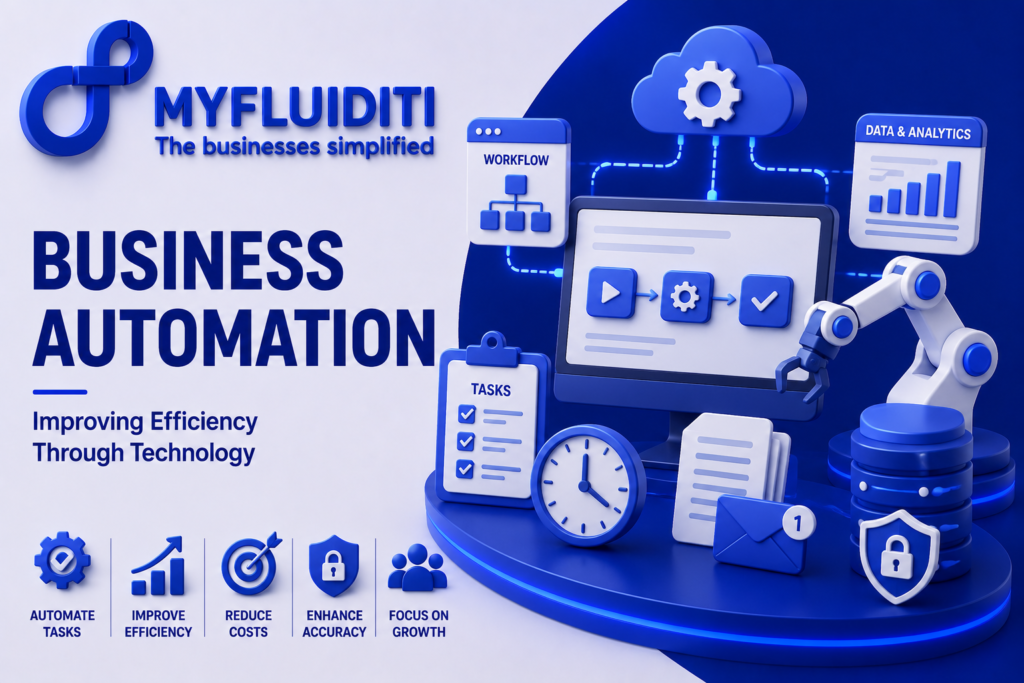
Introduction In today’s highly competitive business environment, organizations are constantly seeking ways to improve productivity, reduce operational costs, and deliver better customer experiences. One of the most effective strategies for achieving these goals is Business Automation. By leveraging modern technology to automate repetitive tasks, streamline workflows, and optimize business processes, companies can operate more efficiently while focusing on innovation and growth. From customer service and finance to human resources, sales, and supply chain management, automation has become an essential component of successful business operations. Businesses that embrace business process automation gain a competitive advantage by increasing speed, improving accuracy, and enabling employees to focus on strategic initiatives rather than manual activities. At MyFluiditi, we help organizations transform traditional operations into intelligent, technology-driven ecosystems through customized automation solutions. Our expertise in software development, workflow optimization, application integration, and digital technologies enables businesses to achieve sustainable growth while maximizing operational efficiency. Understanding Business Automation Business Automation refers to the use of technology to perform routine business processes with minimal human intervention. Instead of relying on manual workflows that consume time and resources, organizations can automate repetitive activities such as data entry, document management, approvals, reporting, customer communication, and operational monitoring. Modern automation solutions integrate multiple business systems into a unified environment where information flows seamlessly across departments. This not only improves operational efficiency but also minimizes errors, increases productivity, and accelerates decision-making. At MyFluiditi, we design customized automation solutions that align with each organization’s unique business processes, ensuring measurable improvements across daily operations. Why Businesses Are Investing in Automation As businesses continue to expand, managing increasing workloads manually becomes both expensive and inefficient. Organizations face growing pressure to deliver faster services, maintain higher quality standards, and respond quickly to changing customer expectations. Business process automation helps address these challenges by eliminating repetitive work, reducing delays, and improving consistency throughout operations. Automated systems allow employees to spend more time on innovation, strategic planning, customer engagement, and business development instead of administrative tasks. Businesses also benefit from improved resource utilization, faster turnaround times, and greater operational transparency. At MyFluiditi, we work closely with organizations to identify automation opportunities that deliver immediate and long-term business value while supporting future scalability. Improving Productivity Through Workflow Automation One of the biggest advantages of workflow automation is its ability to simplify complex business operations. Many organizations rely on multiple disconnected processes that require manual coordination between teams. These fragmented workflows often result in delays, communication gaps, and reduced efficiency. By automating approvals, notifications, task assignments, document processing, and reporting, businesses can significantly improve productivity while maintaining operational consistency. Automated workflows also provide greater visibility into ongoing activities, allowing managers to monitor performance and identify opportunities for continuous improvement. MyFluiditi develops intelligent workflow automation solutions that integrate seamlessly with existing business applications, enabling organizations to optimize operations without disrupting their current systems. Enhancing Customer Experience Customer expectations continue to evolve as digital interactions become increasingly important. Businesses are expected to provide faster responses, personalized experiences, and seamless service across multiple communication channels. Business Automation enables organizations to improve customer engagement by automating support requests, order processing, appointment scheduling, notifications, and service delivery. Customers receive faster responses while employees gain more time to focus on complex interactions that require personal attention. At MyFluiditi, we help businesses implement automation strategies that improve customer satisfaction, strengthen brand loyalty, and create more meaningful customer experiences through intelligent digital solutions. Reducing Operational Costs Manual business processes often require significant time, labor, and administrative effort. These inefficiencies contribute to higher operational costs and reduced profitability. Automation reduces dependency on repetitive manual work while improving overall resource utilization. Organizations implementing automation technology experience lower processing costs, fewer operational errors, reduced paperwork, and faster execution of daily tasks. These efficiencies contribute directly to improved financial performance and stronger business competitiveness. MyFluiditi helps businesses optimize operational costs by developing scalable automation platforms that improve efficiency while supporting long-term business objectives. Data Accuracy and Better Decision-Making Accurate information is essential for making informed business decisions. Manual data entry increases the risk of errors, inconsistencies, and duplicated information that can affect reporting and operational performance. Automated systems capture, process, and update information consistently across integrated business platforms, ensuring greater accuracy and reliability. Real-time reporting and performance dashboards provide business leaders with valuable insights that support faster and more informed decision-making. At MyFluiditi, we develop automation solutions that centralize business information, improve data quality, and enable organizations to make strategic decisions based on accurate and up-to-date information. Business Automation Across Industries Automation is transforming organizations across virtually every industry. Healthcare providers automate patient scheduling and administrative processes. Financial institutions streamline payment processing and compliance activities. Retail businesses optimize inventory management and customer engagement. Manufacturing companies automate production workflows and quality monitoring. Logistics organizations improve shipment tracking and warehouse operations. Regardless of industry, business automation solutions enable organizations to improve efficiency while delivering better services to customers. MyFluiditi works with businesses across multiple sectors to design industry-specific automation strategies that align technology with operational goals. Security and Scalability As organizations automate more business processes, security becomes increasingly important. Automated systems often manage sensitive business information, customer records, and operational data that require strong protection. At MyFluiditi, security is incorporated into every stage of solution development. We implement secure authentication, encrypted communications, role-based access controls, audit logging, and compliance-focused development practices to ensure business information remains protected. Our automation solutions are also designed with scalability in mind, allowing businesses to expand operations, integrate new technologies, and support future growth without significant redevelopment. How MyFluiditi Helps Businesses Automate Operations Every organization has unique operational challenges that require customized technology solutions. At MyFluiditi, we begin by understanding each client’s business objectives, workflows, and growth strategy before designing automation solutions tailored to their specific needs. Our services include business process automation, workflow optimization, custom software development, application integration, business intelligence solutions, web and mobile application development, and ongoing technology support. We focus on building flexible, scalable systems that simplify operations while improving efficiency, productivity, and