The Business Value of Modern Application Development
Introduction In today’s fast-changing digital economy, businesses need more than just functional software they need modern application development that accelerates innovation, improves operational efficiency, and delivers exceptional customer experiences. As customer expectations evolve and markets become increasingly competitive, organizations must invest in applications that are scalable, secure, high-performing, and built to adapt to future business needs. Modern application development empowers businesses to streamline workflows, automate repetitive processes, integrate critical systems, and launch new products faster. Companies that embrace innovative development strategies gain a significant competitive advantage by responding quickly to changing market demands while maintaining reliability and performance. At MyFluiditi, we understand that every business has unique operational goals and challenges. Our development approach focuses on building intelligent, future-ready software solutions that align with business objectives, enabling organizations to transform ideas into scalable digital products that create measurable business value. Why Modern Application Development Matters Modern application development is no longer limited to writing code. It represents a complete shift toward building applications that are flexible, maintainable, and capable of supporting business growth for years to come. Organizations increasingly require applications that integrate seamlessly with existing platforms, support growing user bases, and remain secure against evolving cyber threats. Businesses also expect shorter development cycles, continuous improvements, and faster deployment without compromising quality. This is why modern software development practices have become a strategic business investment rather than simply an IT initiative. Driving Operational Efficiency Through Modern Applications One of the greatest business advantages of modern application development is increased operational efficiency. Well-designed applications automate manual processes, eliminate repetitive tasks, reduce human error, and improve productivity across departments. Employees spend less time managing administrative work and more time focusing on strategic activities that contribute directly to business growth. Faster workflows, real-time collaboration, and integrated business systems allow organizations to make informed decisions with greater speed and accuracy. At MyFluiditi, we develop custom business applications that simplify complex workflows, improve collaboration, and enhance operational performance across organizations of every size. Building Scalable Applications for Business Growth Scalability has become another defining characteristic of successful business applications. As organizations expand into new markets, onboard more customers, or introduce additional services, their applications must handle increasing workloads without affecting performance. MyFluiditi develops scalable software architectures that support business growth while maintaining speed, reliability, and stability. Our solutions ensure businesses can confidently expand without worrying about technology limitations or costly redevelopment projects. Future-ready architecture also enables organizations to introduce new features, integrate emerging technologies, and respond to changing customer expectations without rebuilding existing applications. Strengthening Security with Modern Development Practices Security remains one of the most critical aspects of application development. Modern businesses handle sensitive customer information, financial transactions, and confidential operational data every day. A secure application protects valuable business assets while building trust with customers and partners. At MyFluiditi, security is integrated throughout the development lifecycle rather than treated as an afterthought. We implement secure coding practices, authentication mechanisms, role-based access controls, data encryption, vulnerability assessments, API security, and compliance-focused development standards to ensure every application remains protected against evolving cyber threats. Enhancing User Experience Through Intuitive Design User experience plays a major role in determining business success. Customers expect applications that are intuitive, responsive, and easy to navigate across desktops, tablets, and mobile devices. A poor user experience often leads to reduced engagement, lost sales, and declining customer loyalty. MyFluiditi creates applications with modern UI/UX principles that prioritize usability, accessibility, and performance. By combining user-centered design with responsive interfaces, we help businesses deliver seamless digital experiences that increase customer satisfaction, strengthen customer retention, and improve conversion rates. Accelerating Innovation with Agile Development Another significant benefit of modern application development is faster product delivery. Traditional software projects often required lengthy development cycles before reaching customers. Today’s Agile development methodologies allow businesses to release applications faster, gather real user feedback, and continuously improve features through iterative updates. This accelerated development process reduces time-to-market while allowing organizations to remain competitive in rapidly changing industries. At MyFluiditi, we embrace Agile practices, continuous integration, automated testing, and collaborative development to deliver reliable software faster without compromising quality. Seamless System Integration for Connected Businesses Integration capabilities have become equally important for modern organizations. Businesses rely on multiple platforms, including CRM systems, ERP software, payment gateways, inventory management solutions, marketing platforms, HR systems, and third-party APIs. Modern applications must connect these systems efficiently to eliminate data silos and improve operational visibility. MyFluiditi specializes in developing applications with seamless integration capabilities that enable businesses to centralize operations, automate workflows, synchronize data, and improve decision-making through unified business ecosystems. Leveraging Data and Analytics for Smarter Decisions Data has become one of the most valuable business assets, making analytics an essential component of application development. Modern applications generate meaningful insights through dashboards, reporting tools, and performance monitoring features. Business leaders gain real-time visibility into customer behavior, operational efficiency, sales performance, and business trends, allowing them to make faster and more informed decisions. At MyFluiditi, we build intelligent applications that transform raw business data into actionable insights, helping organizations continuously optimize their operations and improve business performance. Reducing Long-Term Costs with Future-Ready Applications Modern application development also supports long-term cost efficiency. While building advanced software requires strategic investment, businesses benefit from lower maintenance costs, reduced downtime, simplified upgrades, and improved operational productivity over time. Flexible software architecture minimizes future redevelopment expenses while enabling continuous innovation as business requirements evolve. MyFluiditi develops applications using scalable architectures and modern development frameworks that maximize return on investment while reducing long-term technology costs. Industry-Specific Application Development Every industry has unique operational requirements. Healthcare organizations require secure patient management systems, financial institutions need compliance-focused applications, logistics companies depend on supply chain visibility, manufacturers require production management solutions, and retailers benefit from connected commerce platforms. MyFluiditi develops customized software solutions that address industry-specific challenges while delivering measurable business outcomes. By understanding each client’s operational workflows, we create software that improves productivity, streamlines processes, and supports long-term business growth. Preparing for the Future with Modern Software Architecture As technology
Creating High-Impact Software Solutions for Modern Businesses
Introduction In today’s fast-changing digital landscape, businesses need more than just software, they need high-impact software solutions that improve operations, enhance customer experiences, and create measurable business value. As organizations embrace digital transformation, modern software has become the driving force behind productivity, innovation, and long-term growth. Whether it’s a startup launching its first product or an established enterprise modernizing legacy systems, investing in scalable and future-ready software is essential for staying competitive. Businesses that prioritize custom software development, seamless integrations, and user-focused applications are better positioned to respond to market changes, automate workflows, and deliver exceptional customer experiences. At MyFluiditi, we specialize in building intelligent, scalable, and business-focused software solutions tailored to the unique needs of every organization. Our development approach combines innovation, strategic planning, and the latest technologies to create applications that solve real-world business challenges while preparing organizations for future growth. Why High-Impact Software Matters Modern businesses generate enormous amounts of data, manage complex operations, and serve customers across multiple digital channels. Generic software often lacks the flexibility required to meet these evolving demands. High-impact software solutions are designed specifically around business objectives, enabling organizations to streamline workflows, improve collaboration, reduce operational costs, and increase efficiency. Unlike off-the-shelf applications, custom software adapts to changing business requirements instead of forcing businesses to adjust their processes. From automating repetitive tasks to integrating multiple business systems, well-designed software creates a connected digital ecosystem that supports sustainable growth. The Role of Custom Software Development Every business has unique goals, processes, and customer expectations. This is why custom software development has become one of the most valuable investments for organizations seeking competitive advantage. Tailored applications provide greater flexibility, improved performance, stronger security, and easier scalability compared to traditional software solutions. MyFluiditi develops customized software that aligns with each client’s operational needs. Whether organizations require business management platforms, customer portals, workflow automation systems, internal management tools, or industry-specific applications, our experienced development team creates solutions that improve productivity while maintaining long-term scalability. Our development process focuses on understanding business challenges first before designing software that delivers measurable outcomes. This ensures every feature directly contributes to operational efficiency and customer satisfaction. Modern Technologies Driving Software Innovation Technology continues to evolve rapidly, creating new opportunities for businesses to optimize operations and enhance digital experiences. Modern software solutions increasingly incorporate automation, API integrations, advanced analytics, IoT connectivity, mobile accessibility, cloud-native architecture, cybersecurity best practices, and scalable microservices to deliver greater value. At MyFluiditi, we leverage the latest software engineering methodologies and modern development frameworks to build secure, high-performing applications. Our solutions are designed with future scalability in mind, allowing businesses to expand functionality without rebuilding their technology infrastructure. By embracing agile development practices, continuous testing, and user-centered design, we help organizations launch reliable software faster while maintaining exceptional quality standards. Delivering Exceptional User Experiences The success of any software application depends heavily on the experience it provides to users. Businesses today must deliver intuitive, responsive, and engaging digital experiences across desktop, web, and mobile platforms. Poor usability often results in lower adoption rates, reduced productivity, and lost business opportunities. User experience (UX) and interface design are central to every project developed by MyFluiditi. Our design teams focus on creating clean interfaces, seamless navigation, responsive layouts, and user-friendly workflows that improve engagement while reducing learning curves. The result is software that employees enjoy using and customers trust. Scalability for Long-Term Business Growth Business requirements rarely remain static. As organizations grow, software must support increasing users, larger datasets, additional integrations, and evolving operational processes. Scalable architecture ensures businesses can expand without costly redevelopment projects. At MyFluiditi, scalability is built into every software solution from the beginning. Our development approach enables organizations to introduce new features, integrate third-party systems, and accommodate business expansion with minimal disruption. This future-ready strategy helps businesses maximize their technology investments while remaining adaptable to market demands. Security and Reliability in Every Solution Cybersecurity has become one of the most critical considerations in software development. Businesses handle sensitive customer information, financial data, and proprietary business assets that require comprehensive protection. Security must be integrated throughout the software development lifecycle rather than added later. MyFluiditi follows industry best practices for secure software development by implementing encryption, authentication protocols, secure APIs, role-based access control, compliance standards, regular testing, and continuous monitoring. These measures ensure businesses can confidently operate digital platforms while protecting valuable information and maintaining customer trust. Industry-Specific Software Solutions Different industries face different operational challenges. Healthcare organizations require secure patient management systems, retailers need integrated eCommerce platforms, logistics companies benefit from supply chain automation, financial institutions demand secure transaction processing, and manufacturers require intelligent production management. MyFluiditi develops industry-specific software solutions that address these unique requirements while supporting business innovation. Our ability to understand industry workflows allows us to deliver applications that generate measurable operational improvements and long-term business value. Agile Development for Faster Delivery Speed has become a competitive advantage in software development. Businesses need solutions that can quickly adapt to customer feedback and changing market conditions. Agile development enables continuous collaboration, rapid iteration, and faster deployment without compromising quality. At MyFluiditi, we follow agile software development methodologies that promote transparency, flexibility, and continuous improvement throughout every project. Clients remain involved throughout the development process, ensuring the final solution aligns perfectly with business goals while reducing development risks. Future Trends in Software Development Software development continues to evolve alongside advancements in digital technologies. Businesses are increasingly investing in intelligent automation, low-code development platforms, predictive analytics, IoT-enabled applications, enhanced cybersecurity, cross-platform solutions, and data-driven decision-making tools. Organizations that invest in modern software today will be better equipped to innovate tomorrow. Future-ready applications not only improve current operations but also provide the flexibility needed to embrace emerging technologies as business needs evolve. At MyFluiditi, we continuously monitor technology trends and incorporate proven innovations into our development strategies. This enables our clients to stay ahead of competitors while building sustainable digital capabilities for long-term success. Why Choose MyFluiditi Selecting the right technology partner is just as important
UI/UX Modernization: Creating Digital Experiences That Convert
Introduction In today’s digital-first business environment, customers expect every online interaction to be fast, simple, intuitive, and visually engaging. Whether users are visiting a business website, mobile application, customer portal, eCommerce platform, or enterprise software solution, their experience directly influences how they perceive the brand and whether they take the next step. Outdated interfaces, confusing navigation, slow interactions, and inconsistent designs can quickly push potential customers away. This is why UI/UX Modernization has become an essential strategy for businesses seeking to improve engagement, increase conversions, and create stronger digital experiences. Modernizing the user interface and user experience is not simply about changing colors, fonts, or layouts. It involves understanding user behavior, identifying usability challenges, simplifying customer journeys, and redesigning digital products around real user expectations. At MyFluiditi, we help businesses transform outdated digital platforms into modern, user-focused experiences through strategic UI/UX Design Services, usability improvements, responsive design, and conversion-focused digital solutions. Understanding UI/UX Modernization UI/UX Modernization is the process of redesigning and improving existing digital interfaces to create more intuitive, accessible, visually appealing, and high-performing user experiences. It combines modern User Interface Design with strategic User Experience Design to improve how users interact with digital products. Many businesses continue to operate websites and applications built several years ago. While these platforms may still function technically, they may no longer meet modern customer expectations. Complicated menus, outdated visual elements, inconsistent interfaces, and poor mobile experiences can significantly affect user engagement. At MyFluiditi, we analyze existing digital platforms to identify usability gaps and modernization opportunities. Our approach focuses on creating interfaces that are visually modern while ensuring every interaction supports the user’s needs and the organization’s business objectives. Why UI/UX Modernization Matters for Business Growth Customer experience has become a major competitive advantage. Users can easily compare multiple brands, products, and services online. If a digital platform is difficult to use, customers can quickly move to a competitor offering a better experience. Investing in UI/UX Modernization Services helps businesses improve usability, customer satisfaction, brand perception, and conversion performance. A well-designed digital experience guides users naturally through the customer journey while reducing unnecessary steps and confusion. MyFluiditi helps organizations modernize digital experiences with a clear focus on measurable business outcomes. By connecting user needs with business goals, we create interfaces designed to improve engagement and support sustainable digital growth. Creating Digital Experiences That Convert A visually attractive design alone does not guarantee conversions. Successful digital platforms must make it easy for users to understand information, navigate the interface, and complete important actions. Conversion-Focused UI/UX Design involves strategically designing every element of the user journey. Buttons, forms, menus, content sections, product pages, checkout processes, and calls-to-action must work together to guide users toward specific business objectives. For example, a business website may aim to generate enquiries, while an eCommerce platform may focus on product purchases. A SaaS application may prioritize user onboarding and subscription activation. Each platform requires a different Conversion Rate Optimization Strategy. At MyFluiditi, we design digital experiences around clearly defined conversion goals. We simplify customer journeys, improve content hierarchy, strengthen calls-to-action, and reduce interaction barriers that may prevent users from converting. Understanding User Behavior Before Redesigning Effective modernization begins with understanding how users currently interact with a digital product. Businesses must identify where users experience confusion, where they abandon processes, and which features receive the most engagement. UX Research and Analysis helps organizations understand user behavior through website analytics, heatmaps, user feedback, session observations, and customer journey analysis. These insights allow designers to make informed decisions rather than relying only on visual preferences. At MyFluiditi, we use a data-driven approach to UI/UX modernization. By understanding user behavior and identifying usability challenges, we develop design strategies that solve real customer problems and improve overall digital performance. Simplifying User Journeys Complex digital journeys often result in high abandonment rates. Users expect to find information and complete actions quickly without navigating through unnecessary steps. User Journey Optimization focuses on simplifying interactions across digital platforms. This may involve reducing form fields, improving navigation structures, simplifying checkout processes, or reorganizing information based on user priorities. A simplified customer journey improves user satisfaction while increasing the likelihood of conversion. Businesses can also reduce customer support requirements by making digital platforms easier to understand. MyFluiditi maps complete user journeys to identify unnecessary friction points. We redesign digital interactions to create clear and efficient pathways that help users achieve their goals faster. Modern User Interface Design Builds Stronger Brand Experiences The visual appearance of a digital platform plays an important role in creating trust and credibility. Outdated interfaces may make businesses appear less innovative or reliable, even when their products and services are highly competitive. Modern UI Design focuses on clean layouts, consistent visual elements, clear typography, intuitive icons, effective use of space, and strong content hierarchy. These elements help create professional digital experiences that strengthen brand identity. At MyFluiditi, we create modern interfaces that align with each organization’s brand guidelines and target audience. Our design approach ensures visual consistency across websites, mobile applications, customer portals, and enterprise platforms. Mobile-First UI/UX Modernization Customers increasingly interact with businesses through smartphones and tablets. A digital experience that performs well on desktop but poorly on mobile can significantly reduce engagement and conversion rates. Mobile-First UI/UX Design prioritizes smaller screens and touch-based interactions from the beginning of the design process. Navigation, buttons, forms, images, and content layouts must be optimized for mobile users. Responsive digital experiences ensure that platforms adapt seamlessly across multiple screen sizes and devices. This improves accessibility while providing users with consistent experiences. MyFluiditi develops responsive and mobile-focused digital interfaces that provide smooth user experiences across smartphones, tablets, laptops, and desktop devices. Improving Website Conversion Rates Through UX Businesses invest heavily in SEO, social media, paid advertising, and content marketing to attract website visitors. However, generating traffic alone does not guarantee business growth. The website must effectively convert visitors into customers or qualified leads. Website Conversion Optimization uses strategic UI/UX improvements to increase user actions. Clear navigation, strong value
Digital Product Development: Turning Business Ideas into Scalable Solutions
Introduction Every successful digital product begins with an idea. However, transforming a business idea into a high-performing, scalable, and user-friendly digital solution requires more than innovative thinking. Businesses need the right strategy, technology, design approach, and development expertise to turn concepts into products that deliver measurable value. This is where Digital Product Development plays a critical role in helping organizations convert ideas into market-ready digital solutions. From mobile applications and web platforms to enterprise software and cloud-based solutions, businesses are increasingly investing in Digital Product Development Services to improve customer experiences, automate operations, and create new revenue opportunities. A well-developed digital product can help organizations solve real business challenges while building a strong foundation for long-term growth. At MyFluiditi, we help businesses transform innovative ideas into powerful digital products through strategic planning, user-focused design, modern software development, and scalable technology solutions. Our approach combines business understanding with technical expertise to create products that are designed for today’s needs and tomorrow’s opportunities. Understanding Digital Product Development Digital Product Development is the complete process of planning, designing, developing, launching, and continuously improving a technology-driven product. A digital product may include a mobile application, web application, SaaS platform, enterprise portal, customer management system, eCommerce platform, or customized business application. Unlike traditional software projects that may focus only on technical requirements, Digital Product Development Solutions focus on solving specific user problems and achieving clear business objectives. The process begins by understanding the target audience, identifying market opportunities, defining product goals, and selecting the right technologies. At MyFluiditi, we work closely with businesses to understand their ideas, challenges, and growth objectives. This allows us to create a structured Digital Product Strategy that transforms an initial concept into a practical and scalable digital solution. Turning Business Ideas into Digital Products A great business idea alone does not guarantee product success. The idea must be carefully evaluated, validated, and transformed into a clear development roadmap. The first stage of Custom Digital Product Development involves understanding the business problem and determining how technology can provide an effective solution. Organizations must identify their target users, analyze competitors, define product functionality, and establish measurable success goals. MyFluiditi helps businesses refine their ideas through detailed discovery and requirement analysis. We identify essential product features, user expectations, technical requirements, and future scalability needs. This structured approach reduces development risks and ensures that every digital product is aligned with real business objectives. Building a Strong Digital Product Strategy A successful digital product requires a clear strategy that connects business goals with customer needs and technology capabilities. Without a structured strategy, organizations may invest significant resources in features that do not create meaningful value. An effective Digital Product Strategy defines the product vision, target market, user requirements, key features, technology architecture, development timeline, and growth opportunities. It also establishes how the product will differentiate itself in a competitive market. At MyFluiditi, we help organizations develop product strategies that focus on usability, scalability, performance, and long-term business growth. Our team evaluates both immediate requirements and future opportunities to create digital products that can evolve alongside changing market conditions. User-Centric Design Creates Better Digital Experiences Modern users expect digital products to be simple, intuitive, fast, and visually engaging. A complicated user interface or poor navigation experience can quickly reduce customer engagement and product adoption. UI/UX Design Services play a critical role in digital product success. User-centric design focuses on understanding user behavior, preferences, challenges, and expectations. This information helps designers create interfaces that make digital interactions easier and more enjoyable. MyFluiditi follows a user-focused design approach that combines usability research, wireframing, prototyping, and visual design. We create intuitive digital experiences that improve customer engagement while ensuring the product reflects the organization’s brand identity and business objectives. Developing a Minimum Viable Product Launching a complete digital product with every possible feature can require significant time and investment. Many organizations begin their product journey by developing a Minimum Viable Product (MVP). An MVP includes the essential features required to solve the primary customer problem. It allows businesses to launch products faster, collect real user feedback, and validate market demand before investing in advanced functionality. MVP Development Services help organizations reduce development risks while accelerating time-to-market. Businesses can test product ideas, understand user behavior, and continuously improve the product based on actual customer feedback. At MyFluiditi, we help businesses identify core product features and develop high-performing MVP solutions that provide a strong foundation for future expansion. Agile Development Accelerates Product Delivery Modern businesses operate in fast-changing markets where customer expectations and technology trends continuously evolve. Traditional development methods may struggle to adapt quickly to these changes. Agile Software Development enables businesses to develop digital products through smaller, iterative development cycles. Development teams continuously build, test, evaluate, and improve product features based on stakeholder and user feedback. This approach improves collaboration, reduces development risks, and accelerates product delivery. Businesses can also adjust priorities as market conditions or customer requirements change. MyFluiditi follows agile development methodologies that encourage continuous communication, transparent progress tracking, and flexible product development. Our approach helps businesses bring innovative products to market faster without compromising quality or performance. Building Scalable Digital Products A digital product must be prepared to support business growth. As user numbers increase and business operations expand, applications must handle higher workloads without experiencing performance issues. Scalable Software Development focuses on building technology architectures that can support increasing users, data volumes, integrations, and business requirements. Scalable applications allow businesses to introduce new features and expand operations without rebuilding the entire product. At MyFluiditi, we design Scalable Digital Solutions using modern software architectures and cloud technologies. Our development approach ensures that digital products remain flexible, reliable, and high-performing as businesses grow. Cloud Technologies Support Product Scalability Cloud computing has transformed the way modern digital products are developed and managed. Cloud-Based Application Development enables organizations to build flexible applications that can scale resources based on business demand. Cloud environments provide improved accessibility, reliability, data management, and infrastructure efficiency. Businesses can quickly deploy updates, support users
Accelerating Business Growth Through Modern Software Development
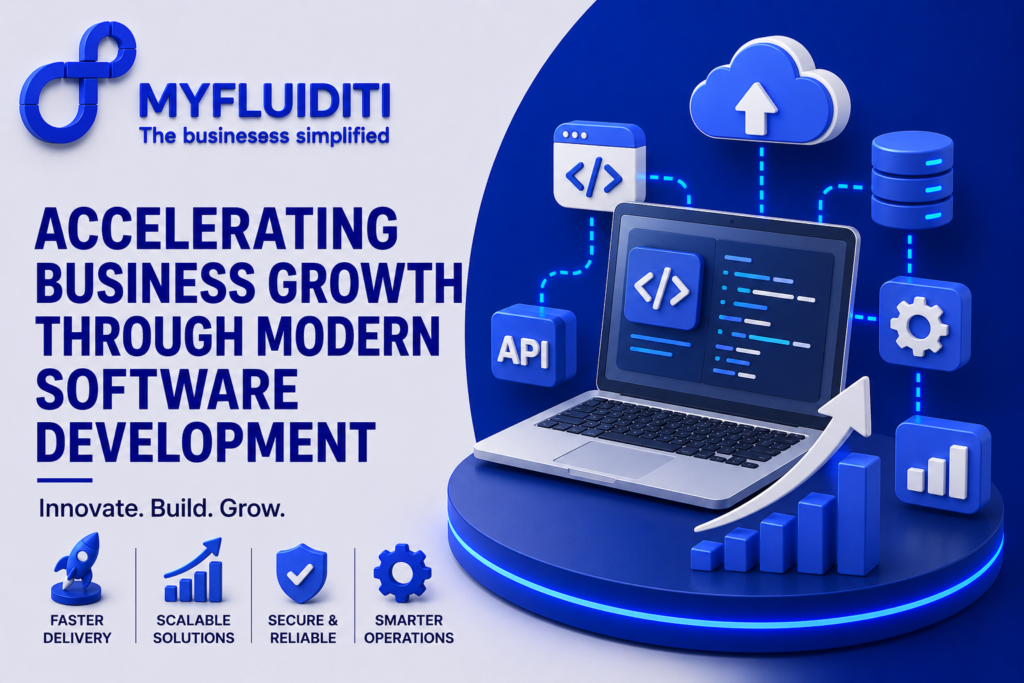
Introduction In today’s fast-changing business environment, technology has become one of the most powerful drivers of innovation, efficiency, and long-term success. Organizations across industries are investing in modern software development to improve operational performance, enhance customer experiences, and adapt quickly to evolving market demands. Traditional software systems often struggle to support growing business requirements, making modernization essential for companies seeking sustainable growth. By adopting scalable applications, intelligent automation, and agile development practices, businesses can streamline operations while creating new opportunities for innovation. At MyFluiditi, we help organizations transform their ideas into high-performing software solutions that accelerate growth, improve productivity, and deliver measurable business value through customized technology strategies. Understanding Modern Software Development Modern software development goes beyond writing code. It involves building secure, scalable, and user-centric applications using contemporary development methodologies, agile practices, continuous integration, automation, and advanced architectures. Businesses today require applications that are flexible enough to support changing customer expectations while maintaining reliability, performance, and security. Modern development focuses on faster delivery, continuous improvement, and seamless user experiences rather than lengthy development cycles. At MyFluiditi, we combine technical expertise with business understanding to develop software solutions that not only meet today’s requirements but are also prepared for future growth. Why Modern Software Development Matters The success of any organization increasingly depends on how effectively it can leverage technology to solve business challenges. Legacy systems often lead to slower operations, higher maintenance costs, and limited scalability. Custom software development enables businesses to eliminate operational bottlenecks, automate repetitive tasks, improve collaboration, and respond more quickly to market opportunities. Modern software also supports better decision-making by integrating business data into centralized platforms, allowing organizations to gain real-time insights and improve overall efficiency. MyFluiditi works closely with businesses to modernize outdated systems and build reliable software that supports long-term digital transformation goals. Improving Customer Experience Through Better Applications Customer expectations continue to evolve as digital interactions become the standard across industries. Businesses need applications that provide fast performance, intuitive navigation, personalized experiences, and seamless accessibility across multiple devices. Modern software development emphasizes user experience at every stage, ensuring applications remain responsive, secure, and easy to use. High-performing software helps businesses strengthen customer relationships, improve satisfaction, and increase retention rates. At MyFluiditi, every application is designed with the end user in mind, combining functionality, performance, and intuitive design to create engaging digital experiences. Accelerating Business Operations One of the biggest advantages of modern software development is its ability to streamline business operations. Organizations often rely on multiple disconnected systems that reduce efficiency and create unnecessary complexity. By developing integrated software platforms, businesses can automate workflows, centralize information, reduce manual processes, and improve collaboration across departments. This operational efficiency enables teams to focus on strategic initiatives rather than repetitive administrative tasks. MyFluiditi develops customized business applications that simplify daily operations while increasing productivity and reducing operational costs. Scalable Software for Growing Businesses As businesses expand, their technology must grow alongside them. Scalable software architecture allows organizations to handle increasing users, larger datasets, and expanding operational requirements without compromising performance. Modern software solutions are designed with flexibility, ensuring businesses can introduce new features, integrate additional systems, and adapt to future changes with minimal disruption. At MyFluiditi, we build scalable applications that support business growth while providing the flexibility needed to remain competitive in evolving markets. Security as a Core Development Principle As organizations handle increasing volumes of digital information, software security has become a critical priority. Modern software development incorporates security throughout the development lifecycle rather than treating it as an afterthought. Secure coding practices, encryption, authentication, access management, regular testing, and continuous monitoring help protect applications from evolving cyber threats. At MyFluiditi, security is embedded into every solution we deliver, ensuring businesses can operate confidently while protecting sensitive customer and business information. Agile Development for Faster Delivery Businesses cannot afford lengthy development cycles that delay innovation and market opportunities. Agile software development enables organizations to deliver applications faster through iterative development, continuous feedback, and ongoing improvements. Agile methodologies encourage collaboration between development teams and business stakeholders, ensuring software evolves according to real business needs. This flexible approach reduces project risks while improving software quality and customer satisfaction. MyFluiditi follows agile development practices to deliver high-quality solutions that adapt quickly to changing business priorities. Integration with Modern Business Systems Modern organizations rely on various software platforms to manage operations, customer relationships, finance, communication, and analytics. Effective software development focuses on seamless integration between these systems to create unified business ecosystems. Connected applications eliminate data silos, improve collaboration, and provide organizations with complete visibility into business performance. At MyFluiditi, we design software that integrates smoothly with existing platforms, helping businesses maximize the value of their technology investments while improving operational efficiency. Innovation Through Customized Software Solutions Every business has unique challenges that cannot always be addressed through off-the-shelf software. Custom software development enables organizations to build applications tailored specifically to their operational requirements, customer expectations, and business goals. Customized solutions improve flexibility, support innovation, and provide competitive advantages that standardized software often cannot deliver. MyFluiditi works closely with clients to understand their objectives and develop software solutions that align technology with long-term business strategies. How MyFluiditi Helps Businesses Grow Technology should serve as a catalyst for business success rather than an operational challenge. At MyFluiditi, we partner with organizations throughout their software development journey, from strategy and planning to design, development, implementation, optimization, and ongoing support. Our experienced development teams focus on creating reliable, scalable, and high-performance software solutions that solve real business problems. By combining modern development methodologies, user-focused design, robust architecture, and continuous innovation, we help businesses improve efficiency, strengthen customer engagement, and accelerate sustainable growth. Whether organizations require custom applications, application modernization, workflow automation, or software consulting, MyFluiditi delivers solutions designed to create measurable business impact. The Future of Modern Software Development The software development landscape continues to evolve rapidly as businesses seek greater flexibility, improved user experiences, and faster innovation. Emerging technologies, intelligent automation, low-code platforms, advanced analytics, and modern application