Generative AI for IT: Integration Approaches, Use Cases, Challenges, ROI Evaluation and Future Outlook
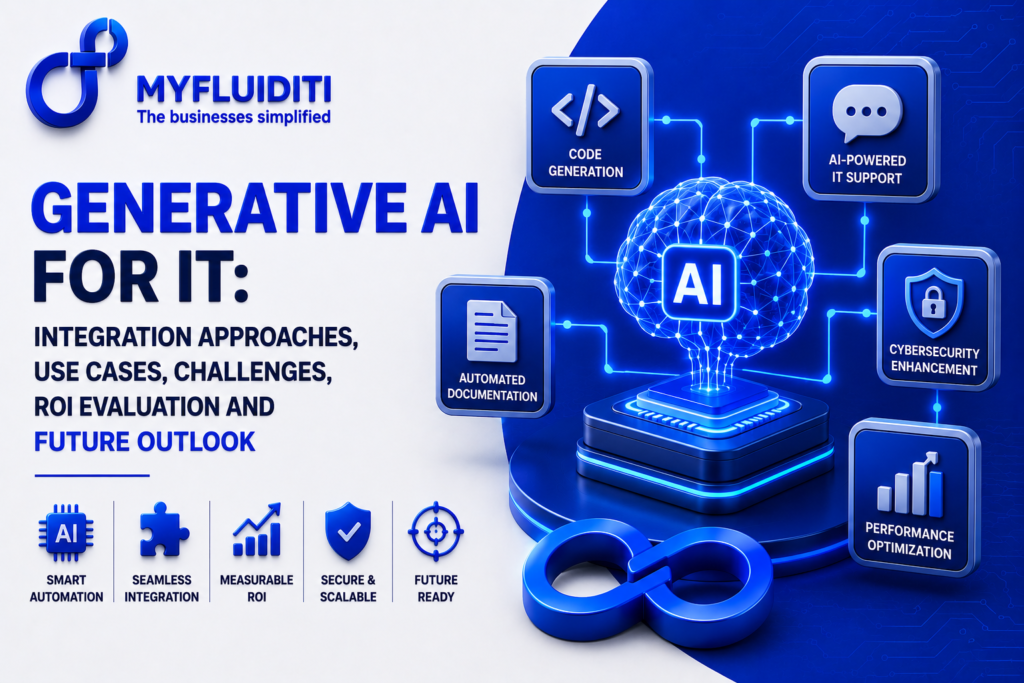
Introduction The rapid advancement of artificial intelligence is reshaping the technology landscape, and Generative AI for IT has emerged as one of the most transformative innovations for modern enterprises. Organizations are increasingly adopting Generative AI solutions to automate workflows, enhance productivity, accelerate software development, improve customer experiences, and optimize IT operations. As businesses continue their digital transformation journeys, Generative AI is becoming a strategic enabler that helps organizations innovate faster while reducing operational costs. From intelligent code generation and IT service management to automated documentation and predictive support systems, Generative AI is creating new opportunities for businesses to improve efficiency and competitiveness. At MyFluiditi, we help organizations successfully adopt and integrate Generative AI technologies through customized AI solutions, cloud-native architectures, automation frameworks, and enterprise-grade implementation strategies that align with business objectives. Understanding Generative AI in IT Generative AI refers to advanced artificial intelligence systems capable of creating new content, generating insights, producing code, automating tasks, and supporting decision-making based on large volumes of data. Unlike traditional AI models that focus primarily on prediction and classification, Generative AI can create human-like outputs, making it highly valuable across various IT functions. Modern enterprises are leveraging Generative AI to enhance software engineering, automate IT support, improve cybersecurity operations, streamline documentation processes, and accelerate innovation. At MyFluiditi, we help businesses harness the power of enterprise Generative AI solutions to transform traditional IT environments into intelligent and adaptive ecosystems. Why Businesses Are Investing in Generative AI for IT Organizations face increasing pressure to deliver technology solutions faster while maintaining operational efficiency and controlling costs. Growing demands for innovation, complex infrastructures, talent shortages, and evolving customer expectations are driving the adoption of AI-powered IT solutions. Generative AI enables businesses to automate repetitive tasks, improve resource utilization, reduce manual workloads, and enhance productivity across IT teams. By integrating AI into everyday operations, organizations can focus more on strategic initiatives while improving service delivery and operational agility. At MyFluiditi, we work closely with enterprises to identify high-impact AI opportunities that deliver measurable business outcomes and long-term value. Integration Approaches for Generative AI Implementation Successful implementation of Generative AI requires a structured integration strategy that aligns technology capabilities with organizational goals. Businesses must evaluate existing infrastructure, data availability, security requirements, and operational workflows before deployment. Many organizations begin by integrating Generative AI into specific use cases such as IT helpdesks, software development environments, or knowledge management systems. Over time, AI capabilities can expand across departments through API integrations, cloud platforms, enterprise applications, and workflow automation systems. At MyFluiditi, we follow a phased implementation approach that minimizes risk while maximizing adoption. Our experts design scalable AI architectures that seamlessly integrate with ERP systems, CRM platforms, cloud environments, DevOps pipelines, and enterprise applications. Generative AI for Software Development One of the most impactful applications of Generative AI in IT is software development. Development teams can leverage AI-powered coding assistants to generate code snippets, automate testing, identify bugs, optimize performance, and accelerate project delivery. Generative AI significantly reduces development time by assisting developers with repetitive coding tasks and providing intelligent recommendations throughout the software lifecycle. Organizations can improve productivity while maintaining high-quality code standards. MyFluiditi helps businesses integrate AI-assisted development tools into their engineering workflows, enabling faster product development and improved software delivery outcomes. Enhancing IT Service Management with Generative AI IT service management is undergoing significant transformation through AI-driven automation. Generative AI can automate ticket resolution, provide intelligent recommendations, generate knowledge base articles, and improve service desk efficiency. AI-powered virtual assistants can respond to employee queries, troubleshoot common issues, and guide users through problem-resolution processes without requiring human intervention. This reduces support workloads and improves user satisfaction. At MyFluiditi, we implement intelligent IT service management solutions that leverage Generative AI to enhance service delivery, improve response times, and optimize operational efficiency. Intelligent Knowledge Management and Documentation Documentation remains a critical yet time-consuming aspect of IT operations. Generative AI can automatically create technical documentation, user manuals, system configurations, incident reports, and project summaries. By transforming raw data into structured knowledge assets, organizations can improve information accessibility and reduce the burden on technical teams. Automated documentation also helps maintain consistency and supports compliance requirements. MyFluiditi develops AI-powered knowledge management systems that help organizations centralize information and improve collaboration across teams. Generative AI for Cybersecurity Operations Cybersecurity teams are increasingly adopting Generative AI to strengthen threat detection, automate incident analysis, and improve security operations. AI models can analyze security logs, identify attack patterns, generate incident summaries, and provide actionable recommendations for threat mitigation. Security teams benefit from faster investigations and improved response capabilities. At MyFluiditi, we integrate Generative AI into cybersecurity frameworks to enhance threat intelligence, automate security workflows, and support proactive risk management strategies. AI-Powered Infrastructure Management Managing modern IT infrastructure requires continuous monitoring, optimization, and maintenance. Generative AI can help organizations monitor system performance, predict failures, automate troubleshooting, and recommend infrastructure improvements. By analyzing operational data in real time, AI systems can identify inefficiencies and proactively resolve issues before they impact business operations. MyFluiditi helps enterprises implement intelligent infrastructure management solutions that improve system reliability, reduce downtime, and enhance operational resilience. Challenges of Generative AI Adoption While the benefits of Generative AI are significant, organizations must address several challenges during implementation. Data privacy and security remain major concerns, particularly when handling sensitive business information. AI-generated outputs must also be monitored to ensure accuracy, compliance, and reliability. Additionally, businesses may face integration complexities, governance challenges, and change management requirements. At MyFluiditi, we adopt a security-first approach to AI implementation by incorporating governance frameworks, data protection measures, compliance controls, and responsible AI practices throughout the deployment process. Measuring ROI from Generative AI Investments Evaluating the return on investment (ROI) of Generative AI initiatives is essential for long-term success. Organizations should measure both quantitative and qualitative outcomes to assess business value. Key performance indicators may include: At MyFluiditi, we help organizations establish AI success metrics and performance measurement frameworks that provide visibility into business impact and ROI. Best Practices for Successful Generative AI Integration
Agentic AI for Next-Gen Cybersecurity Operations
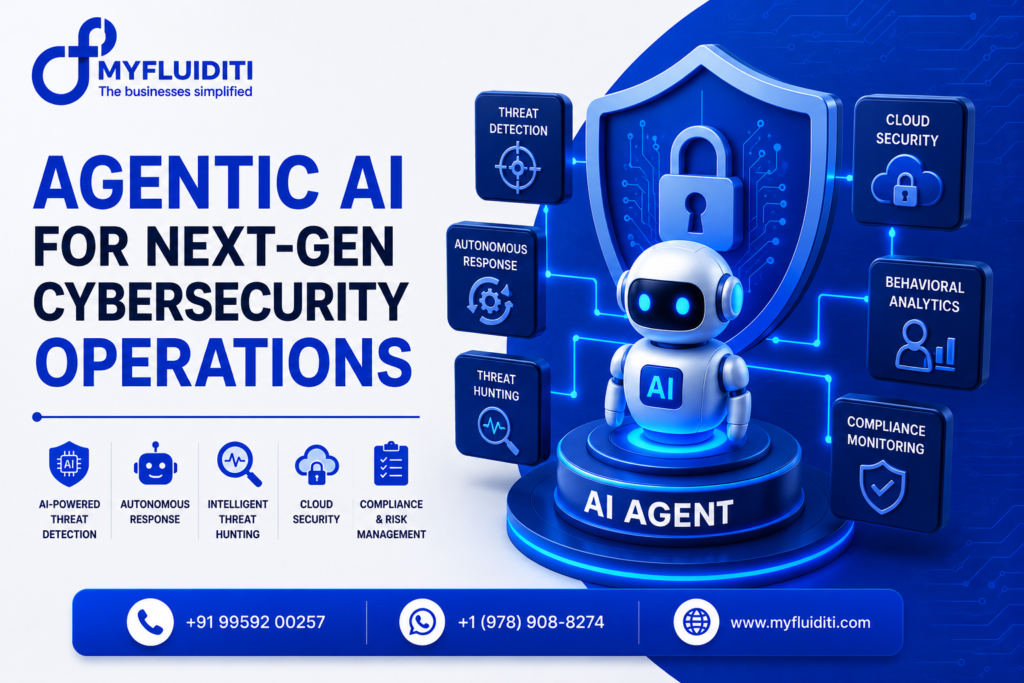
Introduction As cyber threats continue to evolve in complexity and scale, traditional security operations centers (SOCs) are struggling to keep pace with the growing volume of alerts, sophisticated attack techniques, and expanding digital infrastructures. Organizations today require faster threat detection, intelligent response mechanisms, and autonomous security capabilities to defend against modern cyber risks. This is where Agentic AI is transforming modern Cybersecurity Operations. Agentic AI represents a new generation of artificial intelligence systems capable of making context-aware decisions, taking autonomous actions, learning continuously, and coordinating multiple security tasks without constant human intervention. Unlike traditional AI models that primarily provide recommendations, Agentic AI can actively execute security workflows, investigate threats, prioritize incidents, and respond to attacks in real time. At MyFluiditi, we help organizations strengthen their cybersecurity posture through advanced AI-Driven Cybersecurity Solutions, intelligent automation frameworks, cloud-native security architectures, and next-generation threat detection systems designed for modern enterprises. What is Agentic AI in Cybersecurity? Agentic AI refers to autonomous AI systems that can perceive, analyze, decide, and act independently within defined security environments. These intelligent agents operate continuously across networks, endpoints, cloud platforms, applications, and digital assets to identify threats and initiate appropriate responses. Unlike conventional security tools that depend heavily on human analysts, Agentic AI combines machine learning, large language models, behavioral analytics, and autonomous decision-making capabilities to reduce response times and improve security outcomes. At MyFluiditi, we develop intelligent security ecosystems that leverage Agentic AI to automate threat detection, incident investigation, and response orchestration while maintaining human oversight where required. Why Traditional Security Operations Are No Longer Enough Modern cybersecurity teams face several challenges, including massive volumes of security alerts, increasing ransomware attacks, sophisticated phishing campaigns, insider threats, cloud security complexities, and talent shortages. Security analysts often spend valuable time reviewing false positives and manually investigating incidents. This reactive approach creates operational bottlenecks and increases the likelihood of missed threats. Agentic AI addresses these challenges by automating repetitive security tasks, continuously monitoring environments, and enabling proactive threat management. At MyFluiditi, we help businesses transition from reactive security models to intelligent, autonomous Cybersecurity Operations that improve efficiency and resilience. Autonomous Threat Detection and Response One of the most powerful applications of Agentic AI is Autonomous Threat Detection and response. Traditional security systems generate alerts that require manual investigation. Agentic AI can analyze suspicious activities, correlate data from multiple sources, determine attack severity, and automatically initiate containment measures. When unusual network behavior is detected, AI security agents can analyze affected systems, identify attack patterns, isolate compromised endpoints, block malicious IP addresses, generate incident reports, and escalate critical threats to security teams. MyFluiditi helps organizations implement AI-driven Security Operations Centers that significantly reduce Mean Time to Detect (MTTD) and Mean Time to Respond (MTTR). AI-Powered Security Operations Center (SOC) The future of cybersecurity lies in intelligent and automated SOC environments. An AI-Powered Security Operations Center continuously monitors security events, prioritizes incidents, and coordinates response activities across various security tools and platforms. Organizations benefit from faster incident response, reduced analyst workload, improved threat visibility, enhanced security efficiency, lower operational costs, and stronger compliance management. At MyFluiditi, we design AI-powered SOC solutions that integrate SIEM platforms, cloud security tools, endpoint protection systems, and threat intelligence feeds to create a unified security ecosystem. Intelligent Threat Hunting Traditional threat hunting is often time-consuming and dependent on analyst expertise. Threat Hunting powered by Agentic AI proactively searches for indicators of compromise, identifies hidden attack patterns, and uncovers suspicious activities before they escalate into major incidents. Through advanced behavioral analysis and machine learning models, AI agents continuously monitor network activity, user behavior, and system logs to detect emerging threats. MyFluiditi enables organizations to implement intelligent threat-hunting capabilities that improve cyber resilience while reducing manual effort. Automated Incident Investigation Cybersecurity teams frequently spend hours investigating security alerts. Agentic AI can automatically gather evidence, correlate events, reconstruct attack timelines, and determine root causes within minutes. Instead of manually reviewing thousands of logs, security teams receive comprehensive incident summaries with actionable recommendations. At MyFluiditi, we build AI-driven investigation frameworks that enable faster decision-making and more effective incident management. Advanced Behavioral Analytics Modern cyberattacks often bypass traditional signature-based detection methods. Agentic AI utilizes behavioral analytics to identify deviations from normal user and system behavior. By establishing baseline activity patterns, AI agents can quickly detect anomalies that may indicate malicious activity, including insider threats, privileged account misuse, suspicious logins, account takeover attempts, and data exfiltration activities. MyFluiditi helps organizations deploy behavioral analytics solutions that provide deeper visibility into evolving cyber risks. Agentic AI for Cloud Security As businesses accelerate cloud adoption, securing cloud environments has become increasingly challenging. Cloud Security powered by Agentic AI continuously monitors configurations, permissions, workloads, and access controls across multi-cloud environments. AI agents can automatically detect cloud misconfigurations, monitor privileged access, identify suspicious activities, enforce security policies, and generate compliance reports. At MyFluiditi, we deliver cloud-native security solutions powered by Agentic AI that help organizations secure AWS, Azure, Google Cloud, and hybrid environments. Ransomware Detection and Prevention Ransomware Detection remains one of the most critical cybersecurity priorities for modern organizations. Agentic AI can identify early indicators of ransomware activity by monitoring file behavior, encryption patterns, endpoint activity, and network communications. When suspicious behavior is detected, AI agents can automatically isolate affected systems and initiate response protocols before the attack spreads. MyFluiditi leverages advanced AI-based ransomware defense mechanisms that provide proactive protection against evolving ransomware campaigns. Continuous Compliance and Risk Management Maintaining regulatory compliance is a critical requirement for modern businesses. Agentic AI enables automated Compliance Monitoring by continuously assessing security controls, identifying compliance gaps, and generating real-time audit reports. Organizations can streamline compliance efforts for standards such as ISO 27001, SOC 2, HIPAA, GDPR, PCI DSS, and the NIST Cybersecurity Framework. At MyFluiditi, we help organizations automate compliance monitoring and risk assessment processes through intelligent Security Automation solutions. Benefits of Agentic AI for Cybersecurity Operations Organizations adopting Agentic AI gain significant advantages, including enhanced threat detection, reduced response times, improved operational efficiency, lower security costs, stronger threat intelligence
10-Step Checklist to Build a Successful MVP for Startups
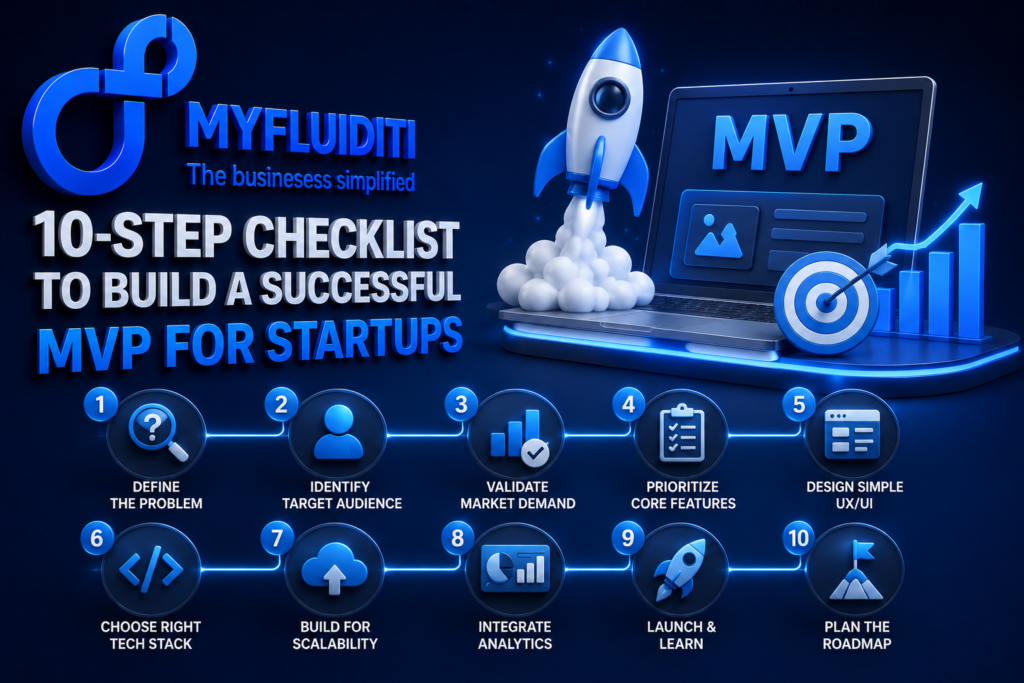
Introduction Launching a startup comes with uncertainty, limited resources, and the constant pressure to validate ideas quickly. This is why building a Minimum Viable Product (MVP) has become one of the most effective approaches for startups seeking rapid market validation. An MVP allows businesses to launch with essential features, gather real user feedback, reduce development risks, and accelerate time-to-market without investing heavily in a full-scale product. Successful startups understand that the goal is not to build a perfect product from day one. Instead, the focus is on solving a core problem for users while collecting valuable insights for future improvements. At MyFluiditi, we help startups transform innovative ideas into scalable digital products through MVP development services, product strategy consulting, AI-powered solutions, and custom software development. Our structured approach enables startups to validate concepts faster and build products that align with market needs. Step 1: Clearly Define the Problem You Are Solving Every successful MVP begins with a clearly defined problem. Before writing a single line of code, startups must understand the specific challenge their product aims to address. Many startups fail because they focus on features rather than customer problems. The most successful products solve a genuine pain point experienced by a target audience. At MyFluiditi, we work closely with founders to identify market gaps, user challenges, and business opportunities before beginning product development. A strong problem statement provides the foundation for every future product decision. Step 2: Identify Your Target Audience Understanding your audience is critical when building an MVP for startups. Different users have different expectations, behaviors, and needs. Startups should define who their ideal customers are, what problems they face, and how they currently solve those challenges. User research helps prioritize features that provide the highest value during the MVP phase. At MyFluiditi, we use customer discovery workshops, user persona development, and market analysis to ensure products are designed around real customer needs rather than assumptions. Step 3: Validate Market Demand Before investing heavily in development, startups should validate whether there is genuine demand for the solution. Market validation can involve customer interviews, surveys, competitor analysis, landing pages, and prototype testing. Gathering early feedback helps confirm that users are willing to adopt the solution. A validated idea significantly reduces product risk and increases the chances of long-term success. MyFluiditi helps startups conduct market validation exercises that support informed product development decisions. Step 4: Prioritize Core Features Only One of the biggest mistakes startups make is attempting to build too many features during the MVP stage. An MVP should focus only on the essential functionality required to solve the primary problem. Additional features can be added later based on user feedback and business priorities. Key MVP priorities often include: At MyFluiditi, we help startups identify high-impact features that deliver maximum value while keeping development lean and efficient. Step 5: Design a Simple and User-Friendly Experience Even the most innovative product can struggle if users find it difficult to navigate. User experience plays a major role in MVP success. Clean interfaces, intuitive navigation, and streamlined workflows help improve engagement and user retention. A successful MVP does not need complex visual designs, but it must provide a smooth and enjoyable experience. MyFluiditi’s UI/UX specialists focus on creating intuitive digital experiences that encourage user adoption and product growth. Step 6: Choose the Right Technology Stack The technology stack chosen during MVP development can significantly impact scalability, performance, and future expansion. Startups should select technologies that support rapid development while remaining flexible enough to accommodate future growth. Modern frameworks, cloud infrastructure, and scalable architectures help ensure long-term success. At MyFluiditi, we leverage technologies such as React, Next.js, Flutter, Node.js, AWS, Azure, and AI-powered development tools to build future-ready MVPs that can evolve alongside business requirements. Step 7: Build for Scalability from Day One Although an MVP focuses on speed, scalability should never be ignored. Products that gain traction quickly often face performance challenges if scalability is not considered during development. Startups should adopt architectures that support future growth without requiring complete redevelopment. MyFluiditi helps startups implement cloud-native architecture, microservices, and scalable infrastructure solutions that support both immediate product launches and long-term expansion. Step 8: Integrate Analytics and Feedback Mechanisms Data is one of the most valuable assets for any startup. An MVP should include analytics tools that track user behavior, engagement patterns, conversion rates, and feature usage. These insights help founders make informed decisions about future development priorities. User feedback mechanisms such as surveys, ratings, and support channels provide additional visibility into customer needs. At MyFluiditi, we integrate analytics and reporting capabilities that enable startups to continuously improve their products based on real-world usage data. Step 9: Launch Quickly and Learn Continuously The purpose of an MVP is learning, not perfection. Startups that spend too much time refining products before launch often miss valuable opportunities to gather user feedback. A faster launch enables businesses to validate assumptions and identify improvement opportunities sooner. Successful startup teams embrace continuous iteration by releasing updates, testing new features, and responding to customer insights. MyFluiditi follows an agile development approach that enables startups to launch efficiently while maintaining flexibility for ongoing enhancements. Step 10: Plan the Product Roadmap An MVP is only the beginning of the product journey. After launch, startups should develop a roadmap outlining future features, improvements, scaling strategies, and growth objectives. Product evolution should be driven by user feedback, business goals, and market trends. A clear roadmap helps startups allocate resources effectively while maintaining focus on long-term success. At MyFluiditi, we support startups beyond the MVP stage by providing product scaling, AI integration, cloud transformation, and ongoing development services that help businesses grow confidently. How MyFluiditi Helps Startups Build Successful MVPs Building an MVP requires a combination of technical expertise, business strategy, and market understanding. MyFluiditi provides end-to-end MVP development services that help startups move from idea validation to product launch efficiently. Our services include product discovery, market validation, UI/UX design, custom software development, cloud architecture, AI integration, testing, deployment, and post-launch support.
IoT for Smarter Supply Chain Management and Logistics
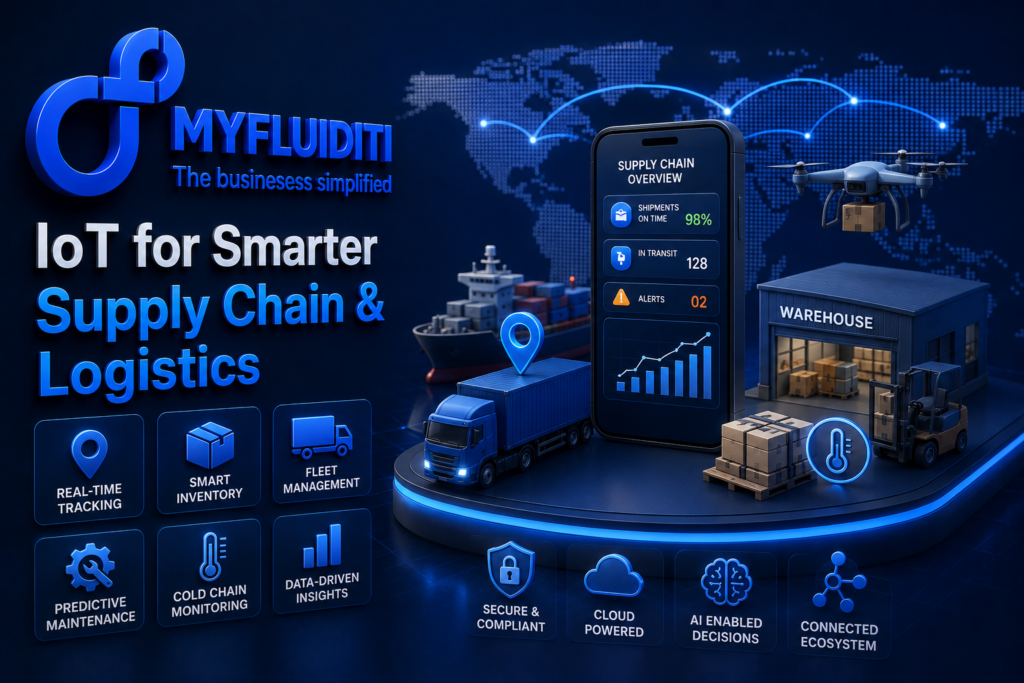
Introduction The modern supply chain is undergoing a significant transformation driven by the rapid adoption of Internet of Things (IoT) technologies. Businesses across industries are increasingly leveraging connected devices, real-time tracking systems, and intelligent analytics to build agile, transparent, and highly efficient logistics networks. In an era where customers expect faster deliveries, complete visibility, and seamless experiences, traditional supply chain models often struggle to keep pace with growing demands. This is why IoT for Supply Chain Management and Logistics has emerged as a strategic investment for organizations aiming to enhance operational efficiency, reduce costs, improve inventory control, and strengthen decision-making. From fleet monitoring and warehouse automation to predictive maintenance and asset tracking, IoT is redefining every stage of the supply chain lifecycle. At MyFluiditi, we help organizations harness the power of IoT by developing intelligent, scalable, and cloud-enabled logistics ecosystems that provide real-time insights and drive measurable business outcomes. By integrating IoT technologies with analytics, automation, and enterprise systems, we enable businesses to build future-ready supply chains designed for resilience and growth. Understanding IoT in Supply Chain and Logistics The Internet of Things in logistics refers to a network of interconnected devices, sensors, machines, vehicles, and software systems that collect, transmit, and analyze data throughout the supply chain. These connected systems provide organizations with continuous visibility into inventory movement, shipment conditions, equipment performance, and operational workflows. Unlike traditional supply chain systems that often rely on manual updates and fragmented information, IoT-enabled environments offer real-time intelligence that supports faster and more informed decision-making. Businesses can monitor assets across multiple locations, identify inefficiencies proactively, and optimize processes based on accurate operational data. At MyFluiditi, we design customized IoT solutions that seamlessly integrate with existing enterprise applications, cloud platforms, ERP systems, and analytics tools to create connected logistics ecosystems that improve agility and responsiveness. Why Businesses Are Investing in IoT for Supply Chain Management Supply chains today face increasing complexity due to globalization, changing consumer expectations, fluctuating market conditions, and rising operational costs. Organizations require greater transparency and flexibility to adapt to disruptions while maintaining service quality. IoT-powered supply chain solutions enable businesses to gain end-to-end visibility across their operations. Real-time data collection improves forecasting accuracy, enhances inventory management, and minimizes delays caused by unforeseen events. Businesses can also identify bottlenecks more quickly and implement corrective actions before problems escalate. At MyFluiditi, we help organizations deploy IoT technologies that improve supply chain resilience, streamline logistics processes, and support data-driven decision-making. Our solutions are designed to deliver both immediate operational improvements and long-term strategic value. Real-Time Asset Tracking and Visibility One of the most significant advantages of IoT adoption is enhanced visibility throughout the supply chain. Businesses often struggle to track goods accurately during transportation, resulting in delays, misplaced shipments, and customer dissatisfaction. IoT sensors and GPS-enabled devices provide real-time asset tracking, allowing organizations to monitor the location and status of shipments continuously. Companies gain instant access to shipment updates, estimated arrival times, and route information, improving communication and accountability. At MyFluiditi, we develop intelligent tracking solutions that provide centralized dashboards and actionable insights, enabling businesses to improve delivery performance and strengthen customer trust through complete transparency. Smart Inventory Management Inventory management remains one of the most challenging aspects of supply chain operations. Overstocking increases carrying costs, while stock shortages lead to lost sales opportunities and dissatisfied customers. IoT-enabled inventory management systems use sensors, RFID tags, and connected devices to monitor inventory levels automatically. Businesses can receive alerts when stock reaches predefined thresholds, improving replenishment planning and reducing waste. Through advanced IoT integrations, MyFluiditi helps organizations automate inventory monitoring, optimize stock levels, and improve warehouse efficiency while reducing manual intervention and human errors. Fleet Management and Transportation Optimization Transportation costs represent a substantial portion of supply chain expenditures. Managing fleets efficiently while ensuring timely deliveries is essential for maintaining profitability and customer satisfaction. IoT technologies enable organizations to monitor vehicle performance, fuel consumption, driver behavior, route efficiency, and maintenance requirements in real time. Businesses can optimize delivery routes, reduce idle time, and improve fleet utilization through intelligent analytics. At MyFluiditi, we build connected fleet management platforms that combine IoT sensors, GPS technologies, and predictive analytics to help logistics providers maximize operational efficiency and reduce transportation costs. Predictive Maintenance for Logistics Operations Unexpected equipment failures can disrupt operations, delay shipments, and increase maintenance expenses. Traditional maintenance approaches often rely on fixed schedules that may not accurately reflect equipment conditions. Predictive maintenance powered by IoT allows businesses to monitor machinery health continuously using connected sensors. By analyzing operational data, organizations can identify early warning signs of potential failures and schedule maintenance proactively. MyFluiditi helps businesses implement predictive maintenance strategies that minimize downtime, extend equipment lifespan, and improve overall supply chain reliability. Enhancing Warehouse Automation Warehouses are becoming increasingly intelligent as businesses seek to improve productivity and accuracy. IoT technologies support warehouse automation by connecting equipment, inventory systems, and operational workflows. Connected devices enable automated inventory tracking, environmental monitoring, equipment management, and workforce coordination. Real-time insights allow warehouse managers to optimize space utilization, streamline order fulfillment, and reduce processing times. At MyFluiditi, we develop smart warehouse solutions that integrate IoT technologies with automation systems to create highly efficient fulfillment environments capable of adapting to changing business demands. Improving Cold Chain Monitoring Industries such as pharmaceuticals, healthcare, and food distribution require strict environmental controls during transportation and storage. Temperature fluctuations can compromise product quality, regulatory compliance, and customer safety. IoT sensors continuously monitor environmental conditions such as temperature, humidity, and pressure throughout the supply chain. Organizations receive instant alerts when conditions deviate from acceptable thresholds, enabling rapid intervention. MyFluiditi helps businesses deploy IoT-enabled cold chain solutions that enhance compliance, reduce spoilage, and protect product integrity across sensitive supply chains. Data Analytics and Decision Intelligence The true value of IoT extends beyond data collection. Organizations must transform operational data into actionable insights that support strategic decision-making. By integrating IoT with advanced analytics, businesses can identify patterns, forecast demand, optimize resource allocation, and improve supply chain performance. Predictive insights
Money Transfer App Development: Building Secure Payment Apps in 2026
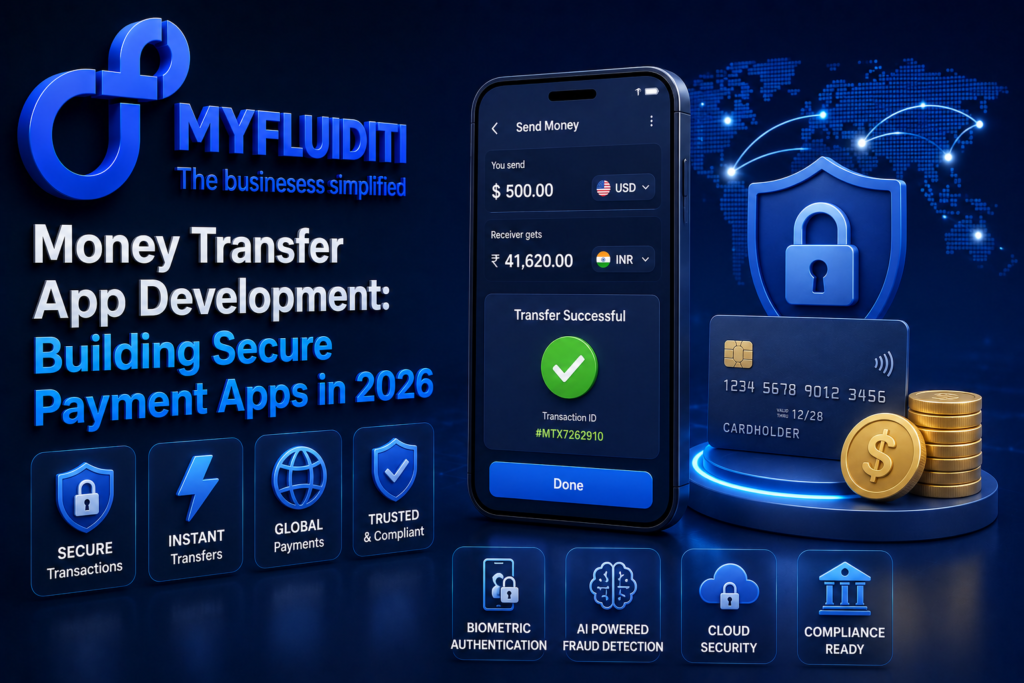
Introduction The global financial ecosystem is undergoing a significant transformation as digital payments become the preferred method of conducting transactions worldwide. Consumers today expect instant, secure, and seamless payment experiences that can be accessed anytime and anywhere. As a result, Money Transfer App Development has emerged as one of the fastest-growing sectors within the fintech industry, helping businesses provide real-time money transfers, digital wallet services, peer-to-peer payments, and cross-border transaction capabilities. The demand for secure payment apps, mobile banking platforms, and digital financial solutions is expected to grow even further in 2026 as cashless economies continue expanding. Businesses entering the fintech market must focus not only on user convenience but also on security, compliance, scalability, and fraud prevention. At MyFluiditi, we help organizations build innovative and secure payment applications powered by cloud technologies, AI-driven fraud detection, advanced encryption, and scalable fintech architectures. Our solutions enable businesses to deliver trusted digital payment experiences while meeting evolving customer expectations. Understanding Money Transfer App Development Money transfer app development involves designing and building software applications that allow users to send, receive, manage, and track financial transactions digitally. These applications connect users, financial institutions, payment gateways, and digital wallets through secure transaction networks that facilitate seamless money movement. Modern payment apps support a wide range of services including peer-to-peer transfers, merchant payments, bill settlements, subscription payments, salary disbursements, and international remittances. Consumers increasingly expect payment apps to deliver instant processing, transparency, convenience, and security. At MyFluiditi, we develop custom fintech applications tailored to business requirements. By combining cloud-native infrastructure, API-driven integrations, and advanced security frameworks, we help businesses launch payment platforms capable of supporting millions of transactions efficiently. Why Secure Payment Apps Are Essential in 2026 The rise of digital payments has also increased cybersecurity threats targeting financial applications. Fraudsters continuously develop sophisticated techniques to exploit vulnerabilities in payment systems, making security a top priority for businesses operating in the fintech sector. Customers trust payment applications with highly sensitive information including personal details, banking credentials, transaction histories, and financial records. Any security breach can result in financial losses, reputational damage, and regulatory consequences. Building a secure payment app requires implementing multiple layers of protection that safeguard user information and transaction data. At MyFluiditi, we integrate security into every stage of development, ensuring applications are protected against evolving cyber threats while maintaining a seamless user experience. Organizations that prioritize security gain stronger customer trust, improve user retention, and create long-term competitive advantages in the digital payments market. Key Features of Modern Money Transfer Apps To succeed in today’s highly competitive fintech landscape, payment applications must deliver both functionality and convenience. Users expect fast, intuitive, and secure experiences that simplify financial transactions. Some of the most important features include: At MyFluiditi, we focus on building feature-rich payment ecosystems that enhance user engagement while maintaining enterprise-grade security and performance. The Growing Role of Artificial Intelligence in Payment Apps Artificial Intelligence is rapidly becoming a cornerstone of modern fintech software development. AI technologies help businesses improve security, automate operations, and deliver personalized user experiences. One of the most valuable applications of AI is fraud detection. Traditional rule-based systems often struggle to identify complex fraud patterns. AI-powered systems can analyze large volumes of transaction data in real time, detect anomalies, and prevent suspicious activities before they impact users. At MyFluiditi, we integrate intelligent fraud prevention mechanisms, predictive analytics, behavioral monitoring, and machine learning models into payment platforms. These capabilities enable businesses to reduce risks while enhancing operational efficiency. AI also supports customer service automation, transaction recommendations, spending insights, and personalized financial experiences, helping businesses strengthen customer relationships and engagement. Compliance and Regulatory Requirements Compliance is a critical component of successful payment app development. Financial applications must adhere to various regulations designed to protect consumer data, prevent fraud, and ensure transaction integrity. Organizations developing money transfer solutions must consider: Failure to comply with industry regulations can result in legal penalties, operational disruptions, and loss of customer trust. At MyFluiditi, we help businesses build compliance-ready fintech platforms by integrating secure identity verification systems, regulatory reporting mechanisms, and governance frameworks that align with industry standards. Cloud Infrastructure for Scalable Payment Solutions The increasing volume of digital transactions requires payment applications to operate on highly scalable and resilient infrastructure. Traditional systems often struggle to handle growing user bases and transaction loads efficiently. Cloud computing provides the scalability, flexibility, and reliability required for modern payment ecosystems. Cloud-native architectures allow businesses to process transactions in real time while maintaining high availability and performance. At MyFluiditi, we develop cloud-powered fintech solutions that support: Our cloud engineering expertise helps businesses create payment applications capable of scaling seamlessly as transaction volumes increase. Cybersecurity Strategies for Money Transfer Apps Security remains the foundation of every successful digital payment platform. As cyber threats continue evolving, businesses must adopt proactive strategies to protect users and financial data. Essential security measures include: At MyFluiditi, we implement comprehensive cybersecurity frameworks that protect payment applications against fraud, account takeovers, data breaches, and unauthorized access. Our security-first approach ensures businesses can deliver trusted financial services while maintaining compliance and operational resilience. How MyFluiditi Helps Businesses Build Secure Payment Apps At MyFluiditi, we specialize in creating intelligent financial technology solutions that combine innovation, security, compliance, and scalability. Rather than building standalone applications, we develop connected payment ecosystems designed to support long-term business growth. Our fintech development services include: By aligning technology strategies with business objectives, we help organizations launch future-ready payment applications that deliver exceptional customer experiences. Future Trends Shaping Money Transfer Apps in 2026 The digital payments industry continues evolving through advancements in AI, blockchain, open banking, and embedded finance. Businesses that embrace these innovations will be better positioned to compete in the future financial landscape. Emerging trends include: These technologies are expected to improve transaction speed, security, accessibility, and personalization while creating new opportunities for fintech innovation. At MyFluiditi, we help organizations stay ahead of industry changes by developing advanced payment ecosystems that integrate emerging technologies with secure and scalable architectures. Conclusion Money