IoT Education in Enterprises: Financial Impact, Risks and Roadmap
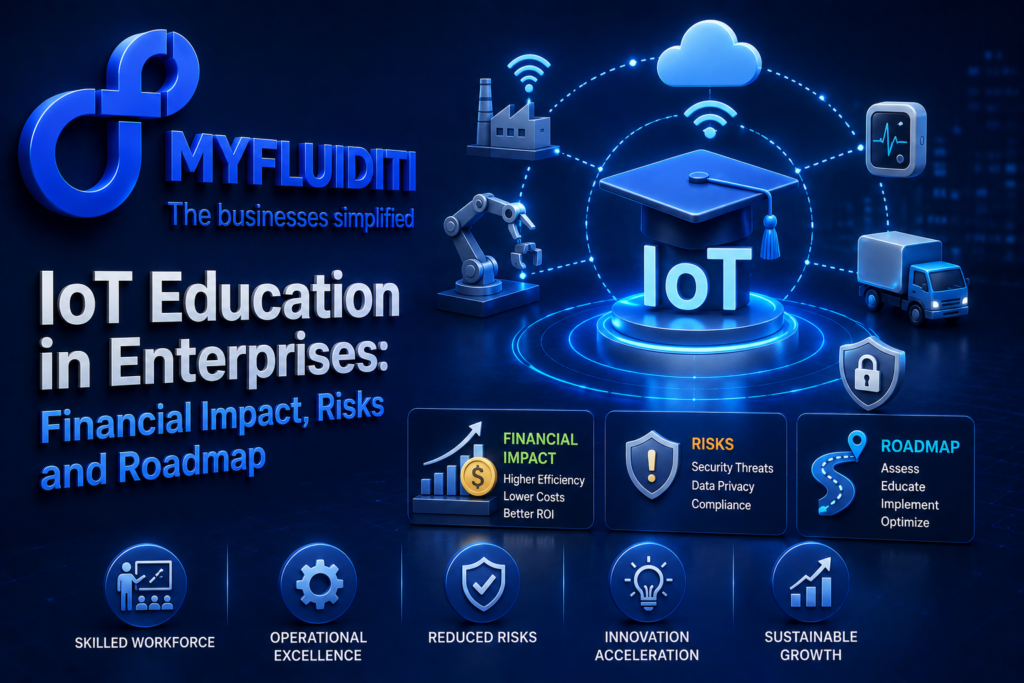
Introduction The adoption of Internet of Things (IoT) technologies is rapidly transforming enterprise learning and workforce development. Organizations across industries are investing in IoT education in enterprises to improve employee skills, accelerate digital transformation, enhance operational efficiency, and prepare teams for increasingly connected business environments. As businesses embrace Industry 4.0, smart devices, automation, and data-driven decision-making, educating employees about IoT technologies has become a strategic necessity rather than an optional initiative. Modern enterprises require professionals who understand IoT infrastructure, connected devices, cloud platforms, cybersecurity, data analytics, and intelligent automation systems. Without proper training, organizations may struggle to maximize the value of their technology investments. At MyFluiditi, we help businesses build scalable digital transformation strategies by integrating IoT solutions, cloud technologies, AI systems, and enterprise training initiatives that empower organizations to adapt to evolving technological landscapes. Understanding IoT Education in Enterprises IoT education refers to structured learning programs that help employees understand how connected devices, sensors, networks, cloud platforms, and data analytics work together within enterprise ecosystems. These programs provide technical and operational knowledge that enables teams to manage, maintain, optimize, and innovate using IoT technologies. As enterprises deploy smart manufacturing systems, connected logistics platforms, predictive maintenance solutions, and intelligent workplace environments, employee education becomes essential for ensuring successful implementation and adoption. At MyFluiditi, we assist organizations in building technology-driven ecosystems where workforce readiness aligns with business innovation goals. The Financial Impact of IoT Education Investing in enterprise IoT training delivers measurable financial benefits across multiple areas of business operations. Organizations that educate employees on IoT technologies often experience higher productivity, reduced operational costs, improved asset utilization, and faster innovation cycles. A well-trained workforce can identify opportunities for automation, improve equipment performance, optimize resource allocation, and leverage real-time data for better decision-making. Employees who understand IoT systems are also better equipped to troubleshoot issues, reducing downtime and minimizing disruptions. At MyFluiditi, we help businesses align IoT adoption with measurable business outcomes by combining technology implementation with workforce enablement strategies. This integrated approach maximizes return on investment while accelerating digital maturity. Another significant financial benefit comes from predictive maintenance and operational efficiency. Employees trained in IoT technologies can utilize sensor-generated data to identify potential equipment failures before they occur, reducing maintenance costs and preventing expensive production interruptions. How IoT Education Supports Digital Transformation Digital transformation requires more than technology deployment; it requires people who can effectively utilize that technology. Many organizations invest heavily in IoT infrastructure but fail to achieve expected outcomes due to knowledge gaps within their workforce. IoT education programs help bridge this gap by enabling employees to understand connected systems, interpret real-time data, and participate in innovation initiatives. This improves adoption rates and ensures technology investments generate meaningful business value. At MyFluiditi, we support organizations through comprehensive digital transformation initiatives that combine IoT consulting, cloud integration, automation strategies, and enterprise technology education. By aligning technology and talent development, businesses can accelerate transformation while reducing implementation challenges. Risks Associated with IoT Education and Adoption While IoT technologies offer substantial benefits, organizations must also address several risks associated with implementation and workforce training. One of the most significant concerns is cybersecurity. Connected devices expand the enterprise attack surface, creating potential vulnerabilities if employees lack awareness of security best practices. Improper device management, weak authentication mechanisms, and inadequate monitoring can increase exposure to cyber threats. At MyFluiditi, security is integrated into every IoT deployment strategy. We help organizations establish secure IoT architectures, implement access controls, and educate employees on cybersecurity best practices to reduce operational risks. Another challenge involves data privacy and compliance. IoT systems generate vast amounts of information, including sensitive operational and customer data. Organizations must ensure employees understand regulatory requirements and data governance policies to maintain compliance and protect business-critical information. Operational Challenges in Enterprise IoT Training Many organizations face difficulties when developing effective IoT education programs. Rapid technological evolution can make training content outdated quickly, requiring continuous updates and skill development initiatives. Additionally, employees often possess varying levels of technical expertise, making it difficult to design standardized learning experiences. Enterprises must create flexible training programs that address both foundational knowledge and advanced technical skills. At MyFluiditi, we help organizations develop scalable learning frameworks that support ongoing skill development while aligning with evolving business objectives and technology roadmaps. Resistance to change can also slow adoption efforts. Employees may be hesitant to embrace new technologies due to concerns about complexity or job displacement. Effective education programs should focus on demonstrating how IoT technologies enhance productivity and create opportunities for innovation rather than replacing human expertise. Building a Successful IoT Education Roadmap A successful IoT education roadmap begins with a clear understanding of business goals, technology initiatives, and workforce requirements. Organizations should identify the specific IoT capabilities needed to support operational objectives and develop training programs accordingly. The first step involves assessing existing skill levels across departments. This helps organizations identify knowledge gaps and prioritize learning initiatives. Training programs should then be tailored to different roles, including technical teams, operations personnel, managers, and executive stakeholders. At MyFluiditi, we help businesses create structured IoT adoption strategies that combine workforce development, technology deployment, cloud integration, and process optimization. Our roadmap-driven approach ensures organizations build both the technical infrastructure and human capabilities required for long-term success. Practical learning experiences are equally important. Employees benefit from hands-on exposure to IoT devices, analytics platforms, cloud environments, and real-world use cases. Interactive training accelerates learning and improves retention compared to traditional classroom-based approaches. The Role of Cloud and AI in Enterprise IoT Education Modern IoT ecosystems increasingly rely on cloud computing, artificial intelligence, and advanced analytics. As a result, enterprise IoT education programs should include training on cloud-native architectures, data processing platforms, machine learning applications, and automation technologies. Cloud platforms enable scalable IoT deployments by providing centralized data management, real-time analytics, and remote accessibility. AI enhances IoT capabilities by enabling predictive insights, intelligent automation, and anomaly detection. At MyFluiditi, we develop integrated solutions that combine IoT development services, cloud infrastructure, AI implementation, and enterprise training programs.
Table-Valued Parameters in SQL Server
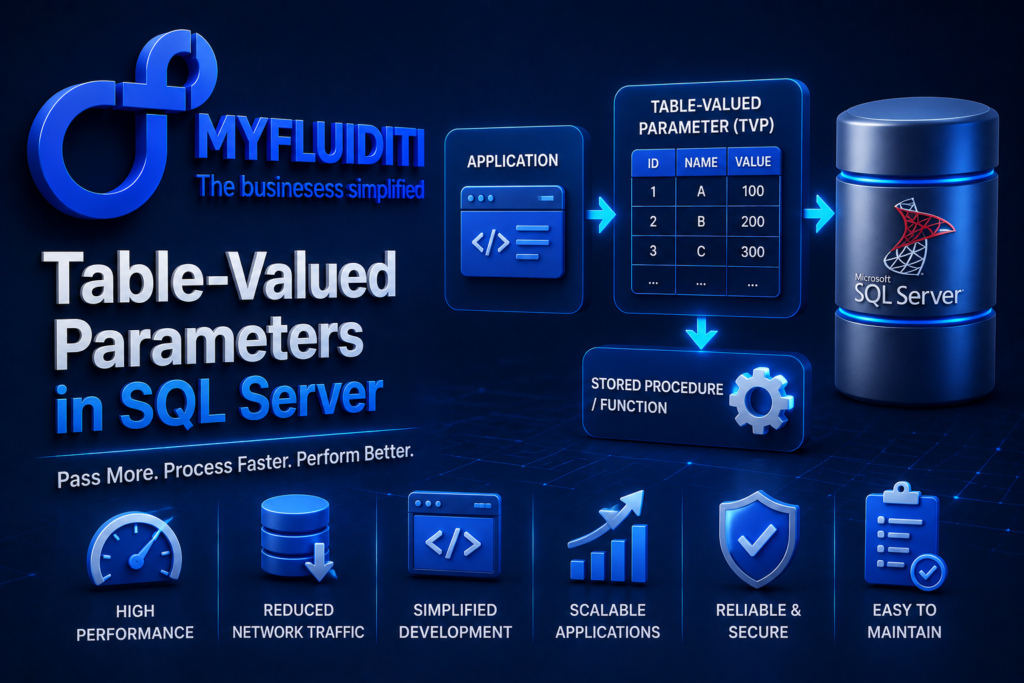
Introduction In today’s data-driven business environment, organizations need database solutions that can process large volumes of data efficiently while maintaining high performance and scalability. One of the most effective features available in Microsoft SQL Server for handling multiple rows of data in a single operation is Table-Valued Parameters (TVPs). Instead of sending individual values through multiple database calls, TVPs allow applications to pass entire datasets directly to stored procedures and functions. This significantly improves performance, reduces network traffic, and simplifies database operations. As businesses continue to build modern enterprise applications, understanding and implementing Table-Valued Parameters in SQL Server has become essential for achieving optimized database performance and scalable application architecture. At MyFluiditi, we help organizations design high-performance database solutions that leverage advanced SQL Server capabilities to improve efficiency, scalability, and business productivity. Understanding Table-Valued Parameters in SQL Server Table-Valued Parameters (TVPs) are a SQL Server feature that enables developers to pass multiple rows of structured data to stored procedures and user-defined functions using a single parameter. Unlike traditional parameters that accept only individual values, TVPs allow applications to transmit entire tables of information directly to SQL Server. This approach eliminates the need for multiple insert statements, temporary tables, or repetitive database calls. TVPs are based on user-defined table types, which define the structure of the data being passed. Once created, these table types can be reused across multiple procedures and applications. At MyFluiditi, we implement TVP-based database architectures that streamline data processing and improve application performance for enterprise systems. Why Businesses Use Table-Valued Parameters Modern business applications often need to process large batches of records simultaneously. Traditional methods of inserting or updating data row by row can increase execution time, consume network resources, and create performance bottlenecks. SQL Server Table-Valued Parameters solve these challenges by enabling bulk data operations through a single database call. Organizations working with financial systems, healthcare platforms, eCommerce applications, CRM software, ERP systems, and analytics platforms frequently rely on TVPs to improve operational efficiency. By reducing the number of database round trips, businesses can achieve faster transaction processing and better overall application responsiveness. At MyFluiditi, we help businesses optimize database communication layers using TVPs, resulting in improved performance and reduced infrastructure overhead. Key Benefits of Table-Valued Parameters One of the biggest advantages of TVPs is performance optimization. Instead of sending hundreds or thousands of individual parameters, applications can transmit complete datasets in a structured format. This significantly reduces network traffic and processing time. Another major benefit is simplified code management. Developers can pass complex collections of data through a single parameter rather than building dynamic SQL statements or creating temporary staging tables. This improves maintainability and reduces development complexity. Additional benefits of Table-Valued Parameters in SQL Server include: At MyFluiditi, we leverage these advantages to create database solutions that support high-volume enterprise workloads. How Table-Valued Parameters Work The implementation of TVPs begins with creating a user-defined table type. This table type defines the structure of the data that will be passed to SQL Server. Once created, the table type can be referenced within stored procedures as a read-only parameter. Applications populate the table structure with data before sending it to the database. SQL Server then processes the dataset as a single parameterized operation, improving efficiency compared to multiple individual requests. This architecture is particularly useful for bulk inserts, updates, data synchronization processes, and transactional operations involving large record sets. MyFluiditi designs optimized SQL Server environments that utilize TVPs to improve data throughput and application performance. Performance Advantages of TVPs Database performance remains a critical factor in enterprise application success. Traditional methods of processing multiple records often require loops, repeated stored procedure calls, or dynamically generated SQL statements. These approaches can introduce unnecessary overhead and increase execution times. High-performance SQL Server applications frequently use Table-Valued Parameters to handle batch operations more efficiently. By reducing the number of database interactions, TVPs help improve throughput, lower latency, and minimize server resource consumption. At MyFluiditi, our database architects analyze existing workloads and implement performance optimization strategies that maximize the benefits of TVPs within complex enterprise environments. Table-Valued Parameters vs Temporary Tables Developers often compare TVPs with temporary tables when handling large datasets. While both approaches can manage multiple records, TVPs offer several advantages in many scenarios. Temporary tables require creation, population, and cleanup processes within the database. These operations consume resources and can impact performance under heavy workloads. TVPs, on the other hand, allow data to be passed directly from the application layer into stored procedures without requiring additional staging steps. For applications focused on speed, scalability, and maintainability, Table-Valued Parameters often provide a more efficient solution. At MyFluiditi, we help organizations determine the most effective database architecture based on workload characteristics and business objectives. Common Use Cases for Table-Valued Parameters TVPs are widely used across industries where applications must process multiple records efficiently. Common scenarios include bulk product updates in eCommerce systems, mass patient record processing in healthcare platforms, financial transaction management, customer data synchronization, inventory management, and reporting applications. Organizations implementing cloud-native applications, enterprise resource planning systems, and customer relationship management platforms frequently benefit from TVP-based architectures. These solutions improve operational efficiency while supporting growing data volumes. MyFluiditi develops enterprise-grade software solutions that integrate SQL Server TVPs into modern application workflows to maximize database performance and scalability. Security and Best Practices Like any database feature, TVPs should be implemented using established security and development best practices. Organizations should enforce proper access controls, validate incoming data, and follow secure coding standards to protect business-critical information. Developers should design user-defined table types carefully, optimize indexing strategies where appropriate, and monitor execution plans to ensure efficient performance. Proper testing is essential to validate behavior under high-load conditions. At MyFluiditi, security and performance are integrated into every stage of database development. We help businesses implement robust SQL Server architectures that balance efficiency, reliability, and data protection. How MyFluiditi Helps Businesses Optimize SQL Server Performance At MyFluiditi, we specialize in designing high-performance database solutions that support enterprise-scale applications. Our SQL Server services
Building Microservices Architecture Design on Azure
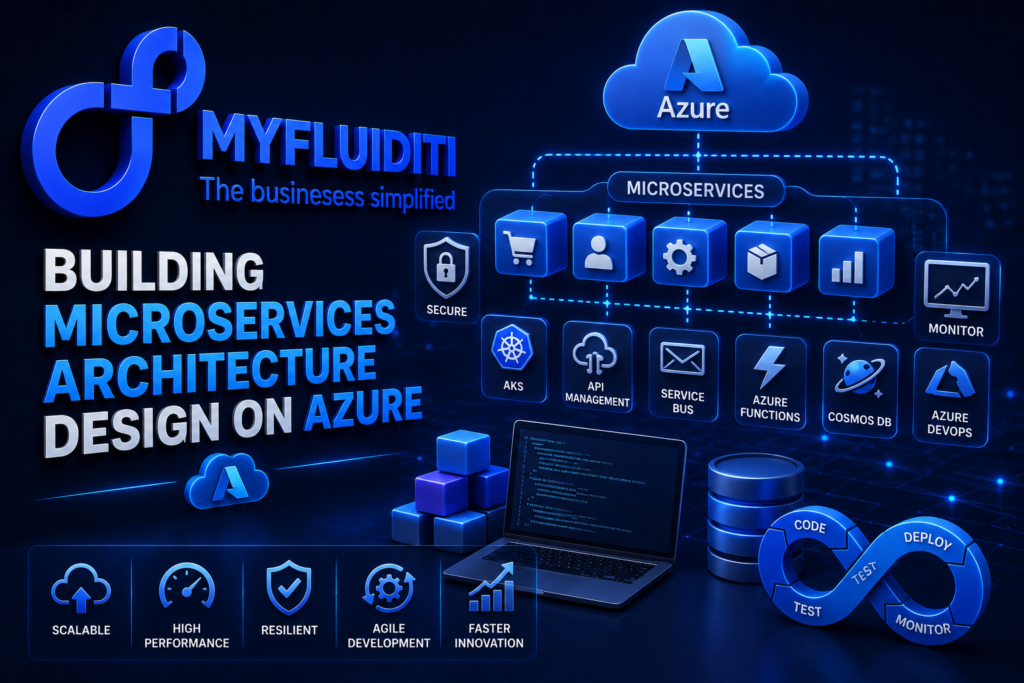
Introduction As businesses accelerate their digital transformation initiatives, the demand for scalable, resilient, and cloud-native applications continues to grow. Traditional monolithic applications often struggle to support rapid innovation, high availability, and evolving customer expectations. This is why organizations across industries are increasingly adopting Microservices Architecture Design on Azure to build flexible, secure, and highly scalable software solutions. By breaking large applications into smaller, independently deployable services, businesses can improve development speed, enhance system reliability, and support continuous innovation. At MyFluiditi, we help enterprises design, develop, and optimize Azure-based microservices architectures that enable faster software delivery, seamless scalability, and long-term business growth. Understanding Microservices Architecture on Azure A microservices architecture is a software design approach where applications are built as a collection of loosely coupled services that communicate through APIs and messaging systems. Each service is responsible for a specific business function and can be developed, deployed, updated, and scaled independently. Microsoft Azure provides a comprehensive ecosystem of cloud services that support microservices development, including Azure Kubernetes Service (AKS), Azure Service Fabric, Azure API Management, Azure Functions, Azure Container Apps, and Azure DevOps. These services help organizations build highly available and fault-tolerant applications capable of handling dynamic workloads. At MyFluiditi, we leverage Azure’s cloud-native capabilities to create robust microservices environments tailored to specific business requirements. Why Businesses Are Moving to Azure Microservices Modern organizations require technology platforms that can adapt quickly to changing market demands. Monolithic systems often create bottlenecks that slow development cycles, increase maintenance complexity, and limit scalability. Azure microservices architecture eliminates these challenges by enabling teams to work independently across services while supporting continuous integration and continuous deployment. Businesses benefit from faster product releases, improved application performance, reduced downtime, and better resource utilization. MyFluiditi helps organizations modernize legacy applications by transitioning them into scalable Azure microservices ecosystems that improve agility and operational efficiency. Core Components of Azure Microservices Architecture Successful microservices implementation requires a well-designed cloud infrastructure. Azure offers multiple services that work together to support distributed application development. Azure Kubernetes Service (AKS) provides container orchestration and automated scaling capabilities, while Azure API Management acts as a centralized gateway for managing service communication. Azure Service Bus and Azure Event Grid enable reliable messaging and event-driven architectures. Azure Monitor and Application Insights provide real-time observability, helping teams track performance and troubleshoot issues proactively. At MyFluiditi, we design integrated Azure architectures that combine these services to deliver high-performance and resilient enterprise applications. Benefits of Building Microservices on Azure One of the primary advantages of microservices is scalability. Individual services can scale independently based on workload demands, ensuring optimal resource utilization and cost efficiency. Azure’s cloud infrastructure supports automatic scaling, enabling applications to handle traffic spikes without impacting performance. Another major benefit is fault isolation. If one service encounters an issue, other services continue functioning normally, improving overall system reliability. Cloud-native microservices on Azure also support faster deployments, allowing development teams to release updates without affecting the entire application. MyFluiditi helps businesses leverage these benefits through customized Azure cloud strategies and microservices implementation frameworks. Azure Kubernetes Service for Microservices Deployment Containerization plays a critical role in modern microservices development. Azure Kubernetes Service (AKS) simplifies container orchestration by automating deployment, scaling, and management of containerized applications. AKS supports high availability, load balancing, automated updates, and resource optimization, making it one of the most popular platforms for enterprise microservices. At MyFluiditi, we design AKS-based architectures that enable businesses to achieve operational consistency, faster deployments, and improved infrastructure management while reducing operational overhead. Event-Driven Architecture and Microservices Many modern applications rely on event-driven architecture to improve responsiveness and scalability. Azure provides powerful messaging and event management services such as Azure Event Grid, Azure Service Bus, and Azure Event Hubs. These technologies enable microservices to communicate asynchronously, reducing dependencies and improving system flexibility. Event-driven systems support real-time data processing, workflow automation, and intelligent application behavior. MyFluiditi helps organizations build event-driven microservices ecosystems that enhance business agility and improve customer experiences through real-time processing capabilities. Security Best Practices for Azure Microservices Security is a critical consideration when designing distributed systems. Microservices environments often involve multiple APIs, containers, databases, and cloud services that require comprehensive protection. Azure provides advanced security capabilities including Azure Active Directory, Managed Identities, Key Vault, network security groups, and encryption services. These tools help organizations implement secure authentication, authorization, and data protection strategies. At MyFluiditi, security is embedded into every stage of the development lifecycle. We implement DevSecOps practices, API security frameworks, identity management solutions, and compliance-focused architectures that protect business-critical applications and sensitive data. DevOps and Continuous Delivery in Azure The success of microservices architecture depends heavily on automation. Azure DevOps enables organizations to implement CI/CD pipelines, infrastructure automation, automated testing, and deployment workflows. By automating repetitive processes, businesses can improve software quality, reduce deployment risks, and accelerate delivery cycles. At MyFluiditi, we integrate Azure DevOps, Infrastructure as Code (IaC), and cloud automation tools to create efficient software delivery pipelines that support rapid innovation and operational excellence. Monitoring and Observability for Azure Microservices Managing multiple services requires complete visibility into system performance and health. Azure provides comprehensive monitoring solutions including Azure Monitor, Application Insights, Log Analytics, and distributed tracing capabilities. These tools help organizations identify bottlenecks, optimize resource utilization, and resolve issues proactively. Real-time monitoring and observability are essential for maintaining service reliability in large-scale microservices environments. MyFluiditi develops intelligent monitoring frameworks that provide actionable insights, improve system performance, and support business continuity. How MyFluiditi Helps Businesses Build Azure Microservices Solutions At MyFluiditi, we specialize in designing and implementing scalable cloud-native architectures that align with business goals and digital transformation strategies. Our Azure microservices development services include architecture consulting, cloud migration, containerization, Kubernetes implementation, API development, DevOps automation, cloud security, and ongoing optimization. We work closely with organizations to modernize legacy systems, improve application performance, and create future-ready digital platforms. By combining cloud engineering expertise with business-focused technology strategies, MyFluiditi helps enterprises unlock the full potential of Azure microservices architecture. Future Trends in Azure Microservices Architecture The future of cloud-native development
Still Using Chatbots? Here’s Why Modern AI Agents Are the Better Investment
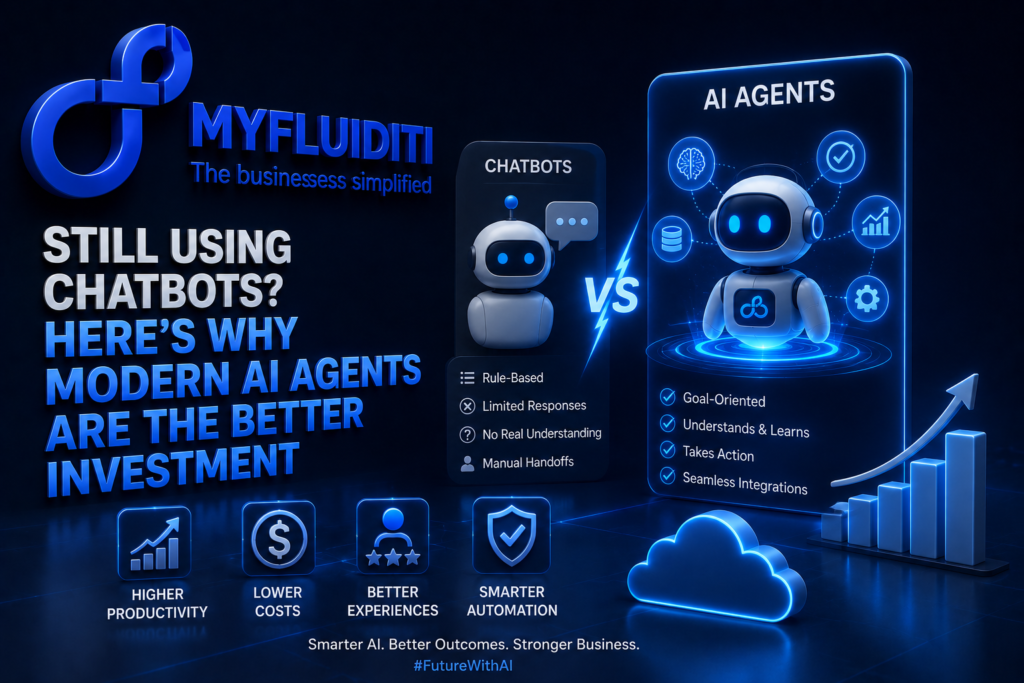
Introduction As businesses accelerate their digital transformation initiatives, the demand for intelligent automation solutions continues to grow. For years, chatbots have served as a popular tool for automating customer interactions, handling basic inquiries, and improving response times. While traditional chatbots have delivered value in many industries, modern business environments now require far more advanced capabilities. This shift has led to the rapid adoption of AI agents, intelligent systems capable of reasoning, learning, decision-making, and autonomous task execution. Organizations seeking greater efficiency, personalization, and scalability are increasingly investing in AI agent development rather than relying solely on conventional chatbot technology. At MyFluiditi, we help businesses move beyond basic conversational automation by building intelligent AI ecosystems powered by Generative AI, Machine Learning, Natural Language Processing (NLP), cloud infrastructure, and enterprise integrations. Our AI solutions are designed to automate complex workflows, improve customer experiences, and deliver measurable business outcomes. Understanding Traditional Chatbots Traditional chatbots are rule-based systems designed to respond to predefined questions and commands. These systems typically operate through scripted workflows, keyword matching, and decision trees. While chatbots can effectively handle repetitive customer service tasks, they often struggle when conversations become complex, contextual, or unpredictable. Many businesses initially adopted chatbots to reduce support costs and provide 24/7 assistance. However, customers today expect intelligent interactions that resemble human conversations. They want systems capable of understanding intent, maintaining context, solving problems, and taking meaningful actions. Unfortunately, most traditional chatbots were never designed to meet these expectations. As organizations scale their operations, chatbot limitations often become barriers to growth, productivity, and customer satisfaction. What Are Modern AI Agents? Unlike traditional chatbots, AI agents are intelligent software systems capable of understanding goals, analyzing information, making decisions, and executing tasks with minimal human intervention. Powered by advanced Large Language Models (LLMs), AI agents can interpret context, reason through problems, interact with multiple systems, and continuously improve based on new information. Modern AI agents are not limited to answering questions. They can automate workflows, generate reports, schedule appointments, process transactions, analyze business data, coordinate tasks, and support complex decision-making processes. At MyFluiditi, we develop intelligent AI agents that integrate seamlessly with enterprise applications, cloud platforms, CRM systems, ERP software, healthcare platforms, financial systems, and customer engagement tools. These solutions enable businesses to create highly automated and connected digital ecosystems. Why Chatbots Are No Longer Enough The business landscape has changed dramatically over the past few years. Customers expect personalized experiences, instant resolutions, and seamless interactions across multiple channels. Traditional chatbots often fail to deliver these experiences because they lack contextual understanding and decision-making capabilities. Chatbots generally operate within predefined boundaries. When users ask unexpected questions or require assistance outside scripted workflows, the system often fails to provide meaningful responses. This results in frustration, abandoned interactions, and increased reliance on human support teams. Modern AI agents address these limitations by leveraging conversational AI, contextual memory, intelligent reasoning, and real-time data access. Instead of following static scripts, they dynamically adapt to each interaction and provide more relevant, accurate, and personalized responses. AI Agents Deliver True Business Automation One of the biggest advantages of AI agents is their ability to automate complete business processes rather than individual conversations. Traditional chatbots focus primarily on communication, while AI agents can execute actions across systems and workflows. For example, an AI agent can receive a customer request, verify account information, access internal databases, retrieve relevant records, process a transaction, update enterprise systems, and send confirmation messages automatically. This level of automation significantly improves operational efficiency and reduces manual workloads. At MyFluiditi, we build AI-powered automation platforms that connect customer interactions with backend business processes, creating end-to-end workflow automation that drives productivity and scalability. Enhanced Customer Experience Through Personalization Customer experience has become a major competitive differentiator. Businesses that provide personalized interactions are more likely to build loyalty, improve engagement, and increase customer retention. Traditional chatbots often deliver generic responses because they lack access to customer history, behavioral insights, and contextual information. Modern AI agents can analyze customer preferences, past interactions, purchase history, and real-time behavior to deliver highly personalized experiences. At MyFluiditi, our AI solutions leverage advanced analytics and machine learning models to create intelligent customer engagement systems that adapt to individual user needs and preferences. Better Decision-Making with Real-Time Intelligence AI agents go beyond conversation management by providing actionable business intelligence. They can analyze large volumes of structured and unstructured data, identify patterns, generate insights, and support decision-making in real time. Organizations across healthcare, finance, retail, logistics, and insurance are using AI-driven business intelligence to improve operational performance and customer outcomes. AI agents can monitor key performance indicators, identify anomalies, predict trends, and recommend actions automatically. MyFluiditi helps businesses implement intelligent AI systems that transform data into strategic advantages through predictive analytics, automated reporting, and real-time decision support. Scalability Without Increasing Operational Costs As businesses grow, customer interactions and operational demands increase significantly. Scaling traditional support teams can be expensive and resource-intensive. While chatbots help manage basic inquiries, they often require human intervention for more complex scenarios. AI agents provide a scalable alternative by handling sophisticated interactions and automating tasks across departments. They can support thousands of simultaneous conversations, process large volumes of requests, and maintain consistent service quality without increasing staffing costs. At MyFluiditi, we design cloud-native AI agent platforms that scale effortlessly as business requirements evolve, ensuring long-term operational efficiency and cost optimization. AI Agents Improve Productivity Across Departments The value of AI agents extends far beyond customer service. Modern organizations are deploying AI-powered systems across multiple business functions, including sales, marketing, human resources, finance, healthcare, and operations. AI agents can assist sales teams by qualifying leads, scheduling meetings, and generating proposals. In HR, they can automate onboarding processes, employee support, and document management. Healthcare organizations use AI agents for patient engagement, appointment scheduling, and clinical documentation support. MyFluiditi develops customized AI solutions tailored to industry-specific requirements, helping businesses unlock productivity gains across their entire organization. Security and Compliance in AI Agent Development As AI systems gain access to critical
Choosing the Right Tech Stack: Next.js vs React.js
Introduction Choosing the right frontend technology is one of the most important decisions for businesses planning to build a scalable web application, enterprise platform, or AI-powered digital solution. The debate around Next.js vs React.js has become increasingly relevant as organizations seek faster performance, better SEO, and improved user experiences while maintaining development flexibility. Although both technologies are developed around the React ecosystem, they serve different purposes and offer unique advantages depending on business requirements. Understanding their capabilities helps companies make informed technology decisions that support long-term growth. At MyFluiditi, we help startups and enterprises choose the right technology stack by aligning business goals with modern engineering practices. Our experts build high-performance web applications, AI-driven platforms, and cloud-native solutions using technologies like Next.js, React.js, Node.js, AWS, and modern DevOps frameworks to deliver scalable digital products. Understanding React.js React.js is one of the world’s most popular JavaScript libraries for building interactive user interfaces. Developed by Meta, React enables developers to create reusable components that make application development faster and more maintainable. React focuses primarily on the frontend layer, allowing developers to build dynamic single-page applications with exceptional flexibility. It gives engineering teams complete control over architecture and integrates seamlessly with numerous third-party libraries and tools. Businesses often choose React.js development when they need highly customized applications, dashboards, enterprise portals, or SaaS platforms where client-side rendering delivers an excellent user experience. At MyFluiditi, our React development approach emphasizes scalable architecture, reusable components, and optimized performance to create applications that can evolve with business growth. Understanding Next.js While React is a JavaScript library, Next.js is a powerful framework built on top of React that adds enterprise-grade capabilities such as Server-Side Rendering (SSR), Static Site Generation (SSG), API routes, and built-in optimization features. Next.js simplifies many challenges developers face while building modern web applications. It automatically handles routing, image optimization, performance enhancements, and SEO-friendly rendering. For businesses focused on digital visibility, Next.js offers significant advantages because search engines can index server-rendered content more effectively compared to traditional client-rendered applications. At MyFluiditi, we leverage Next.js development services to build fast, secure, and SEO-optimized platforms that improve user engagement while supporting long-term scalability. Next.js vs React.js: Performance Comparison Performance has become a critical ranking factor for both search engines and user satisfaction. Slow-loading applications often lead to lower engagement and higher bounce rates. React applications typically render content on the client side, which means browsers must execute JavaScript before displaying content. While this approach works well for many applications, it may impact initial page load speed. Next.js addresses this challenge through server-side rendering and static generation, allowing pages to load faster and improving overall performance. Businesses prioritizing: often find Next.js to be an ideal solution. MyFluiditi helps organizations optimize application performance through modern frameworks, cloud infrastructure, and intelligent engineering practices. SEO Benefits: Why Next.js Has an Edge For businesses investing in SEO-driven web development, visibility on search engines is a major priority. Since React applications rely heavily on client-side rendering, search engine crawlers may require additional processing to index content effectively. Next.js provides server-rendered pages that improve crawlability and indexing, making it highly suitable for: At MyFluiditi, we build SEO-friendly applications using Next.js to help businesses improve organic visibility, website performance, and digital growth. Development Flexibility and Customization One of React’s biggest strengths is flexibility. Developers can choose routing libraries, state management solutions, backend integrations, and deployment strategies based on project requirements. Next.js, while also flexible, provides a structured architecture that simplifies development and reduces configuration complexity. Features like automatic routing and built-in optimization accelerate project delivery. At MyFluiditi, we evaluate each client’s business objectives before recommending whether a fully customized React architecture or a structured Next.js framework will deliver the best outcomes. Scalability for Enterprise Applications Modern applications must handle increasing traffic, expanding feature sets, and growing user expectations. Scalability therefore becomes a critical consideration when selecting a technology stack. Both React.js and Next.js support scalable architectures when implemented correctly. However, Next.js offers additional capabilities that simplify enterprise-level deployments through optimized rendering strategies and efficient resource management. Our engineering teams at MyFluiditi design cloud-native architectures that ensure applications remain secure, scalable, and high-performing as businesses grow. When Should You Choose React.js? React.js is an excellent choice when businesses require highly interactive applications with maximum architectural flexibility. It is particularly suitable for: MyFluiditi develops React-based solutions that combine clean architecture, reusable components, and modern engineering standards to deliver long-term business value. When Should You Choose Next.js? Next.js becomes the preferred choice when businesses require strong SEO performance, faster loading speeds, and simplified deployment. It works exceptionally well for: Our team at MyFluiditi builds Next.js applications that combine performance optimization, cloud scalability, and exceptional user experiences. How MyFluiditi Helps Businesses Choose the Right Tech Stack Selecting between Next.js and React.js is not simply a technical decision it is a strategic business decision. The right framework depends on project goals, scalability requirements, SEO priorities, user experience expectations, and future expansion plans. At MyFluiditi, we provide end-to-end technology consulting and development services, including: Our experts analyze business objectives and recommend technology stacks that maximize performance, scalability, and return on investment. The Future of Modern Web Development The future of web development will increasingly rely on AI-powered applications, edge computing, server-side rendering, cloud-native architecture, and high-performance frontend frameworks. Both React.js and Next.js will continue playing significant roles in this evolution. Organizations that invest in modern technology stacks today will be better positioned to deliver exceptional digital experiences while adapting quickly to changing market demands. With MyFluiditi, businesses gain a technology partner focused on building intelligent, scalable, and future-ready digital solutions. Conclusion The debate between Next.js vs React.js does not have a universal winner because both technologies excel in different scenarios. React offers unmatched flexibility for highly interactive applications, while Next.js provides superior SEO, faster performance, and built-in optimization features for modern web platforms. The best choice depends on your business goals, technical requirements, and growth strategy. At MyFluiditi, we help organizations make the right technology decisions and build secure, scalable,