Cloud Computing: Why It’s Essential for Modern Business Operations
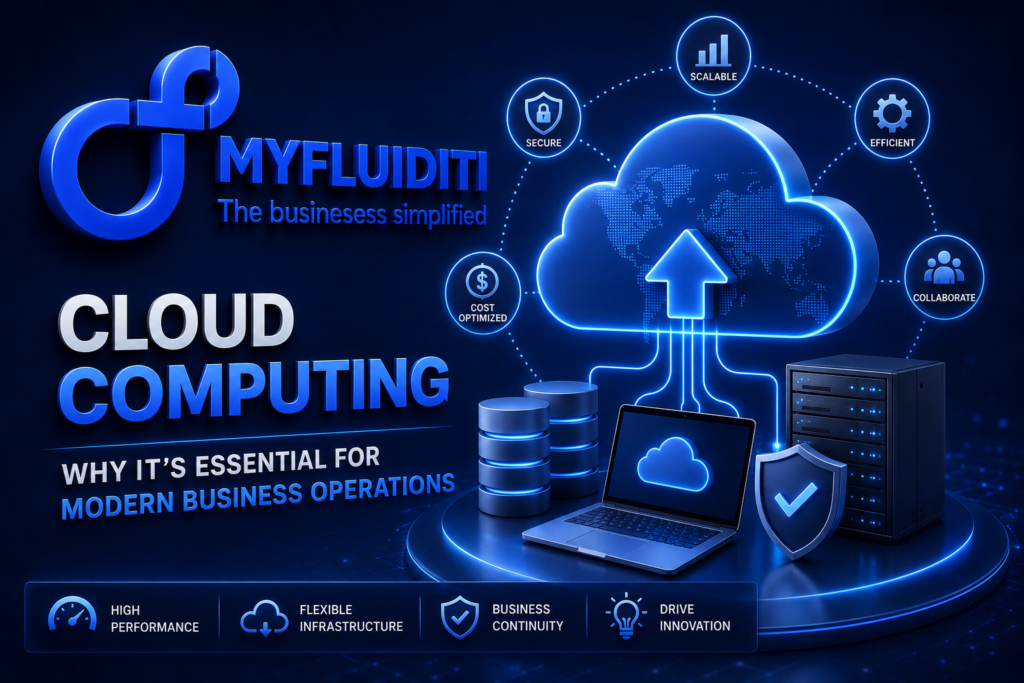
Introduction In today’s fast-paced digital economy, businesses are under constant pressure to innovate, scale operations, improve customer experiences, and maintain operational efficiency. Traditional IT infrastructures often struggle to keep up with these evolving demands, leading organizations to adopt Cloud Computing as a strategic foundation for growth and transformation. From startups and SMEs to large enterprises, companies across industries are leveraging cloud computing services to streamline operations, reduce infrastructure costs, improve agility, and accelerate digital innovation. The importance of cloud technology for business operations extends far beyond data storage. Modern cloud platforms enable organizations to deploy applications faster, automate workflows, strengthen cybersecurity, enhance collaboration, and gain access to advanced technologies such as Artificial Intelligence (AI), Machine Learning (ML), Big Data Analytics, and Internet of Things (IoT) solutions. At MyFluiditi, we help businesses modernize their digital ecosystems through scalable cloud computing solutions, cloud-native application development, cloud migration services, DevOps automation, and AI-powered cloud infrastructure designed to support long-term business growth and innovation. Understanding Cloud Computing in Modern Business Cloud computing refers to the delivery of computing services such as servers, storage, databases, networking, software, analytics, and intelligence over the internet. Instead of relying on expensive on-premise infrastructure, businesses can access resources on demand through highly scalable cloud environments. Modern organizations require flexibility and speed to remain competitive. Cloud infrastructure solutions provide businesses with the ability to scale resources instantly, deploy applications globally, and support remote workforces without significant capital investments. At MyFluiditi, we design and implement cloud-first strategies that help businesses reduce complexity, improve operational performance, and create future-ready technology environments. By leveraging cloud-native architectures, organizations can adapt quickly to changing market demands while maintaining reliability and security. Why Cloud Computing Is Essential for Modern Business Operations The growing demand for digital services, mobile applications, real-time analytics, and customer-centric experiences has made cloud adoption a necessity rather than an option. Businesses operating on traditional infrastructure often face challenges related to scalability, maintenance costs, system downtime, and limited flexibility. Cloud computing services address these challenges by providing dynamic resource allocation, automated infrastructure management, and high availability environments. Companies can launch products faster, optimize operational workflows, and respond to customer needs more efficiently. At MyFluiditi, we help organizations implement cloud solutions that improve agility, accelerate innovation, and support sustainable business growth. Our cloud experts work closely with businesses to align technology infrastructure with strategic objectives and operational requirements. Scalability and Flexibility Through Cloud Infrastructure One of the most significant advantages of cloud computing for businesse is scalability. Organizations can increase or decrease computing resources based on demand without investing in additional hardware or infrastructure. Whether managing seasonal traffic spikes, expanding into new markets, or launching digital products, cloud platforms provide the flexibility needed to support growth efficiently. Businesses can scale applications, databases, storage systems, and analytics platforms in real time. MyFluiditi develops scalable cloud architectures that enable organizations to adapt quickly while maintaining performance, reliability, and cost efficiency. Our cloud engineering teams build environments capable of supporting both current operations and future expansion. Cost Optimization and Operational Efficiency Managing traditional IT infrastructure often requires substantial investments in hardware, maintenance, upgrades, and dedicated IT resources. Cloud computing eliminates many of these expenses through usage-based pricing models and automated infrastructure management. Organizations only pay for the resources they consume, making cloud adoption highly cost-effective. Businesses can redirect capital toward innovation, product development, and customer engagement rather than maintaining physical infrastructure. At MyFluiditi, we help businesses optimize cloud costs through intelligent resource allocation, infrastructure monitoring, and cloud performance management. Our cloud strategies are designed to maximize operational efficiency while reducing unnecessary expenditures. Enhancing Business Continuity and Reliability Downtime can significantly impact revenue, customer trust, and operational performance. Modern businesses require infrastructure that remains available even during unexpected disruptions. Cloud platforms offer built-in redundancy, disaster recovery capabilities, automated backups, and high-availability configurations that help organizations maintain continuity during outages or system failures. MyFluiditi designs resilient cloud environments that support uninterrupted business operations. Our cloud solutions include disaster recovery planning, backup automation, and infrastructure optimization to ensure organizations remain operational under all conditions. Cloud Security for Modern Enterprises As cyber threats continue to evolve, businesses must prioritize security across every aspect of their digital infrastructure. Cloud computing provides advanced security capabilities including encryption, identity management, threat detection, access controls, and compliance frameworks. Organizations handling sensitive customer information, financial data, and proprietary business assets require robust cybersecurity measures to maintain trust and regulatory compliance. At MyFluiditi, security is integrated into every cloud deployment. We implement cloud security solutions, DevSecOps practices, secure API architectures, identity and access management systems, and continuous threat monitoring to protect critical business assets. Supporting Remote Work and Collaboration The modern workforce increasingly relies on remote and hybrid work models. Cloud computing enables employees to access applications, data, and collaboration tools from any location while maintaining security and productivity. Cloud-based platforms support seamless communication, document sharing, project management, and real-time collaboration across distributed teams. This flexibility improves operational efficiency while enhancing employee experiences. MyFluiditi helps organizations implement cloud collaboration ecosystems that support secure remote work environments and improve workforce productivity across global operations. Accelerating Innovation with AI and Cloud Technologies The combination of Artificial Intelligence, Machine Learning, and cloud computing is creating new opportunities for innovation across industries. Cloud platforms provide the computational power needed to train AI models, process large datasets, and deploy intelligent applications at scale. Businesses can leverage AI-powered analytics, automation systems, predictive modeling, customer intelligence platforms, and real-time decision-making tools without investing in expensive infrastructure. At MyFluiditi, we integrate AI and cloud technologies to help organizations unlock new business opportunities, automate processes, and improve operational outcomes through intelligent digital solutions. Cloud Migration and Digital Transformation Many organizations still operate legacy systems that limit agility, increase maintenance costs, and create operational bottlenecks. Cloud migration enables businesses to modernize infrastructure while improving scalability, performance, and security. Successful cloud transformation requires careful planning, architecture design, data migration, application modernization, and ongoing optimization. Poorly executed migrations can lead to disruptions and inefficiencies. MyFluiditi provides end-to-end cloud
Modular App Development: How Teams That Actually Ship Fast Are Structuring Their Code
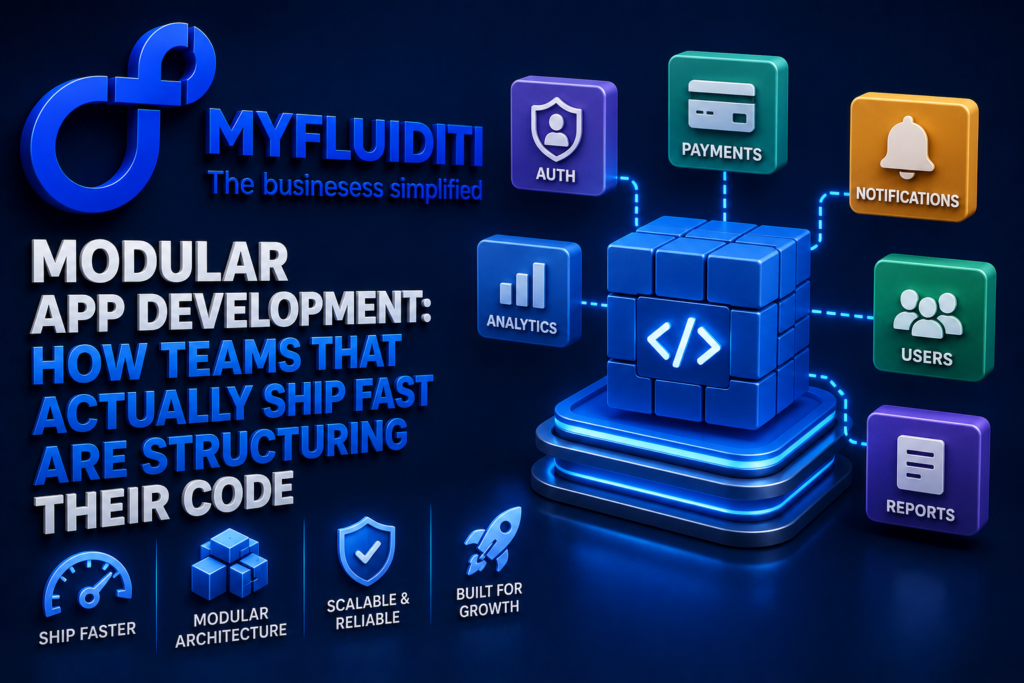
Introduction In today’s highly competitive digital landscape, businesses are under constant pressure to release applications faster without compromising quality, scalability, or user experience. Traditional monolithic architectures often slow down development cycles, create maintenance challenges, and make it difficult for engineering teams to adapt to changing business requirements. This is why Modular App Development has become one of the most effective software engineering strategies for organizations focused on speed, flexibility, and long-term scalability. Modern technology companies, startups, and enterprises are increasingly adopting modular software architecture, component-based development, and scalable application frameworks to accelerate product delivery. Teams that consistently ship high-quality software at speed are structuring their codebases into independent, reusable modules that can be developed, tested, and deployed efficiently. At MyFluiditi, we help businesses build scalable digital products using modern modular development practices, cloud-native architecture, DevOps automation, and AI-powered engineering solutions. Our approach enables organizations to reduce technical debt, improve collaboration, and accelerate software delivery while maintaining enterprise-grade reliability. What Is Modular App Development? Modular app development is a software architecture approach where applications are divided into smaller, self-contained modules that perform specific functions independently. Rather than building a single large codebase where every feature is tightly connected, modular architecture separates functionality into reusable components that can evolve independently. Each module handles a specific responsibility such as authentication, payments, notifications, analytics, user management, or reporting. These modules communicate through clearly defined interfaces, allowing developers to make changes without affecting the entire application. At MyFluiditi, we design modular application architectures that improve maintainability, simplify scaling, and support faster product evolution. This approach allows businesses to introduce new features quickly while minimizing risks associated with large-scale code changes. Why High-Performing Engineering Teams Prefer Modular Architecture Teams that consistently deliver software faster understand that speed comes from structure, not shortcuts. As applications grow, monolithic systems become increasingly difficult to maintain. Small updates often require changes across multiple parts of the system, increasing testing complexity and deployment risks. Modular software development solves these challenges by enabling teams to work independently on different parts of an application. Developers can build, test, and deploy modules without impacting unrelated functionality. This reduces bottlenecks, improves productivity, and supports continuous delivery practices. At MyFluiditi, we implement modular architectures that allow engineering teams to scale efficiently while maintaining development velocity. By reducing dependencies between features, businesses can accelerate release cycles and respond faster to market demands. Faster Development Through Independent Modules One of the biggest advantages of modular app development is parallel development. Multiple teams can work on different modules simultaneously without creating conflicts in the codebase. For example, while one team enhances user authentication, another can improve analytics functionality and a third can build new payment integrations. Since each module operates independently, development progresses faster and deployment becomes more predictable. This approach is particularly valuable for organizations building enterprise applications, SaaS platforms, mobile apps, and AI-powered software solutions where frequent updates are essential for maintaining competitiveness. At MyFluiditi, we help businesses implement modular development workflows that improve engineering efficiency while reducing release delays. Improved Scalability and Performance Modern digital products must handle growing user bases, increasing workloads, and evolving business requirements. Applications built using modular architecture are easier to scale because individual modules can be optimized independently. Instead of scaling an entire application when only one component experiences high demand, businesses can allocate resources specifically to the modules that require additional capacity. This improves performance while reducing infrastructure costs. Cloud-native application development, microservices architecture, and modular systems work together to create highly scalable software environments. MyFluiditi helps organizations leverage these technologies to build applications capable of supporting long-term growth. Better Code Quality and Maintainability As applications become more complex, maintaining clean and organized code becomes increasingly important. Modular architecture encourages developers to create smaller, focused codebases that are easier to understand, test, and maintain. When bugs occur, developers can quickly identify the affected module rather than searching through a large interconnected system. This reduces troubleshooting time and improves software reliability. At MyFluiditi, we follow modern software engineering best practices that emphasize clean architecture, reusable components, automated testing, and continuous improvement. This helps businesses maintain high-quality applications while reducing long-term maintenance costs. Modular Development and DevOps Success The success of DevOps, CI/CD pipelines, and continuous delivery practices depends heavily on architecture. Applications built with modular structures are naturally better suited for automated deployment workflows. Because modules can be tested independently, development teams can automate quality assurance processes and deploy updates more frequently. Smaller deployments reduce risks, improve stability, and accelerate feature releases. MyFluiditi integrates modular architecture with DevOps automation to help organizations achieve faster software delivery while maintaining governance, security, and operational reliability. How MyFluiditi Builds Modular Applications At MyFluiditi, we combine modular app development, cloud engineering, AI integration, and platform modernization to create future-ready software solutions. Our development process focuses on designing scalable architectures that support both current business needs and future growth. We begin by identifying core business functions and organizing them into independent modules with clearly defined responsibilities. Each module is designed for reusability, scalability, and seamless integration within the broader ecosystem. Our engineering teams leverage modern technologies such as React, Angular, Flutter, Node.js, AWS, Azure, and cloud-native infrastructure to deliver high-performance applications that evolve efficiently over time. By combining technical excellence with business strategy, MyFluiditi helps organizations accelerate innovation while maintaining software quality. The Future of Modular Software Development As businesses continue adopting AI-driven applications, cloud-native platforms, microservices, and digital transformation strategies, modular development will become even more important. Future software ecosystems will require greater flexibility, faster deployment cycles, and improved adaptability to changing market conditions. Emerging trends such as AI-assisted development, platform engineering, composable applications, and intelligent automation are all strengthening the importance of modular architecture. Organizations that embrace modular development today will be better positioned to innovate rapidly while maintaining operational efficiency. At MyFluiditi, we help businesses prepare for this future by building scalable software ecosystems designed for continuous growth, faster releases, and long-term success. Conclusion Modular App Development is transforming how modern engineering
Machine Learning in Healthcare: Deploying LLM and RG Systems Safely
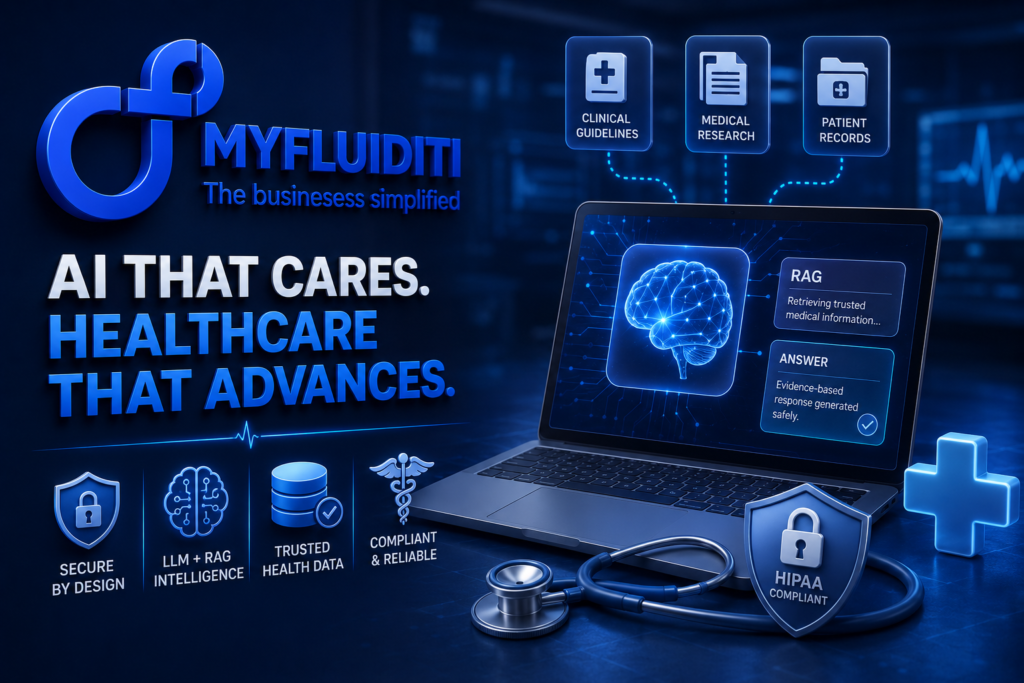
Introduction The healthcare industry is experiencing a major transformation driven by Machine Learning in Healthcare, Large Language Models (LLMs), and Retrieval-Augmented Generation (RAG) systems. Healthcare organizations are increasingly leveraging artificial intelligence to improve patient care, streamline clinical workflows, accelerate diagnostics, automate administrative tasks, and enhance decision-making. As AI adoption continues to grow, healthcare providers are looking for ways to deploy intelligent systems while maintaining the highest standards of security, accuracy, compliance, and patient privacy. While LLM-powered healthcare solutions offer significant advantages, they also introduce challenges related to data security, hallucinations, regulatory compliance, and trustworthiness. Healthcare organizations cannot afford inaccurate outputs or unauthorized access to sensitive patient information. This is why deploying AI systems safely has become one of the most critical priorities in healthcare technology. At MyFluiditi, we help healthcare organizations build secure, scalable, and compliant AI ecosystems by combining machine learning, cloud infrastructure, healthcare software development, and intelligent data management. Our approach focuses on delivering AI-powered healthcare solutions that balance innovation with safety and regulatory compliance. Understanding LLMs and RAG Systems in Healthcare Large Language Models (LLMs) are advanced AI systems trained on massive datasets that can understand, generate, summarize, and analyze human language. In healthcare, these models can assist with clinical documentation, patient communication, medical research, decision support, and administrative automation. However, standalone LLMs often rely solely on their training data, which can lead to outdated information or inaccurate responses. This is where Retrieval-Augmented Generation (RAG) becomes valuable. RAG systems enhance AI performance by retrieving relevant information from trusted healthcare databases, clinical records, medical guidelines, and enterprise knowledge repositories before generating responses. Instead of relying entirely on pre-trained knowledge, the AI can access real-time and context-specific information. At MyFluiditi, we design healthcare AI systems that integrate LLMs with RAG architectures to improve accuracy, reduce misinformation, and support evidence-based healthcare decisions. Why Healthcare Organizations Are Adopting LLM and RAG Solutions Healthcare providers face growing challenges related to increasing patient volumes, administrative workloads, clinician burnout, and the demand for personalized care. Traditional systems often struggle to manage vast amounts of medical information efficiently. AI-powered healthcare solutions can automate repetitive tasks, improve knowledge accessibility, and support faster clinical decision-making. LLM and RAG systems are increasingly being deployed for medical documentation, patient engagement, care coordination, healthcare analytics, and operational optimization. At MyFluiditi, we help healthcare organizations implement AI technologies that improve efficiency while ensuring patient data remains protected and compliant with healthcare regulations. The ability to deliver accurate information quickly makes LLM and RAG systems valuable tools across hospitals, clinics, insurance providers, telemedicine platforms, and healthcare research institutions. The Importance of Safe AI Deployment in Healthcare Unlike many industries, healthcare operates in an environment where errors can have serious consequences. Incorrect recommendations, incomplete information, or unauthorized access to patient records can impact patient outcomes and organizational trust. Deploying Machine Learning in Healthcare requires a strong focus on safety, governance, and transparency. Healthcare organizations must ensure that AI systems provide reliable outputs, maintain data integrity, and comply with industry regulations. At MyFluiditi, safety is embedded into every stage of AI development, from architecture design and data governance to deployment and ongoing monitoring. We help organizations implement secure frameworks that support responsible AI adoption without compromising performance. Addressing Hallucinations in Healthcare LLMs One of the biggest concerns associated with LLM deployment is the risk of hallucinations. Hallucinations occur when AI systems generate responses that appear credible but are factually incorrect. In healthcare environments, inaccurate medical information can create significant risks. RAG architectures help mitigate this issue by grounding AI responses in verified and trusted data sources. By connecting AI systems to clinical databases, treatment guidelines, research repositories, and healthcare knowledge bases, organizations can improve response accuracy and reliability. At MyFluiditi, we implement intelligent RAG frameworks that prioritize evidence-based information retrieval, helping healthcare providers reduce risks associated with AI-generated content. Protecting Patient Data and Privacy Healthcare organizations manage some of the most sensitive information in the digital world. Patient records, medical histories, insurance information, diagnostic reports, and treatment plans require strict protection. When deploying LLM and RAG systems, organizations must ensure compliance with healthcare data privacy regulations and industry standards. Secure data storage, access controls, encryption, audit trails, and identity management are essential components of responsible AI deployment. MyFluiditi develops healthcare AI platforms with security-first architecture, ensuring sensitive patient information remains protected throughout the AI lifecycle. Our solutions support secure cloud environments, encrypted communications, and role-based access controls that align with healthcare compliance requirements. Cloud Infrastructure for Scalable Healthcare AI The computational requirements of modern AI systems often exceed the capabilities of traditional infrastructure. Healthcare organizations increasingly rely on cloud-based healthcare solutions to support machine learning workloads, large-scale data processing, and real-time analytics. Cloud-native architectures provide scalability, flexibility, and high availability, making them ideal for deploying AI-driven healthcare applications. They also enable secure collaboration, centralized data management, and continuous system optimization. At MyFluiditi, we build cloud-powered healthcare ecosystems that support secure AI deployment while maintaining performance, reliability, and operational efficiency. Our cloud engineering expertise allows healthcare organizations to scale AI initiatives without compromising security or compliance. AI Governance and Regulatory Compliance Healthcare AI deployment must align with evolving regulatory frameworks and ethical guidelines. Organizations need clear governance structures that define how AI systems are trained, monitored, validated, and maintained. Effective AI governance includes data quality controls, model validation processes, explainability mechanisms, risk assessments, and continuous monitoring. These measures help ensure AI systems remain transparent, accountable, and trustworthy. At MyFluiditi, we help healthcare organizations establish governance frameworks that support safe and responsible AI adoption. Our solutions are designed to align technology innovation with regulatory expectations and organizational risk management objectives. Real-World Applications of LLM and RAG Systems in Healthcare The adoption of AI-powered healthcare applications continues to expand across various use cases. Healthcare providers are using LLM and RAG technologies to improve clinical workflows, patient communication, and operational efficiency. Applications include intelligent clinical documentation, medical knowledge assistants, patient support chatbots, healthcare analytics platforms, claims processing automation, telemedicine support systems, and personalized treatment recommendations. MyFluiditi develops
ITIL Methodology for Platform & DevOps Teams: Governance Without Drag
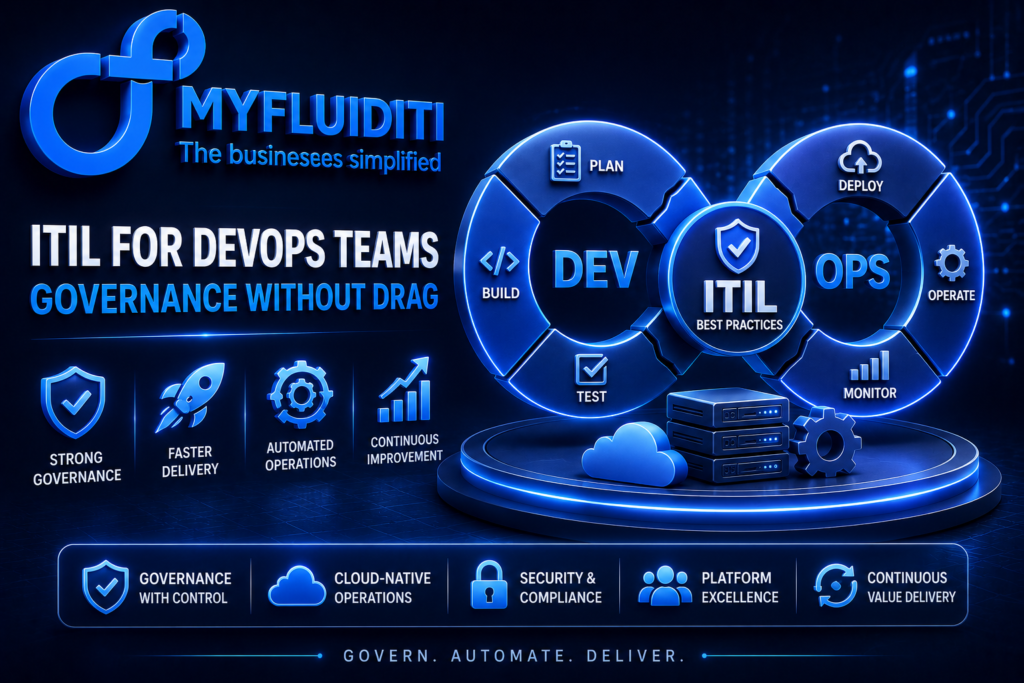
Introduction As organizations accelerate their digital transformation, cloud adoption, and DevOps implementation, maintaining control without slowing innovation has become one of the biggest challenges for modern technology teams. Businesses want faster software delivery, continuous deployment, improved reliability, and stronger security, but they also need governance, compliance, risk management, and operational consistency. This is where the ITIL methodology for Platform and DevOps teams plays a crucial role. Modern ITIL practices are no longer viewed as rigid frameworks that create excessive bureaucracy. Instead, they provide a structured approach that enables organizations to achieve governance without creating unnecessary delays. When combined with modern DevOps principles, ITIL helps businesses balance agility, operational stability, and continuous improvement. At MyFluiditi, we help organizations integrate ITIL best practices, DevOps automation, cloud-native operations, and platform engineering strategies to create scalable technology ecosystems that support both innovation and governance. Our approach focuses on enabling teams to move faster while maintaining visibility, control, and operational excellence. Understanding ITIL in the Modern DevOps Era The Information Technology Infrastructure Library (ITIL) has long been recognized as one of the most widely adopted frameworks for IT service management. Traditionally, ITIL focused on process standardization, incident management, change control, service delivery, and operational governance. However, modern software development environments have evolved significantly. Businesses now operate in cloud-native ecosystems where applications are updated continuously, infrastructure is automated, and deployment cycles occur multiple times per day. In this environment, ITIL is no longer about enforcing slow approval chains. Modern ITIL 4 practices emphasize value creation, collaboration, automation, and service optimization. At MyFluiditi, we help organizations modernize ITIL adoption by aligning governance frameworks with agile development and DevOps methodologies. Why Governance Matters for Platform and DevOps Teams Many organizations mistakenly believe that governance slows innovation. In reality, effective governance provides the structure necessary to scale innovation safely and efficiently. As DevOps teams manage increasingly complex cloud environments, they must ensure operational consistency, security compliance, service reliability, and risk management. Without governance, organizations often face configuration drift, security vulnerabilities, deployment failures, and operational inefficiencies. A well-implemented ITIL framework helps teams establish clear processes while allowing automation to handle repetitive operational tasks. This creates a balance between speed and control, enabling businesses to scale confidently. At MyFluiditi, we design governance models that empower engineering teams rather than restrict them, ensuring compliance requirements support business growth instead of becoming obstacles. ITIL and DevOps: A Complementary Relationship There is a common misconception that ITIL and DevOps are opposing approaches. In reality, they are highly complementary when implemented correctly. DevOps focuses on collaboration, automation, continuous integration, continuous delivery, and rapid deployment. ITIL focuses on service management, governance, operational stability, and customer value. Together, they create a framework where innovation can occur without sacrificing reliability. Modern organizations increasingly combine DevOps automation with ITIL service management practices to improve operational maturity. Automated workflows, intelligent monitoring, incident response systems, and continuous feedback loops help organizations achieve both agility and governance simultaneously. At MyFluiditi, we integrate ITIL principles into DevOps pipelines, ensuring businesses can maintain governance standards while accelerating software delivery. Change Management Without Slowing Delivery One of the most significant areas where ITIL supports DevOps teams is change management. Traditional change approval processes often introduced delays that conflicted with agile development goals. Modern ITIL practices take a more adaptive approach. Automated testing, CI/CD pipelines, infrastructure as code, and deployment monitoring allow organizations to manage changes safely while reducing manual intervention. By implementing intelligent change management systems, businesses can deploy updates frequently without increasing operational risk. MyFluiditi helps organizations automate governance controls within deployment workflows, ensuring compliance requirements are met without slowing release cycles. Incident Management in Cloud-Native Environments As organizations adopt cloud computing, microservices, and distributed architectures, incident management becomes increasingly complex. Service disruptions can impact multiple systems simultaneously, making rapid response critical. ITIL provides structured incident management processes that help teams identify, prioritize, resolve, and prevent issues effectively. Combined with modern observability tools, real-time monitoring, and AI-powered analytics, these processes enable faster recovery times and improved service reliability. At MyFluiditi, we implement intelligent monitoring and incident response frameworks that align ITIL best practices with cloud-native operations, helping organizations maintain business continuity and customer satisfaction. Platform Engineering and Service Reliability The rise of platform engineering is changing how organizations manage internal developer platforms, infrastructure services, and operational workflows. Platform teams are responsible for creating scalable environments that allow developers to work efficiently while maintaining governance and reliability standards. ITIL methodologies support platform engineering by providing structured approaches to service management, configuration management, capacity planning, and continuous improvement. MyFluiditi helps businesses develop platform engineering strategies that combine self-service capabilities, automation, governance controls, and operational transparency. This enables engineering teams to innovate faster while maintaining enterprise-grade reliability. Automation as the Foundation of Modern Governance Governance should not depend on manual approvals and repetitive administrative tasks. Modern organizations increasingly rely on automation to enforce policies, monitor compliance, and maintain operational consistency. Through Infrastructure as Code (IaC), automated security scanning, policy-as-code frameworks, CI/CD automation, and intelligent monitoring systems, businesses can embed governance directly into their technology environments. At MyFluiditi, we leverage automation to transform governance from a bottleneck into a competitive advantage. Our DevOps and cloud engineering teams help organizations implement automated controls that improve compliance while reducing operational overhead. The Role of ITIL in Security and Compliance Security and compliance remain top priorities for businesses operating in regulated industries. Cloud adoption, AI integration, and remote work environments have increased the complexity of managing risk effectively. ITIL provides structured processes for managing security incidents, service continuity, access control, risk assessment, and compliance reporting. When integrated with modern DevSecOps practices, organizations can strengthen security without sacrificing agility. MyFluiditi works closely with businesses to implement secure and compliant technology ecosystems that align governance requirements with modern software delivery practices. How MyFluiditi Helps Organizations Implement ITIL for DevOps Success At MyFluiditi, we understand that governance should support innovation rather than restrict it. Our approach focuses on integrating ITIL service management, DevOps automation, platform engineering, cloud transformation, and enterprise governance frameworks into
The New Economics of Software: Why Agentic Software Engineering Demands Better Code
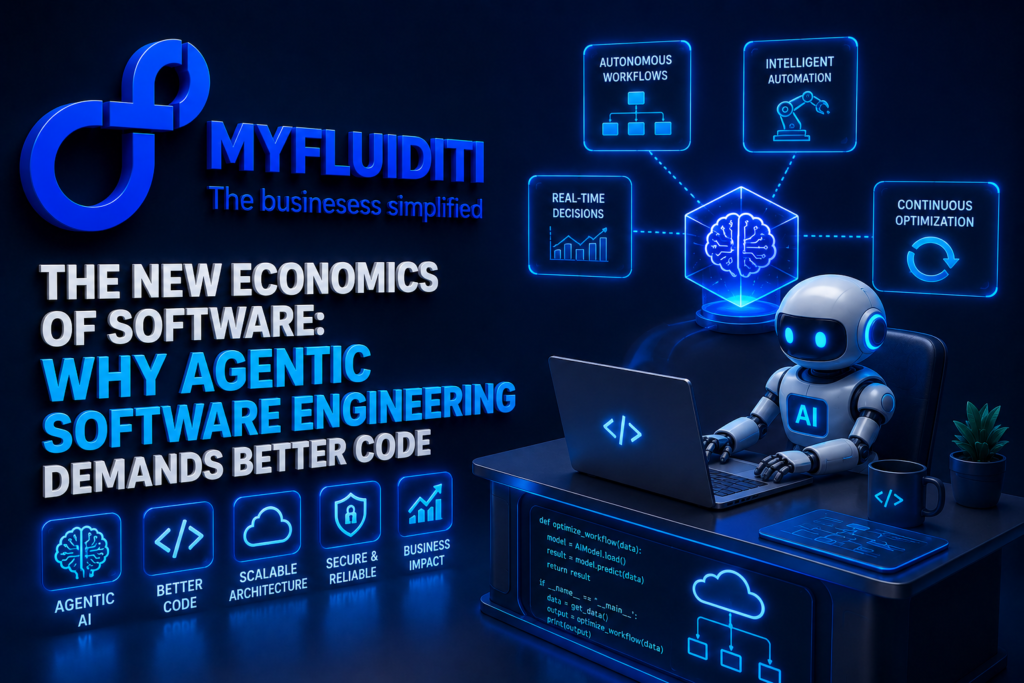
Introduction The software industry is entering a new era where Agentic AI, autonomous systems, and intelligent software agents are reshaping how applications are built, tested, deployed, and maintained. Traditional software development focused primarily on creating applications that users interact with directly. Today, organizations are increasingly developing systems where AI agents can analyze information, make decisions, execute workflows, and continuously optimize business processes with minimal human intervention. As businesses adopt Agentic Software Engineering, the quality of underlying code becomes more critical than ever. Poor architecture, technical debt, inefficient APIs, and unstable systems can significantly limit the effectiveness of AI-driven automation. In contrast, clean, scalable, and well-structured code enables AI agents to operate efficiently, securely, and reliably. At MyFluiditi, we help organizations build modern software ecosystems designed for the age of intelligent automation. By combining AI integration, cloud-native development, scalable architectures, and software engineering best practices, we enable businesses to maximize the value of agentic systems while ensuring long-term maintainability and growth. Understanding the New Economics of Software The economics of software development have changed dramatically over the past decade. Traditionally, software value was measured by development speed, feature releases, and operational efficiency. Today, businesses must also consider how effectively their systems support AI automation, intelligent workflows, and autonomous decision-making. Agentic systems continuously interact with applications, databases, APIs, cloud environments, and enterprise platforms. Every inefficiency in software architecture creates friction that affects AI performance. This means that software quality is no longer just a technical concern, it has become a direct business factor influencing productivity, scalability, and competitive advantage. At MyFluiditi, we design software platforms that support both human users and intelligent AI agents, ensuring businesses can adapt to the rapidly evolving digital economy. Why Agentic Software Engineering Requires Better Code Unlike traditional applications that rely on user-driven interactions, agentic systems operate autonomously across multiple workflows. These AI agents process information, communicate with systems, trigger actions, and make decisions in real time. For this to work effectively, software must provide: When software contains excessive technical debt or fragmented architecture, AI agents struggle to perform efficiently. This often leads to inaccurate outputs, workflow failures, increased operational costs, and poor user experiences. At MyFluiditi, we focus on developing software foundations that allow AI agents to operate seamlessly across enterprise environments while maintaining performance and reliability. The Impact of Technical Debt on AI Systems Technical debt has always been a challenge in software development, but its impact becomes significantly greater in AI-driven environments. Agentic systems rely heavily on structured workflows, consistent data access, and predictable application behavior. When organizations continue building on outdated architectures, AI systems encounter bottlenecks that reduce efficiency and increase maintenance costs. Legacy systems often contain fragmented codebases, undocumented processes, and disconnected integrations that limit automation capabilities. By modernizing software architecture and eliminating technical debt, MyFluiditi helps businesses create environments where AI agents can function effectively and deliver measurable business value. Cloud-Native Architecture as the Foundation for Agentic Systems Modern cloud-native software development plays a critical role in enabling agentic engineering. AI agents require scalable infrastructure capable of processing large volumes of data while supporting real-time decision-making. Cloud platforms provide the flexibility, scalability, and reliability necessary for intelligent automation. Services such as microservices architecture, containerization, serverless computing, and automated orchestration create ideal environments for AI-driven applications. At MyFluiditi, we develop cloud-native platforms that support continuous scalability while enabling AI systems to integrate seamlessly across business operations. This ensures organizations can expand their automation capabilities without compromising performance. APIs Become Business-Critical Assets In the age of agentic software engineering, APIs are no longer simple integration tools. They have become the communication layer through which AI agents interact with business systems. Well-designed APIs enable agents to retrieve information, execute transactions, trigger workflows, and coordinate across multiple applications. Poorly designed APIs create latency, errors, and operational inefficiencies that directly impact automation outcomes. MyFluiditi helps businesses build secure, scalable, and AI-ready API ecosystems that support intelligent automation across enterprise environments. Security Challenges in Agentic Software Engineering As AI agents gain access to more business systems, security becomes increasingly important. Autonomous agents often interact with sensitive customer data, financial records, operational systems, and enterprise workflows. Organizations must implement robust AI security frameworks, including access controls, authentication systems, encryption protocols, monitoring tools, and governance policies. At MyFluiditi, security is embedded into every stage of software development. Our engineering teams build secure-by-design architectures that protect critical business assets while enabling safe AI adoption. Data Quality Becomes a Competitive Advantage Agentic systems depend heavily on data quality. Even the most advanced AI models cannot deliver reliable outcomes when operating on incomplete, inaccurate, or inconsistent data. Organizations must invest in strong data management practices, real-time analytics infrastructure, and scalable data architectures to maximize AI performance. High-quality data enables AI agents to make smarter decisions, automate complex processes, and improve continuously over time. MyFluiditi helps businesses create intelligent data ecosystems that support AI-powered applications, predictive analytics, and enterprise automation initiatives. How MyFluiditi Supports Agentic Software Engineering As businesses transition toward AI-powered operations, software engineering practices must evolve accordingly. At MyFluiditi, we help organizations prepare for this transformation through a combination of modern development methodologies, cloud technologies, and AI integration expertise. Our services include custom software development, AI application development, cloud-native architecture design, DevOps automation, API engineering, enterprise platform modernization, and digital transformation consulting. By aligning technology decisions with business goals, we ensure organizations can successfully adopt agentic systems while maintaining scalability and operational efficiency. We focus not only on building software but also on creating connected digital ecosystems where intelligent agents can operate effectively and generate long-term business value. The Future of Agentic Software Engineering The future of software development will be increasingly shaped by autonomous systems capable of managing complex workflows with minimal human intervention. Businesses that invest in high-quality software architecture, AI-ready infrastructure, and scalable development practices will be better positioned to capitalize on this transformation. Emerging trends include autonomous coding assistants, AI-driven testing platforms, intelligent DevOps systems, predictive software maintenance, and self-optimizing business applications. These innovations will continue