What Makes an Engineering Team High-Performing in the AI Era: The Updated Playbook
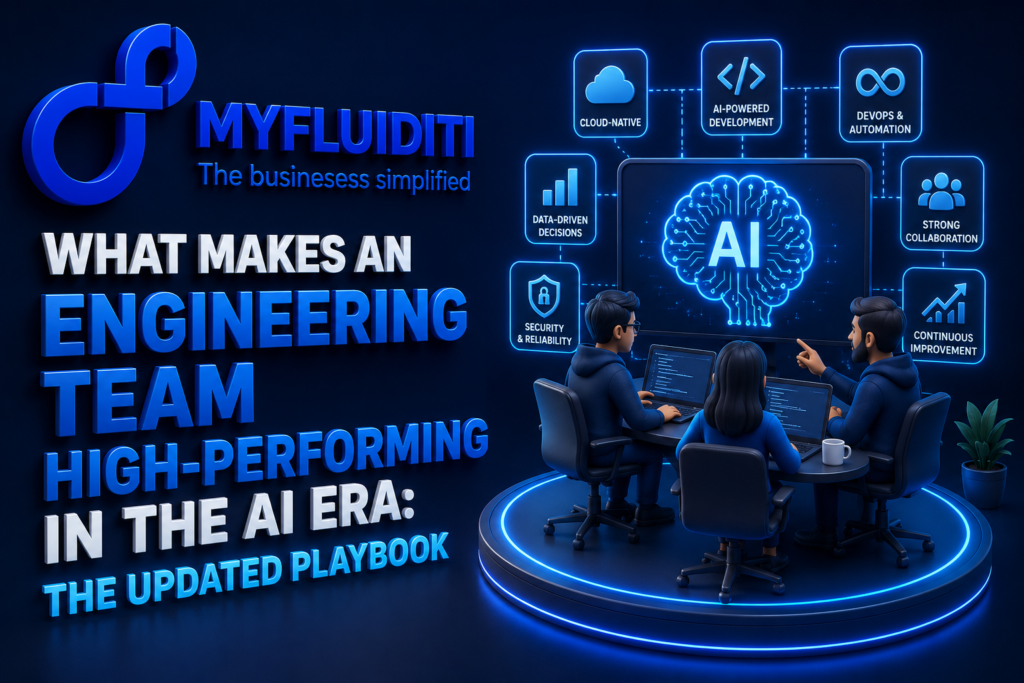
Introduction The software development landscape is undergoing a dramatic transformation. The rise of Artificial Intelligence (AI), intelligent automation, cloud-native architectures, and data-driven decision-making is reshaping how engineering teams build, deploy, and scale digital products. Organizations are no longer competing solely on technology; they are competing on how effectively their engineering teams can innovate, adapt, and deliver value in an increasingly AI-driven world. In today’s competitive environment, building a high-performing engineering team requires much more than technical expertise. Modern teams must combine AI capabilities, agile development practices, cloud infrastructure knowledge, data intelligence, DevOps culture, and business alignment to deliver scalable digital solutions. Companies that fail to evolve their engineering practices risk slower innovation, higher operational costs, and reduced competitiveness. At MyFluiditi, we help organizations build future-ready engineering ecosystems by combining AI development services, cloud solutions, DevOps practices, automation frameworks, and scalable software engineering strategies. Our approach focuses on creating engineering teams that not only write code but also drive measurable business outcomes. The Definition of a High-Performing Engineering Team in the AI Era Traditionally, engineering success was measured by development speed and technical delivery. Today, success depends on how effectively teams can leverage AI, automate workflows, accelerate innovation, and continuously improve products based on real-time insights. A high-performing software engineering team is one that consistently delivers secure, scalable, and customer-focused solutions while adapting quickly to changing business requirements. These teams use AI-powered tools, collaborative workflows, and data-driven decision-making to improve efficiency and reduce development bottlenecks. At MyFluiditi, we believe engineering excellence comes from aligning technology, people, processes, and business goals into a unified system that supports continuous innovation. AI-Augmented Development Is Becoming Essential One of the biggest characteristics of modern engineering teams is the ability to leverage AI-powered software development tools. AI is no longer viewed as a future technology; it has become an integral part of daily engineering workflows. From code generation and automated testing to predictive analytics and intelligent monitoring, AI helps developers reduce repetitive tasks and focus on solving complex business problems. Teams that successfully integrate AI into their development lifecycle can accelerate delivery while improving software quality. MyFluiditi helps organizations implement AI-driven engineering practices that improve productivity, enhance collaboration, and support scalable digital transformation initiatives. Rather than replacing engineers, AI empowers them to work smarter, innovate faster, and deliver greater value to businesses and customers. Strong Engineering Culture Drives Performance Technology alone does not create high-performing teams. Culture remains one of the most important factors influencing engineering success. Organizations that encourage collaboration, continuous learning, experimentation, and accountability consistently outperform teams operating in siloed environments. Engineers must feel empowered to contribute ideas, challenge assumptions, and innovate without unnecessary barriers. At MyFluiditi, we help businesses build engineering cultures that promote transparency, knowledge sharing, and continuous improvement. This creates an environment where innovation becomes a natural outcome rather than an isolated effort. In the AI era, learning agility is becoming just as important as technical expertise. Cloud-Native Architecture Enables Faster Innovation Modern engineering teams are increasingly adopting cloud-native development practices to improve scalability, flexibility, and deployment speed. Legacy systems often limit innovation due to infrastructure constraints and operational complexity. Cloud-native environments allow teams to deploy updates rapidly, scale resources dynamically, and support global user bases efficiently. This flexibility is particularly important for AI-powered applications that require significant computational resources and continuous optimization. At MyFluiditi, we help organizations modernize their technology stacks through cloud transformation, AWS solutions, DevOps automation, and scalable application architecture. Engineering teams equipped with cloud-native capabilities can respond faster to market demands while maintaining performance and reliability. Data-Driven Decision Making Improves Outcomes High-performing engineering teams rely heavily on data rather than assumptions. Metrics, analytics, user behavior insights, and performance monitoring help teams make informed decisions throughout the development lifecycle. In the AI era, access to real-time data enables engineers to identify bottlenecks, optimize performance, and prioritize features based on actual customer needs. Teams that embrace data-driven engineering practices are better positioned to deliver meaningful business results. At MyFluiditi, we integrate analytics, monitoring systems, and AI-powered insights into software ecosystems to support continuous optimization and informed decision-making. Data-driven engineering helps organizations improve efficiency while reducing risk and uncertainty. DevOps and Automation Accelerate Delivery The adoption of DevOps practices has become a defining characteristic of high-performing engineering organizations. DevOps eliminates barriers between development and operations teams, creating a culture focused on collaboration, automation, and continuous delivery. Automation enables faster testing, deployment, infrastructure management, and monitoring. By reducing manual intervention, teams can improve reliability while accelerating product releases. MyFluiditi helps businesses implement DevOps strategies that streamline workflows, enhance software quality, and support continuous innovation. Organizations that combine AI with DevOps gain additional advantages through intelligent automation, predictive maintenance, and real-time operational visibility. Cross-Functional Collaboration Is More Important Than Ever The most successful engineering teams no longer operate independently from the rest of the organization. They collaborate closely with product managers, designers, business stakeholders, data scientists, and customer success teams. Cross-functional collaboration ensures that engineering efforts align with broader business objectives and customer expectations. This approach reduces miscommunication, accelerates development cycles, and improves product quality. At MyFluiditi, we emphasize system-driven collaboration where technology decisions are aligned directly with business outcomes, creating more effective and scalable solutions. Engineering teams that understand the business context behind their work are often more innovative and impactful. Continuous Learning Creates Competitive Advantage Technology evolves rapidly, particularly in fields such as Artificial Intelligence, Machine Learning, Cloud Computing, Cybersecurity, and Software Development. High-performing engineering teams recognize that continuous learning is essential for long-term success. Organizations that invest in training, certifications, technical mentorship, and skill development create teams capable of adapting to emerging technologies and market changes. At MyFluiditi, continuous learning is embedded into our engineering philosophy. We encourage teams to stay ahead of industry trends, explore new technologies, and continuously refine their expertise. This commitment to learning enables businesses to remain competitive in an increasingly technology-driven marketplace. Security and Reliability Must Be Built Into Every Process As software systems become more complex and interconnected, security can no longer
On-Device AI vs Cloud AI for Mobile Apps
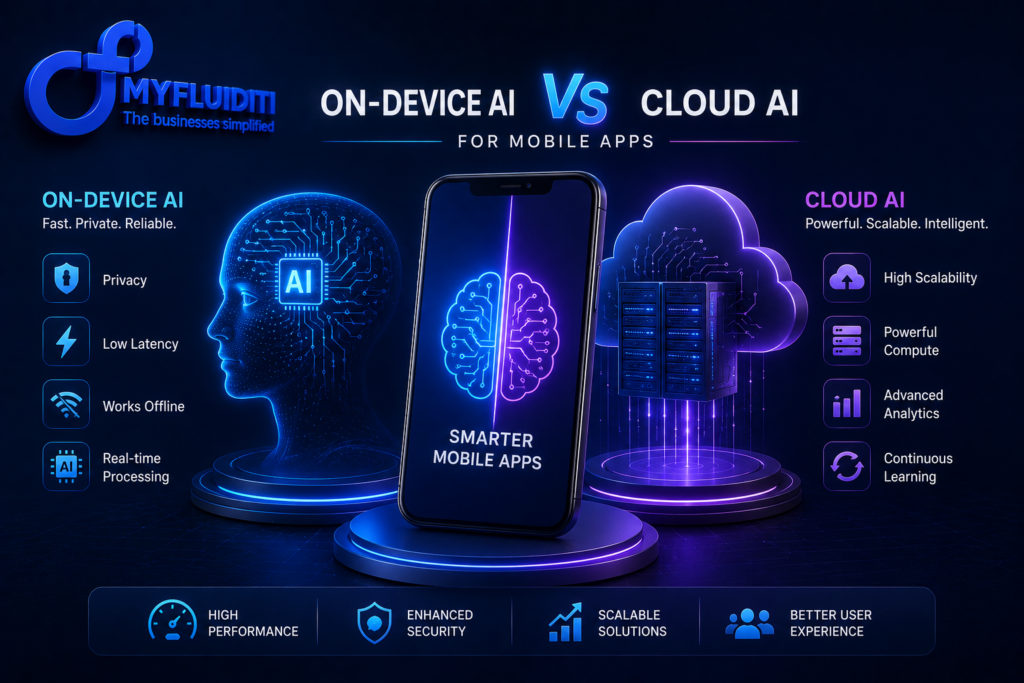
Introduction The rapid evolution of Artificial Intelligence (AI) is transforming the mobile app industry at an unprecedented pace. From personalized recommendations and intelligent chatbots to voice assistants, predictive analytics, and real-time automation, AI has become a critical component of modern mobile applications. As businesses invest in AI-powered mobile app development, one important question often arises: should AI processing happen directly on the device or in the cloud? The debate between On-Device AI vs Cloud AI for Mobile Apps is becoming increasingly relevant as organizations seek the perfect balance between performance, security, scalability, and user experience. Both approaches offer unique advantages and challenges, making the right choice dependent on business objectives, application requirements, and user expectations. At MyFluiditi, we help businesses build intelligent mobile applications by designing AI architectures that align with performance goals, security requirements, and long-term scalability. Whether leveraging on-device intelligence, cloud-based AI systems, or a hybrid approach, our team develops future-ready mobile solutions that maximize business value and user engagement. Understanding On-Device AI On-Device AI refers to artificial intelligence models that run directly on smartphones, tablets, wearable devices, or edge devices without relying heavily on cloud infrastructure. In this approach, data processing, decision-making, and inference occur locally within the device. Modern mobile processors and AI accelerators have significantly improved the ability of devices to perform complex machine learning tasks. Features such as facial recognition, voice assistants, image enhancement, language translation, and predictive text often utilize on-device AI capabilities. At MyFluiditi, we help businesses integrate on-device machine learning models that deliver faster response times, enhanced privacy, and improved offline functionality while maintaining a seamless user experience. One of the biggest advantages of on-device AI is reduced latency. Since data does not need to travel to external servers for processing, users experience near-instant responses. This makes on-device AI highly effective for applications requiring real-time interactions. Understanding Cloud AI Cloud AI refers to artificial intelligence models hosted on cloud infrastructure where data is processed remotely using powerful computing resources. Mobile applications send data to cloud servers, where AI algorithms perform analysis, predictions, or automation tasks before returning the results to users. Cloud AI enables businesses to leverage large-scale machine learning models, deep learning frameworks, and advanced analytics without being constrained by device hardware limitations. At MyFluiditi, we develop cloud-based AI solutions that utilize scalable cloud environments, high-performance computing, and centralized data processing to support enterprise-grade mobile applications. Cloud AI is particularly valuable for applications requiring large datasets, continuous model training, predictive analytics, and advanced AI capabilities that exceed the processing power of mobile devices. Performance Comparison: On-Device AI vs Cloud AI Performance is often one of the primary factors influencing AI architecture decisions. On-device AI provides faster response times because processing occurs locally without network dependency. Applications such as voice assistants, biometric authentication, and augmented reality experiences benefit significantly from this low-latency approach. Cloud AI, however, offers greater computational power and flexibility. Complex AI models that require extensive data processing can perform more efficiently in cloud environments where resources can scale dynamically. At MyFluiditi, we evaluate application requirements carefully to determine whether local processing, cloud computing, or a hybrid AI architecture provides the best balance between speed and intelligence. Security and Data Privacy Considerations Data privacy has become a major concern for businesses and consumers alike. Regulations and growing cybersecurity risks require organizations to handle sensitive information responsibly. On-device AI offers strong privacy advantages because user data remains on the device rather than being transmitted to external servers. This minimizes exposure to network vulnerabilities and reduces data transfer risks. Cloud AI, while highly secure when properly implemented, involves transmitting and storing data across cloud infrastructure. Businesses must implement encryption, access controls, compliance frameworks, and secure cloud architecture to protect sensitive information. At MyFluiditi, security is integrated into every AI solution we develop. Whether deploying on-device models or cloud-based AI systems, we implement enterprise-grade security measures designed to protect business and customer data. Scalability and Continuous Learning One limitation of on-device AI is scalability. Mobile devices have finite processing power, memory, and storage capabilities. As AI models become larger and more sophisticated, deploying advanced algorithms entirely on-device can become challenging. Cloud AI excels in scalability because resources can expand dynamically based on demand. Organizations can continuously train, update, and improve AI models without requiring users to download large updates. MyFluiditi helps businesses build scalable AI ecosystems that support continuous model optimization, centralized management, and long-term growth through cloud-native architectures. For enterprises handling millions of users or large volumes of data, cloud AI often provides a more practical solution for maintaining performance and innovation. Offline Functionality and User Experience One of the strongest advantages of on-device AI is its ability to function without internet connectivity. Users can continue accessing AI-powered features even in low-connectivity environments, making it ideal for mobile-first experiences. Applications that require instant decision-making or operate in remote locations often benefit significantly from local AI processing. Cloud AI depends on network availability, which can sometimes introduce delays or service interruptions. However, cloud-based models can deliver more advanced intelligence due to their access to larger datasets and computing resources. At MyFluiditi, we frequently implement hybrid AI strategies that combine the strengths of both approaches, ensuring optimal user experiences regardless of network conditions. When Businesses Should Choose On-Device AI Organizations may benefit from On-Device AI development when applications require: Industries such as healthcare, mobile productivity, smart devices, biometric authentication, and augmented reality frequently utilize on-device AI to improve responsiveness and user engagement. When Businesses Should Choose Cloud AI Businesses often choose Cloud AI solutions when applications require: Industries such as fintech, insurance, eCommerce, logistics, and enterprise software commonly rely on cloud AI to support high-volume operations and intelligent automation. At MyFluiditi, we help organizations select the right architecture based on business goals, technical requirements, compliance needs, and growth strategies. The Rise of Hybrid AI Architectures The future of mobile app development is increasingly moving toward Hybrid AI, where on-device intelligence and cloud AI work together seamlessly. This approach allows applications to process
AI Fraud Detection Software Development: Why Enterprises Are Replacing Rule-Based Systems
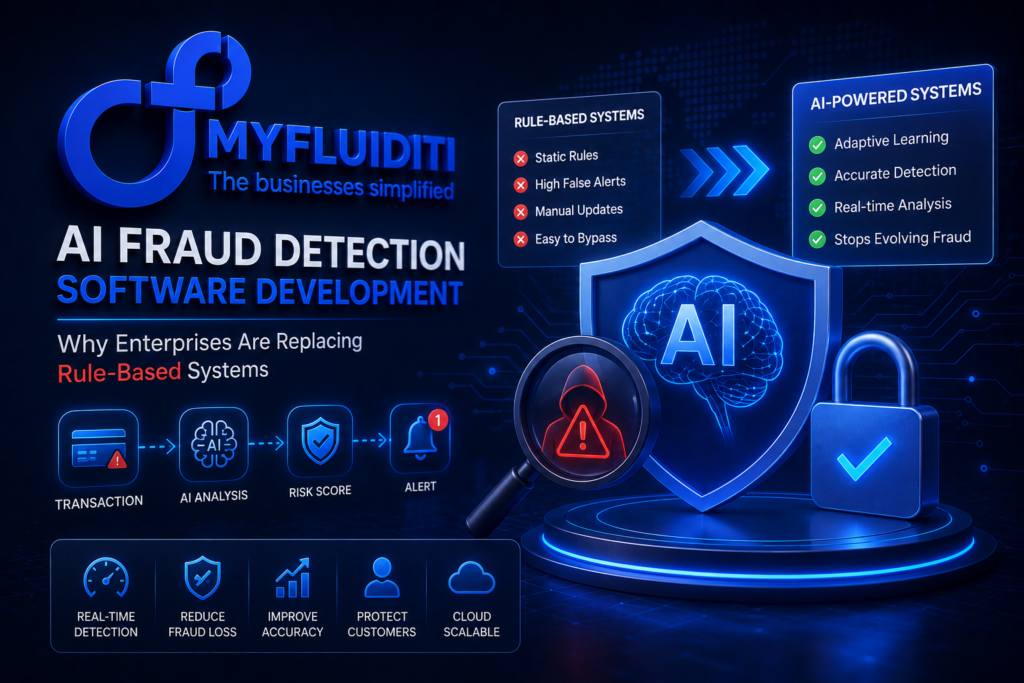
Introduction The rise of digital transactions, online banking, eCommerce platforms, fintech applications, insurance systems, and enterprise software has significantly increased the complexity of fraud detection. Traditional fraud prevention methods that once relied on fixed rules and predefined conditions are no longer sufficient to combat modern cyber threats. Fraudsters continuously evolve their tactics, making it increasingly difficult for static systems to identify suspicious activities accurately. This is why enterprises worldwide are investing in AI Fraud Detection Software Development to improve accuracy, reduce financial losses, and strengthen digital security. Unlike traditional rule-based systems, AI-powered fraud detection solutions can analyze massive volumes of data in real time, identify hidden patterns, and adapt to emerging threats automatically. At MyFluiditi, we help organizations build intelligent fraud detection platforms powered by Artificial Intelligence (AI), Machine Learning (ML), predictive analytics, cloud infrastructure, and real-time monitoring systems. Our solutions enable businesses to proactively identify fraudulent activities while improving operational efficiency and customer trust. Understanding Rule-Based Fraud Detection Systems For many years, businesses relied on rule-based fraud detection models to identify suspicious activities. These systems operate using predefined rules such as transaction limits, geographic restrictions, login attempts, or unusual spending patterns. While rule-based systems were effective in earlier digital environments, they struggle to handle today’s sophisticated fraud techniques. Fraudsters can easily learn and bypass static rules, resulting in increased fraud risks and higher operational costs. One of the biggest challenges with rule-based systems is their inability to adapt automatically. Every new fraud pattern requires manual rule creation, testing, and deployment. As businesses scale and transaction volumes increase, maintaining these systems becomes increasingly complex and inefficient. At MyFluiditi, we frequently help enterprises modernize legacy fraud detection environments by replacing rigid rule engines with intelligent AI-driven platforms capable of continuous learning and adaptation. Why Enterprises Are Moving Toward AI Fraud Detection Modern fraud schemes often involve complex behavioral patterns that cannot be detected using simple rule-based logic. AI-powered systems analyze vast amounts of structured and unstructured data simultaneously, identifying anomalies that traditional systems might overlook. Unlike static rules, AI fraud detection software continuously learns from new data and evolving attack patterns. This enables organizations to detect emerging threats faster while reducing false positives. Businesses adopting AI-powered fraud prevention solutions benefit from: At MyFluiditi, we develop scalable fraud detection ecosystems that combine machine learning models, behavioral analytics, automation, and cloud-native infrastructure to deliver enterprise-grade protection. How AI Fraud Detection Software Works Modern AI fraud detection systems use advanced machine learning algorithms to analyze user behavior, transaction history, device information, location data, and interaction patterns. Instead of relying on fixed conditions, AI models evaluate multiple risk factors simultaneously. The system continuously compares current activities with historical behavior and identifies anomalies that may indicate fraudulent actions. For example, if a user suddenly initiates high-value transactions from an unfamiliar location using a new device, the AI system can immediately assign a higher risk score and trigger additional verification processes. At MyFluiditi, we build intelligent fraud detection platforms capable of processing millions of transactions in real time while maintaining high levels of accuracy and performance. The Role of Machine Learning in Fraud Prevention Machine Learning for fraud detection is one of the primary reasons enterprises are replacing traditional systems. Machine learning models continuously improve their accuracy by learning from historical and real-time data. These models can identify subtle fraud indicators that would be impossible to detect using manual rules alone. As new fraud patterns emerge, machine learning algorithms automatically adapt without requiring constant human intervention. Our team at MyFluiditi develops machine learning-powered fraud prevention systems that enable organizations to detect suspicious activities proactively while minimizing operational overhead. Behavioral Analytics and Real-Time Fraud Detection One of the most powerful advantages of AI-based fraud prevention is behavioral analytics. Every user has unique behavioral patterns, including login habits, transaction behavior, browsing activities, and interaction preferences. AI systems monitor these behaviors continuously and identify deviations that may indicate fraudulent activity. This approach provides significantly higher accuracy than traditional rule-based systems. At MyFluiditi, we integrate behavioral analytics, real-time monitoring, and predictive intelligence into fraud detection platforms to help enterprises identify risks before financial damage occurs. Cloud-Based AI Fraud Detection Platforms Scalability is a critical requirement for modern fraud prevention systems. Enterprises process enormous volumes of transactions daily, making cloud infrastructure essential for high-performance fraud detection. Cloud-based AI fraud detection platforms provide: MyFluiditi develops cloud-native fraud detection solutions using modern cloud technologies that support enterprise growth while maintaining security and reliability. Industries Benefiting from AI Fraud Detection Software The adoption of AI-powered fraud detection solutions is rapidly expanding across industries. Financial institutions use AI to identify suspicious transactions, account takeovers, and payment fraud. Insurance companies leverage AI to detect fraudulent claims and risk patterns. eCommerce businesses use intelligent fraud prevention systems to secure online payments and protect customer accounts. Healthcare organizations implement fraud detection platforms to prevent billing fraud and unauthorized access to sensitive information. At MyFluiditi, we help businesses across fintech, banking, insurance, healthcare, retail, logistics, and enterprise software industries deploy intelligent fraud prevention ecosystems tailored to their operational requirements. Security and Compliance Advantages Modern enterprises must comply with increasingly strict data protection and cybersecurity regulations. AI-powered fraud detection systems help organizations strengthen compliance while improving risk management. At MyFluiditi, security is integrated throughout every stage of development. Our fraud detection platforms incorporate: These security measures help organizations reduce risks while maintaining regulatory compliance. How MyFluiditi Helps Enterprises Build Intelligent Fraud Detection Solutions At MyFluiditi, we go beyond traditional fraud prevention systems by building connected, AI-driven security ecosystems. Our fraud detection software development services combine artificial intelligence, machine learning, cloud computing, predictive analytics, and automation to create highly scalable enterprise solutions. We help businesses modernize legacy fraud systems, implement intelligent risk assessment engines, automate fraud investigations, and continuously optimize detection accuracy through advanced AI models. Our approach focuses on delivering measurable business outcomes, including reduced fraud losses, improved operational efficiency, enhanced customer trust, and long-term scalability. The Future of AI Fraud Detection The future of fraud prevention will be driven
Why is DevOps as a Service the Smartest Move for Startups?
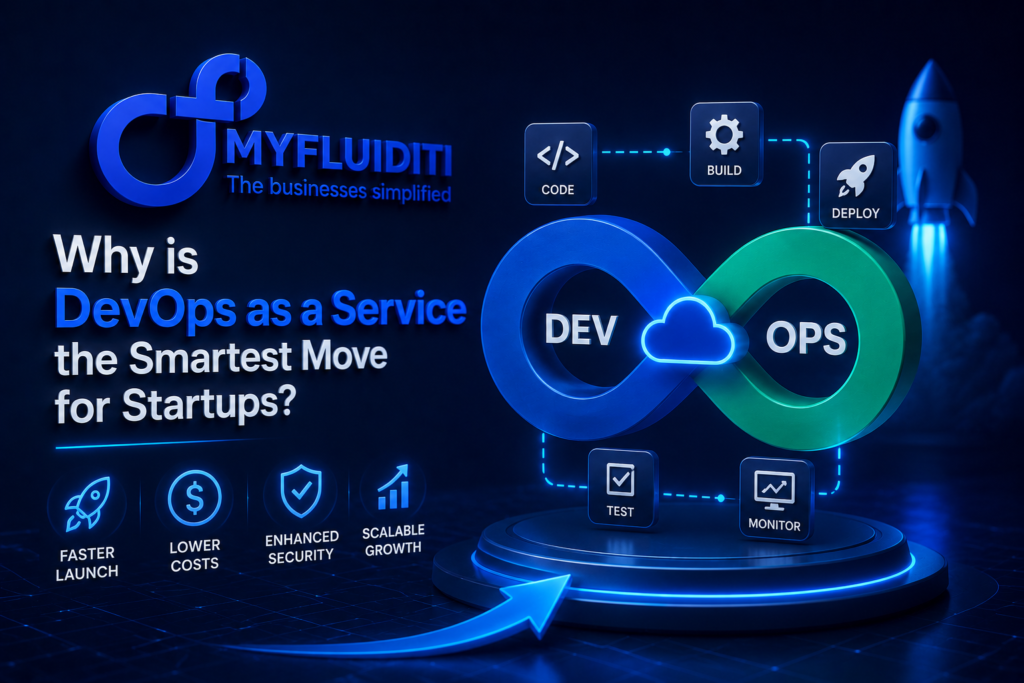
Introduction In today’s highly competitive digital landscape, startups are expected to innovate quickly, launch products faster, and scale efficiently while operating with limited resources. Building and managing a dedicated DevOps team can be expensive and challenging for early-stage companies that need to focus on product development, customer acquisition, and business growth. This is why DevOps as a Service (DaaS) has emerged as one of the smartest technology investments for modern startups. By combining cloud computing, automation, continuous integration, continuous deployment (CI/CD), infrastructure management, and monitoring services, DevOps as a Service enables startups to streamline software development and accelerate time-to-market. Instead of investing heavily in infrastructure and specialized talent, startups can leverage expert DevOps services to improve operational efficiency and scalability. At MyFluiditi, we help startups build modern, cloud-native ecosystems through intelligent DevOps strategies, automation frameworks, and scalable infrastructure solutions that support rapid growth and innovation. Understanding DevOps as a Service DevOps as a Service is a cloud-based approach that integrates development and operations processes through automation, collaboration, and continuous delivery practices. Rather than managing infrastructure manually, startups can use DevOps services to automate software deployment, testing, monitoring, and maintenance. The primary goal of DevOps is to eliminate bottlenecks between development and operations teams while ensuring faster and more reliable software releases. By leveraging DevOps services, startups can focus on building great products while experts handle infrastructure management, deployment pipelines, security, and system optimization. At MyFluiditi, we provide end-to-end DevOps solutions that help startups create agile development environments capable of supporting business growth without operational complexity. Why Startups Need DevOps as a Service Startups operate in fast-changing environments where speed and adaptability determine success. Delayed product releases, infrastructure issues, and inefficient deployment processes can significantly impact growth opportunities. One of the biggest challenges startups face is limited technical resources. Hiring experienced DevOps engineers, cloud architects, and infrastructure specialists often requires substantial investment. DevOps consulting services provide access to specialized expertise without the cost of building a full in-house team. Another critical factor is scalability. Startups often experience unpredictable user growth, making it difficult to manage infrastructure efficiently. Through cloud DevOps services, businesses can automatically scale resources based on demand while maintaining performance and reliability. At MyFluiditi, we help startups implement scalable DevOps frameworks that reduce operational overhead and support long-term expansion. Faster Product Launches and Time-to-Market For startups, speed is everything. The ability to launch products quickly allows businesses to validate ideas, gather customer feedback, and gain a competitive advantage. DevOps as a Service accelerates development through automated workflows, continuous testing, and CI/CD pipelines. Developers can deploy updates more frequently without disrupting application performance. Instead of spending days or weeks managing deployments manually, automated pipelines ensure software moves seamlessly from development to production environments. At MyFluiditi, we implement modern CI/CD strategies that help startups release features faster, reduce deployment risks, and maintain product quality throughout the development lifecycle. Cost Optimization for Growing Businesses Budget management is a major concern for startups. Investing heavily in servers, infrastructure, monitoring tools, and DevOps specialists can quickly drain resources. DevOps as a Service providers eliminate many of these expenses by offering scalable cloud infrastructure, automation tools, and expert support through flexible engagement models. Startups only pay for the services they require, making DevOps an affordable alternative to building internal infrastructure teams. MyFluiditi helps businesses optimize cloud spending through infrastructure automation, resource monitoring, and performance tuning, ensuring maximum efficiency without unnecessary costs. Improved Software Quality and Reliability Application reliability directly affects customer satisfaction and business reputation. Frequent outages, bugs, and performance issues can negatively impact user trust. DevOps practices improve software quality by introducing automated testing, continuous integration, and proactive monitoring. Issues are identified and resolved before they affect end users. Through automated quality assurance processes, startups can maintain consistent performance across applications while reducing technical debt. At MyFluiditi, we integrate monitoring systems, testing frameworks, and deployment automation tools that improve application reliability and operational stability. Scalability Through Cloud-Native Infrastructure Modern startups require infrastructure capable of supporting rapid growth. Traditional systems often struggle to handle increasing traffic, expanding workloads, and changing business requirements. Cloud DevOps solutions provide scalable infrastructure that adapts automatically as user demand grows. Technologies such as Kubernetes, Docker, AWS, Microsoft Azure, and Google Cloud enable startups to build flexible and highly available environments. At MyFluiditi, we design cloud-native architectures that support seamless scalability while maintaining performance, security, and cost efficiency. This allows startups to focus on innovation without worrying about infrastructure limitations. Enhanced Security and Compliance Security is no longer optional for startups. Data breaches, cyberattacks, and compliance violations can cause significant financial and reputational damage. Modern DevSecOps services integrate security directly into the development lifecycle. Security testing, vulnerability scanning, access controls, and compliance monitoring become part of the deployment process rather than an afterthought. At MyFluiditi, we implement security-first DevOps strategies that help startups protect sensitive data, secure cloud environments, and maintain compliance with industry regulations. This proactive approach reduces risks while building trust with customers and stakeholders. Automation as a Competitive Advantage Automation is one of the biggest benefits of DevOps as a Service. Manual processes often slow down development and increase the likelihood of human errors. Through intelligent automation, startups can streamline infrastructure provisioning, application deployment, testing, monitoring, and maintenance. Automation not only improves efficiency but also enables teams to focus on strategic initiatives rather than repetitive operational tasks. At MyFluiditi, we leverage advanced automation frameworks that help businesses increase productivity, reduce downtime, and accelerate digital transformation initiatives. How MyFluiditi Helps Startups Succeed with DevOps At MyFluiditi, we understand that every startup has unique business goals, technical requirements, and growth challenges. Our DevOps approach focuses on building scalable systems that align technology with business objectives. We help startups implement: Cloud Infrastructure Management Scalable cloud environments optimized for performance and cost efficiency. CI/CD Pipeline Development Automated software delivery pipelines for faster releases. Infrastructure as Code (IaC) Automated infrastructure provisioning using modern DevOps practices. Monitoring and Performance Optimization Real-time monitoring systems that improve reliability and user experience. Security and Compliance Integration
Biometric Software Development: Building Secure and Intelligent Digital Identity Solutions
Introduction As businesses move toward fully digital ecosystems, the demand for biometric software development is growing rapidly across industries. Organizations are increasingly adopting biometric technologies to improve security, simplify authentication, reduce fraud, and enhance user experiences. From fingerprint authentication and facial recognition to voice biometrics and iris scanning, biometric systems are transforming how businesses verify identities in real time. Traditional password-based systems are no longer sufficient in today’s cybersecurity landscape. Businesses require smarter and more reliable identity verification systems that provide both convenience and protection. This is where MyFluiditi helps organizations build scalable and intelligent biometric software solutions powered by AI, cloud infrastructure, and advanced security frameworks. Modern biometric systems are no longer limited to smartphones or banking apps. They are now widely used in healthcare, fintech, enterprise security, government systems, retail, and smart workplaces. As digital transformation accelerates, businesses investing in custom biometric software development are gaining a strong competitive advantage. Understanding Biometric Software Development Biometric software development refers to the process of building applications and systems that identify and authenticate users based on unique biological or behavioral characteristics. Unlike passwords or PINs, biometric identifiers are difficult to duplicate, making them highly secure for digital authentication. Biometric systems commonly use: At MyFluiditi, we develop intelligent biometric systems that integrate seamlessly with mobile apps, enterprise platforms, cloud environments, and IoT ecosystems. Our solutions are designed to improve security while delivering smooth and user-friendly experiences. Why Businesses Are Adopting Biometric Authentication The rapid increase in cyber threats, identity fraud, and data breaches has pushed businesses to adopt more advanced authentication systems. Password fatigue and weak credential management have made traditional login systems vulnerable to attacks. Businesses are now investing in AI-powered biometric authentication software because it provides stronger identity verification while reducing friction for users. Biometric systems improve both security and operational efficiency by enabling faster access control and automated identity management. At MyFluiditi, we help businesses implement biometric technologies that support secure digital transformation while maintaining scalability and compliance. Our systems are designed to protect sensitive user data without compromising performance or accessibility. Key Features of Modern Biometric Software A successful biometric solution requires more than just identity verification. Modern businesses need scalable, secure, and intelligent systems capable of handling large volumes of authentication requests in real time. Some essential features of advanced biometric platforms include: At MyFluiditi, we build biometric systems that combine AI, automation, and cloud technologies to deliver highly secure and scalable authentication solutions. AI and Machine Learning in Biometric Software Development Artificial Intelligence plays a major role in modern biometric software development services. AI-powered algorithms improve recognition accuracy, reduce false positives, and enable systems to adapt continuously based on user behavior patterns. For example, AI-driven facial recognition systems can analyze thousands of facial data points within seconds to verify identities accurately even under varying lighting conditions or device environments. Similarly, voice biometrics powered by machine learning can identify unique speech patterns and behavioral traits. At MyFluiditi, we integrate AI and machine learning into biometric systems to improve performance, security, and automation. Our intelligent biometric solutions help businesses create adaptive security environments capable of evolving with emerging threats. Cloud-Based Biometric Solutions Cloud computing is transforming the future of biometric technology by enabling scalable infrastructure, centralized identity management, and real-time accessibility across devices and locations. Traditional on-premise biometric systems often face limitations in scalability and maintenance. Cloud-based biometric platforms eliminate these issues by providing flexible and highly available environments for authentication services. At MyFluiditi, we build cloud-native biometric software solutions that support: Our cloud-integrated approach helps businesses deploy biometric solutions efficiently while supporting future growth and digital expansion. Industries Using Biometric Software Development The adoption of biometric technologies is increasing across multiple industries due to the growing need for secure and intelligent authentication systems. In the banking and fintech sector, biometric authentication is used for secure transactions, digital onboarding, and fraud prevention. Healthcare organizations use biometric systems to protect patient data and manage secure access to medical records. Retail businesses leverage biometric technology for personalized customer experiences and secure payment systems. Enterprises implement biometric access control systems to improve workplace security and employee authentication. At MyFluiditi, we help organizations across industries develop custom biometric platforms tailored to their operational requirements and compliance standards. Security Challenges in Biometric Systems While biometric technologies improve security significantly, they also introduce challenges related to data privacy, storage, and cybersecurity. Since biometric data is highly sensitive, businesses must implement strong protection mechanisms to prevent misuse or unauthorized access. At MyFluiditi, security is integrated into every stage of biometric software development. We implement: These measures help businesses maintain trust, compliance, and long-term security in their digital ecosystems. How MyFluiditi Helps Businesses Build Scalable Biometric Solutions At MyFluiditi, we focus on building intelligent biometric systems that combine security, scalability, and seamless user experiences. Instead of delivering isolated authentication tools, we create connected ecosystems powered by AI, cloud infrastructure, and automation. Our biometric software development services include: By aligning technology with business goals, we help organizations improve digital security while accelerating operational efficiency and innovation. Future of Biometric Software Development The future of biometric authentication technology is moving toward intelligent, frictionless, and highly adaptive systems. Emerging technologies such as AI-driven behavioral biometrics, decentralized identity systems, and multimodal authentication are expected to redefine digital security. Future biometric systems will increasingly integrate with: Businesses investing in advanced biometric systems today will be better positioned to manage future security challenges and evolving customer expectations. At MyFluiditi, we continue helping businesses build future-ready biometric platforms that combine intelligent automation, secure architecture, and scalable digital infrastructure. Conclusion The growing demand for secure digital experiences is driving rapid adoption of biometric software development solutions across industries. From facial recognition and fingerprint authentication to AI-powered identity verification systems, biometric technologies are transforming how businesses secure users, data, and digital platforms. At MyFluiditi, we help organizations develop intelligent biometric systems powered by AI, cloud technologies, and scalable infrastructure. Our solutions are designed to improve security, streamline authentication, and support long-term digital transformation. As