E-Commerce Development for Scalable Online Business Growth
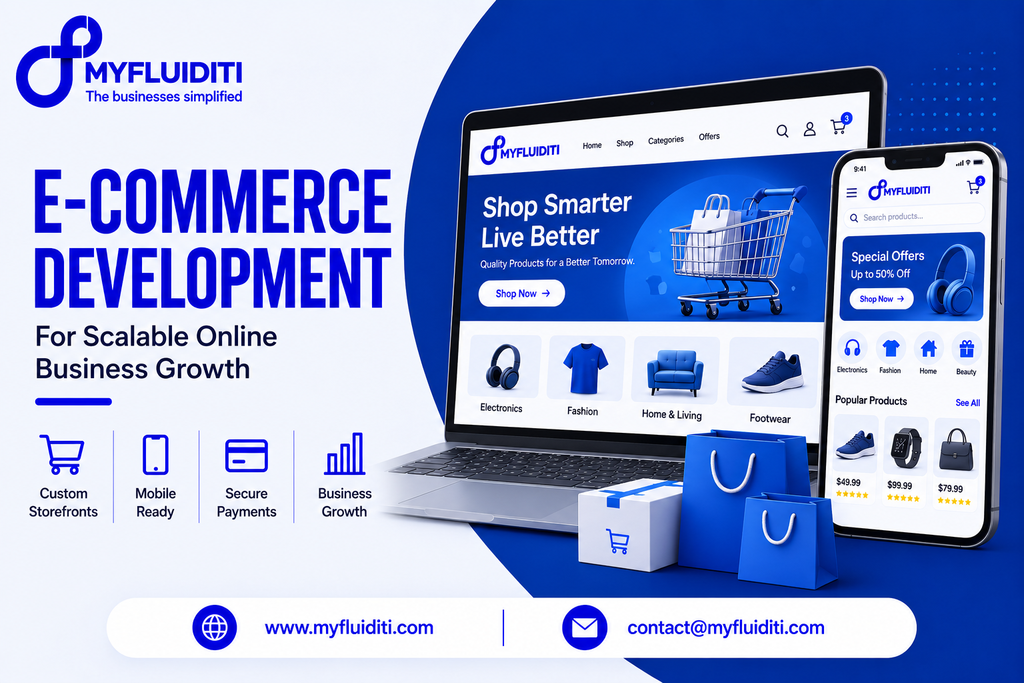
Introduction to E-Commerce Development The rapid growth of digital commerce has changed how businesses attract customers, sell products, process payments, and build long-term customer relationships. A successful online store needs more than an attractive interface. It requires a secure, fast, scalable, mobile-friendly, and conversion-focused digital platform that can support products, customers, orders, payments, inventory, marketing, and business operations. E-Commerce Development helps businesses create digital storefronts that are designed around their products, target audience, sales model, and growth objectives. MyFluiditi helps businesses transform E-Commerce ideas into modern online shopping platforms that combine intuitive user experiences, powerful backend systems, secure integrations, and scalable architecture. Modern E-Commerce Development for Digital Commerce Customers expect online stores to provide fast navigation, simple product discovery, convenient checkout, flexible payment options, personalized experiences, and seamless browsing across devices. Modern E-Commerce Website Development focuses on creating a complete digital shopping experience rather than simply listing products online. MyFluiditi develops E-Commerce solutions that connect the customer-facing storefront with product management, inventory, payment systems, order processing, analytics, and other essential business operations. Custom E-Commerce Website Development Every business has different products, customer journeys, pricing structures, sales channels, and operational workflows. Generic platforms may not always meet specialized requirements. Custom E-Commerce Development allows businesses to build online stores around their unique business model and customer expectations. MyFluiditi designs customized E-Commerce websites with flexible functionality, intuitive interfaces, scalable backend architecture, and integrations tailored to the organization’s specific requirements. B2C E-Commerce Development Business-to-consumer commerce depends heavily on user experience, product discovery, trust, and checkout simplicity. B2C E-Commerce Development creates digital storefronts where customers can browse products, compare options, add products to carts, complete secure payments, and track orders through a connected experience. MyFluiditi develops customer-focused B2C platforms that emphasize usability, performance, responsive design, and conversion opportunities. B2B E-Commerce Development Business customers often require more advanced features than traditional consumers, including bulk ordering, custom pricing, account-based purchasing, approval workflows, recurring orders, and enterprise integrations. B2B E-Commerce Development enables organizations to build digital commerce platforms around these requirements. MyFluiditi develops B2B solutions that can connect purchasing workflows with ERP, CRM, inventory, accounting, and other enterprise systems. Multi-Vendor E-Commerce Development Online marketplaces require a technology architecture capable of managing multiple vendors, product catalogs, customers, orders, commissions, payments, and seller operations. Multi-Vendor E-Commerce Development provides a foundation for marketplace businesses that bring different sellers and customers together on one platform. MyFluiditi can develop marketplace solutions with vendor management, seller dashboards, product controls, order workflows, payment integrations, and administrative functionality. E-Commerce Storefront Development The storefront is the primary digital interaction between an online business and its customers. A well-designed E-Commerce Storefront should make products easy to discover while providing a fast and engaging shopping experience. MyFluiditi focuses on responsive layouts, clear navigation, product categorization, optimized product pages, search functionality, and intuitive checkout experiences to help businesses create storefronts that support both engagement and conversions. Mobile E-Commerce Development A large share of online shopping activity takes place on smartphones and tablets. Mobile E-Commerce Development ensures customers can browse products, manage carts, make payments, and track orders through a responsive and convenient mobile experience. MyFluiditi develops mobile-friendly E-Commerce platforms that adapt to different screen sizes and provide consistent functionality across devices. E-Commerce Mobile App Development Businesses seeking deeper customer engagement can extend their online store into dedicated mobile applications. E-Commerce Mobile App Development can provide personalized shopping experiences, push notifications, saved preferences, faster repeat purchases, loyalty features, and mobile-specific interactions. MyFluiditi can develop mobile commerce applications that connect with existing E-Commerce backends, product catalogs, customer accounts, inventory systems, and payment infrastructure. Product Catalog and Management A well-organized product catalog is essential for online retail. E-Commerce Product Management enables businesses to manage products, categories, descriptions, images, prices, attributes, variations, availability, and other catalog information through centralized systems. MyFluiditi develops flexible catalog structures that can support growing product ranges and improve how customers discover and evaluate products. E-Commerce Search and Product Discovery Customers need to find relevant products quickly, especially when online stores contain large catalogs. E-Commerce Search Functionality can improve product discovery through keyword search, filters, categories, attributes, sorting, and intelligent recommendations. MyFluiditi develops search experiences that make it easier for users to find relevant products and move efficiently from discovery to purchase. Shopping Cart and Checkout Development The checkout experience has a direct impact on conversion. Complicated forms, unnecessary steps, or limited payment choices can create friction during purchase. E-Commerce Checkout Development focuses on creating a streamlined purchasing process that supports customer information, shipping, discounts, taxes, payment processing, order confirmation, and other required steps. MyFluiditi designs checkout workflows that prioritize simplicity, speed, security, and usability. E-Commerce Payment Gateway Integration Secure and flexible payments are fundamental to online commerce. E-Commerce Payment Gateway Integration enables E-Commerce websites to support relevant digital payment methods and process transactions through connected payment services. MyFluiditi integrates payment systems into E-Commerce platforms while considering transaction flow, security, order status synchronization, refunds, and payment-related business workflows. Shopping Cart and Order Management Once an order is placed, businesses need efficient systems for processing and tracking it. E-Commerce Order Management connects order creation, payment confirmation, inventory updates, fulfillment, shipping, notifications, cancellations, and returns. MyFluiditi builds connected order workflows that provide businesses with greater control over the complete order lifecycle. E-Commerce Inventory Management Inventory accuracy is critical for online businesses because customers need reliable information about product availability. E-Commerce Inventory Management can synchronize stock information across the online store, warehouses, physical stores, and other sales channels. MyFluiditi integrates inventory systems to help businesses reduce stock discrepancies, manage product availability, and maintain more efficient fulfillment operations. Omnichannel E-Commerce Development Customers increasingly interact with brands through websites, mobile applications, marketplaces, social commerce, and physical stores. Omnichannel E-Commerce Development connects these channels to create a more consistent customer journey and centralized operational environment. MyFluiditi helps businesses integrate commerce channels so customer data, products, inventory, orders, and other key information can be managed more effectively across the digital ecosystem. Headless E-Commerce Development Businesses looking for greater flexibility can adopt Headless E-Commerce Development, where the
AI Wearable App Development for Intelligent Connected Experiences
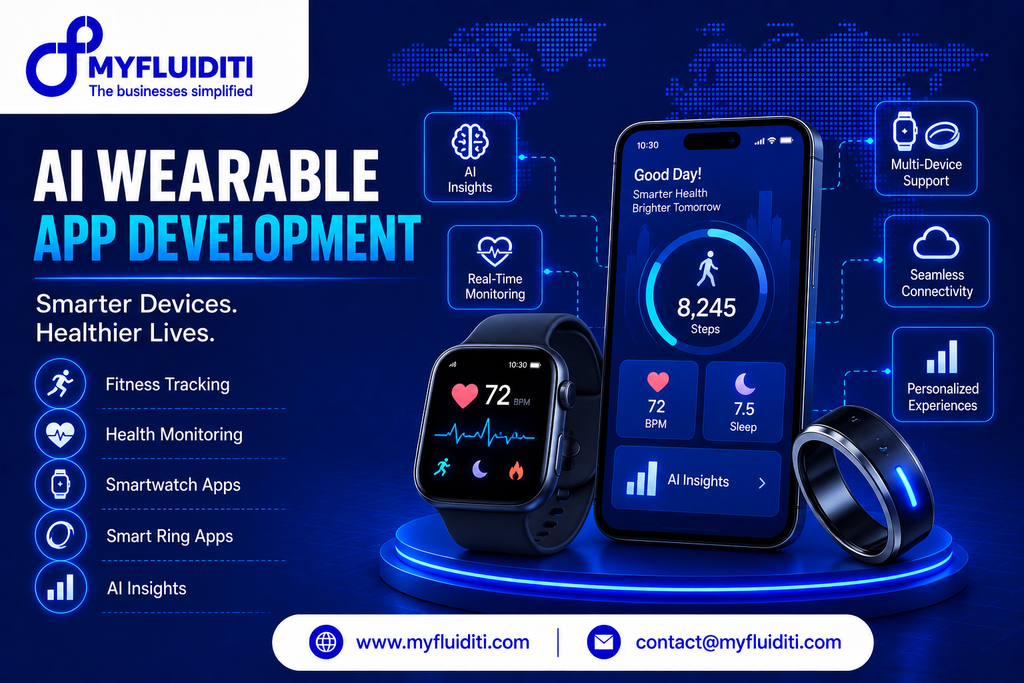
Introduction to AI Wearable App Development Wearable technology is evolving from simple activity trackers into intelligent, connected devices that can continuously capture data and deliver personalized digital experiences. Smartwatches, fitness bands, smart rings, smart glasses, medical wearables, and other connected devices are creating new opportunities for businesses across healthcare, fitness, sports, retail, enterprise, and consumer technology. AI wearable app development combines wearable device connectivity, mobile applications, artificial intelligence, sensor data, cloud services, and real-time analytics to create intelligent solutions that can understand user activity and provide meaningful insights. MyFluiditi helps businesses transform wearable technology ideas into scalable applications designed around specific user needs, device capabilities, and business objectives. Intelligent Wearable Applications for Modern Businesses Traditional wearable applications primarily focused on collecting and displaying information such as steps, heart rate, sleep activity, calories, or notifications. AI is expanding these capabilities by enabling wearable applications to interpret data, identify patterns, generate personalized insights, and support intelligent decision-making. Modern AI-powered wearable apps can connect device data with mobile applications and cloud platforms to create more responsive experiences. Current wearable development is also increasingly influenced by on-device AI, real-time processing, and privacy-focused architectures. Custom AI Wearable App Development Every wearable product has different requirements depending on the device, target users, sensor capabilities, business model, and intended use case. Custom wearable app development allows organizations to create applications that are built around their specific product vision rather than relying entirely on generic solutions. MyFluiditi analyzes the wearable ecosystem, data requirements, user journeys, and integration needs before designing a customized architecture that connects wearable devices, mobile applications, AI services, and backend systems. AI-Powered Smartwatch App Development Smartwatches are among the most widely used wearable platforms and provide access to sensors, notifications, location information, activity data, and other contextual signals. AI smartwatch app development can transform this information into personalized recommendations, activity insights, alerts, conversational experiences, and intelligent assistance. MyFluiditi develops smartwatch-connected applications that are designed to work with mobile ecosystems while supporting efficient data synchronization and user-friendly interactions. Smart Ring App Development Smart rings provide compact form factors with continuous sensing capabilities and are becoming an important category within the wearable ecosystem. AI can help interpret the data collected by these devices and provide more meaningful insights through companion applications. Smart ring app development can include activity tracking, wellness insights, sleep analysis, personalized recommendations, and intelligent trend detection. MyFluiditi can build companion mobile applications that transform raw sensor information into useful, understandable user experiences. AI Fitness Wearable App Development Fitness and wellness remain major application areas for wearable technology. AI enables fitness applications to move beyond basic tracking toward personalized fitness intelligence, activity analysis, performance insights, goal recommendations, and adaptive experiences. MyFluiditi can develop AI fitness applications that combine data from wearables with user profiles, historical activity, exercise patterns, and mobile application data to provide more personalized and engaging fitness experiences. AI Health and Wellness Wearable Applications Wearable devices can continuously capture health and wellness-related signals, creating opportunities for applications focused on monitoring, trends, lifestyle insights, and personalized engagement. AI health wearable apps can analyze relevant data streams and present understandable insights through companion mobile or web applications. MyFluiditi develops health and wellness-oriented wearable solutions with careful attention to data security, user permissions, reliability, and appropriate product boundaries. Sensor Data Integration for Wearable Apps Wearables can generate information from sensors such as accelerometers, gyroscopes, heart-rate sensors, temperature sensors, GPS, and other device-specific components. The value of this data depends on how effectively it can be processed and interpreted. Wearable sensor integration allows applications to collect relevant signals and connect them with AI and analytics systems. MyFluiditi designs data pipelines that can combine sensor information with contextual application data to support intelligent product functionality. AI-Based Sensor Fusion Using a single sensor may not always provide enough context for sophisticated wearable applications. Sensor fusion combines signals from multiple sensors to create a more complete understanding of activity or environmental conditions. This can support applications such as movement analysis, activity recognition, fitness intelligence, safety monitoring, and personalized recommendations. MyFluiditi can design sensor-fusion architectures that process multiple data streams while balancing accuracy, performance, battery consumption, and device limitations. Real-Time AI and Edge Intelligence Wearable applications often require fast responses, particularly for notifications, activity recognition, contextual assistance, and other time-sensitive experiences. Edge AI for wearables enables selected intelligence to operate closer to the device, reducing dependence on constant cloud communication. Industry research shows that edge AI adoption in wearables is increasing as devices become more capable of performing intelligent processing locally. MyFluiditi evaluates edge and cloud processing requirements to determine which workloads should run on the device, smartphone, or backend infrastructure. Cloud-Based AI Wearable Applications Cloud infrastructure provides scalable resources for data storage, analytics, machine learning, model management, dashboards, and application services. A cloud-based wearable application can process information collected across multiple devices and users while providing centralized access to analytics and business intelligence. MyFluiditi integrates wearable applications with scalable backend systems and cloud services to support data synchronization, analytics, AI inference, notifications, and connected digital experiences. Wearable-to-Mobile App Integration A strong companion application is often essential for wearable products because mobile devices provide richer interfaces, greater processing capacity, and broader application functionality. Wearable mobile app integration connects the device with iOS or Android applications for synchronization, visualization, configuration, notifications, account management, and personalized insights. MyFluiditi creates connected architectures in which wearable devices and mobile applications work together as part of a unified user experience. Wearable API Integration Modern wearable applications may need to connect with health platforms, cloud services, third-party applications, enterprise systems, analytics platforms, and other digital ecosystems. Wearable API integration enables information to move securely between these systems. MyFluiditi develops API-driven architectures that connect device data with backend systems and relevant external services while supporting scalability, security, and reliable data exchange. AI-Powered Personalized Insights One of the most valuable capabilities of AI wearable applications is personalization. Instead of presenting users with raw measurements alone, intelligent applications can analyze historical patterns and contextual information to generate personalized insights
SEO Services for Sustainable Online Visibility and Business Growth
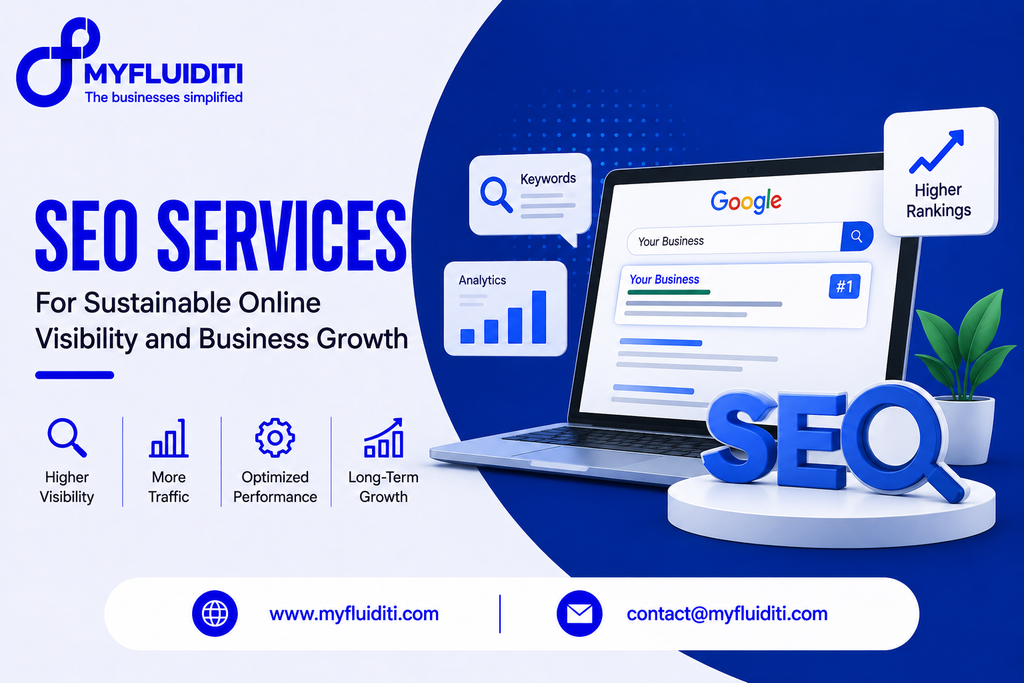
Introduction to SEO Services In a highly competitive digital environment, having a website is only the beginning of building an online presence. Businesses need to appear in relevant search results when potential customers are actively looking for products, services, and solutions. SEO services help businesses improve organic search visibility, attract relevant website traffic, strengthen online authority, and generate sustainable growth through search engines. Search engine optimization combines technical improvements, content optimization, keyword targeting, website structure, user experience, and authority-building strategies to improve how a website is discovered and understood. MyFluiditi helps businesses build search-focused digital strategies that connect their websites with the right audiences and support long-term online growth. Modern SEO for Digital Business Growth Search engine optimization has evolved beyond simply placing keywords throughout website content. Modern SEO involves understanding search intent, improving website performance, creating valuable content, optimizing technical infrastructure, building topical authority, and delivering a strong experience across devices. MyFluiditi approaches search engine optimization services as an ongoing growth strategy that connects technical SEO, content marketing, website optimization, and performance analysis to measurable business goals. Technical SEO Services A strong SEO strategy begins with a technically accessible website. Technical SEO services focus on areas such as website architecture, crawlability, indexing, internal linking, canonicalization, structured data, page performance, mobile usability, and other technical factors that influence how search engines discover and understand website content. MyFluiditi evaluates technical website health and identifies areas that can be improved so search engines can efficiently access important pages while users receive a smoother browsing experience. On-Page SEO Services On-page optimization ensures that individual website pages clearly communicate their purpose and relevance to search engines and users. On-page SEO services include optimizing page titles, headings, content structure, keyword usage, internal links, image attributes, metadata, and other page-level elements. MyFluiditi creates optimization strategies that balance search visibility with natural, useful content, helping businesses target relevant search terms without relying on excessive keyword repetition. Keyword Research and Search Intent Effective SEO begins with understanding what potential customers are searching for and why they are searching for it. SEO keyword research identifies relevant primary keywords, secondary keywords, long-tail searches, industry terms, and commercial search opportunities. MyFluiditi analyzes keyword relevance and search intent to develop content and landing-page strategies that target users at different stages of the buying journey. This helps businesses attract traffic that is more closely aligned with their products, services, and conversion objectives. Local SEO Services For businesses serving specific cities, regions, or local markets, visibility in geographically relevant searches can be especially valuable. Local SEO services focus on improving a business’s presence for location-based searches through relevant website optimization, local content, business information, location signals, and other local search strategies. MyFluiditi helps businesses strengthen their local digital presence and improve their ability to connect with customers searching for services within their target geographic markets. Content SEO and Content Marketing High-quality content plays an important role in building organic search visibility. SEO content marketing combines keyword research, search intent, topic development, content optimization, and ongoing refinement to create useful pages that can attract organic traffic. MyFluiditi develops content strategies around service pages, blogs, industry topics, informational searches, and commercial keywords, helping businesses establish topical relevance while providing useful information to their target audiences. SEO for Service-Based Businesses Service businesses need visibility for searches related to their expertise, offerings, locations, and customer needs. A well-optimized service website can help potential customers discover a company at the moment they are researching or evaluating a solution. MyFluiditi develops service-based SEO strategies that improve landing pages, strengthen content relevance, target valuable keywords, and build stronger relationships between search intent and business offerings. E-Commerce SEO Services E-commerce websites compete across large numbers of product, category, and transactional searches. E-commerce SEO services focus on improving product pages, category pages, website architecture, internal linking, metadata, content, and overall search accessibility. MyFluiditi helps online businesses develop search-friendly e-commerce structures that support product discovery, organic traffic growth, and better opportunities for converting search visitors into customers. Enterprise SEO Services Large websites often contain hundreds or thousands of pages, multiple categories, complex architectures, and several business units. Enterprise SEO services address the scalability challenges associated with large digital platforms. MyFluiditi develops enterprise-focused strategies covering technical SEO, content architecture, internal linking, keyword targeting, website migrations, international or multi-location visibility, and ongoing performance monitoring to support large-scale organic growth. Mobile SEO and User Experience Mobile devices represent a major part of modern web usage, making mobile-friendly experiences essential for businesses competing in search. Mobile SEO focuses on responsive design, usability, page speed, navigation, content presentation, and technical performance across mobile devices. MyFluiditi works with businesses to ensure their websites deliver consistent experiences across smartphones, tablets, and desktops while maintaining strong technical foundations for search visibility. SEO-Friendly Website Architecture Website structure influences both user navigation and search engine discovery. A well-planned SEO-friendly website architecture creates logical relationships between pages, improves internal linking, distributes authority effectively, and makes important content easier to discover. MyFluiditi considers website hierarchy, navigation, URL structures, category organization, internal links, and content relationships when developing SEO strategies for websites and web applications. Internal Linking and Website Structure Internal links help users navigate related information while helping search engines understand relationships between pages. Internal linking strategy can strengthen important service pages, connect supporting content, and improve the overall flow of authority throughout a website. MyFluiditi develops contextual internal linking structures that connect relevant pages naturally and help businesses build stronger topical relationships across their websites. Link Building and Off-Page SEO A website’s authority is influenced by signals beyond its own pages. Off-page SEO and link building focus on building relevant online authority through credible backlinks, digital mentions, partnerships, content outreach, and other legitimate authority-building strategies. MyFluiditi approaches link acquisition with relevance and quality in mind, helping businesses develop stronger off-page signals while maintaining a sustainable search strategy. SEO Audits and Website Performance Analysis An SEO campaign should begin with an understanding of the website’s existing performance. SEO audit services evaluate technical health, content quality,
Salesforce Lightning Development for Connected Enterprise Growth
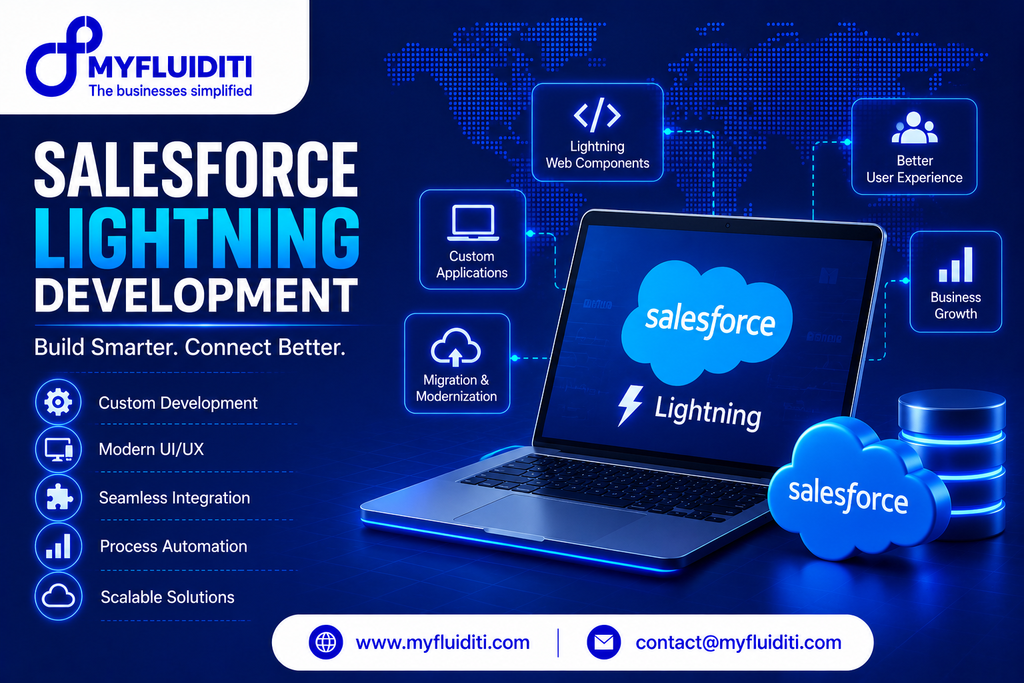
Introduction to Salesforce Lightning Development Businesses today need CRM platforms that are flexible, connected, scalable, and capable of supporting rapidly changing customer and operational requirements. Salesforce Lightning has become a powerful platform for creating modern customer relationship management experiences, custom applications, intelligent workflows, and connected enterprise solutions. Salesforce Lightning Development enables organizations to extend Salesforce beyond standard configurations and create tailored digital experiences that align with specific business processes. MyFluiditi helps businesses transform their Salesforce environment through custom Lightning development, application modernization, integration, automation, and scalable enterprise solutions designed around business goals. Modern Salesforce Lightning Solutions for Enterprises Salesforce Lightning provides organizations with a modern platform for developing interactive and responsive business experiences. It supports custom user interfaces, Salesforce applications, mobile experiences, and digital experiences through technologies such as Lightning Web Components and Lightning base components. Salesforce recommends Lightning Web Components for new development, making it an important technology for modern Salesforce customization. Custom Salesforce Lightning Development Every organization has unique workflows, customer journeys, data structures, and operational requirements. Standard Salesforce functionality may not always cover specialized business needs. Custom Salesforce Lightning development allows businesses to extend the platform with tailored interfaces, components, workflows, features, and applications. MyFluiditi works with organizations to understand their business processes and develop Lightning solutions that fit naturally into their Salesforce environment while maintaining scalability and usability. Lightning Web Components Development Lightning Web Components, commonly known as LWC, are a modern programming model based on web standards and are used to create custom interfaces and applications on the Salesforce Platform. LWC components use HTML and JavaScript and can be used across Lightning Experience, the Salesforce mobile app, and Experience Builder sites. MyFluiditi uses Lightning Web Components development to create responsive and reusable Salesforce interfaces that improve application usability and business productivity. Custom components can be designed around specific business functions, allowing organizations to provide employees with focused experiences instead of relying only on standard screens. Salesforce Lightning UI and UX Development User experience has a direct impact on productivity, adoption, and customer engagement. Salesforce Lightning development enables organizations to create modern interfaces using Lightning base components and the Salesforce Lightning Design System. Salesforce notes that its base components are designed to support consistent experiences, accessibility, and efficient UI development. MyFluiditi focuses on creating intuitive Salesforce Lightning UI/UX solutions that make complex workflows easier to navigate. From dashboards and record pages to custom components and application interfaces, we structure experiences around the needs of the actual users. Salesforce Lightning Application Development Organizations often need custom applications within Salesforce to manage specialized processes, departments, or customer interactions. Salesforce Lightning application development enables businesses to create purpose-built applications that work within the broader Salesforce ecosystem. MyFluiditi develops custom Lightning applications that can connect business data, workflows, users, and integrations into a unified environment. Salesforce Lightning Customization Salesforce offers extensive configuration capabilities, but organizations with advanced requirements may need deeper customization. Salesforce Lightning customization can include custom components, application pages, dashboards, actions, layouts, workflows, and user experiences. MyFluiditi combines configuration and development approaches to deliver solutions that are practical, maintainable, and aligned with business operations. Salesforce Lightning Migration and Modernization Organizations using older Salesforce interfaces or legacy technologies may need to modernize their applications to deliver better user experiences and maintain compatibility with current development practices. Salesforce provides paths for migrating Visualforce and Aura-based experiences toward Lightning technologies, with Lightning Web Components recommended for new development. MyFluiditi helps organizations approach Salesforce Lightning migration as a structured modernization initiative. We assess existing components, business logic, integrations, and workflows before developing a suitable migration strategy that reduces disruption and improves the long-term maintainability of the Salesforce environment. Salesforce Aura to Lightning Web Components Migration Many established Salesforce environments contain Aura components that continue to support existing functionality. At the same time, LWC is the preferred approach for new Lightning development. Salesforce states that LWC and Aura components can coexist and interoperate, which provides flexibility during modernization projects. MyFluiditi can support Aura to LWC migration by assessing existing components, identifying modernization priorities, rebuilding suitable functionality with Lightning Web Components, and validating the updated experience. This approach can help organizations modernize gradually without requiring unnecessary disruption to business operations. Salesforce Visualforce to Lightning Migration Legacy Visualforce applications may continue to support important business processes, but businesses often require more interactive and modern experiences. Salesforce Lightning provides a component-based approach for creating responsive applications and experiences. MyFluiditi helps businesses modernize Visualforce to Lightning applications by analyzing current implementations and developing appropriate Lightning alternatives. Our approach considers business functionality, user experience, integrations, and future scalability rather than simply replacing the visual layer. Salesforce Apex and Lightning Development Lightning applications often require custom backend logic to support advanced business requirements. Salesforce Lightning Web Components can work with Apex methods through wired or imperative calls, allowing custom components to interact with Salesforce data and business logic. MyFluiditi combines Apex development with Lightning components to create solutions that connect frontend experiences with custom Salesforce logic. This allows businesses to support specialized calculations, data processing, validations, automation, and other application requirements within their Salesforce environment. Salesforce API Integration Enterprise organizations frequently depend on multiple applications, platforms, databases, payment services, ERP systems, communication tools, and third-party applications. Salesforce API integration connects these systems so important information can move across the enterprise ecosystem. Lightning applications can work with Salesforce APIs and, where appropriate, third-party APIs through supported integration mechanisms. MyFluiditi develops integration solutions that connect Salesforce with existing business technology, helping organizations reduce disconnected processes and improve data accessibility across applications. Salesforce Lightning Workflow Automation Manual administrative activities can consume employee time and create inconsistent processes. Salesforce workflow automation helps organizations streamline repetitive activities, approvals, record updates, notifications, and business processes. MyFluiditi evaluates existing workflows and identifies opportunities for automation within Salesforce so teams can spend more time on high-value activities and less time managing repetitive operations. Salesforce Lightning CRM Customization Customer relationship management requirements differ across industries and business models. Salesforce CRM customization enables organizations to adapt Salesforce around
Loan Lending Solutions for Faster and Smarter Financial Services
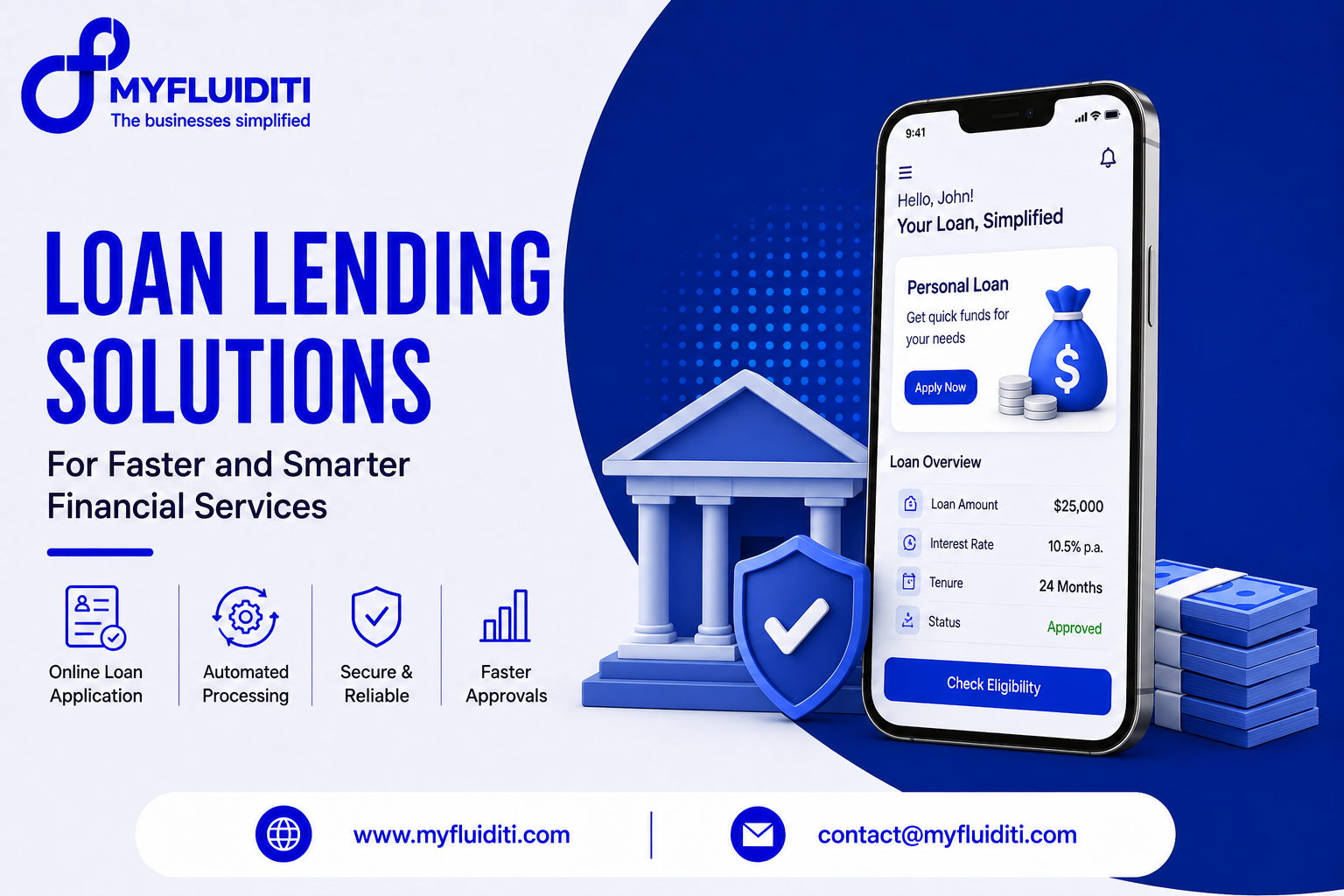
Introduction to Loan Lending Solutions The financial services industry is rapidly evolving as customers expect faster approvals, simpler applications, transparent processes, and convenient digital access to financial products. Traditional lending workflows often involve extensive paperwork, manual verification, fragmented systems, and lengthy approval cycles. Loan lending solutions help financial organizations modernize these processes by combining digital applications, automated decision-making, customer data, document management, payment processing, and secure technology into a connected lending platform. MyFluiditi helps businesses develop scalable and technology-driven lending solutions that simplify loan operations while improving customer experience, operational efficiency, and business visibility. Digital Loan Lending for Modern Financial Operations Digital transformation has changed the way lenders interact with borrowers. Customers increasingly expect to apply for loans through websites and mobile applications, upload documents digitally, receive application updates, and complete financial transactions online. A modern digital lending platform can connect the entire lending lifecycle, from application submission and verification to underwriting, approval, disbursement, repayment, and servicing. MyFluiditi focuses on developing digital lending experiences that are designed around business workflows while providing customers with a smoother and more accessible borrowing journey. Custom Loan Lending Software Development Every lender has different products, policies, approval workflows, customer segments, and compliance requirements. Generic software may not always provide the flexibility needed to support these unique processes. Custom loan lending software development enables financial organizations to build platforms around their specific lending models, integrations, and operational requirements. MyFluiditi develops customized lending applications with flexible workflows, secure architecture, intuitive interfaces, and scalable backend systems to support both current lending operations and future expansion. Online Loan Application Development An efficient digital loan application process can significantly improve customer engagement and reduce administrative work. Online loan application software enables borrowers to submit personal information, financial details, supporting documents, and loan requests through digital channels. MyFluiditi can create user-friendly loan application workflows that simplify data collection, document submission, application tracking, and communication while helping lending organizations manage applications through a centralized platform. Automated Loan Processing Manual loan processing can lead to delays, repetitive administrative tasks, and inconsistencies. Automated loan processing solutions help streamline activities such as data validation, document verification, eligibility checks, workflow routing, and application updates. MyFluiditi integrates automation into lending workflows to reduce unnecessary manual intervention and help lenders process applications more efficiently while maintaining appropriate controls throughout the lending lifecycle. Loan Origination Software Loan origination is a critical stage of the lending process that includes application intake, borrower information collection, credit assessment, underwriting, approval, and documentation. Loan origination software provides a centralized environment for managing these activities. MyFluiditi can develop loan origination platforms that connect customer applications, data sources, verification processes, decision workflows, and approval mechanisms to create a more efficient and structured lending operation. Loan Underwriting and Decision Automation Underwriting plays an important role in evaluating borrower eligibility and lending risk. Technology can help lenders analyze relevant customer and financial information more efficiently. Automated loan underwriting solutions can support eligibility rules, risk assessment workflows, data analysis, and decision-making processes while allowing authorized teams to maintain appropriate oversight. MyFluiditi develops lending architectures that can integrate business rules, data services, analytics, and intelligent technologies into underwriting workflows. Credit Risk Assessment Solutions Effective risk assessment is essential for maintaining healthy lending operations. Credit risk assessment software can help lenders evaluate borrower information, financial history, application data, and other relevant indicators before making lending decisions. MyFluiditi can build solutions that integrate with appropriate external data services and internal systems to support more structured risk evaluation and improve the efficiency of credit decision workflows. Personal Loan Lending Solutions Personal lending requires convenient customer experiences combined with efficient application and approval processes. Personal loan software can support digital applications, identity verification, eligibility checks, underwriting, approval, disbursement, repayment schedules, and customer communication. MyFluiditi develops flexible lending platforms that can support personal loan products while providing lenders with greater control over their end-to-end operations. Business and SME Lending Software Small and medium-sized businesses often need financing with straightforward application processes and faster access to capital. SME lending software can streamline business loan applications, financial information collection, credit evaluation, document management, approvals, and repayment tracking. MyFluiditi helps lenders develop business lending platforms that support efficient workflows while enabling organizations to manage different business loan products and customer segments. Consumer Lending Platform Development Consumer finance organizations require technology that can support high application volumes while maintaining reliable workflows and customer experiences. A scalable consumer lending platform can manage borrower information, loan applications, eligibility checks, approvals, repayment schedules, and customer interactions through a connected system. MyFluiditi develops consumer lending solutions that can be customized to business-specific workflows and integrated with existing financial technology ecosystems. Loan Management and Servicing Loan operations continue after approval and disbursement. Lenders need to manage repayment schedules, outstanding balances, interest calculations, payment records, account information, and customer communications throughout the loan lifecycle. Loan management software brings these activities into a centralized platform. MyFluiditi can develop lending systems that help organizations manage post-disbursement processes efficiently while providing customers and internal teams with appropriate access to loan information. Loan Repayment and Payment Integration Repayment processing is an essential part of the lending lifecycle. Modern lending platforms can integrate with payment gateways, banking systems, digital payment services, and other supported financial infrastructure to simplify collections and repayment management. Loan repayment integration helps lenders maintain accurate transaction records, automate payment workflows, and provide customers with convenient repayment options. MyFluiditi designs secure payment-connected workflows that support reliable financial transactions and operational visibility. Document Management for Lending Loan applications often require identity documents, income information, financial statements, agreements, and other supporting records. Digital document management helps lenders collect, organize, validate, store, and retrieve these documents more efficiently. MyFluiditi can integrate document upload, verification, workflow tracking, and secure storage capabilities into lending applications to reduce paper-based processes and improve information accessibility. Customer Verification and KYC Integration Customer verification is an important part of modern lending operations. KYC and identity verification integration can help lenders validate customer information during the onboarding and loan application process. MyFluiditi can integrate