SMM Services: Grow Your Brand with Strategic Social Media Marketing
Introduction to Social Media Marketing Social media has become one of the most powerful digital channels for businesses looking to build brand awareness, connect with customers, generate leads, and strengthen their online presence. With billions of people using social platforms every day, businesses have an opportunity to reach highly targeted audiences through relevant content, meaningful engagement, and strategic campaigns. However, simply creating social media accounts and publishing occasional posts is not enough to achieve sustainable growth. A successful social media presence requires a well-planned Social Media Marketing Strategy that combines content creation, audience research, social media management, engagement, analytics, and continuous optimization. MyFluiditi provides professional SMM Services designed to help businesses build a stronger digital presence, reach the right audience, and turn social media activity into meaningful business opportunities. What Are SMM Services? SMM Services, or Social Media Marketing Services, involve using social media platforms to promote a business, communicate with its target audience, build brand recognition, increase website traffic, generate leads, and support business growth. Social media marketing can include organic content marketing, community engagement, social media management, paid advertising, influencer collaborations, social listening, audience research, and performance analysis. The right approach depends on the business goals, industry, audience, and platforms where potential customers are most active. MyFluiditi develops customized social media marketing strategies that focus on creating valuable content and maintaining a consistent brand presence across relevant social channels. Why Social Media Marketing Is Important for Businesses Customers increasingly use social media to discover brands, research products and services, interact with companies, and make purchasing decisions. This makes social media an important part of a broader digital marketing strategy. Effective Social Media Marketing can increase brand visibility, create stronger customer relationships, bring qualified traffic to websites, and support lead generation. Social platforms can also provide valuable audience insights that help businesses understand customer interests and improve their marketing strategies. MyFluiditi helps businesses use social media not simply as a publishing platform but as a strategic digital marketing channel that supports awareness, engagement, traffic, and business growth. Building a Strong Social Media Strategy A successful social media campaign begins with a clear strategy. Before creating content, businesses need to understand their target audience, business objectives, competitors, industry trends, preferred communication style, and the platforms where their customers spend time. A well-defined Social Media Strategy helps determine what type of content should be created, which platforms should be prioritized, how frequently content should be published, and how results should be measured. MyFluiditi studies these factors to create a social media approach that aligns with the business’s marketing objectives instead of relying on random or inconsistent posting. Social Media Content Marketing Content is at the center of successful social media marketing. Businesses need content that informs, educates, engages, and encourages audiences to interact with the brand. Social media content can include industry insights, educational content, company updates, service highlights, product information, customer-focused content, videos, graphics, thought leadership, promotional campaigns, and storytelling. MyFluiditi develops Social Media Content Marketing strategies that maintain a consistent brand voice while creating content relevant to the intended audience. By connecting content with business goals, we help brands build recognition and establish a stronger relationship with their social media communities. Social Media Management Services Maintaining an active social media presence requires consistency and continuous management. Social Media Management Services cover activities such as content planning, publishing, profile management, audience engagement, monitoring, campaign coordination, and performance tracking. Businesses can struggle to maintain consistent social activity when internal teams are focused on daily operations, sales, product development, or customer service. MyFluiditi helps manage the social media presence of businesses by creating structured content plans, maintaining publishing consistency, monitoring engagement, and adapting content based on audience response. Facebook Marketing Services Facebook continues to provide businesses with opportunities to reach broad audiences, build communities, share content, drive website traffic, and run targeted advertising campaigns. Effective Facebook Marketing Services combine organic content with paid campaigns, audience targeting, community engagement, and performance analysis. MyFluiditi can help businesses create Facebook marketing strategies that support brand awareness, customer engagement, website traffic, and lead generation. By understanding the target audience and business objectives, we can develop content and campaign approaches that make Facebook a useful part of the overall digital marketing strategy. Instagram Marketing Services Instagram is highly visual and provides businesses with opportunities to showcase products, services, brand identity, company culture, and customer experiences. Instagram marketing can include image-based content, short-form videos, Stories, Reels, campaigns, and community engagement. MyFluiditi provides Instagram Marketing Services focused on creating visually appealing and strategically relevant content that can help businesses increase visibility and audience engagement. Our approach connects creative content with brand messaging so that businesses can maintain a recognizable and professional Instagram presence. LinkedIn Marketing for B2B Businesses For B2B companies, LinkedIn can be an important platform for professional networking, thought leadership, brand visibility, and lead generation. A strong B2B Social Media Marketing strategy on LinkedIn can help businesses communicate their expertise, showcase services, share industry insights, connect with decision-makers, and develop professional relationships. LinkedIn is particularly valuable when the objective is to reach business owners, executives, technology leaders, procurement teams, and other professionals. MyFluiditi helps B2B brands create LinkedIn content strategies that focus on industry expertise, business solutions, professional engagement, and qualified audience reach. Social Media Advertising and Paid Campaigns Organic social media provides valuable long-term opportunities, while paid social media advertising can help businesses reach targeted audiences more quickly. Social Media Advertising allows businesses to develop campaigns around specific objectives such as brand awareness, website traffic, lead generation, product promotion, or conversions. Effective paid campaigns require appropriate audience targeting, creative development, campaign monitoring, testing, and optimization. MyFluiditi can help businesses plan and manage social media advertising campaigns while focusing on relevant audiences, campaign objectives, performance indicators, and continuous improvement. Social Media Lead Generation Social media can play an important role in generating potential business opportunities when content and campaigns are connected to clear conversion paths. Social Media Lead Generation can involve directing users toward websites, landing
Force.com Development: Build Scalable and Customized Salesforce Applications
Introduction to Force.com Development Businesses today need more than standard CRM functionality to manage complex workflows, customer relationships, business operations, and enterprise data. Force.com Development provides a powerful way to extend the Salesforce ecosystem and create customized cloud applications that match specific business requirements. Salesforce Platform supports custom data models, application development, automation, integrations, and user experiences, making it suitable for organizations looking to modernize their business applications. With the right Salesforce development approach, companies can transform their existing Salesforce environment into a scalable application platform that supports unique processes and evolving business needs. MyFluiditi helps businesses leverage Force.com and Salesforce development capabilities to create customized solutions that improve productivity, streamline operations, and connect critical business systems. What Is Force.com Development? Force.com Development refers to building and extending cloud-based applications on the Salesforce Platform using its development technologies, data model, APIs, automation capabilities, and user-interface frameworks. It enables organizations to create applications that work closely with Salesforce data while supporting customized business logic, workflows, integrations, and user experiences. Salesforce application development can combine low-code capabilities with programmatic technologies such as Apex, Visualforce, Lightning Web Components, and Salesforce APIs. Apex enables developers to implement custom business logic, automation, integrations, and transaction processing directly on the Salesforce Platform. This flexibility makes Force.com Development valuable for businesses that need functionality beyond standard Salesforce configurations. Why Businesses Need Custom Salesforce Application Development Every organization has different processes, departments, customers, data requirements, and operational workflows. Standard Salesforce functionality may not always address specialized business requirements, particularly when organizations need custom applications, complex automation, external system integrations, or specialized interfaces. Custom Salesforce application development allows businesses to extend their CRM environment according to their operational requirements instead of forcing teams to adapt their processes to generic software. A customized Salesforce solution can help organizations centralize information, automate repetitive processes, improve collaboration, and provide employees with applications designed around their daily workflows. MyFluiditi works with businesses to understand their requirements and design Salesforce solutions that align technology with business objectives. Customized Force.com Application Development Customized application development is one of the key advantages of the Salesforce Platform. Businesses can develop applications around their specific data structures, workflows, user roles, and operational processes. Salesforce supports both declarative and programmatic development, allowing applications to combine configurable features with custom development where required. MyFluiditi focuses on building custom Force.com applications that are designed around business requirements, whether the organization needs a new enterprise application, an extension of an existing Salesforce environment, or a specialized business workflow. Our development approach emphasizes scalability, usability, integration, maintainability, and long-term business value. Apex Development for Business Logic Complex Salesforce applications often require customized business logic that cannot be achieved through configuration alone. Apex development enables developers to create object-oriented business logic that operates directly on the Salesforce Platform. Apex can support triggers, custom classes, transaction processing, data validation, automation, web services, and integrations with external applications. MyFluiditi uses Apex development where custom logic is required to create reliable and efficient Salesforce applications. By implementing business rules within the Salesforce environment, organizations can automate important processes while maintaining consistency across customer and enterprise data. Lightning Web Components and Modern Salesforce Interfaces Modern Salesforce application development increasingly uses Lightning Web Components (LWC) to create responsive and reusable user interfaces. Salesforce identifies Lightning Web Components as the preferred approach for modern UI development, while Visualforce remains available for existing and specialized use cases. MyFluiditi can help businesses modernize Salesforce interfaces by developing customized Lightning experiences that provide intuitive navigation, responsive layouts, reusable components, and improved user interaction. Combining Salesforce Lightning technologies with business-focused application design can help organizations create interfaces that are easier for employees and customers to use. Visualforce Development and Custom Salesforce Interfaces Visualforce is a Salesforce framework for creating customized interfaces and pages that run on the Lightning Platform. It provides developers with the ability to build custom pages, components, and user experiences using Visualforce markup, HTML, CSS, JavaScript, and Apex-based controllers. Although Salesforce recommends Lightning Web Components for new modern development, Visualforce can remain valuable when organizations need to maintain, extend, or integrate existing Visualforce applications. MyFluiditi supports Visualforce development and modernization, helping businesses maintain existing Salesforce functionality while gradually moving toward modern Lightning-based experiences when appropriate. Salesforce API and Third-Party Integration Enterprise businesses rarely operate with Salesforce as an isolated system. They often depend on ERP platforms, payment systems, websites, mobile applications, marketing platforms, analytics tools, databases, and other enterprise applications. Salesforce integration services can connect these systems and enable information to move between platforms. Salesforce provides APIs and integration capabilities that allow external systems to communicate with Salesforce data and applications. MyFluiditi helps businesses design and develop Salesforce integrations that connect critical systems, reduce manual data entry, improve data consistency, and create more connected business workflows. Salesforce Automation and Workflow Development Automation plays an important role in improving business productivity and reducing repetitive manual activities. Salesforce provides automation capabilities through Flow, workflow-related technologies, formulas, validation rules, Apex, and other platform features. MyFluiditi helps organizations identify processes that can be automated and develop Salesforce solutions that support activities such as record updates, approvals, notifications, data validation, task creation, and business-rule execution. Effective Salesforce workflow automation can help employees spend less time on repetitive administrative tasks and more time on customer engagement and strategic activities. Force.com Custom Application Integration Businesses may already have multiple applications supporting sales, finance, customer service, operations, marketing, and other departments. A customized Force.com solution can serve as an important part of a connected enterprise technology environment. Salesforce Platform is designed to work with external systems through APIs, integration standards, and platform capabilities. MyFluiditi develops integration-focused Salesforce solutions that help businesses connect their CRM environment with existing enterprise applications. This approach can improve visibility across departments while creating a more unified flow of business information. Scalable Salesforce Application Development Scalability is essential when developing enterprise applications because business requirements can change as organizations grow. A Salesforce application should be designed to support increasing users, data, integrations, workflows, and
Food Delivery App Development for Seamless Online Ordering
Introduction The rapid growth of digital commerce has transformed the way customers discover restaurants, order meals, make payments, and receive food at their preferred locations. With customers increasingly choosing convenient online food ordering instead of traditional restaurant visits, businesses need reliable technology to deliver faster, smoother, and more personalized experiences. A well-designed food delivery app development solution can connect customers, restaurants, delivery partners, and administrators through a unified digital platform. From browsing menus and placing orders to secure payments and real-time delivery tracking, modern food delivery technology helps businesses simplify operations while improving customer satisfaction. MyFluiditi helps businesses build scalable and customized food delivery solutions that support modern online ordering requirements and create a seamless digital food delivery experience. Growing Demand for Online Food Delivery Online food delivery has become an important part of the digital food industry, creating new opportunities for restaurants, cloud kitchens, food chains, startups, and food-tech companies. Customers expect food ordering platforms to be fast, convenient, mobile-friendly, and easy to use. They want to search for nearby restaurants, explore menus, compare food items, customize orders, apply discounts, make secure online payments, and track deliveries without unnecessary steps. A powerful online food ordering system helps businesses meet these expectations while creating a direct digital connection with their customers. With the right food delivery technology, businesses can increase online orders, improve customer engagement, strengthen their brand presence, and expand their delivery operations. Custom Food Delivery App Development Every food business operates differently, making customization an important part of successful food delivery app development. A single restaurant may require a simple ordering application, while a food-tech startup may need a multi-vendor marketplace connecting hundreds of restaurants with customers and delivery partners. MyFluiditi develops customized food delivery platforms based on business objectives, target customers, restaurant operations, delivery models, and future scalability requirements. Our approach can support customer applications, restaurant management systems, delivery partner applications, and centralized administration dashboards, creating a connected ecosystem for complete food delivery management. Seamless Online Food Ordering Experience A successful food ordering app should make the complete ordering journey simple and convenient. Customers should be able to discover restaurants, search food by category or cuisine, view detailed menus, select quantities, customize items, add products to their cart, choose delivery locations, and complete orders through a smooth interface. Personalized recommendations, order history, favorite restaurants, saved addresses, and quick reorder options can further improve the customer experience. MyFluiditi focuses on creating intuitive digital experiences that reduce friction throughout the ordering process and help businesses provide a reliable and engaging online food ordering journey. Restaurant Management System Restaurants need more than a customer-facing application to successfully manage online food orders. An integrated restaurant management system can help restaurant owners manage menus, categories, pricing, food availability, operating hours, incoming orders, promotions, and customer information from a centralized dashboard. Restaurant teams can receive order notifications, confirm orders, update preparation status, and manage food availability in real time. By connecting restaurant operations with the overall food delivery platform, MyFluiditi helps businesses improve order processing, reduce manual work, and gain greater visibility into daily restaurant operations. Real-Time Food Delivery Tracking Real-time tracking is an essential feature of modern food delivery software because customers want visibility after placing an order. A connected delivery platform can allow customers to view order status and track the delivery journey while restaurants and administrators monitor delivery progress. Delivery partners can receive assigned orders, access restaurant and customer locations, navigate delivery routes, and update order status through their dedicated application. MyFluiditi can integrate real-time delivery tracking and location-based functionality to create greater transparency between customers, restaurants, delivery partners, and administrators. Secure Online Payment Integration A reliable payment experience is essential for any modern food delivery platform. Customers expect secure and convenient payment options when ordering food online. Payment gateway integration can support different transaction methods depending on the business market and customer requirements, while automated payment confirmation can help restaurants and delivery platforms process orders efficiently. A well-integrated payment system can also support transaction records, refunds, invoices, and financial reporting. MyFluiditi develops food delivery solutions with secure payment workflows designed to make online transactions convenient for customers and easier for businesses to manage. Delivery Partner Management Delivery partners play a critical role in the success of an on-demand food delivery business. A dedicated delivery partner application can help drivers receive delivery assignments, view pickup and drop-off locations, access navigation, update delivery status, and manage completed orders. Businesses can also monitor delivery performance, order completion, delivery times, and operational activity through an administration dashboard. With an integrated delivery management system, MyFluiditi helps businesses coordinate restaurants, customers, and delivery partners through a centralized digital workflow that supports efficient last-mile food delivery. Food Delivery Offers and Customer Engagement Customer acquisition and retention are important for long-term success in the competitive food delivery market. Food businesses can use discount coupons, promotional campaigns, referral programs, loyalty rewards, personalized offers, and push notifications to increase customer engagement. A modern food delivery application can provide businesses with tools to create targeted promotions based on customer preferences, order history, location, and purchasing behavior. MyFluiditi can integrate customer engagement capabilities into food ordering platforms to help businesses encourage repeat orders, improve customer retention, and create stronger relationships with their digital audience. Food Delivery Analytics and Business Insights Data-driven decision-making can significantly improve food delivery operations. A modern food delivery management system can provide valuable information about order volumes, revenue, popular menu items, customer behavior, delivery performance, cancellation rates, peak ordering periods, and restaurant performance. These insights can help businesses identify trends, optimize menus, improve delivery operations, understand customer preferences, and make informed decisions. MyFluiditi can develop analytics and reporting capabilities that give businesses greater visibility into their food delivery operations and help them identify opportunities for operational improvement and business growth. Scalable On-Demand Food Delivery Solutions Scalability is one of the most important considerations when developing an on-demand food delivery platform. As a business grows, the number of customers, restaurants, orders, delivery partners, and transactions can increase
Computer Vision Development for Intelligent Business Automation
Introduction to Computer Vision Development Artificial Intelligence is transforming the way businesses process images, videos, documents, and visual information. Computer Vision Development enables software systems to understand and analyze visual data using Artificial Intelligence, Machine Learning, Deep Learning, image processing, and advanced computer vision algorithms. Organizations across manufacturing, healthcare, retail, logistics, transportation, security, agriculture, sports, and other industries are adopting Computer Vision Solutions to automate visual inspection, recognize objects, analyze video, extract information from documents, monitor operations, and improve business decision-making. MyFluiditi provides Computer Vision Development Services that help businesses transform visual data into intelligent digital solutions designed around specific operational requirements and business goals. Modern Computer Vision Solutions for Digital Transformation Computer vision extends traditional software capabilities by allowing applications to interpret images and video collected from cameras, mobile devices, scanners, IoT devices, and other visual data sources. AI-powered Computer Vision Solutions can identify objects, classify images, detect patterns, recognize text, analyze movements, monitor activities, and generate actionable insights. As organizations accelerate digital transformation, Computer Vision Technology is becoming an important component of intelligent automation. MyFluiditi helps businesses integrate AI Computer Vision capabilities into existing digital ecosystems to improve efficiency, accuracy, automation, and operational visibility. Custom Computer Vision Development Services Every business has different workflows, datasets, environments, and visual processing requirements. Generic AI solutions may not always provide the flexibility required for specialized applications. Custom Computer Vision Development enables organizations to create intelligent systems around their specific images, videos, business processes, cameras, devices, and performance expectations. MyFluiditi develops Custom Computer Vision Software by evaluating business requirements, visual data sources, AI model requirements, infrastructure, integrations, user needs, and scalability objectives to create solutions that can support real-world operations. Image Recognition and Image Classification Image recognition and classification are fundamental capabilities of modern computer vision applications. AI Image Recognition Solutions enable software systems to identify objects, products, categories, patterns, and visual characteristics from images. Image classification can support product identification, quality control, medical image processing, content analysis, visual search, document processing, and automated categorization. MyFluiditi develops Image Recognition and Image Classification Solutions that can be integrated with websites, mobile applications, enterprise software, cloud platforms, and connected devices. Object Detection and Object Tracking Object detection enables AI systems to locate and identify specific objects within images or videos, while object tracking allows those objects to be monitored across multiple frames. Object Detection and Tracking can support retail monitoring, manufacturing inspection, warehouse automation, traffic management, security surveillance, sports analytics, and logistics operations. MyFluiditi develops AI Object Detection Solutions that can process visual information and provide real-time or near-real-time intelligence according to the requirements of the application. AI Video Analytics and Video Processing Businesses increasingly use video data to understand operational activity, customer behavior, safety events, movement, and environmental conditions. AI Video Analytics enables computer vision systems to process video streams and identify objects, activities, events, and patterns. MyFluiditi develops Computer Vision Video Analytics Solutions for security monitoring, customer behavior analysis, asset tracking, industrial operations, transportation, warehouse environments, and other enterprise applications while considering performance, scalability, and processing requirements. Optical Character Recognition and OCR Development Organizations process large volumes of invoices, receipts, contracts, forms, identity documents, reports, and scanned records. Optical Character Recognition (OCR) enables applications to identify and extract text from images and scanned documents. MyFluiditi provides OCR Development Services that combine computer vision, AI, document processing, and automation to help businesses digitize information, reduce manual data entry, improve document processing speed, and create more efficient digital workflows. Intelligent Document Processing Computer vision can work together with Artificial Intelligence and Machine Learning to automate document-heavy business operations. Intelligent Document Processing can identify document types, extract relevant information, classify content, validate fields, and route information into business applications. MyFluiditi develops AI Document Processing Solutions for industries such as finance, healthcare, insurance, logistics, legal services, banking, and enterprise operations, helping organizations automate repetitive document-related tasks. Computer Vision for Manufacturing Manufacturing organizations can use computer vision to improve quality control, production monitoring, defect detection, equipment inspection, and process automation. Computer Vision for Manufacturing enables AI systems to analyze production images and identify defective products, missing components, surface issues, incorrect assembly, and other abnormalities. MyFluiditi develops Industrial Computer Vision Solutions that integrate cameras, AI models, edge devices, dashboards, APIs, and enterprise systems to support intelligent manufacturing operations. Automated Visual Inspection Solutions Manual quality inspection can be time-consuming and difficult to scale, especially in high-volume manufacturing environments. Automated Visual Inspection uses AI-powered computer vision to identify defects, inconsistencies, missing parts, and visual abnormalities. MyFluiditi develops AI Visual Inspection Software that can analyze products and production processes automatically, helping organizations improve inspection speed, consistency, accuracy, and operational efficiency. Computer Vision for Retail and E-Commerce Retail and E-Commerce businesses can use computer vision to improve product recognition, shelf monitoring, inventory visibility, customer behavior analysis, checkout experiences, and store operations. Computer Vision in Retail can help identify products, analyze shelves, understand customer movement, and provide real-time operational insights. MyFluiditi develops Retail Computer Vision Solutions that connect cameras, AI models, analytics systems, and business applications to create intelligent and data-driven retail environments. Computer Vision for Healthcare Healthcare organizations work with complex visual information including medical images, scans, photographs, clinical documents, and diagnostic records. Computer Vision in Healthcare can support medical image analysis, document processing, workflow automation, visual classification, and decision-support applications. MyFluiditi develops Healthcare Computer Vision Solutions with attention to secure data handling, application reliability, AI integration, and responsible technology implementation. Computer Vision for Security and Surveillance Security and surveillance systems can use Artificial Intelligence to analyze large volumes of video and identify events that require attention. AI Video Surveillance Solutions can support object detection, activity monitoring, people counting, perimeter monitoring, event detection, and automated alerts. MyFluiditi develops Computer Vision Surveillance Applications that connect cameras, AI processing, backend systems, dashboards, and alerts to create intelligent monitoring workflows for suitable business and operational environments. Computer Vision for Logistics and Warehousing Logistics and warehouse environments involve the continuous movement of packages, products, vehicles, and employees. Computer Vision for Logistics and Warehousing can support
Software Maintenance for Reliable and Scalable Digital Applications
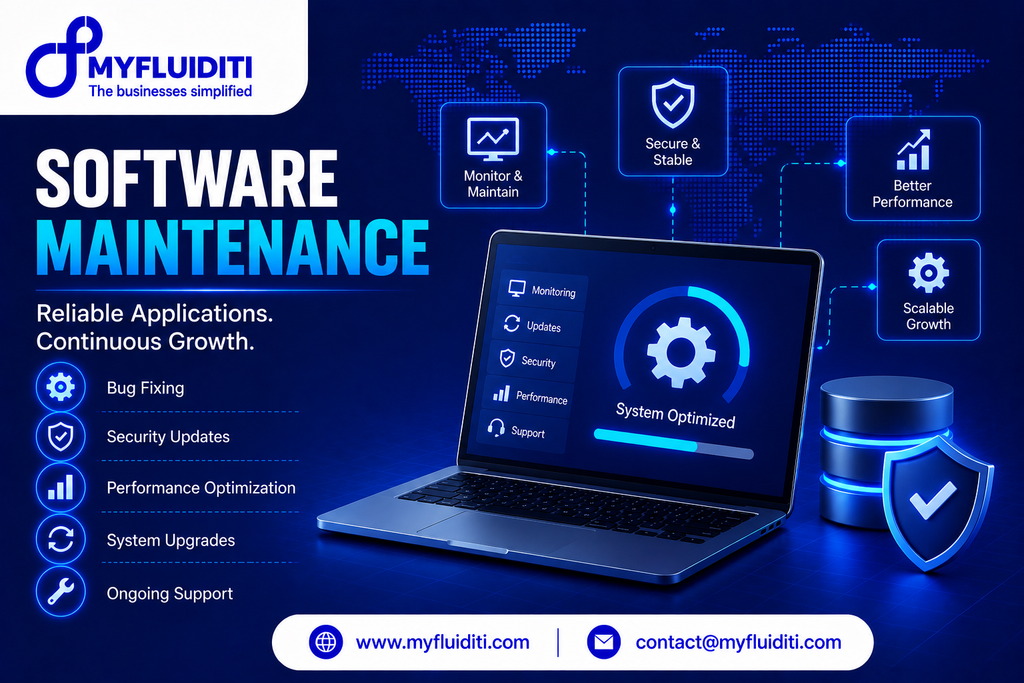
Introduction to Software Maintenance Software applications require continuous attention after development and deployment to remain secure, stable, efficient, and aligned with changing business requirements. As applications grow, organizations may encounter performance issues, software bugs, security vulnerabilities, outdated technologies, integration challenges, and evolving user expectations. Software maintenance services help businesses keep their digital applications operational while continuously improving functionality, performance, security, and scalability. MyFluiditi helps organizations maintain and optimize their software applications through structured monitoring, technical support, bug fixing, performance improvements, system upgrades, and ongoing development. Modern Software Maintenance for Business Continuity A software product is not complete simply because it has been successfully launched. Business applications need regular updates and improvements to remain compatible with operating systems, browsers, APIs, cloud environments, databases, and third-party technologies. Software maintenance and support help organizations reduce downtime, resolve technical problems, and maintain dependable application performance. MyFluiditi provides continuous support to help businesses protect their software investments and keep their applications aligned with evolving operational requirements. Application Maintenance Services Applications can experience technical issues at different stages of their lifecycle, from minor bugs to complex performance problems. Application maintenance services focus on identifying, resolving, and preventing issues that affect functionality or user experience. MyFluiditi supports web applications, mobile applications, enterprise software, SaaS platforms, and custom business applications with structured maintenance processes designed around system stability and long-term reliability. Corrective Software Maintenance Software bugs can affect application functionality, user experience, data integrity, and business operations. Corrective maintenance focuses on identifying and fixing defects discovered after deployment. MyFluiditi analyzes reported issues, identifies their root causes, implements appropriate fixes, and validates the application through testing to reduce the possibility of recurring problems. This approach helps businesses maintain stable applications without interrupting critical workflows unnecessarily. Preventive Software Maintenance Preventive maintenance focuses on reducing the likelihood of future software problems before they significantly affect business operations. Preventive software maintenance can include code improvements, dependency updates, architecture reviews, security updates, database optimization, technical debt reduction, and system monitoring. MyFluiditi proactively evaluates applications to identify potential risks and improvement opportunities, helping businesses create more maintainable and dependable software environments. Adaptive Software Maintenance Business technology environments constantly change as organizations adopt new operating systems, browsers, APIs, cloud platforms, hardware, and third-party services. Adaptive software maintenance ensures applications continue to function effectively when their surrounding technology environment changes. MyFluiditi updates application components, integrations, configurations, and technical dependencies so businesses can adapt to technological changes without completely rebuilding their existing software. Perfective Software Maintenance As businesses grow, their customers and employees often request new capabilities or improvements to existing functionality. Perfective maintenance focuses on enhancing software based on changing user expectations and business requirements. MyFluiditi improves application features, workflows, usability, interfaces, and functionality to help organizations continuously evolve their digital products while preserving the stability of the existing system. Software Bug Fixing and Troubleshooting Unexpected errors can slow down business processes and negatively affect customer experiences. Software bug fixing services focus on diagnosing application errors, identifying root causes, implementing solutions, and validating fixes across relevant environments. MyFluiditi uses structured troubleshooting methods to address frontend, backend, database, API, integration, and infrastructure-related issues while maintaining the overall integrity of the application. Software Performance Optimization Application performance directly influences user satisfaction and operational productivity. Slow page loads, inefficient queries, memory issues, and poorly optimized APIs can affect the overall performance of a digital product. Software performance optimization focuses on improving application response times, database efficiency, API performance, resource utilization, caching, architecture, and infrastructure. MyFluiditi analyzes application performance and implements targeted improvements to create faster and more responsive software. Legacy Software Maintenance Many businesses continue to rely on legacy applications because they support critical operational processes. However, older software can become difficult to maintain as technologies, dependencies, and infrastructure evolve. Legacy software maintenance helps organizations stabilize and modernize existing applications without immediately replacing their entire technology stack. MyFluiditi assesses legacy systems, identifies technical risks, improves maintainability, updates components where appropriate, and supports gradual modernization strategies. Software Modernization and Upgrades Legacy applications may eventually require significant technology upgrades to remain competitive and secure. Software modernization services help businesses migrate outdated architectures, frameworks, libraries, databases, and integrations toward more current technologies. MyFluiditi develops modernization strategies based on business priorities, system complexity, technical debt, and future scalability requirements, helping organizations improve their technology foundation while minimizing operational disruption. Cloud Application Maintenance Cloud-based applications require continuous monitoring and optimization to maintain performance, security, availability, and cost efficiency. Cloud application maintenance can involve infrastructure monitoring, configuration updates, resource optimization, application updates, database management, and cloud service integration. MyFluiditi supports cloud applications and helps organizations maintain reliable digital environments as usage patterns and business requirements evolve. Web Application Maintenance Business websites and web applications depend on multiple frontend, backend, database, API, and infrastructure components. Web application maintenance services help organizations maintain functionality, compatibility, security, and performance across changing browsers and devices. MyFluiditi provides ongoing support for custom web applications, business portals, SaaS platforms, eCommerce systems, and other web-based products. Mobile Application Maintenance Mobile applications require ongoing updates because operating systems, device capabilities, SDKs, APIs, and app-store requirements continue to evolve. Mobile app maintenance services help businesses maintain application compatibility while fixing bugs, improving performance, enhancing features, and supporting new operating system versions. MyFluiditi provides continuous maintenance for Android and iOS applications while helping businesses deliver consistent mobile experiences. SaaS Application Maintenance Software-as-a-Service platforms require high availability, scalable architecture, continuous updates, security improvements, and reliable integrations. SaaS maintenance services help product companies manage application performance, user-facing issues, infrastructure requirements, database efficiency, third-party integrations, and feature improvements. MyFluiditi supports SaaS businesses with ongoing engineering and maintenance capabilities designed to keep their platforms reliable as customer usage grows. API Maintenance and Integration Support Modern applications depend heavily on APIs to communicate with internal systems, third-party services, payment platforms, CRM software, ERP systems, analytics tools, and other technologies. Changes to external APIs can unexpectedly affect application functionality. API maintenance services help businesses monitor integrations, update endpoints, resolve communication issues, improve security, and maintain compatibility. MyFluiditi manages API integrations