Grocery Delivery App Development: Building Scalable On-Demand Grocery Delivery Solutions
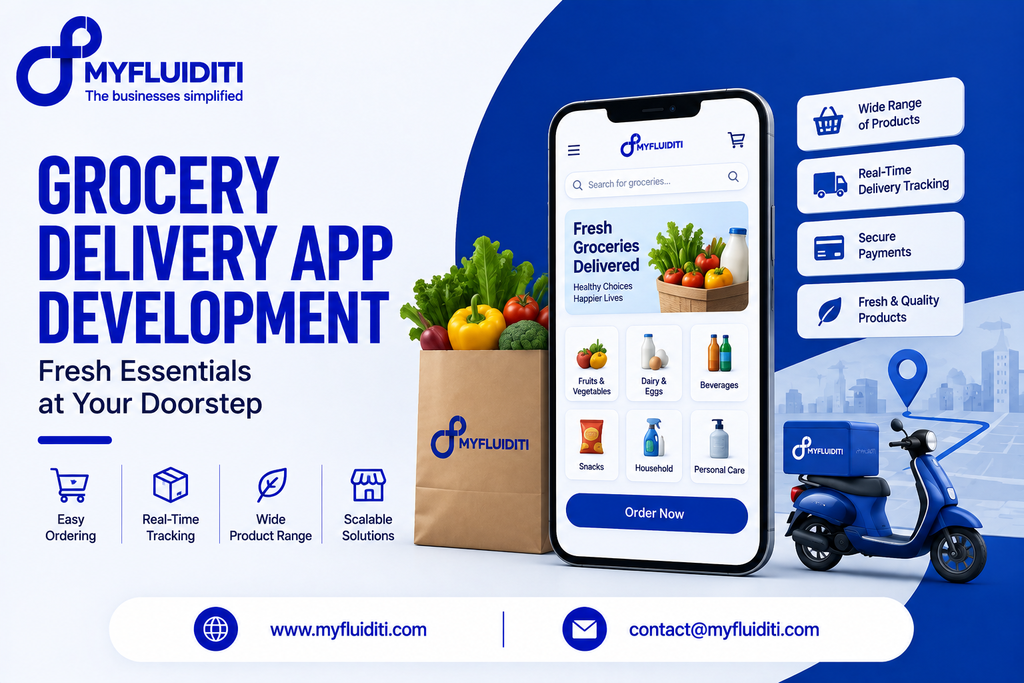
Introduction to Grocery Delivery App Development The grocery industry is rapidly adopting digital platforms as customers increasingly prefer convenient ways to search for products, place orders, make online payments, and receive groceries at their doorstep. A modern grocery delivery app connects customers, grocery stores, delivery partners, and administrators through a single digital ecosystem. For businesses entering the on-demand grocery market, a reliable and scalable grocery delivery platform can simplify operations while creating a convenient shopping experience. MyFluiditi develops custom grocery delivery solutions that combine web applications, mobile applications, backend systems, payment integration, inventory management, order management, and real-time delivery capabilities. What Is a Grocery Delivery App? A grocery delivery application is an on-demand eCommerce platform that enables customers to browse grocery products, add items to a cart, place orders, complete online payments, and track deliveries. Behind the customer-facing application, the platform typically includes grocery store management, product management, inventory management, order processing, delivery management, payment processing, notifications, and administrative dashboards. MyFluiditi designs grocery delivery software around the specific business model, whether the requirement is for a single grocery store, supermarket chain, multi-vendor marketplace, or dedicated grocery delivery startup. Why Businesses Need Grocery Delivery Solutions Traditional grocery shopping can involve travel, waiting in queues, limited store hours, and difficulty comparing products. An online grocery delivery platform provides customers with a digital alternative that allows them to shop from anywhere. For businesses, grocery delivery software can create additional digital sales channels while providing centralized control over products, orders, customers, delivery operations, and business analytics. MyFluiditi helps businesses transform grocery operations into connected digital platforms with scalable architecture and features designed around customer convenience and operational efficiency. Custom Grocery Delivery App Development Every grocery business has different product categories, delivery areas, pricing models, inventory processes, and operational requirements. A ready-made application may not provide the flexibility required to support these differences. Custom grocery delivery app development allows businesses to build functionality around their specific workflows and business objectives. MyFluiditi analyzes the business model, target customers, delivery operations, product structure, payment requirements, and third-party integrations before designing the application architecture. This approach helps create a grocery delivery solution that can evolve as the business expands. Customer Grocery Shopping Experience The customer application is one of the most important components of a grocery delivery platform. Customers should be able to search products, browse categories, view product details, compare prices, manage their shopping cart, select delivery preferences, and place orders through a convenient digital experience. Grocery shopping app development can also include personalized recommendations, saved addresses, favorite products, promotional offers, order history, and real-time notifications. MyFluiditi focuses on developing intuitive customer applications that simplify the complete journey from product discovery to successful delivery. Grocery Store and Vendor Management For multi-vendor grocery marketplaces, store and vendor management is essential for controlling multiple sellers from a centralized platform. Multi-vendor grocery delivery software can allow vendors to manage product catalogs, prices, inventory, orders, store information, promotions, and availability. Administrators can manage vendors, monitor transactions, manage commissions, and oversee platform operations. MyFluiditi can develop customized vendor management functionality that connects grocery stores with customers and delivery partners through a unified digital marketplace. Grocery Product and Inventory Management Accurate product and inventory information is essential for a successful grocery delivery application. Customers need to know whether products are available before placing orders, while businesses need visibility into stock levels and product movement. Grocery inventory management software can connect product catalogs, stock information, orders, purchasing workflows, and store operations. MyFluiditi can integrate inventory management capabilities into grocery delivery platforms to help businesses maintain more accurate product information and streamline inventory-related operations. Online Grocery Ordering System An efficient ordering system allows customers to move from product selection to checkout with minimal friction. A modern online grocery ordering system can support shopping carts, product quantities, delivery addresses, order summaries, discount codes, delivery charges, payment options, order confirmation, and order history. MyFluiditi develops flexible ordering workflows based on the requirements of the grocery business, while ensuring the backend can process and manage orders efficiently as transaction volumes increase. Grocery Delivery Management Managing delivery operations becomes increasingly complex as order volumes and delivery locations increase. Grocery delivery management software can help businesses assign orders to delivery partners, monitor delivery status, manage delivery zones, and provide customers with order updates. Real-time location and mapping integrations can further improve visibility throughout the delivery process. MyFluiditi develops delivery management functionality that connects customers, stores, administrators, and delivery partners, creating a coordinated on-demand delivery ecosystem. Real-Time Grocery Order Tracking Customers increasingly expect visibility after placing an online order. Real-time order tracking can provide updates about order confirmation, preparation, pickup, delivery assignment, and delivery progress. Location-based services and mapping APIs can be integrated into the platform to provide delivery status and location information. MyFluiditi can incorporate real-time tracking capabilities into grocery delivery applications to improve transparency and provide customers with timely information about their orders. Secure Payment Gateway Integration Online grocery platforms need secure and convenient payment options to support different customer preferences. Payment gateway integration can enable customers to complete transactions using cards, digital wallets, online banking, and other supported payment methods. Payment systems can also be connected with order management and transaction records to create a seamless checkout process. MyFluiditi integrates secure payment solutions into grocery delivery applications while designing the payment workflow around the business model and target market. Grocery Delivery Mobile App Development Mobile applications provide customers and delivery partners with convenient access to grocery delivery services. A grocery delivery mobile app can be developed for Android, iOS, or cross-platform environments depending on the project requirements. Customer apps can support product browsing, ordering, payments, tracking, and notifications, while delivery partner applications can provide order assignments, navigation, delivery status updates, and earnings information. MyFluiditi develops mobile applications that connect with secure backend APIs and centralized databases to provide consistent functionality across the grocery delivery ecosystem. Admin Dashboard for Grocery Delivery Platforms A centralized administration panel gives businesses visibility and control over their grocery delivery operations. Grocery delivery
NLP Development Services: Building Intelligent Language Solutions for Modern Businesses
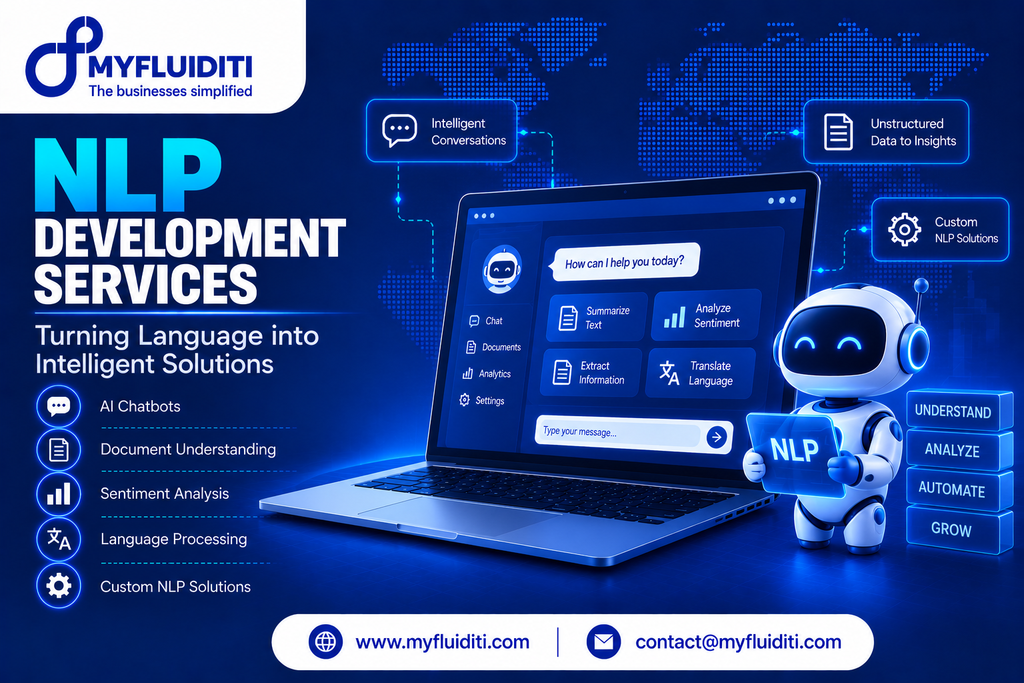
Introduction to NLP Development Services Businesses today generate enormous amounts of unstructured data through emails, customer conversations, documents, reviews, social media, support tickets, voice interactions, and digital communication. Traditional software systems often struggle to understand this information because it is created in natural human language. Natural Language Processing (NLP) enables computers to understand, process, analyze, and generate human language, making it an important technology for modern artificial intelligence applications. From intelligent chatbots and virtual assistants to sentiment analysis, document processing, text analytics, and conversational AI, NLP development services help organizations transform unstructured language data into actionable information. MyFluiditi provides custom NLP development services designed to help businesses integrate intelligent language capabilities into applications, enterprise platforms, and digital workflows. What Is Natural Language Processing? Natural Language Processing is a branch of artificial intelligence that enables machines to interpret and work with human language in text and speech formats. NLP technology combines artificial intelligence, machine learning, computational linguistics, and language models to process information and understand the meaning, context, intent, and relationships within language. NLP software development can include capabilities such as text classification, named entity recognition, sentiment analysis, language translation, speech recognition, question answering, document understanding, summarization, and conversational AI. MyFluiditi uses modern AI technologies to develop NLP solutions that are aligned with specific business use cases and operational requirements. Why Businesses Need NLP Solutions Organizations across industries interact with customers, employees, suppliers, and partners through large volumes of text and voice data. Manually analyzing this information can be time-consuming and difficult to scale. NLP solutions can automate language-based tasks, extract valuable information from unstructured data, improve customer interactions, and support faster decision-making. Businesses can use NLP to analyze customer feedback, classify support requests, extract information from documents, automate responses, search large knowledge bases, and identify patterns in communication. MyFluiditi helps organizations identify practical NLP use cases and integrate language intelligence into existing business applications. Custom NLP Software Development Every business has different data sources, workflows, terminology, users, and objectives. Generic NLP applications may not always understand industry-specific language or organizational requirements. Custom NLP software development allows businesses to create solutions trained, configured, or integrated around their specific use cases. MyFluiditi begins by understanding the business problem, data environment, expected outcomes, and technical requirements before selecting suitable NLP models, frameworks, APIs, and architectures. This helps create customized NLP applications that can integrate into existing software systems while supporting future scalability. NLP Chatbot Development AI-powered chatbots have become an important application of natural language processing. Traditional rule-based chatbots often depend on predefined questions and responses, while modern NLP chatbots can understand user intent, conversational context, and natural language variations. Businesses can use intelligent chatbots for customer support, sales assistance, employee help desks, product information, appointment management, and internal knowledge access. MyFluiditi develops conversational AI solutions that combine NLP, machine learning, LLMs, and enterprise integrations to create more intelligent and responsive chatbot experiences. Conversational AI Development Conversational AI enables software applications to interact with users through natural language conversations. Conversational AI development can combine NLP, speech recognition, machine learning, Generative AI, and large language models to create intelligent digital assistants and automated support systems. These solutions can understand user questions, identify intent, retrieve relevant information, and generate context-aware responses. MyFluiditi helps businesses build conversational AI applications that can be integrated with websites, mobile applications, enterprise systems, customer support platforms, and internal business tools. NLP and Large Language Models The development of Large Language Models (LLMs) has significantly expanded the capabilities of natural language processing. LLMs can process large amounts of text and support applications such as content generation, summarization, question answering, document analysis, conversational assistants, and knowledge retrieval. MyFluiditi integrates modern LLM technologies into business applications where they can provide practical value. Depending on the requirements, NLP development can incorporate LLM APIs, open-source language models, prompt engineering, model orchestration, retrieval systems, and enterprise data sources. Generative AI and NLP Development Generative AI has introduced new possibilities for language-based software development. Generative AI solutions can generate natural language responses, summarize documents, create content, answer questions, transform information, and support intelligent automation. When combined with NLP capabilities, Generative AI can provide businesses with more flexible language-processing systems. MyFluiditi works with AI, NLP, LLM, and Generative AI technologies to develop intelligent applications that can automate language-heavy workflows while maintaining appropriate controls around business data and application access. Retrieval-Augmented Generation for NLP Applications Enterprise applications often need AI systems to answer questions using specific business documents and knowledge rather than relying only on general model knowledge. Retrieval-Augmented Generation (RAG) can connect language models with external knowledge sources, allowing relevant information to be retrieved before generating a response. RAG-based NLP solutions can be used for enterprise knowledge assistants, document search, customer support, technical documentation, internal help desks, and information retrieval. MyFluiditi can develop RAG-powered applications that connect LLMs with organizational knowledge bases, databases, documents, and other approved information sources. Text Analytics and NLP Development Businesses generate valuable insights through customer reviews, emails, surveys, social media conversations, support tickets, and other text-based information. NLP text analytics can process large volumes of text and identify patterns, topics, keywords, entities, relationships, and sentiment. Text analytics solutions can help organizations understand customer opinions, classify documents, identify recurring issues, and monitor communication trends. MyFluiditi develops customized text analytics solutions that transform unstructured language data into structured information that businesses can use for analysis and decision-making. Sentiment Analysis Solutions Understanding how customers feel about products, services, brands, or experiences can provide valuable business insights. Sentiment analysis uses NLP and machine learning techniques to classify text based on emotional tone or sentiment. Organizations can apply sentiment analysis to customer reviews, surveys, social media comments, support conversations, and feedback forms. MyFluiditi can integrate sentiment analysis capabilities into customer experience platforms, analytics applications, social listening systems, and business intelligence solutions to help organizations process customer feedback at scale. Document Processing and Information Extraction Businesses process large numbers of contracts, invoices, reports, forms, applications, emails, and other documents every day. Manually extracting information from these documents can
ERP Development: Custom ERP Software Solutions for Scalable Business Growth
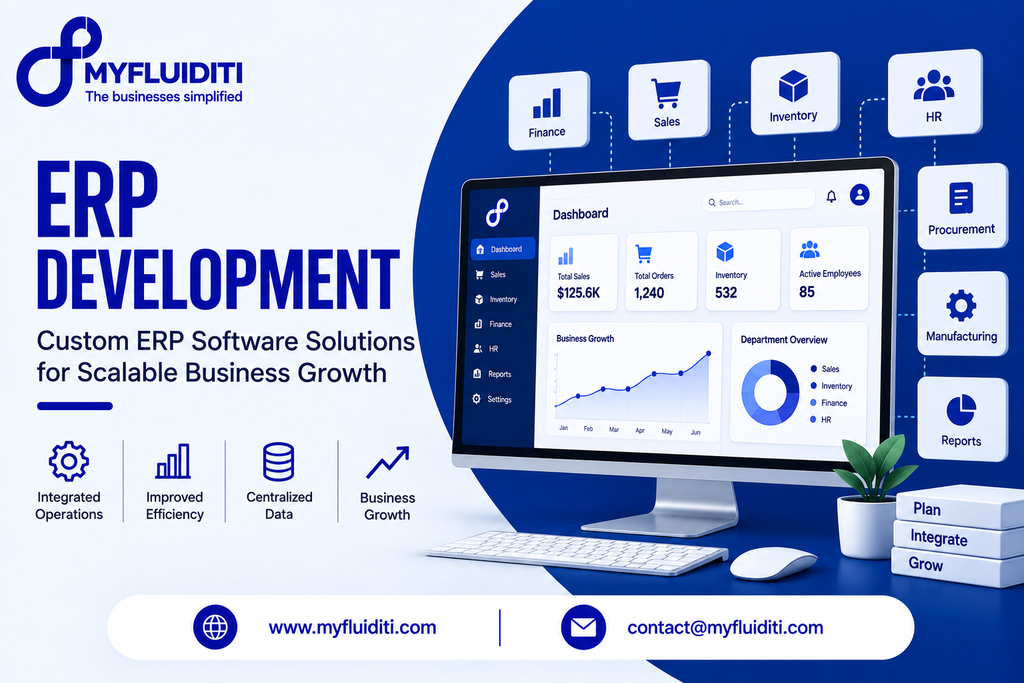
Introduction to ERP Development Modern businesses manage complex operations across finance, sales, procurement, inventory, human resources, customer management, supply chain, and reporting. When these functions operate through disconnected applications and manual processes, businesses can face data duplication, operational delays, limited visibility, and inefficient decision-making. ERP development provides a centralized approach to managing these business functions through an integrated enterprise resource planning platform. With a well-designed ERP system, organizations can connect departments, centralize business data, automate workflows, improve operational visibility, and create a scalable technology foundation for long-term growth. MyFluiditi provides custom ERP software development services designed around specific business workflows, operational requirements, integrations, and growth objectives. What Is ERP Software Development? ERP software development is the process of designing, developing, integrating, deploying, and maintaining an enterprise resource planning system that connects multiple business operations through a centralized software platform. A modern ERP software solution can bring together finance and accounting, inventory management, procurement, sales management, CRM, human resources, payroll, manufacturing, supply chain management, project management, reporting, and workflow automation. Instead of maintaining separate systems for different departments, an integrated ERP platform allows authorized users to work with connected business information. Custom ERP development becomes particularly valuable when an organization’s workflows, reporting requirements, approval processes, or integrations require functionality beyond what standard software can provide. Custom ERP Development for Unique Business Requirements Every organization has different processes, structures, users, approval workflows, reporting requirements, and operational challenges. Custom ERP development allows businesses to create an enterprise software solution around their actual business processes rather than forcing their teams to completely change their existing workflows. MyFluiditi begins ERP projects by understanding the organization’s requirements, identifying process gaps, studying existing systems, and defining the appropriate ERP architecture. This approach helps create customized ERP modules, workflows, dashboards, integrations, and user experiences that align with the organization’s business model and future expansion plans. Why Businesses Need ERP Solutions As businesses grow, managing operations through spreadsheets, disconnected applications, emails, and manual processes can become increasingly difficult. Sales teams may maintain customer information separately, finance teams may use different accounting systems, inventory teams may depend on spreadsheets, and management may need to collect information from several sources before preparing reports. Enterprise resource planning software connects these functions through centralized data and integrated workflows. This can help organizations reduce duplicate data entry, improve information accessibility, streamline business processes, and create better visibility across departments. A properly planned ERP system can also provide a foundation for business process automation and data-driven decision-making. ERP Modules and Business Management A comprehensive ERP solution can include multiple interconnected modules based on the organization’s operational requirements. ERP modules can support finance and accounting, inventory and warehouse management, procurement and purchasing, sales and order management, CRM, human resources, payroll, manufacturing, supply chain operations, project management, customer service, reporting, and business intelligence. Instead of developing every module unnecessarily, MyFluiditi focuses on identifying the functionality that provides value to each business. This modular approach allows organizations to begin with critical ERP functionality and expand their enterprise software platform as their operational requirements evolve. Finance and Accounting ERP Solutions Financial management is one of the most important components of an enterprise resource planning system. Finance ERP software can connect accounting workflows with sales, procurement, inventory, invoicing, expenses, payments, and reporting. Centralizing financial information can provide authorized users with better visibility into transactions and business performance. MyFluiditi can develop customized finance and accounting workflows as part of an ERP platform, helping organizations connect financial operations with other departments and reduce dependence on disconnected business applications. Inventory and Warehouse Management ERP Inventory accuracy is essential for businesses involved in manufacturing, distribution, retail, eCommerce, and supply chain operations. Inventory management ERP software can help organizations monitor stock, product movement, purchasing, warehouse operations, reorder requirements, and inventory-related transactions through a centralized system. Connecting inventory data with sales and procurement processes can provide better visibility into stock availability and operational requirements. MyFluiditi develops integrated ERP solutions that can connect inventory and warehouse processes with other business functions, helping organizations create a more coordinated operational environment. Procurement and Supply Chain ERP Development Procurement involves multiple activities, including supplier management, purchase requests, purchase orders, approvals, receiving, and payment-related processes. Procurement ERP software can bring these activities into a structured digital workflow while connecting purchasing information with inventory and finance. For organizations with complex supply chains, ERP integration can also help connect suppliers, logistics systems, inventory platforms, and other enterprise applications. MyFluiditi can design ERP workflows that support procurement automation, approval management, supplier information, purchasing operations, and supply chain visibility. Sales and CRM Integration With ERP Sales and customer information can become more valuable when connected directly with operational and financial systems. ERP CRM integration allows customer information, orders, sales activities, billing, inventory availability, and other business information to work together within an integrated technology environment. Instead of requiring employees to manually transfer information between multiple platforms, API-based integrations can help synchronize data between systems. MyFluiditi develops ERP integrations and enterprise applications that can connect CRM, sales, eCommerce, payment platforms, and other business applications according to specific operational requirements. HR and Payroll ERP Software Human resource operations involve employee information, attendance, leave, payroll workflows, organizational structures, and other administrative processes. An HR ERP system can centralize employee-related information and connect HR operations with the broader enterprise platform. Depending on the business requirements, ERP development can include employee management, attendance workflows, payroll integration, role management, reporting, and approval processes. MyFluiditi can incorporate HR and workforce management functionality into customized ERP solutions when these capabilities are required as part of the organization’s centralized business platform. Cloud ERP Development Cloud computing has transformed enterprise software by providing organizations with flexible infrastructure, remote accessibility, scalable resources, and centralized system management. Cloud ERP development enables businesses to deploy enterprise resource planning applications using modern cloud infrastructure while supporting distributed teams, multiple locations, integrations, and growing data requirements. MyFluiditi can design cloud-ready ERP architectures that support scalability, performance, security, integration, and future modernization. Cloud ERP can also help organizations reduce dependency
Magento Development Services for Scalable, High-Performance and Custom Ecommerce Solutions
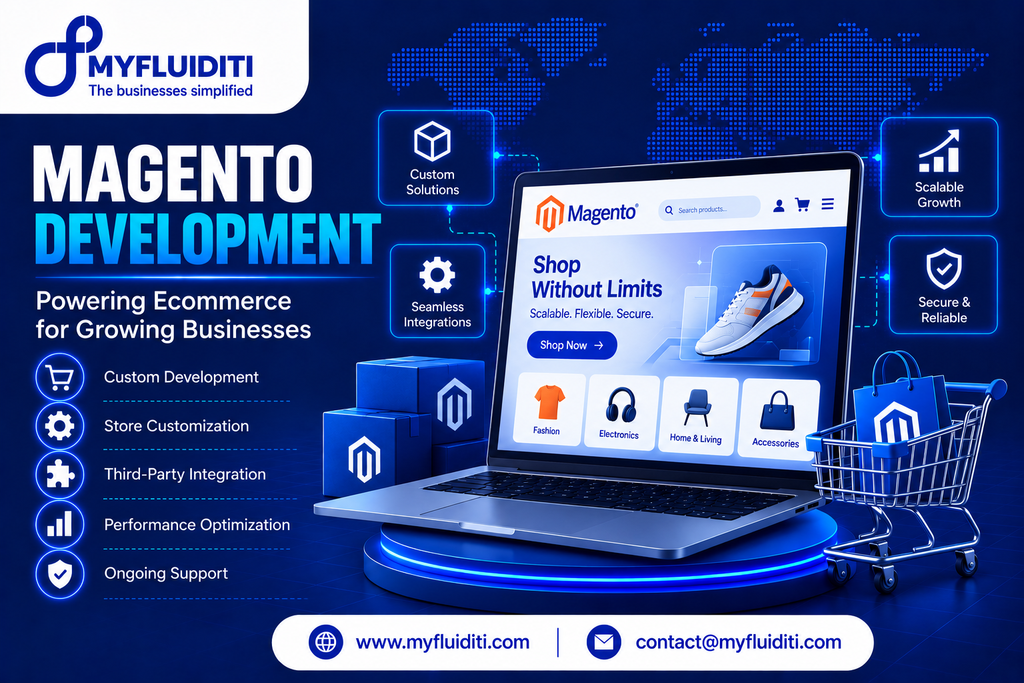
Introduction to Magento Development Ecommerce businesses need a powerful digital platform that can handle growing product catalogs, increasing customer traffic, multiple integrations, and changing business requirements. Magento Development provides a flexible foundation for businesses looking to build, customize, and scale professional ecommerce websites. From creating a new online store to improving an existing ecommerce platform, Magento enables businesses to develop experiences that are aligned with their products, customers, and operational workflows. At MyFluiditi, we help businesses transform their ecommerce requirements into reliable and scalable Magento solutions. Our development approach focuses on building websites that combine functionality, performance, usability, security, and scalability. Whether you are launching a new ecommerce business or upgrading an existing Magento store, our team works around your specific requirements to create a solution that supports long-term digital growth. What Is Magento Development? Magento Development involves designing, developing, customizing, integrating, and maintaining ecommerce websites using the Magento platform and Adobe Commerce ecosystem. It can include storefront development, product catalog management, checkout customization, payment integration, third-party integrations, custom modules, extensions, migration, performance optimization, and ongoing technical improvements. Unlike a basic ecommerce website, Magento can support businesses with complex product structures, large catalogs, customized shopping experiences, and advanced business processes. This makes Magento Ecommerce Development suitable for businesses that require greater control over their online store and want an ecommerce platform that can evolve with their changing requirements. Why Businesses Choose Magento for Ecommerce Modern ecommerce businesses need more than an attractive website. They need a platform that can support customers throughout the complete buying journey, from discovering products to completing payments and receiving orders. Magento provides capabilities that can help businesses manage products, customers, orders, promotions, shopping experiences, and integrations from a centralized ecommerce environment. Magento is also suitable for businesses operating different ecommerce models. Companies selling directly to consumers can use Magento for B2C ecommerce experiences, while organizations serving business customers can build workflows around B2B ecommerce requirements. With the right Magento Development Services, businesses can customize the platform to match their operational processes instead of forcing their business model into a fixed ecommerce structure. Custom Magento Development Solutions Every business has different products, customers, workflows, and technical requirements. Standard ecommerce functionality may not always provide everything a business needs. Custom Magento Development allows companies to extend their ecommerce platform with functionality created specifically for their business requirements. At MyFluiditi, we first understand the existing ecommerce environment and the challenges that need to be addressed. Based on those requirements, our team can develop custom features, storefront functionality, business workflows, modules, and integrations. This approach allows businesses to create a Magento store that reflects their unique requirements while maintaining a scalable technical foundation. Magento Website Development A successful ecommerce website needs to provide a smooth experience across product discovery, navigation, search, product selection, cart management, and checkout. Magento Website Development focuses on creating an ecommerce storefront that combines business functionality with a convenient customer experience. MyFluiditi develops responsive Magento websites that can work across desktops, tablets, and mobile devices. We focus on creating clean navigation, structured product experiences, responsive interfaces, and efficient customer journeys. By combining frontend development with Magento backend capabilities, we help businesses create ecommerce websites that are designed around both customer expectations and business operations. Magento Store Development for Growing Businesses An ecommerce store can become more complex as a business adds products, customers, categories, markets, and sales channels. A development approach that considers future requirements can make it easier to expand the store without repeatedly rebuilding its core functionality. Our Magento Store Development process considers scalability from the beginning. MyFluiditi can help businesses structure product catalogs, develop custom storefront functionality, integrate business systems, and improve existing ecommerce features. This helps create a foundation that can support future changes as the business expands. Magento Integration Services Ecommerce websites often need to work with several systems at the same time. Payment gateways, CRM platforms, ERP systems, inventory applications, shipping platforms, marketing tools, analytics solutions, and customer service systems may all need to exchange information with the ecommerce store. Magento Integration Services help connect these systems so that important information can move between different parts of the business. MyFluiditi works with businesses to understand their existing technology environment and implement integrations according to their requirements. We consider data flow, authentication, business logic, system compatibility, and error handling while developing integration solutions. Magento Extension Development Businesses sometimes require functionality that is not available through their existing Magento installation or available extensions. In such situations, custom extension development can provide a more suitable solution. Magento Extension Development allows businesses to add specialized features while keeping the ecommerce platform aligned with their business processes. At MyFluiditi, we can develop and customize Magento extensions based on specific functional requirements. Our approach focuses on creating maintainable solutions that work with the existing ecommerce environment and can be managed as the business continues to evolve. Magento Migration Services Moving an ecommerce website from another platform or upgrading an existing Magento implementation requires careful planning. Product information, customer accounts, order history, categories, URLs, integrations, extensions, and custom functionality may all need to be considered during the transition. With Magento Migration Services, MyFluiditi helps businesses plan and manage the migration process with a structured approach. We review the existing platform, identify migration requirements, plan the required data movement, address technical compatibility, and test important ecommerce functionality. The goal is to help businesses transition to a Magento environment while minimizing disruption to their online operations. Magento Performance Optimization Ecommerce customers expect websites to respond quickly when browsing products, adding items to their carts, and completing purchases. Performance issues can create friction throughout the shopping journey and may affect the overall user experience. Magento Performance Optimization focuses on identifying technical factors that may affect website speed and efficiency. MyFluiditi can analyze areas such as frontend performance, database operations, application functionality, integrations, caching, and other technical components. By identifying performance bottlenecks and improving the underlying implementation, businesses can create a more responsive ecommerce experience. Magento SEO-Friendly Development Search
Progressive Web App Development: Building Fast, Scalable and Engaging Web Experiences
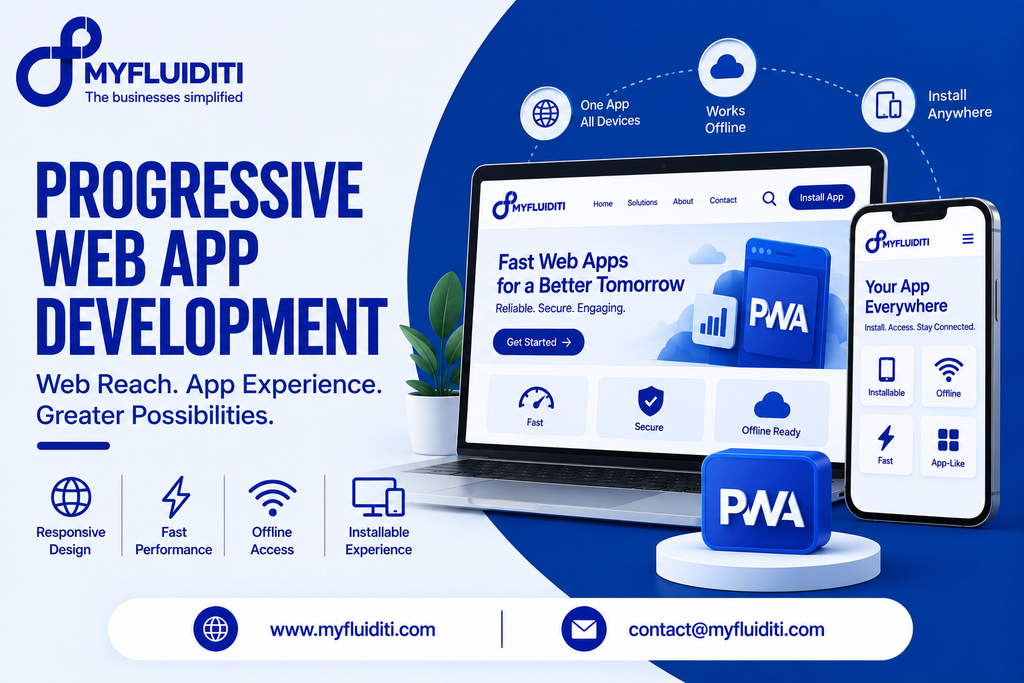
Introduction to Progressive Web App Development In today’s digital-first environment, users expect websites and applications to be fast, responsive, secure, and easy to access from any device. Businesses are therefore looking for modern solutions that combine the reach of a website with the engaging experience of a mobile application. Progressive Web App Development (PWA Development) provides an effective way to achieve this goal by creating web applications that deliver an app-like experience directly through a browser. Progressive Web Apps can be responsive, installable, fast, linkable, and capable of supporting offline experiences depending on their implementation. A Progressive Web App allows businesses to provide customers with a seamless digital experience without requiring users to begin with a traditional app-store download. A well-designed PWA can work across smartphones, tablets, desktops, and other supported devices while maintaining a consistent user experience. For startups, ecommerce companies, SaaS businesses, enterprises, and service providers, PWA development services can provide a scalable approach to delivering modern digital products while maintaining the discoverability and accessibility of the web. What Is a Progressive Web App? A Progressive Web App is a web application built using modern web technologies that can provide functionality commonly associated with mobile applications. Unlike a conventional website, a PWA can support features such as installation on compatible devices, offline experiences, background capabilities, and an app-like interface. At the same time, it remains accessible through a web browser and can use individual URLs for pages and content. The foundation of a PWA commonly includes technologies such as service workers, web app manifests, responsive design, HTTPS, caching strategies, and modern JavaScript frameworks. These technologies work together to improve reliability, performance, and usability. However, simply converting a website into a PWA does not automatically guarantee strong SEO performance. Search-friendly rendering, crawlable content, meaningful URLs, structured content, and performance optimization remain important parts of successful PWA implementation. Why Progressive Web App Development Matters for Businesses Businesses increasingly need digital experiences that work smoothly across different devices and network conditions. Traditional websites may provide reach but can lack some of the engagement characteristics users expect from applications. Native mobile applications can provide rich experiences but require platform-specific development, maintenance, updates, and distribution. Progressive Web App Development offers another approach by combining web accessibility with selected app-like capabilities. With a PWA, users can discover a business through a web search, open the application through a link, interact with responsive interfaces, and, where supported, install the experience for easier future access. This creates a connected journey between search, website engagement, and application-like usage. For businesses focused on customer engagement, ecommerce, SaaS, booking platforms, content platforms, and on-demand services, this approach can help create a more consistent digital presence. Key Features of Progressive Web Apps One of the major characteristics of a PWA is responsive design. A properly developed progressive web application should adapt its layout, navigation, content, and interactions to different screen sizes. This enables users to access the same digital experience through mobile phones, tablets, laptops, and desktop computers. Responsive implementation is especially important because users may interact with the same business through different devices throughout their customer journey. Another important capability is offline and low-connectivity support. Service workers can help manage caching and network requests so that applications can provide useful experiences even when connectivity is limited. Depending on the application’s architecture, selected resources and functionality can remain available without an active internet connection. This can be particularly valuable for businesses whose customers operate in environments with inconsistent network access. Installability is another important part of the PWA experience. A compatible PWA can be installed so users can access it more like an application while still being built on web technologies. PWAs can also use deep links and individual URLs, allowing users to share specific pages and enabling search engines to discover publicly accessible content when the application is properly implemented for crawling and indexing. Progressive Web App Development and SEO PWA SEO is an important consideration when developing a progressive web application. A PWA should not sacrifice search visibility simply because it provides an app-like experience. Search engines need access to meaningful content, crawlable links, stable URLs, and appropriate rendering. JavaScript-heavy applications require careful technical implementation so that important content is available to search engines. At MyFluiditi, we approach PWA development with both user experience and digital visibility in mind. Our development process can incorporate responsive architecture, SEO-friendly page structures, performance optimization, clean URLs, appropriate metadata, and search-accessible content. This helps businesses build a progressive web application that is not only visually engaging but also structured for discoverability. Performance is another important part of modern PWA development services. Fast loading, responsive interactions, optimized assets, effective caching, and efficient code can contribute to a better user experience. Businesses should also evaluate performance using appropriate tools and real-world testing rather than assuming that simply using PWA technology guarantees high performance. Benefits of Custom PWA Development Custom PWA development enables businesses to create applications around their specific workflows, customers, products, and business objectives. Instead of forcing business processes into a generic platform, a custom progressive web application can be designed around the functionality that users actually need. This can include customer portals, ecommerce experiences, booking systems, dashboards, SaaS products, internal business applications, marketplaces, and on-demand platforms. A PWA can also provide a unified development approach for businesses that want to reach users across multiple platforms. Because the application is based on web technologies, businesses can create a common experience across supported browsers and devices instead of maintaining completely separate web experiences for every platform. This can simplify parts of development and maintenance while still allowing progressive enhancement for supported capabilities. How MyFluiditi Approaches Progressive Web App Development At MyFluiditi, we focus on understanding the business requirement before selecting the right application architecture. Our approach starts with understanding the target audience, business objectives, required features, user journeys, performance expectations, integrations, security requirements, and scalability needs. Based on these requirements, we plan a PWA solution that balances functionality, usability, performance, and long-term maintainability.