ML Development Services: Building Intelligent Machine Learning Solutions for Business Growth
Introduction to ML Development Services Businesses generate enormous amounts of data through websites, mobile applications, customer interactions, transactions, enterprise systems, IoT devices, and digital platforms. The real value of this data comes from the ability to analyze it, identify patterns, make predictions, automate decisions, and improve business processes. ML Development Services help organizations transform business data into intelligent solutions that can support prediction, classification, recommendation, automation, anomaly detection, forecasting, and data-driven decision-making. Machine learning development goes beyond creating an experimental model. A successful machine learning solution needs reliable data, appropriate algorithms, model training, validation, deployment, integration, monitoring, and continuous improvement. MyFluiditi helps businesses move from machine learning ideas to practical solutions by combining machine learning engineering, AI development, data engineering, cloud technologies, and software development expertise. What Is Machine Learning Development? Machine learning development is the process of designing, developing, training, testing, deploying, and maintaining machine learning models that solve specific business problems. Instead of relying entirely on predefined rules, machine learning models can learn patterns from historical and real-time data and use those patterns to generate predictions, classifications, recommendations, or other outputs. Machine Learning Development Services can support use cases such as customer churn prediction, demand forecasting, fraud detection, recommendation engines, predictive maintenance, lead scoring, image classification, sentiment analysis, anomaly detection, document classification, and intelligent automation. The appropriate machine learning approach depends on the business objective, available data, model requirements, expected performance, and deployment environment. Custom Machine Learning Solutions Every business has different data, processes, customers, products, and operational challenges. Generic software may not always provide the intelligence required for a specific business problem. Custom Machine Learning Solutions allow organizations to build models around their own data and business objectives. At MyFluiditi, we begin by understanding the business problem before selecting a machine learning approach. Our team evaluates the available data, identifies useful variables, considers the desired prediction or outcome, and defines an appropriate technical strategy. This helps ensure that the ML solution is developed around a meaningful business requirement rather than simply adding machine learning technology without a clear purpose. Machine Learning Consulting Services Before developing a machine learning model, businesses need to understand whether their data and infrastructure are suitable for the intended use case. Machine learning consulting helps organizations identify opportunities, evaluate technical feasibility, understand data requirements, and establish a practical development roadmap. MyFluiditi provides Machine Learning Consulting Services to help businesses identify potential ML use cases and determine how machine learning can fit into their existing technology environment. Our team can assess data readiness, application architecture, integration requirements, scalability considerations, and potential implementation approaches before moving into full-scale development. Machine Learning Model Development Machine learning model development involves selecting algorithms, preparing data, training models, evaluating performance, tuning parameters, and selecting an appropriate model for deployment. The model needs to be tested against relevant datasets and business requirements before being integrated into a production environment. MyFluiditi provides Machine Learning Model Development Services for organizations that need customized predictive and intelligent capabilities. Depending on the use case, our engineers can work with supervised learning, unsupervised learning, deep learning, classification, regression, clustering, recommendation systems, time-series forecasting, and anomaly detection techniques. Supervised Machine Learning Development Supervised learning uses labeled datasets to train models for specific prediction or classification tasks. It can be applied when historical examples are available and the desired outcome is known. MyFluiditi can develop supervised machine learning models for applications such as customer churn prediction, sales forecasting, lead scoring, fraud classification, demand prediction, risk assessment, and other business use cases. The model development process can include data preparation, feature engineering, training, validation, testing, optimization, and production deployment. Unsupervised Machine Learning Development Unsupervised machine learning works with data where predefined labels may not be available. It can help organizations discover hidden patterns, groups, relationships, and unusual behavior within large datasets. Unsupervised Machine Learning Solutions can be useful for customer segmentation, behavioral analysis, clustering, anomaly detection, product grouping, and exploratory data analysis. MyFluiditi can design unsupervised learning solutions based on the structure of the available data and the business questions that need to be answered. Predictive Analytics and Machine Learning Predictive analytics uses historical and current information to estimate potential future outcomes. Machine learning can strengthen predictive analytics by identifying complex relationships and patterns within large datasets. MyFluiditi develops Predictive Analytics Solutions that can help businesses analyze customer behavior, demand patterns, operational data, sales information, financial data, and other business datasets. Predictive models can be integrated into dashboards, applications, APIs, or internal workflows so that predictions become part of everyday decision-making. Machine Learning for Business Intelligence Traditional business intelligence primarily focuses on understanding what has already happened through reports and dashboards. Machine learning can extend this capability by helping organizations estimate what may happen next or identify patterns that require attention. MyFluiditi can combine Machine Learning and Business Intelligence to create intelligent dashboards and analytical systems. Machine learning outputs can be incorporated into reporting environments to provide predictions, classifications, risk indicators, recommendations, and other data-driven insights alongside conventional business metrics. Machine Learning for Predictive Maintenance Unexpected equipment failures can create downtime, operational disruption, and maintenance costs. Machine learning can analyze historical equipment data, sensor information, usage patterns, and operational measurements to identify potential failure patterns. MyFluiditi can develop Predictive Maintenance Solutions using machine learning models that analyze relevant operational data. Depending on the use case, these solutions can support anomaly detection, failure prediction, equipment monitoring, and maintenance planning for industrial and connected systems. Machine Learning for Fraud Detection Fraud detection requires organizations to identify suspicious patterns within large volumes of transactions and activities. Machine learning can analyze historical transaction behavior and identify patterns that may indicate unusual or potentially fraudulent activity. With Machine Learning Fraud Detection, MyFluiditi can develop models that evaluate transaction data, behavioral patterns, risk signals, and other relevant features. These models can be integrated with existing applications and APIs to support automated risk scoring and fraud monitoring workflows. Machine Learning Recommendation Systems Recommendation engines help businesses provide personalized products, services, content, or information based
LMS Development: Building Scalable and Custom Learning Management Systems
Introduction to LMS Development Digital learning has become an important part of education, corporate training, employee development, professional certification, and online skill development. Organizations need reliable digital platforms that can deliver courses, manage learners, track progress, conduct assessments, provide certifications, and generate meaningful learning insights. LMS Development enables organizations to create customized Learning Management Systems that bring these capabilities together within a centralized digital learning environment. A modern Learning Management System is more than a platform for uploading videos and documents. It can connect learners, instructors, administrators, training managers, educational institutions, and business systems through a single platform. MyFluiditi provides LMS Development Services focused on creating scalable, secure, user-friendly, and business-specific learning platforms. Our approach begins with understanding the learning model, target users, content structure, business requirements, integrations, and future growth plans before designing the appropriate LMS architecture. What Is LMS Development? LMS development is the process of designing, developing, deploying, and maintaining a Learning Management System that enables organizations to manage digital learning and training activities. An LMS can provide course management, learner registration, content delivery, assessments, quizzes, assignments, certifications, progress tracking, instructor management, reporting, analytics, and administrative controls within one platform. A custom LMS can be designed according to the specific learning requirements of an organization instead of forcing the organization to adapt its training process to a fixed platform. This makes Custom LMS Development valuable for EdTech companies, universities, schools, coaching institutes, professional training providers, enterprises, and organizations running employee learning and development programs. Custom LMS Development Services Every organization has a different learning model. An EdTech company may need a course marketplace and subscription system, while a corporate organization may require employee onboarding, compliance training, certification tracking, and HR integration. Educational institutions may require student management, instructor dashboards, assignments, examinations, and academic reporting. MyFluiditi develops custom LMS software solutions around these specific requirements. Our team can design the learner experience, instructor workflows, administration modules, course architecture, assessment functionality, reporting system, and integration layer according to the organization’s objectives. This allows the LMS to evolve as the organization’s users, courses, content, and business requirements increase. Learning Management System Software Development Learning Management System software development involves building the technical foundation required to manage digital learning at scale. This includes frontend interfaces, backend application logic, databases, APIs, authentication, content management, analytics, administration systems, and integration capabilities. At MyFluiditi, we focus on developing LMS software that combines usability with scalable architecture. Our engineers consider application performance, user roles, security, data management, responsive design, API communication, and future feature requirements while building the platform. This helps create a learning environment that can support both current training requirements and future expansion. E-Learning Platform Development An LMS is an important part of a broader e-learning ecosystem. E-Learning Platform Development can include course delivery, multimedia learning, virtual classrooms, assessments, certification, communication, learner engagement, analytics, and mobile access. MyFluiditi helps organizations develop e-learning platforms that bring different learning activities into one connected environment. Depending on the requirements, the platform can support video lessons, downloadable resources, assignments, quizzes, examinations, learning paths, instructor interactions, progress tracking, and other digital learning workflows. Online Learning Platform Development The demand for online learning continues to create opportunities for organizations to deliver education and training beyond traditional physical environments. Online Learning Platform Development allows businesses and educational organizations to provide courses to learners across locations and devices. MyFluiditi can develop online learning platforms with responsive web interfaces and mobile-friendly experiences so learners can access their content through desktops, tablets, and smartphones. The platform architecture can also be designed to support increasing numbers of learners, courses, instructors, and learning resources. LMS Course Management Course management is one of the core components of any Learning Management System. Administrators and instructors need to create courses, organize lessons, upload learning materials, define prerequisites, manage enrollment, update content, and monitor learner participation. With LMS Course Management, MyFluiditi can create structured course management functionality that allows administrators and instructors to organize learning content efficiently. Courses can be divided into modules and lessons, while learners can follow defined learning paths based on their enrollment, role, skill level, or training requirements. LMS Content Management An effective learning platform needs a centralized system for managing educational content. Videos, documents, presentations, audio files, assignments, quizzes, downloadable resources, and other learning materials need to be organized in a way that makes content easy to manage and access. MyFluiditi develops LMS Content Management Systems that allow authorized users to create, update, organize, and publish learning resources. Our development approach can also consider content access permissions, course structures, multimedia delivery, content versioning, and integration with external storage or content platforms where required. LMS Student and Learner Management Learner management is essential for understanding who is using the platform, what courses they have enrolled in, how they are progressing, and whether they have completed required learning activities. A centralized learner management system can simplify these processes for administrators and training teams. MyFluiditi can develop LMS Student Management and Learner Management functionality that supports registration, profiles, enrollment, course assignments, learning progress, completion status, certifications, and user activity. Role-based access can ensure that learners, instructors, administrators, and managers receive access to the features relevant to their responsibilities. Instructor and Trainer Management Instructors and trainers require dedicated tools to create courses, manage lessons, evaluate learners, conduct assessments, provide feedback, and monitor class performance. An instructor dashboard can make these activities easier to manage from one location. Our LMS development approach includes Instructor Management and Trainer Management functionality based on the organization’s requirements. MyFluiditi can create instructor dashboards, course authoring interfaces, assignment management, assessment tools, learner communication features, and performance reporting to support educators and training professionals. LMS Assessment and Examination Development Assessments help organizations measure learner understanding and evaluate training outcomes. A modern LMS can support quizzes, examinations, assignments, question banks, automated grading, manual evaluation, time-based tests, and performance analysis. MyFluiditi develops LMS Assessment and Examination Systems that can be customized according to the learning model. Assessment workflows can include different question types, scoring rules, pass
Yii Development: Building High-Performance and Scalable Web Applications
Introduction to Yii Development Businesses today need web applications that are fast, secure, scalable, flexible, and capable of supporting continuously evolving digital requirements. Yii Development provides a powerful approach to building modern PHP web applications with structured architecture, reusable components, efficient database interaction, and performance-focused development. Yii is a high-performance, component-based PHP framework designed for developing web applications and follows the Model-View-Controller architecture, making it suitable for structured and maintainable application development. At MyFluiditi, we provide professional Yii Development Services for businesses looking to build, modernize, customize, integrate, or maintain PHP-based web applications. Our development approach focuses on understanding business requirements first and then designing a Yii application architecture that supports functionality, performance, security, scalability, and long-term maintainability. Whether you need a custom business application, enterprise web application, SaaS platform, eCommerce solution, API backend, or existing Yii application enhancement, our team can help transform your requirements into a reliable digital solution. What Is Yii Development? Yii development refers to the process of creating web applications, business platforms, APIs, portals, and customized software solutions using the Yii PHP framework. Yii is designed around reusable components and MVC architecture, helping developers organize application logic, user interfaces, and data interactions into maintainable structures. Its framework capabilities can support applications ranging from business portals and content management systems to eCommerce platforms and high-traffic web applications. With Yii Web Development, businesses can create customized applications instead of relying entirely on generic software solutions. Developers can build application modules, database-driven functionality, user management systems, APIs, dashboards, integrations, and business workflows according to specific operational requirements. This makes Yii a useful technology for organizations that require custom PHP application development with a focus on performance and extensibility. Why Choose Yii for Web Application Development? Choosing the right framework can influence application performance, development efficiency, scalability, security, and long-term maintenance. Yii is designed as a lightweight, component-based PHP framework with capabilities that support reusable development, caching, database access, validation, authentication, and structured application architecture. These characteristics make Yii Framework Development suitable for many custom web application requirements. For businesses, the value of Yii is not simply the framework itself but how effectively its capabilities are mapped to the application’s requirements. At MyFluiditi, we evaluate the business model, application functionality, data structure, integrations, expected traffic, security requirements, and future roadmap before deciding how Yii should be implemented. This helps us create solutions that are aligned with actual business needs instead of building unnecessary technical complexity. Custom Yii Web Development Every business has different workflows, users, data structures, and operational requirements. Custom Yii Web Development enables businesses to build applications specifically around those requirements. Instead of modifying an off-the-shelf platform that may contain unnecessary features, organizations can create a tailored web application with functionality designed around their business processes. MyFluiditi develops custom Yii applications by translating business requirements into technical architecture, application modules, database structures, user interfaces, APIs, and backend functionality. Our team can build applications from the ground up or extend an existing Yii application based on the current technology environment. The objective is to create a flexible solution that can evolve as the business grows. Yii Web Application Development Yii can be used for developing different types of database-driven and business-focused web applications. Its MVC architecture provides a structured way to separate application logic, presentation, and data-related responsibilities, supporting cleaner development and easier maintenance. Our Yii Web Application Development Services focus on creating applications that are responsive, scalable, secure, and aligned with business workflows. Depending on the project, MyFluiditi can develop customer portals, enterprise applications, business management systems, SaaS platforms, online marketplaces, eCommerce applications, dashboards, internal tools, and other customized PHP web solutions using Yii. Yii MVC Development The Model-View-Controller pattern is an important part of Yii development. MVC separates data and business logic from presentation and request handling, helping developers organize complex web applications into manageable components. This separation can support code reusability, maintainability, and structured application development. At MyFluiditi, we use structured Yii MVC Development practices to organize application functionality according to project requirements. We focus on maintaining clean application architecture so that future developers can understand the codebase, add functionality, troubleshoot issues, and maintain the application more efficiently. Yii PHP Development Services Yii is built for PHP web development, making it relevant for organizations that already operate within a PHP technology environment or require a custom PHP-based application. Yii PHP Development Services can include new application development, customization, API development, database-driven applications, third-party integrations, migration, optimization, and ongoing maintenance. MyFluiditi brings PHP development expertise together with modern software engineering practices to create Yii applications that support both current and future business requirements. Our engineers can work with existing PHP systems or develop new Yii-based applications while considering performance, security, database efficiency, integrations, and scalability. Yii Enterprise Application Development Enterprise applications often require complex business logic, multiple user roles, data management, workflow automation, integrations, reporting, and secure access controls. Yii can support these requirements through its structured framework architecture and reusable components. Yii Enterprise Application Development at MyFluiditi focuses on creating business applications that can handle complex operational requirements. We can develop customized dashboards, workflow systems, administrative platforms, enterprise portals, reporting systems, customer-facing applications, and backend services that connect with other enterprise technologies. Yii eCommerce Development Modern eCommerce platforms require more than product catalogs and shopping carts. They often involve customer management, product management, inventory, order processing, payment gateways, shipping integrations, promotions, analytics, administration, and external APIs. MyFluiditi provides Yii eCommerce Development Services for businesses that require customized online commerce platforms. Our developers can build or enhance product management, shopping workflows, payment integrations, order processing, customer accounts, inventory-related functionality, and administrative dashboards while keeping the application architecture flexible for future expansion. Yii CMS Development Content management systems allow organizations to manage website content, pages, media, users, publishing workflows, and other digital information. Yii’s web development capabilities can be used to create customized CMS solutions when businesses require functionality beyond conventional content management platforms. With Yii CMS Development, MyFluiditi can build customized content management solutions around
Content Marketing Service: Driving Organic Growth, Brand Visibility, and Qualified Leads
Introduction to Content Marketing Service In a digital-first business environment, customers increasingly research products, services, companies, and solutions online before making purchasing decisions. This makes high-quality, relevant, and search-optimized content an important part of a modern digital marketing strategy. A professional content marketing service helps businesses create valuable content that attracts the right audience, answers customer questions, improves search visibility, builds brand authority, and supports lead generation. From SEO blogs and website content to landing pages, thought leadership, social media content, and industry-specific resources, strategic content can create multiple opportunities for businesses to connect with potential customers throughout the buyer journey. MyFluiditi provides content marketing services designed to combine content strategy, SEO, content creation, optimization, and digital distribution to help businesses strengthen their online presence. What Is Content Marketing? Content marketing is a strategic digital marketing approach focused on creating, publishing, optimizing, and distributing valuable content for a clearly defined audience. Unlike promotional advertising that focuses primarily on immediate visibility, content marketing strategy focuses on educating audiences, addressing their problems, answering search queries, building trust, and creating long-term organic visibility. Businesses can use content marketing across blogs, websites, social media, email campaigns, videos, case studies, landing pages, guides, and other digital channels. MyFluiditi develops content strategies around business goals, target audiences, industry topics, search intent, and relevant keywords so every piece of content has a clear purpose. Why Content Marketing Is Important for Businesses Businesses need more than a website to compete in crowded digital markets. They need content that allows potential customers to discover their services through search engines and other online channels. Digital content marketing helps businesses communicate their expertise while creating opportunities to reach users at different stages of the buying process. Informational content can answer early-stage questions, comparison content can support evaluation, and service-focused content can help users understand solutions and take the next step. MyFluiditi helps businesses create connected content ecosystems that support visibility, engagement, authority, and lead generation. SEO Content Marketing for Better Search Visibility Search engine optimization and content marketing work closely together because valuable content needs to be discoverable by the people searching for it. SEO content marketing combines keyword research, search intent analysis, content structure, on-page optimization, internal linking, and high-quality writing to create pages that are useful for both users and search engines. MyFluiditi focuses on identifying relevant search opportunities and developing content around meaningful keyword themes instead of simply inserting keywords into articles. This approach helps create content that can target informational, commercial, and transactional search intent. Keyword Research and Content Strategy Effective content marketing begins with understanding what the target audience is searching for. Keyword research helps identify relevant search terms, questions, topics, long-tail keywords, commercial keywords, and industry-specific phrases that can guide content planning. MyFluiditi analyzes business offerings, target audiences, competitors, search intent, and keyword opportunities to build a content strategy around relevant topics. By connecting primary keywords with related semantic keywords and supporting topics, businesses can create a stronger content structure while addressing a wider range of customer searches. SEO Blog Writing Services Business blogs can become valuable sources of organic traffic when they are planned around real customer questions and search demand. SEO blog writing services focus on creating informative, well-structured, keyword-focused articles that provide useful answers while naturally supporting business objectives. MyFluiditi develops long-form and short-form blog content based on the business industry, target audience, search intent, and content strategy. Blog topics can address industry trends, common customer problems, technical questions, product use cases, solution comparisons, and other subjects relevant to potential customers. Website Content Writing Services Website content plays an important role in communicating what a business offers and why potential customers should consider its solutions. Website content writing includes homepage content, service pages, solution pages, industry pages, about pages, technology pages, landing pages, and other website sections. MyFluiditi creates SEO-friendly website content that combines relevant keywords with clear messaging and business value. The goal is to ensure that website visitors can understand the company’s capabilities while search engines can identify the topics and services represented on each page. B2B Content Marketing B2B customers often conduct extensive research before contacting a technology provider or service company. This makes B2B content marketing valuable for businesses selling software development, IT services, enterprise solutions, AI solutions, cloud services, digital transformation, and other complex offerings. MyFluiditi develops B2B content that addresses technical challenges, business requirements, industry use cases, technology trends, and solution considerations. By creating educational and solution-focused content, businesses can establish stronger digital authority and support prospects throughout longer B2B buying journeys. Content Marketing for Lead Generation Content can support lead generation by attracting users who are actively searching for solutions related to a company’s products or services. Lead generation through content marketing can involve service pages, SEO articles, industry landing pages, case studies, guides, comparison content, and other conversion-focused assets. MyFluiditi connects content strategy with business objectives so content is not created only to generate website traffic. Relevant calls to action, internal links, service information, and conversion opportunities can help move interested visitors from content discovery toward business inquiries. Content Creation for Brand Awareness Consistent, valuable content can help businesses establish visibility within their target markets. Brand awareness content allows companies to communicate expertise, share industry insights, explain complex technologies, and participate in relevant conversations. MyFluiditi creates content that reflects a company’s services, expertise, positioning, and target audience while maintaining consistency across digital channels. Over time, a structured content library can provide businesses with more opportunities to appear in relevant searches and introduce their brand to potential customers. Content Optimization for Search Engines Creating content is only one part of an effective content marketing program. Existing pages often require ongoing content optimization to improve relevance, structure, search intent alignment, internal linking, readability, and keyword coverage. MyFluiditi can optimize existing website pages and articles by identifying content gaps, improving headings, strengthening keyword relevance, adding contextual internal links, updating outdated information, and improving overall page quality. Content optimization helps businesses make better use of existing digital
IT Staff Augmentation Services: Scale Your Technology Team With Skilled IT Professionals
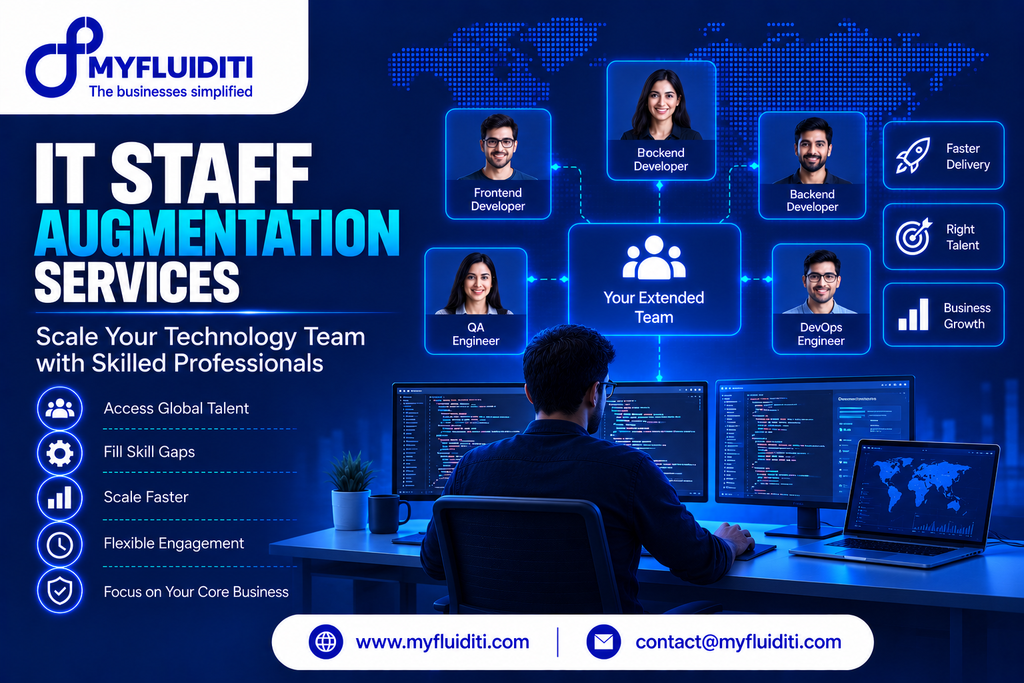
Introduction to IT Staff Augmentation Services Businesses today need to deliver software products faster while adapting to changing technology requirements, project timelines, and customer expectations. However, building a large in-house technology team for every project can be time-consuming and expensive. IT staff augmentation services provide businesses with a flexible way to access skilled technology professionals without going through lengthy traditional hiring processes. Through staff augmentation, companies can add experienced developers, engineers, QA specialists, cloud professionals, AI developers, and other technical experts to their existing teams based on current project requirements. MyFluiditi provides flexible IT staff augmentation solutions that help businesses scale their technical capabilities, fill skill gaps, accelerate software development, and manage changing project demands. What Is IT Staff Augmentation? IT staff augmentation is a technology staffing model in which businesses add external IT professionals to their existing teams for a specific project, technology requirement, or period of time. Unlike traditional outsourcing, the client maintains direct control over project priorities, workflows, communication, and technical decisions while augmented professionals work as an extension of the internal team. IT resource augmentation can be used when a company needs additional software developers, specialized technical expertise, temporary engineering support, or additional development capacity. MyFluiditi helps businesses identify the required technical skills and connect them with suitable professionals who can integrate into existing development environments and workflows. Why Businesses Choose IT Staff Augmentation Technology projects frequently experience changing requirements, tight deadlines, unexpected skill gaps, and increased development workloads. Hiring permanent employees for every short-term requirement may not be practical, while relying entirely on an existing team can create delivery bottlenecks. Staff augmentation services provide businesses with the flexibility to increase or decrease technical resources according to project requirements. MyFluiditi helps organizations access additional technical talent when they need it, allowing internal teams to maintain control while gaining additional development capacity for important projects and initiatives. IT Staff Augmentation vs Traditional Hiring Traditional IT hiring often involves job postings, candidate sourcing, interviews, technical assessments, negotiations, onboarding, and administrative processes. This can take considerable time when businesses urgently need technical resources. IT staff augmentation provides an alternative by allowing businesses to access pre-screened technical professionals according to specific skill requirements. MyFluiditi handles the resource-matching process so businesses can focus on project execution rather than spending extensive time searching for specialized technology talent. This model can be particularly useful for companies that need immediate technical support or temporary expertise. IT Staff Augmentation vs Software Outsourcing IT staff augmentation and software outsourcing are different engagement models. In traditional software outsourcing, an external development company may take responsibility for delivering an entire project or a defined set of deliverables. In staff augmentation, the external professionals become an extension of the client’s existing team and work under the client’s project direction. Developer staff augmentation is therefore useful when businesses want to maintain direct control over development processes while increasing their available technical resources. MyFluiditi supports flexible engagement structures so organizations can select a model that aligns with their project requirements, internal capabilities, and development roadmap. Hire Dedicated Software Developers Businesses often require additional developers with specific technical skills to accelerate application development or support an existing product. Dedicated software developers can work directly with internal engineering teams and contribute to frontend development, backend development, mobile applications, APIs, databases, cloud systems, testing, and other technical requirements. MyFluiditi provides access to developers across modern technology stacks, helping businesses strengthen their development capabilities without needing to build a completely new internal team. Hire Full-Stack Developers Full-stack developers can contribute across both frontend and backend development, making them valuable additions to growing software teams. Full-stack developer staff augmentation can support web application development, API development, database integration, application architecture, and feature development. MyFluiditi can provide developers experienced with technologies such as React, Angular, Node.js, Python, Java, and other modern frameworks based on project requirements. This allows businesses to add development capacity while maintaining alignment with their existing technology stack. Frontend and Backend Developer Augmentation Some projects require additional expertise specifically on the frontend or backend side of development. Frontend developer augmentation can help businesses accelerate interface development, responsive web applications, component development, and user-facing features, while backend developer augmentation can support APIs, databases, business logic, integrations, authentication, and server-side systems. MyFluiditi matches technical professionals according to the specific requirements of each project, helping businesses strengthen individual areas of their software development lifecycle. Mobile App Developer Staff Augmentation Mobile application projects often require specialized knowledge across Android, iOS, cross-platform frameworks, APIs, backend services, and mobile performance optimization. Mobile app staff augmentation allows businesses to add experienced mobile developers to existing teams when additional expertise or development capacity is required. MyFluiditi can provide mobile development resources with experience across technologies such as Flutter, React Native, Android, and iOS, depending on the requirements of the application. AI and Machine Learning Staff Augmentation Artificial intelligence and machine learning projects require specialized technical expertise that may not always exist within traditional software development teams. Businesses working on AI applications may need professionals experienced in Python, machine learning, deep learning, Generative AI, LLMs, RAG, computer vision, NLP, and AI engineering. AI staff augmentation allows organizations to add specialized AI professionals to their teams without making permanent hires for every project. MyFluiditi can help businesses access AI engineers and specialists who can contribute to AI application development, model integration, intelligent automation, and enterprise AI initiatives. Cloud and DevOps Staff Augmentation Modern applications require reliable cloud infrastructure, automated deployment pipelines, monitoring, security, and scalable environments. Cloud and DevOps staff augmentation can help businesses strengthen their infrastructure and deployment capabilities when internal resources are limited. MyFluiditi can provide professionals with experience in cloud platforms, DevOps practices, CI/CD, containers, infrastructure automation, monitoring, and deployment workflows. These resources can work alongside existing engineering teams to support cloud migration, application deployment, infrastructure management, and continuous delivery. QA and Testing Staff Augmentation Software quality is critical for applications that need to provide reliable customer experiences. When development workloads increase, internal QA teams may need additional resources to