Introduction
Automation has evolved significantly over the past decade. What began as simple task automation has now transformed into intelligent, adaptive systems capable of making decisions in real time.
Businesses today are no longer asking whether to automate; they are asking how to automate at scale, intelligently, and sustainably.
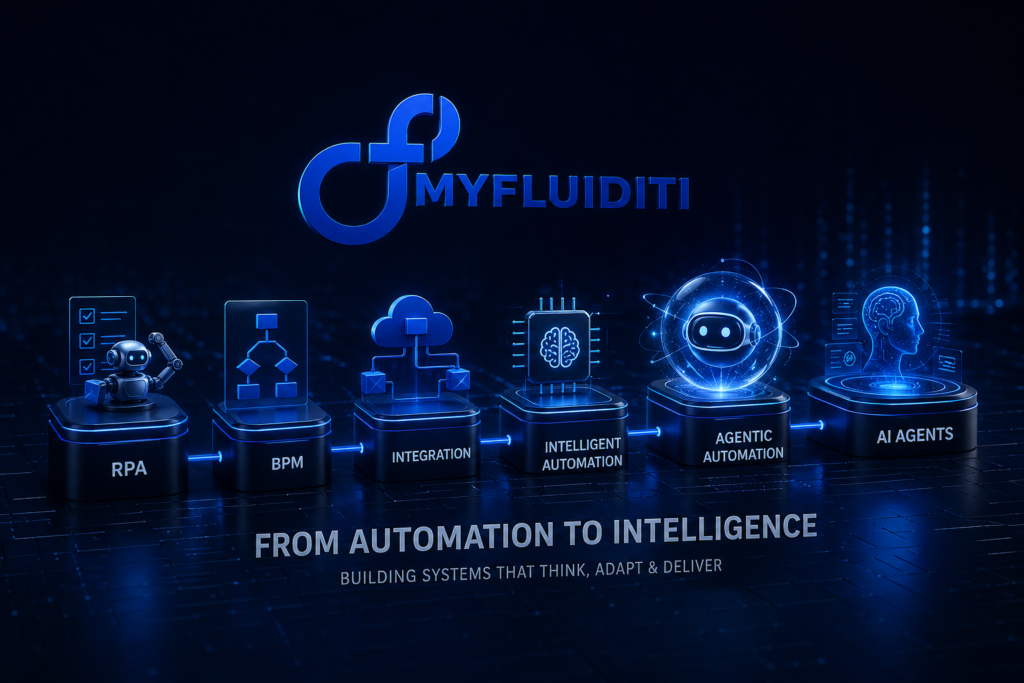
At MyFluiditi, we see automation not as a collection of tools, but as a connected system that evolves with business needs. From foundational technologies like RPA and BPM to the emergence of AI Agents, the journey of automation is now entering a new phase, one defined by intelligence, adaptability, and system-level thinking.
Understanding the Foundations of Modern Automation
Before exploring where automation is going, it’s important to understand where it started. Modern automation is built on several key components that continue to play a role even today.
Robotic Process Automation (RPA)
RPA was the first major step toward automation at scale. It uses software bots to handle repetitive, rule-based tasks such as data entry, invoice processing, and system updates. These bots mimic human interactions with systems, reducing manual effort and improving efficiency.
While RPA delivers quick wins, it operates best in structured environments. At MyFluiditi, we use RPA as a foundational layer, but never as a standalone solution.
Business Process Management (BPM)
BPM focuses on designing and optimizing entire workflows rather than individual tasks. It ensures that processes are structured, compliant, and efficient across departments.
This is where many organizations begin to see the bigger picture. However, without integration and intelligence, BPM alone cannot handle dynamic business environments.
At MyFluiditi, BPM is integrated into end-to-end system design, ensuring workflows are not just defined but continuously improved.
Integration and Connectivity (ESB & iPaaS)
Automation cannot succeed without connectivity. Systems need to communicate seamlessly across platforms such as CRM, ERP, and cloud services.
Technologies like ESB and iPaaS enable this by ensuring secure, real-time data flow between systems.
MyFluiditi emphasizes this layer heavily because disconnected systems are the root cause of most inefficiencies in modern businesses.
Intelligent Automation (IA)
As automation matured, artificial intelligence was introduced to handle more complex tasks. Intelligent Automation combines RPA with AI to enable systems to analyze data, understand context, and make decisions.
This marked a shift from rule-based execution to context-aware automation.
At MyFluiditi, this is where automation starts becoming truly valuable when systems can adapt, not just execute.
Digital Process Automation (DPA)
DPA goes beyond automating tasks; it transforms entire processes into fully digital workflows. From onboarding to approvals, everything becomes streamlined and paperless.
This aligns closely with MyFluiditi’s approach of re-engineering processes instead of simply automating them.
The Shift Toward Agentic Process Automation
As businesses scale, traditional automation begins to show limitations. Systems become complex, exceptions increase, and maintaining automation becomes expensive.
This is where Agentic Process Automation (APA) emerges.
APA combines RPA, BPM, AI, and integration into a unified framework that can handle multi-step, cross-functional processes with minimal human intervention.
Instead of executing fixed instructions, systems begin to adapt based on context, data, and outcomes.
At MyFluiditi, this transition is critical. We design automation systems where:
- Processes are interconnected
- Decisions are data-driven
- Exceptions are handled intelligently
This is not just automation, it is orchestrated intelligence.
The Rise of AI Agents
The next evolution in automation is AI Agents, autonomous systems capable of sensing, reasoning, and acting independently.
Unlike traditional automation, AI Agents:
- Understand context
- Learn from outcomes
- Adapt their behavior over time
- Operate across multiple systems without rigid rules
These systems can handle complex workflows such as customer interactions, decision-making processes, and dynamic operations.
They represent a shift from automation of tasks to automation of outcomes.
Why AI Agents Are a Game-Changer
Traditional automation systems are deterministic; they follow predefined rules. This works well for stable environments but breaks down in dynamic scenarios.
AI Agents change this by introducing goal-driven execution.
Instead of asking:
“What steps should the system follow?”
We now ask:
“What outcome should the system achieve?”
AI Agents then determine the best way to achieve that outcome.
This results in:
- Higher accuracy
- Reduced operational costs
- Faster decision-making
- Continuous improvement over time
Research shows that AI-driven automation can significantly reduce exception handling and improve efficiency compared to traditional RPA systems.
How MyFluiditi Helps Businesses Transition to AI-Driven Automation
At MyFluiditi, we don’t just implement automation, we design intelligent systems that evolve with your business.
Our approach includes:
System-First Thinking
We start by understanding the business problem, not the tool. This ensures automation is aligned with real outcomes.
Integrated Architecture
We connect RPA, BPM, AI, and data systems into a single, cohesive ecosystem.
AI-Driven Execution
We embed AI into workflows to enable decision-making, prediction, and adaptability.
Scalable Automation
Our solutions are designed to grow with your business, avoiding the common pitfalls of rigid automation systems.
Continuous Optimization
Automation is not a one-time implementation. We ensure systems learn, improve, and adapt over time.
The Future of Automation Is System-Driven
The future of automation is not about replacing humans, it is about enabling them to focus on higher-value work.
AI Agents, combined with structured automation systems, will redefine how businesses operate.
Organizations that adopt this approach will:
- Scale faster
- Operate more efficiently
- Adapt to change more effectively
- Gain a competitive advantage
At MyFluiditi, we are already building this future where systems, AI, and human intelligence work together seamlessly.
Conclusion
The journey from RPA to AI Agents is not a replacement, it is an evolution.
Each layer of automation still matters, but the real transformation happens when they are connected into a unified, intelligent system.
This is where most businesses struggle and where MyFluiditi makes the difference.
By combining structured systems, AI-driven intelligence, and scalable architecture, MyFluiditi helps organizations move beyond fragmented automation to true digital transformation.The future is not just automated.
It is intelligent, adaptive, and system-driven.