Introduction
In the evolution of electoral systems, Electronic Voting Machines (EVMs) represent a shift from manual, error-prone ballot methods to deterministic, embedded-system-driven voting infrastructure. Designed for accuracy, speed, and operational efficiency, EVMs are widely used in India to ensure reliable vote capture and counting. At MyFluiditi, we studied the architecture and working principles of EVMs from both a hardware engineering and software systems standpoint to understand how such a critical, trust-sensitive system is built and validated.
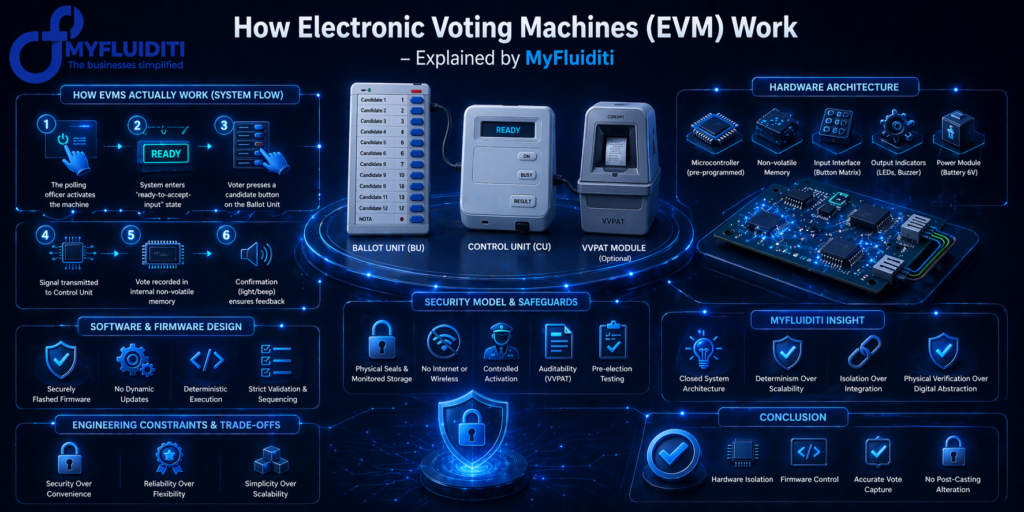
What is an EVM?
An Electronic Voting Machine is a standalone embedded system designed specifically to record votes securely without relying on network connectivity. It primarily consists of two tightly coupled modules:
- Control Unit (CU): Managed by the polling officer, controls the voting process and stores votes
- Ballot Unit (BU): Interface used by voters to cast their vote via buttons
- (Optional) VVPAT Module: Provides a physical audit trail of the vote
These units are connected via a secure cable, ensuring controlled communication between input (voter action) and storage (vote recording).
How EVMs Actually Work (System Flow)
From a systems engineering perspective, the EVM follows a controlled event-driven workflow:
- The polling officer activates the machine via the Control Unit
- The system enters a “ready-to-accept-input” state
- The voter presses a candidate button on the Ballot Unit
- The signal is transmitted to the Control Unit
- The vote is recorded in internal non-volatile memory
- A confirmation (light/beep) ensures user feedback
This process ensures one vote per activation cycle, eliminating duplication or invalid entries.
At MyFluiditi, our analysis highlights that this is essentially a finite state machine (FSM) implementation, where transitions are strictly controlled and externally gated by the polling officer.
Hardware Architecture: How the Board is Built
EVM hardware is not a general-purpose computing system. It is a purpose-built embedded device, optimized for reliability and tamper resistance.
Core hardware components include:
- Microcontroller (pre-programmed, no runtime OS)
- EEPROM / Non-volatile memory for vote storage
- Input interface (button matrix for candidates)
- Output indicators (LEDs, buzzer)
- Power module (battery-operated, typically 6V)
Key engineering decisions observed by MyFluiditi:
- No external network interface → eliminates remote attack vectors
- Limited instruction set firmware → reduces exploit surface
- Physical sealing and isolation → prevents hardware tampering
Additionally, EVMs are designed to function without electricity using battery power, increasing deployment flexibility in remote regions.
Software & Firmware Design
Unlike modern applications, EVMs do not run complex operating systems. Instead, they operate on firmware-level logic embedded into microcontrollers.
Software characteristics:
- One-time programmable or securely flashed firmware
- No dynamic updates during operation
- Deterministic execution (no concurrency, no threads)
- Strict input validation and event sequencing
From MyFluiditi’s research perspective, this resembles safety-critical systems design (similar to avionics or industrial controllers), where:
- Predictability > flexibility
- Isolation > connectivity
- Simplicity > feature richness
Security Model and Safeguards
Security in EVMs is not purely software-based; it is multi-layered across hardware, process, and governance.
Key safeguards include:
- Physical seals and monitored storage
- No internet or wireless communication
- Controlled activation via polling officer
- Auditability through VVPAT (paper trail)
- Pre-election testing and validation procedures
These mechanisms collectively reduce risks such as unauthorized access, duplication of votes, or external manipulation.
MyFluiditi’s evaluation suggests that EVM security relies heavily on “air-gapped architecture + procedural integrity”, rather than cryptographic complexity alone.
Engineering Constraints and Design Trade-offs
Electronic Voting Machines are intentionally designed with strict constraints to maximize reliability and security, which naturally introduces several trade-offs. Instead of using connected or feature-rich systems, EVMs operate as isolated, purpose-built devices. This lack of connectivity significantly enhances security by eliminating remote attack surfaces, but it also means there is no capability for real-time monitoring or remote diagnostics. Similarly, the use of simple, deterministic firmware ensures consistent and predictable behavior, reducing the chances of software failure; however, it limits flexibility for upgrades or feature expansion.
From a hardware and operational standpoint, EVMs rely heavily on physical control mechanisms such as manual activation by polling officers and sealed units to enforce trust. While this strengthens procedural integrity and reduces digital vulnerabilities, it introduces dependency on human processes and strict administrative handling.
In summary, the design philosophy reflects a clear prioritization:
- Security over convenience
- Reliability over flexibility
- Simplicity over scalability
This balance ensures that the system remains robust and trustworthy, even if it sacrifices modern capabilities commonly seen in connected digital systems.
MyFluiditi Insight: Why This Design Still Works
During our research, MyFluiditi observed that EVMs follow a “closed system architecture” model. Unlike modern cloud or distributed systems, they prioritize:
- Determinism over scalability
- Isolation over integration
- Physical verification over digital abstraction
This makes them uniquely robust in environments where trust, auditability, and simplicity are more critical than speed or connectivity.
Conclusion
Electronic Voting Machines are not just devices, they are carefully engineered embedded systems built to operate under strict constraints of security, reliability, and transparency. From hardware-level isolation to firmware-driven control logic, every component is optimized to ensure that each vote is captured accurately and cannot be altered post-casting.
From MyFluiditi’s research standpoint, EVMs demonstrate how well-designed minimal systems can outperform complex architectures in high-stakes environments. As digital systems continue to evolve, the principles behind EVM design simplicity, determinism, and controlled execution remain highly relevant for building secure and trustworthy technology solutions.