Android App Development for Building High-Performance Mobile Experiences
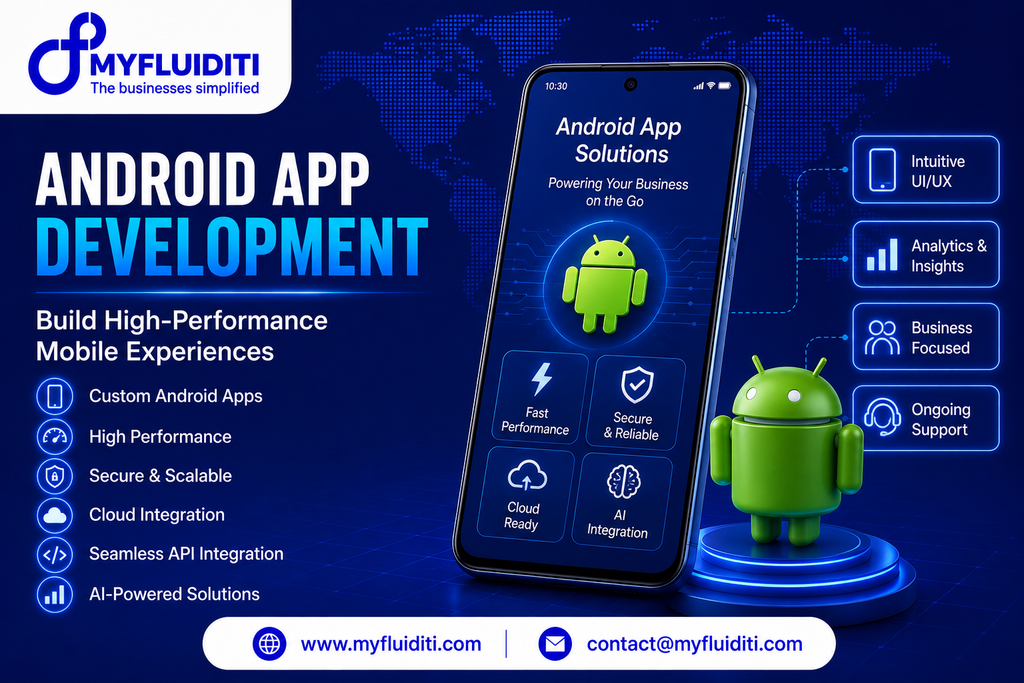
Introduction Mobile applications have become an essential part of modern business strategies, helping organizations connect with customers, deliver services, streamline operations, and create new digital revenue opportunities. With Android powering a vast global mobile ecosystem, businesses have significant opportunities to reach diverse audiences through Android applications. However, a successful Android application requires more than basic functionality. It needs high performance, intuitive UI/UX, scalable architecture, secure data management, seamless integrations, and continuous optimization. At MyFluiditi, we help businesses transform ideas into custom Android applications designed around their users, business objectives, and long-term digital growth requirements. Understanding Android App Development Android app development involves designing, developing, testing, deploying, and maintaining applications for Android-powered devices. Businesses can build Android applications for e-commerce, healthcare, finance, education, logistics, entertainment, social networking, on-demand services, enterprise operations, and SaaS platforms. A custom Android application can be designed around specific workflows, customer requirements, and business models. MyFluiditi works with organizations to understand their application objectives before developing solutions that combine functionality, performance, usability, security, and scalability. Why Businesses Invest in Android Applications Android applications provide businesses with a powerful channel for reaching mobile users and delivering services directly through smartphones and other compatible devices. Companies can use Android applications to improve customer engagement, simplify transactions, provide personalized services, manage operations, and build digital communities. Android mobile app development can also support businesses that need location-based services, real-time communication, mobile commerce, digital payments, or connected enterprise workflows. MyFluiditi helps organizations identify the right mobile strategy and develop Android solutions aligned with their digital transformation goals. Building High-Performance Android Applications Application performance directly influences user satisfaction and engagement. Slow loading times, application crashes, inefficient navigation, and poor responsiveness can negatively affect the overall user experience. High-performance Android development focuses on efficient application architecture, optimized code, responsive interfaces, reliable APIs, and effective data management. MyFluiditi considers performance throughout the development lifecycle, helping businesses create Android applications that remain responsive and reliable as functionality and user activity increase. User-Centric Android UI and UX Design A successful Android application should make it easy for users to understand features and complete tasks. From onboarding and registration to search, payments, communication, and account management, every interaction should be intuitive. Android UI/UX design plays an important role in creating engaging mobile experiences. MyFluiditi combines user experience strategy with mobile application development to create interfaces that are visually consistent, easy to navigate, and aligned with the application’s target audience and business objectives. Custom Android App Development Different businesses require different mobile capabilities. An e-commerce platform may require product catalogs, payments, order tracking, and personalized recommendations, while a logistics application may need real-time location tracking and delivery management. A healthcare application may require appointment scheduling and secure communication. Custom Android app development allows businesses to build functionality around their specific requirements rather than adapting their processes to generic software. MyFluiditi develops customized Android applications designed around individual business workflows and customer journeys. Android Applications with AI Capabilities Artificial Intelligence is transforming mobile applications by enabling more intelligent and personalized experiences. Businesses can integrate AI-powered chatbots, recommendation systems, predictive analytics, natural language processing, intelligent search, and automation into Android applications. AI-powered Android apps can help organizations improve customer interactions and automate selected business processes. MyFluiditi helps businesses identify practical AI opportunities and integrate intelligent capabilities into mobile applications while keeping the technology aligned with business objectives. Secure Android Application Development Mobile applications may process personal information, financial details, business data, account credentials, and other sensitive information. Security therefore needs to be considered throughout the application lifecycle. Secure authentication, authorization, encrypted communication, protected APIs, access controls, and appropriate data management practices can help protect users and businesses. Secure Android app development incorporates security considerations into application architecture, development, testing, and deployment. MyFluiditi follows security-conscious development practices based on the requirements of each application. Backend Development and API Integration Most modern Android applications depend on backend systems to manage users, databases, business logic, transactions, content, and integrations. APIs enable Android applications to communicate with backend services and external platforms such as CRM systems, ERP platforms, payment gateways, cloud services, analytics tools, and other applications. Android API integration creates connected digital experiences by allowing information to move between the mobile application and other business systems. MyFluiditi develops scalable backend architectures and API integrations that support reliable application functionality and business workflows. Cloud-Based Android Applications Cloud technologies provide flexible infrastructure for modern mobile applications. Cloud services can support databases, application APIs, file storage, authentication, notifications, analytics, monitoring, and scalable computing resources. Cloud-based Android development allows businesses to create applications that can accommodate changing workloads and growing user bases. MyFluiditi combines Android development with cloud technologies to create flexible digital ecosystems that can evolve as business requirements increase. Android App Development for Startups Startups often need to validate their ideas quickly while managing development costs and technical complexity. An MVP approach can help businesses launch essential functionality, gather user feedback, and improve their product based on market response. Android MVP development can provide startups with a practical path from concept to initial product launch. MyFluiditi supports businesses through product planning, UI/UX design, agile development, testing, deployment, and scalable architecture, helping startups establish a strong technical foundation for future growth. Android Apps for Enterprise Operations Enterprises increasingly use mobile applications to connect employees, customers, suppliers, and business systems. Android applications can support field operations, inventory management, workforce coordination, customer service, reporting, approvals, and other enterprise workflows. Enterprise Android app development can provide employees and business users with mobile access to important applications and information. MyFluiditi develops enterprise-focused Android solutions that integrate with existing systems and support operational efficiency. Location-Based Android Applications Location-based functionality can support a wide range of mobile business applications, including delivery platforms, taxi booking applications, travel services, retail applications, social platforms, and field-service solutions. GPS and mapping technologies can provide location-aware experiences based on user requirements. Location-based Android app development requires careful consideration of usability, permissions, privacy, and performance. MyFluiditi can integrate appropriate location and mapping capabilities into Android applications based
Salesforce CRM Consulting for Transforming Customer Engagement
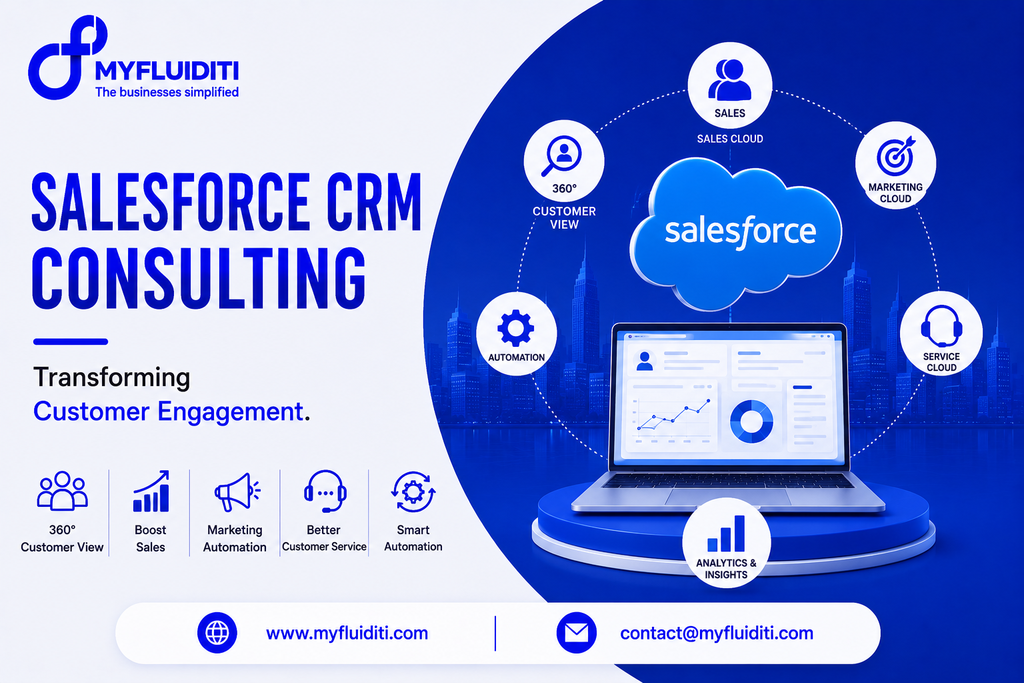
Introduction Customer expectations are evolving rapidly as businesses interact with audiences across websites, mobile applications, social media, email, and other digital channels. Managing these interactions through disconnected systems can make it difficult to understand customer needs, maintain consistent communication, and provide personalized experiences. Salesforce CRM consulting enables businesses to bring customer information, sales processes, marketing activities, service interactions, and analytics into a more connected ecosystem. With the right strategy, Salesforce can become more than a customer relationship management platform; it can serve as a foundation for improving customer engagement and supporting data-driven business growth. At MyFluiditi, we help businesses maximize their Salesforce investment through customized consulting, implementation, integration, automation, and optimization services aligned with their specific business objectives. Understanding Salesforce CRM Consulting Salesforce CRM consulting involves analyzing an organization’s customer management processes and determining how Salesforce capabilities can support business requirements. Consulting can include CRM strategy, business process assessment, Salesforce implementation planning, customization, integration, automation, data migration, user adoption, and ongoing optimization. Salesforce consulting services help organizations create a CRM environment that aligns technology with sales, marketing, customer service, and operational workflows. MyFluiditi works closely with businesses to understand their existing systems, challenges, and growth objectives before developing a Salesforce strategy that fits their digital environment. Why Salesforce CRM Matters for Modern Businesses Businesses interact with customers throughout multiple stages of the customer journey, from initial awareness and lead generation to sales, support, retention, and repeat engagement. Without a centralized CRM strategy, customer information can become fragmented across departments and applications. Salesforce can provide organizations with a connected environment for managing customer relationships and business interactions. MyFluiditi helps businesses leverage Salesforce CRM solutions to improve customer visibility, streamline workflows, and create more consistent experiences across relevant touchpoints. Creating a 360-Degree Customer View One of the major advantages of CRM technology is the ability to bring relevant customer information together. Sales teams, marketing teams, and customer service representatives can use connected information to better understand customer interactions and requirements. A 360-degree customer view can help organizations make customer conversations more informed and personalized. MyFluiditi helps businesses design Salesforce environments that bring relevant customer information together while connecting CRM functionality with existing business systems. Improving Sales Performance with Salesforce Sales teams need efficient tools to manage leads, opportunities, customer information, follow-ups, and sales pipelines. Salesforce can support these activities through structured CRM workflows and automation. Salesforce Sales Cloud consulting can help organizations configure CRM processes around their sales methodology, reporting requirements, and business goals. MyFluiditi helps businesses optimize sales workflows, improve pipeline visibility, automate repetitive tasks, and provide sales teams with better access to relevant customer information. Salesforce for Marketing Automation Marketing teams need to reach customers with relevant messages at the appropriate stages of the customer journey. Salesforce capabilities can support campaign management, customer segmentation, lead nurturing, personalization, and marketing automation. Salesforce Marketing Cloud consulting can help organizations develop connected marketing strategies that use customer data more effectively. MyFluiditi helps businesses align marketing processes with CRM data and customer journeys, enabling more targeted and consistent digital communication. Transforming Customer Service Customer service plays a major role in customer satisfaction and long-term loyalty. Support teams need access to relevant customer information, previous interactions, service requests, and communication history to resolve issues efficiently. Salesforce Service Cloud can support customer service operations by connecting cases, customer information, workflows, and communication channels. MyFluiditi helps businesses implement Salesforce customer service solutions that improve support workflows, streamline case management, and create more connected service experiences. Salesforce CRM Automation Many CRM activities involve repetitive processes such as lead assignment, follow-up reminders, notifications, data updates, approvals, and customer communication. Automating appropriate workflows can reduce manual effort and improve process consistency. Salesforce automation can help organizations streamline routine activities while allowing employees to focus on higher-value customer interactions. MyFluiditi identifies suitable automation opportunities and develops CRM workflows that support operational efficiency without unnecessarily complicating the user experience. Salesforce Integration Services Modern organizations rely on multiple business applications, including ERP platforms, e-commerce systems, marketing tools, payment gateways, customer portals, analytics platforms, and custom applications. Connecting these systems with Salesforce can reduce data silos and create more consistent workflows. Salesforce integration services can use APIs, middleware, and other integration approaches to connect relevant applications. MyFluiditi helps businesses integrate Salesforce with their existing technology ecosystem, enabling information to move efficiently between connected systems. Data Migration and CRM Modernization Organizations moving from legacy CRM systems or disconnected databases may need to migrate customer information into Salesforce. Data migration requires careful planning to maintain data quality, consistency, and usability. Salesforce data migration can involve data assessment, cleansing, mapping, transformation, migration, validation, and post-migration monitoring. MyFluiditi helps businesses plan and execute CRM modernization initiatives while focusing on data accuracy and continuity throughout the transition. Salesforce Customization for Business Requirements Every organization has different customer journeys, sales processes, service workflows, approval structures, and reporting requirements. Standard Salesforce capabilities may need to be configured or extended to support specific business needs. Salesforce customization can include workflows, dashboards, reports, interfaces, business rules, and other platform capabilities. MyFluiditi develops customized Salesforce environments that align with organizational processes while keeping scalability and maintainability in mind. Data-Driven Customer Engagement Customer engagement becomes more effective when businesses understand customer behavior and preferences. Salesforce can provide a foundation for collecting and analyzing relevant customer information across interactions. Organizations can use CRM analytics to evaluate sales performance, customer activity, campaign results, service trends, and other business metrics. MyFluiditi helps businesses implement Salesforce analytics and reporting capabilities that turn CRM information into actionable insights and support data-driven decision-making. AI and Intelligent Salesforce Solutions Artificial Intelligence is increasingly influencing CRM platforms by supporting predictive insights, automation, personalization, conversational experiences, and intelligent recommendations. AI-powered CRM capabilities can help businesses identify patterns, prioritize opportunities, assist service teams, and deliver more personalized customer interactions. MyFluiditi helps organizations explore AI-powered Salesforce solutions based on practical business requirements, connecting intelligent technologies with CRM workflows while maintaining appropriate human oversight and business controls. Personalizing Customer Experiences Customers increasingly expect brands to understand
Music Streaming App Development for Building Next-Generation Music Platforms
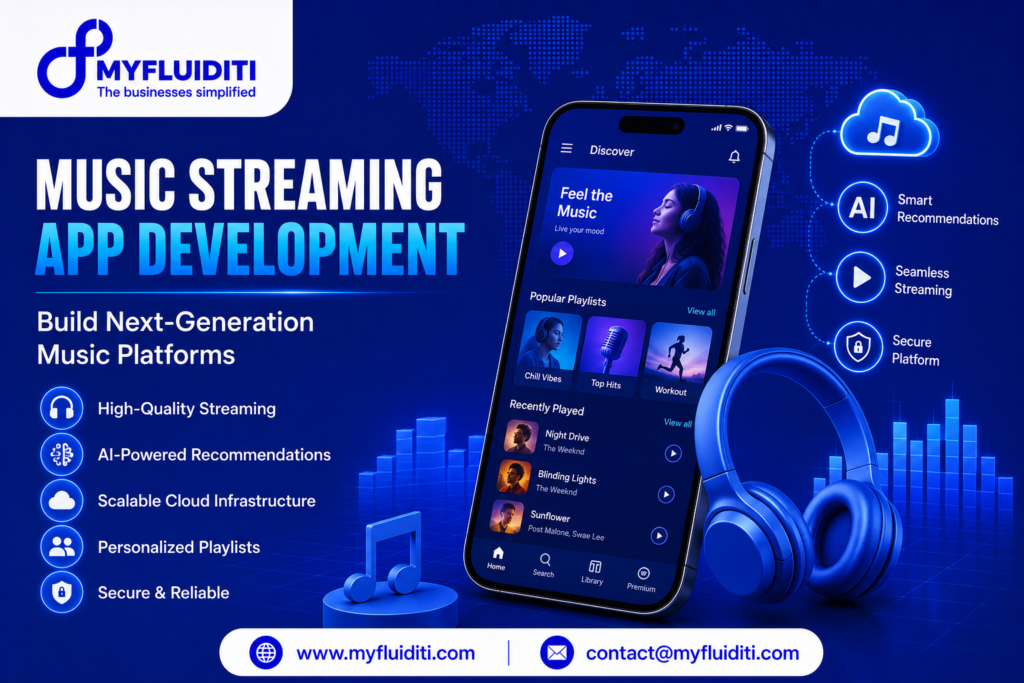
Introduction The way people discover, listen to, and interact with music has changed significantly with the growth of smartphones, high-speed internet, cloud computing, and digital entertainment platforms. Music streaming has become a central part of the modern entertainment ecosystem, allowing users to access vast music libraries, personalized recommendations, curated playlists, podcasts, and other audio content across connected devices. For businesses entering this competitive market, simply building a music player is no longer enough. A successful platform requires seamless streaming, personalized experiences, scalable infrastructure, intelligent recommendations, secure user management, and engaging interfaces. At MyFluiditi, we help businesses transform music streaming concepts into scalable digital platforms by combining mobile and web development, cloud technologies, AI, analytics, and modern user experience design. Understanding Music Streaming App Development Music streaming app development involves creating digital platforms that allow users to discover, access, organize, and stream audio content through internet-connected devices. A complete platform can include user registration, music catalogs, search, playlists, favorites, audio playback, recommendations, subscriptions, notifications, content management, analytics, and administrative functionality. Custom music streaming development enables businesses to design these capabilities around their target audience and business model. MyFluiditi helps organizations plan and develop music streaming applications that connect user experience, technology infrastructure, content management, and monetization into one integrated digital ecosystem. Why Music Streaming Platforms Are Growing Digital consumers increasingly expect entertainment to be accessible whenever and wherever they need it. Music streaming platforms provide convenient access to content without requiring users to manage large local libraries. This accessibility creates opportunities for businesses to build subscription-based platforms, specialized music services, artist-focused applications, and niche audio communities. Music streaming solutions can help businesses create direct digital relationships with listeners while providing opportunities for personalized content and engagement. MyFluiditi helps businesses develop platforms that are designed around their specific audience, content strategy, and long-term digital objectives. Building a Seamless Music Streaming Experience The quality of the listening experience is one of the most important factors in a streaming platform. Users expect quick loading, smooth playback, intuitive navigation, reliable search, and minimal interruptions. A well-designed application should make it easy for users to discover content and continue listening across different sessions and devices. MyFluiditi focuses on user-centric music streaming app development, combining intuitive interfaces with reliable backend systems to create smooth digital entertainment experiences. AI-Powered Music Recommendations Personalized recommendations have become an important component of modern music platforms. Artificial Intelligence and Machine Learning can analyze relevant listening patterns, preferences, interactions, and content characteristics to support personalized discovery. AI-powered music recommendation systems can help users discover artists, songs, albums, playlists, and other audio content that may be relevant to their interests. MyFluiditi can integrate intelligent recommendation capabilities into music streaming platforms, helping businesses create more personalized experiences while continuously improving content discovery. Personalized Playlists and Content Discovery Playlists allow users to organize music around moods, activities, genres, artists, or personal preferences. Intelligent playlist generation can make discovery more dynamic by combining user preferences with relevant content signals. Personalized music experiences can increase engagement by helping listeners discover content without requiring them to search manually for every song. MyFluiditi develops playlist and recommendation functionality based on the specific requirements of the platform, creating opportunities for businesses to differentiate their music streaming products. High-Quality Audio Streaming Audio quality is a key consideration for music streaming applications. Different users may have different network conditions, devices, and subscription preferences, requiring applications to manage streaming efficiently. High-quality audio streaming can involve appropriate encoding, adaptive delivery, caching, content delivery infrastructure, and optimized application performance. MyFluiditi focuses on building streaming architectures that balance audio quality, application performance, bandwidth considerations, and user experience. Cloud-Based Music Streaming Infrastructure Music streaming platforms can manage substantial volumes of audio files, user data, playlists, interactions, and streaming requests. Cloud infrastructure can provide scalable resources for application hosting, storage, databases, content delivery, analytics, and monitoring. Cloud-based music streaming enables businesses to scale technology resources according to changing user activity and content requirements. MyFluiditi helps organizations develop cloud-enabled streaming platforms designed for scalability, reliability, performance, and long-term growth. Scalable Music Streaming Architecture A streaming platform that starts with a limited user base may eventually need to support large numbers of listeners and concurrent streaming sessions. The application’s architecture therefore needs to accommodate growing traffic, content libraries, data volumes, and integrations. Scalable music streaming architecture can incorporate cloud infrastructure, content delivery networks, optimized databases, caching, APIs, and modular application services. MyFluiditi designs digital platforms with future expansion in mind, helping businesses introduce new features and support increasing usage without unnecessary technical limitations. Music Search and Discovery Search is a fundamental component of a music streaming platform because users need to quickly find songs, albums, artists, playlists, and other content. An effective search experience should provide relevant results while supporting different search terms and discovery preferences. Intelligent music search can be enhanced with filtering, categorization, metadata, recommendations, and AI-powered discovery capabilities. MyFluiditi develops search functionality that connects users with relevant content while supporting the broader discovery experience of the platform. Cross-Platform Music Streaming Applications Listeners may use smartphones, tablets, web browsers, smart devices, and other connected platforms to access digital entertainment. Businesses can therefore benefit from applications that provide a consistent experience across relevant devices. Cross-platform music streaming development can help organizations reach wider audiences while maintaining consistent functionality and branding. MyFluiditi develops web and mobile applications that can be connected to common backend services, enabling businesses to create cohesive digital experiences across appropriate platforms. Secure User Accounts and Data Management Music streaming platforms manage user accounts, preferences, subscriptions, playlists, listening histories, and potentially payment information. Protecting this information is important for maintaining user trust and platform reliability. Secure music streaming app development can incorporate authentication, authorization, secure APIs, data protection, access controls, and appropriate security monitoring. MyFluiditi incorporates security-conscious practices throughout application development to help businesses create dependable digital entertainment platforms. Subscription and Monetization Models Music streaming businesses can use different revenue models depending on their target audience and content strategy. Subscription plans, advertising-supported access, premium features, content partnerships,
Deep Learning for Intelligent Automation and Predictive Analytics
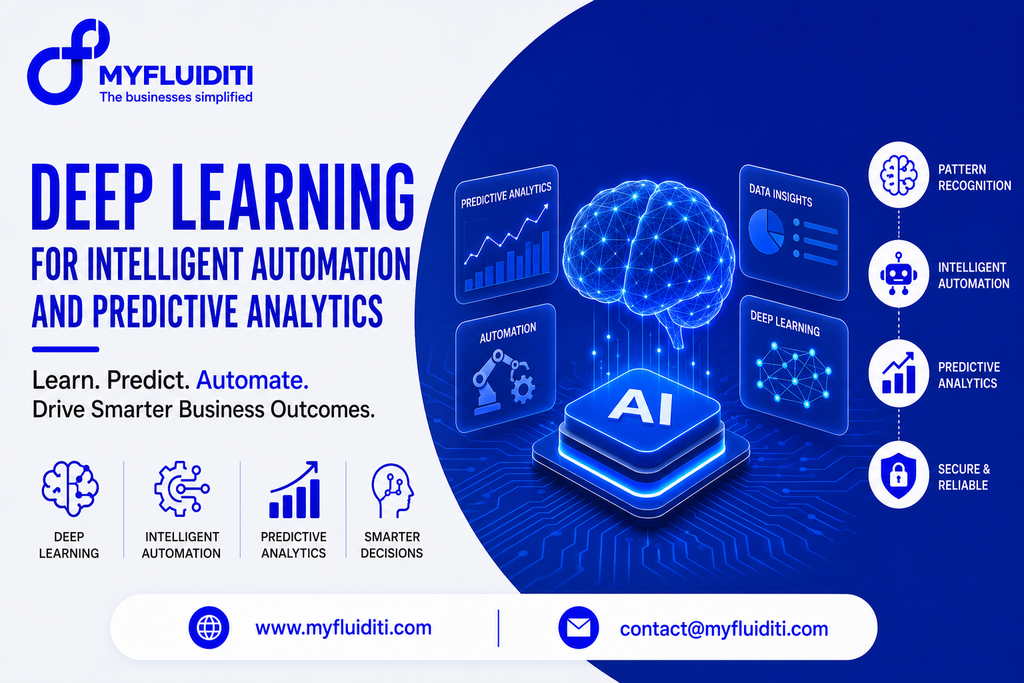
Introduction Businesses today generate enormous amounts of data through customer interactions, transactions, applications, connected devices, websites, and operational systems. Converting this data into useful insights has become essential for organizations looking to improve efficiency, reduce operational challenges, and make faster decisions. Deep Learning has emerged as a powerful branch of Artificial Intelligence capable of analyzing complex datasets, recognizing patterns, understanding relationships, and supporting intelligent predictions. When combined with automation and predictive analytics, deep learning can help organizations transform repetitive processes, anticipate business outcomes, and create smarter digital solutions. At MyFluiditi, we help businesses explore and implement deep learning technologies that align with their operational requirements, data environments, and long-term digital transformation goals. Understanding Deep Learning Deep learning is a subset of Machine Learning that uses multi-layered neural networks to learn complex patterns from large volumes of data. Unlike traditional programming approaches that depend heavily on predefined rules, deep learning models can learn representations from data and improve their ability to perform specific tasks through training. Deep Learning Solutions can support applications involving image recognition, natural language processing, speech analysis, recommendation systems, forecasting, anomaly detection, and intelligent automation. MyFluiditi helps businesses identify suitable deep learning use cases and develop AI-powered applications that connect advanced technology with practical business objectives. Deep Learning and Intelligent Automation Automation has traditionally focused on predefined workflows and rule-based processes. While these approaches remain useful, many business processes involve unstructured information or changing conditions that are difficult to manage through fixed rules alone. Deep learning can introduce greater intelligence into automation by helping systems interpret information, recognize patterns, and support decisions. Intelligent automation can be applied to document processing, customer service, data classification, quality inspection, workflow management, and other repetitive activities. MyFluiditi helps businesses identify processes where deep learning can complement existing automation and create more adaptive digital workflows. Predictive Analytics Powered by Deep Learning Predictive analytics helps businesses understand what may happen in the future by analyzing historical and current data. Deep learning can process complex datasets and identify relationships that may be difficult to detect using conventional analytical approaches. Deep learning predictive analytics can support demand forecasting, customer behavior analysis, risk assessment, anomaly detection, sales forecasting, and operational planning. MyFluiditi helps organizations develop data-driven solutions that turn historical information into useful predictive insights, enabling teams to make more informed business decisions. Improving Business Decision Making Business leaders often need to make decisions based on large amounts of information from multiple sources. Deep learning can support decision-making by identifying patterns, generating predictions, and highlighting relevant insights. Rather than replacing human decision-makers, intelligent systems can provide additional information that helps teams evaluate opportunities and risks. MyFluiditi integrates AI-powered analytics into business environments to help organizations access meaningful insights and make decisions based on data rather than assumptions. Deep Learning for Customer Experience Customer expectations continue to evolve as digital experiences become more personalized and responsive. Deep learning can help organizations analyze customer behavior, preferences, interactions, and engagement patterns to create more relevant experiences. Recommendation engines, conversational AI, personalization systems, sentiment analysis, and customer behavior prediction are examples of how deep learning for customer experience can be applied. MyFluiditi develops intelligent digital solutions that help businesses understand their customers and deliver more personalized interactions across relevant digital channels. Deep Learning for Computer Vision Computer vision is one of the important application areas of deep learning. Neural networks can be trained to analyze images and video for applications such as object detection, classification, quality inspection, facial recognition, document processing, and visual monitoring, depending on the business requirements and applicable policies. Deep learning computer vision can support organizations in automating visual analysis and improving operational processes. MyFluiditi helps businesses explore computer vision applications where image-based intelligence can provide measurable operational value. Deep Learning and Natural Language Processing Businesses interact with customers and employees through large volumes of text and spoken language. Deep learning has significantly advanced Natural Language Processing by enabling systems to understand, classify, summarize, and generate language. Applications can include intelligent chatbots, document analysis, sentiment analysis, information extraction, search, and conversational interfaces. MyFluiditi integrates deep learning and NLP capabilities into appropriate business applications to help organizations automate language-based processes and improve digital communication. Deep Learning for Anomaly Detection Unexpected patterns in business data can indicate operational problems, security concerns, system failures, or unusual customer activity. Deep learning models can analyze historical patterns and identify deviations that may require further investigation. AI-powered anomaly detection can support areas such as cybersecurity, financial transactions, manufacturing operations, system monitoring, and quality control. MyFluiditi helps businesses develop intelligent monitoring solutions that can identify relevant patterns and support faster responses to potential issues. Deep Learning for Demand Forecasting Accurate demand forecasting can help organizations plan inventory, staffing, production, logistics, and resources more effectively. Deep learning models can analyze historical demand alongside other relevant data to identify patterns and support forecasting activities. Deep learning demand forecasting can be particularly valuable when businesses manage complex and changing demand conditions. MyFluiditi helps organizations develop predictive solutions that support planning and operational decision-making using their available data. Deep Learning for Intelligent Recommendations Recommendation systems are widely used to personalize digital experiences. Deep learning can analyze user behavior, preferences, interactions, and relevant contextual information to support personalized recommendations. E-commerce platforms, entertainment services, educational applications, and digital marketplaces can use deep learning recommendation systems to present more relevant products, services, content, or experiences. MyFluiditi develops intelligent recommendation capabilities that can be integrated into digital platforms based on business objectives and user requirements. Deep Learning and Business Process Optimization Organizations often have processes that involve multiple steps, large datasets, and repetitive decisions. Deep learning can support process optimization by identifying patterns in operational information and helping organizations understand where inefficiencies occur. AI-driven process optimization can contribute to improved resource allocation, workflow management, forecasting, and operational planning. MyFluiditi helps businesses connect deep learning capabilities with their existing digital workflows to create more intelligent and efficient operations. Cloud-Based Deep Learning Solutions Deep learning applications can require significant computing resources for model training,
CakePHP Development Services for Accelerating Digital Business Growth
Introduction Businesses today need web applications that are fast, scalable, secure, and capable of adapting to changing customer and operational requirements. As organizations increasingly depend on digital platforms for customer engagement, internal workflows, e-commerce, and business operations, choosing the right development framework becomes an important technology decision. CakePHP development provides a structured PHP framework for creating dynamic and scalable web applications while supporting efficient development and maintainable code. At MyFluiditi, we help businesses build customized web applications that combine performance, usability, scalability, and modern technology to support long-term digital growth. Understanding CakePHP Development CakePHP is an open-source PHP framework designed to simplify the development of web applications. Its structured architecture and development conventions can help teams build applications more efficiently while maintaining organized code. CakePHP web development can be used for business portals, content management systems, e-commerce applications, enterprise platforms, customer portals, and custom web solutions. MyFluiditi uses a business-focused development approach, understanding application requirements and user needs before designing solutions around the organization’s technology and growth objectives. Why Businesses Choose CakePHP Modern businesses need applications that can evolve as their requirements change. CakePHP provides a structured development environment that can support the creation of customized web applications while helping developers maintain consistent development practices. Its framework capabilities can support routing, database interaction, authentication, form handling, and other common web application requirements. MyFluiditi helps businesses determine where CakePHP development services can provide value and creates applications tailored to their specific workflows and digital objectives. Building Scalable Web Applications Scalability is essential for businesses expecting their user base, data volumes, and application functionality to grow. A web application should be capable of handling increasing workloads without requiring extensive redevelopment. Scalable CakePHP development involves thoughtful architecture, optimized database interactions, efficient application logic, and appropriate infrastructure. MyFluiditi focuses on building web applications that can evolve with business growth while maintaining performance and usability. Custom CakePHP Web Development Every business has unique processes, customer journeys, and technology requirements. Generic software may not provide the flexibility needed to support specialized workflows. Custom CakePHP development enables businesses to create web applications around their specific operational needs. MyFluiditi develops customized web solutions for different business models, combining application functionality, user experience, backend development, integrations, and scalable architecture to create solutions aligned with business objectives. CakePHP for Business Web Applications Business applications often need to manage users, workflows, databases, reports, permissions, and integrations within a single digital environment. CakePHP can provide a structured foundation for developing such applications. From internal management systems to customer-facing platforms, CakePHP web applications can be customized according to business requirements. MyFluiditi helps organizations transform operational requirements into practical web applications designed to improve efficiency and digital accessibility. Performance Optimization Website and application performance directly affects user experience and business outcomes. Slow page loading, inefficient database queries, or poorly optimized application components can negatively influence engagement. CakePHP performance optimization involves evaluating application architecture, database operations, queries, caching, APIs, and infrastructure to identify potential bottlenecks. MyFluiditi focuses on performance as part of the development lifecycle, helping businesses create responsive and efficient web applications. Secure CakePHP Development Web applications frequently process customer information, account details, transactions, and business data, making security an important consideration throughout development. Authentication, authorization, secure data handling, input validation, access controls, and protected APIs can help create more reliable applications. Secure CakePHP development incorporates security-conscious practices into application architecture and implementation. MyFluiditi considers security requirements from the early stages of development to help businesses build dependable digital platforms. Database Integration and Management Business applications often depend on databases to store customer records, transactions, product information, operational data, and other important information. Efficient database architecture and interaction are essential for application performance and reliability. CakePHP provides capabilities for working with databases and organizing application data. MyFluiditi develops database-driven CakePHP applications with attention to data structure, application performance, scalability, and integration requirements. API Integration with CakePHP Applications Modern web applications frequently need to communicate with external platforms such as payment gateways, CRM systems, ERP applications, cloud services, analytics platforms, mobile applications, and third-party APIs. CakePHP API integration enables applications to exchange information with other digital systems and create connected business workflows. MyFluiditi develops integration solutions that connect web applications with relevant services, helping businesses reduce disconnected processes and create more unified digital ecosystems. CakePHP for E-Commerce Development E-commerce businesses require reliable web platforms capable of managing products, customers, orders, payments, inventory, and digital experiences. CakePHP can be used as a foundation for developing customized e-commerce applications according to specific business requirements. CakePHP e-commerce development can support customized shopping experiences and integrations with payment, inventory, and business management systems. MyFluiditi helps businesses create e-commerce platforms that focus on usability, performance, security, scalability, and customer experience. CakePHP and Cloud Technologies Cloud infrastructure can provide businesses with flexible resources for hosting and scaling web applications. Cloud-based environments can support application deployment, databases, storage, monitoring, backups, and changing traffic requirements. MyFluiditi develops cloud-ready web applications designed to accommodate business growth and evolving technology requirements. By combining CakePHP development with suitable cloud infrastructure, businesses can establish flexible digital platforms that can adapt to changing workloads. CakePHP Development for Digital Transformation Digital transformation involves more than moving existing processes online. Businesses need to rethink workflows, connect systems, automate repetitive activities, improve customer experiences, and use data more effectively. CakePHP development services can contribute to this transformation by providing customized web applications that support modern business processes. MyFluiditi helps organizations identify opportunities for application modernization and develops digital solutions that connect technology with operational goals. Agile CakePHP Development Business requirements can evolve during the development lifecycle as organizations receive feedback from users and identify new priorities. Agile development provides a flexible approach that supports iterative development, continuous feedback, testing, and improvement. MyFluiditi follows collaborative development practices that allow businesses to remain involved throughout the project. Agile CakePHP development can help teams adapt to changing requirements while maintaining structured milestones and development quality. Testing and Quality Assurance A reliable web application requires comprehensive testing before and after deployment. Functional testing, performance