PPC Campaign Management for Maximizing Online Advertising Results
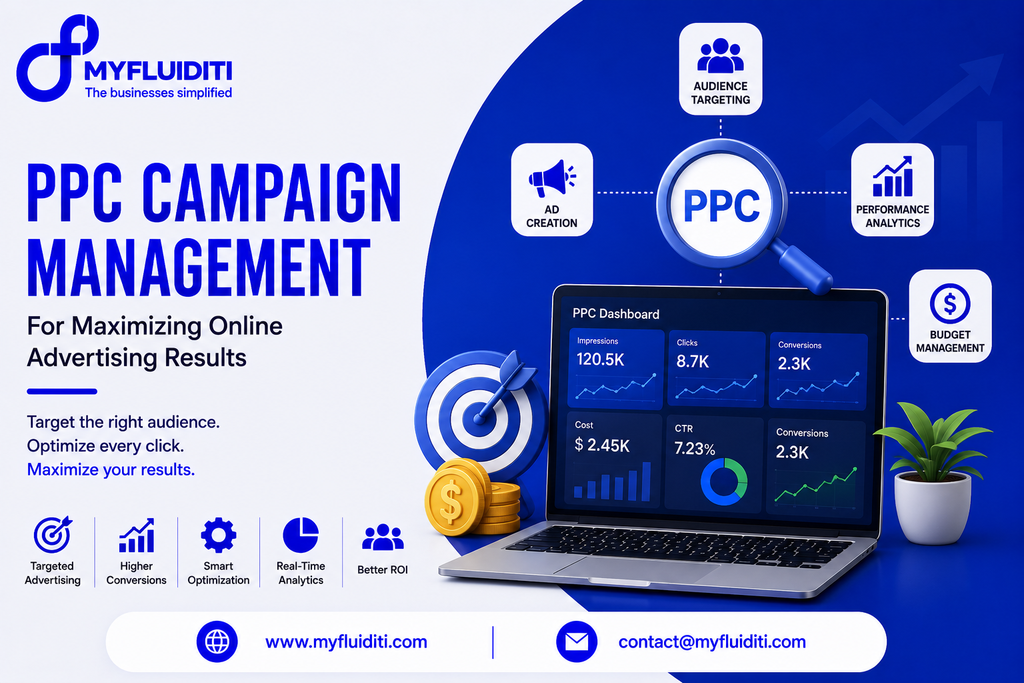
Introduction In today’s competitive digital marketplace, businesses need more than organic visibility to reach potential customers at the right moment. Pay Per Click (PPC) marketing provides businesses with a powerful way to place their products and services in front of audiences actively searching for relevant solutions. However, simply launching paid advertising campaigns does not guarantee success. Effective PPC requires strategic keyword research, audience targeting, compelling ad creatives, landing page optimization, budget management, conversion tracking, and continuous performance analysis. At MyFluiditi, we help businesses develop and manage data-driven PPC campaigns designed to improve online visibility, attract qualified traffic, generate leads, and maximize advertising performance. Understanding PPC Campaign Management PPC campaign management involves planning, launching, monitoring, analyzing, and optimizing paid advertising campaigns across search engines and digital advertising platforms. Businesses pay when users interact with their advertisements, making campaign efficiency an important factor in overall marketing performance. A successful PPC campaign strategy focuses on reaching relevant audiences while controlling advertising costs and improving conversion opportunities. MyFluiditi takes a structured approach to PPC management by understanding business objectives, target audiences, products, services, and competitive positioning before developing campaigns aligned with measurable goals. Why PPC Marketing Matters for Businesses Digital consumers often use search engines to find products, services, solutions, and information. PPC advertising allows businesses to appear prominently when potential customers search for relevant keywords. This immediate visibility can help organizations attract targeted website traffic and reach users with stronger purchase or inquiry intent. Paid search marketing can complement SEO and other digital marketing activities by creating additional opportunities to reach potential customers. MyFluiditi helps businesses integrate PPC campaigns into broader digital marketing strategies to strengthen visibility and support sustainable customer acquisition. Keyword Research for High-Intent Audiences Keywords form the foundation of search advertising campaigns. Selecting the right keywords helps businesses connect advertisements with users who are searching for relevant products or services. Effective keyword research considers search intent, relevance, competition, commercial value, and potential conversion opportunities. High-intent keywords can help businesses reach audiences who are closer to making purchasing or inquiry decisions. MyFluiditi conducts keyword-focused campaign planning to identify relevant search opportunities and structure campaigns around business objectives. Creating High-Converting PPC Ad Copy An advertisement needs to capture attention quickly while clearly communicating the value of the product or service. Relevant headlines, descriptions, calls to action, benefits, and messaging can influence whether users interact with an advertisement. High-converting PPC ads should align closely with the user’s search intent and the landing page experience. MyFluiditi develops campaign messaging around audience needs and business value, helping advertisements communicate relevant information while encouraging meaningful actions. Audience Targeting and Segmentation PPC platforms provide businesses with multiple targeting capabilities that can help campaigns reach more relevant audiences. Depending on the platform and campaign type, advertisers can use factors such as location, demographics, interests, behaviors, devices, search intent, and previous interactions. PPC audience targeting helps businesses focus advertising budgets on audiences that are more likely to engage with their offerings. MyFluiditi develops audience strategies based on customer profiles, campaign objectives, and available performance data. Landing Page Optimization Getting users to click an advertisement is only one part of a successful PPC campaign. The landing page must provide a relevant and compelling experience that encourages visitors to take the intended action. Slow pages, confusing navigation, irrelevant content, or unclear calls to action can reduce conversion rates. PPC landing page optimization focuses on aligning landing page content with advertisement messaging and user intent. MyFluiditi helps businesses improve the connection between advertisements and landing pages to create more consistent customer journeys. Conversion Tracking and Measurement PPC campaigns should be measured based on meaningful business outcomes rather than clicks alone. Conversion tracking can help organizations understand whether users are completing actions such as submitting forms, making purchases, requesting information, signing up for services, or contacting a business. PPC conversion tracking provides valuable information about campaign effectiveness and customer behavior. MyFluiditi helps businesses establish appropriate measurement strategies so campaign performance can be evaluated against actual business objectives. Managing PPC Budgets Effectively Advertising budgets need to be managed carefully to maximize campaign efficiency. Different keywords, audiences, devices, locations, and campaigns can produce different results, making continuous budget analysis important. PPC budget management involves evaluating campaign performance and allocating resources toward opportunities that demonstrate stronger potential. MyFluiditi monitors campaign performance and helps businesses make data-informed budget decisions designed to improve advertising efficiency. PPC Campaign Optimization Digital advertising performance can change as competition, search behavior, audience preferences, and market conditions evolve. Campaigns therefore require continuous monitoring and optimization rather than a one-time setup. PPC optimization can involve refining keywords, adjusting bids, improving ad copy, updating targeting, testing landing pages, and reallocating budgets. MyFluiditi uses data-driven PPC optimization to identify areas for improvement and continuously refine campaigns based on performance insights. A/B Testing for Better Campaign Performance Testing different versions of advertisements and landing pages can help businesses understand which messages and experiences perform better. A/B testing can compare variations of headlines, descriptions, calls to action, landing page elements, or audience strategies. PPC A/B testing allows businesses to make optimization decisions based on actual campaign data rather than assumptions. MyFluiditi incorporates testing into PPC strategies where appropriate to help identify opportunities for improving engagement and conversions. Improving Quality and Relevance Search advertising platforms consider multiple factors when determining how advertisements are displayed and how efficiently campaigns perform. Relevance between keywords, advertisements, landing pages, and user intent can influence campaign effectiveness. Improving PPC ad relevance can contribute to a better user experience and more efficient advertising performance. MyFluiditi focuses on creating consistent connections between search intent, ad messaging, landing page content, and conversion objectives. Remarketing for Customer Retention Not every visitor converts during their first interaction with a website. Remarketing can help businesses reconnect with users who have previously interacted with their websites, applications, or digital content, subject to applicable platform policies and privacy requirements. PPC remarketing campaigns can support continued engagement by presenting relevant advertisements to previous visitors. MyFluiditi helps businesses incorporate remarketing strategies into their
Force.com Solutions for Transforming Cloud-Based Business Operations
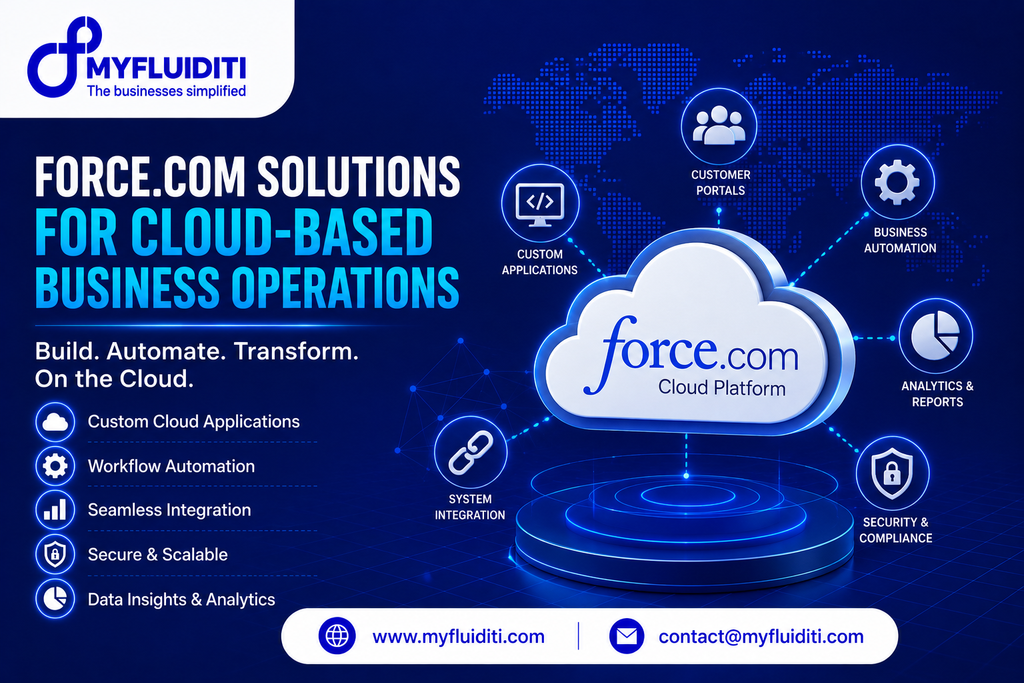
Introduction Cloud technology has changed how businesses manage applications, customer relationships, workflows, data, and enterprise operations. Organizations increasingly need flexible digital platforms that can support changing business requirements without the complexity of maintaining disconnected systems. Force.com, a cloud application platform within the Salesforce ecosystem, provides businesses with capabilities for creating and extending business applications in a cloud environment. Force.com solutions can help organizations streamline workflows, connect business data, automate processes, and improve application accessibility. At MyFluiditi, we help businesses evaluate cloud application requirements and implement customized solutions that align technology capabilities with operational objectives and long-term digital transformation strategies. Understanding Force.com Solutions Force.com provides a cloud-based platform designed to support the creation and customization of business applications within the Salesforce ecosystem. Organizations can use the platform to configure applications, automate workflows, manage data, and connect business processes. Force.com cloud solutions can support customer-facing applications, internal business tools, workflow systems, portals, and customized enterprise applications. MyFluiditi helps businesses understand their requirements and identify how Force.com capabilities can be configured or extended to address specific operational challenges. Why Businesses Are Moving Toward Cloud Applications Traditional business applications can require significant infrastructure management, maintenance, upgrades, and manual administration. Cloud-based platforms can provide organizations with greater flexibility and accessibility while reducing some of the infrastructure responsibilities associated with conventional application environments. Cloud business applications allow employees and teams to access relevant systems from connected environments while supporting centralized data and processes. MyFluiditi helps organizations transition toward cloud-enabled operations by connecting application strategy with business requirements and existing technology environments. Transforming Business Operations with Force.com Business operations often involve repetitive workflows, multiple departments, customer information, approvals, reporting, and data exchange between systems. Force.com can provide a platform for organizing and automating these processes. Force.com business solutions can help organizations streamline workflows and create applications around specific operational requirements. MyFluiditi works with businesses to identify inefficient processes and determine where cloud applications, automation, and integration can improve operational efficiency. Custom Cloud Application Solutions Every organization has unique workflows and requirements, which means a standard application may not always provide the necessary functionality. Force.com provides customization capabilities that can support business-specific applications and processes. Custom Force.com solutions can be designed around organizational workflows, data requirements, user roles, and customer interactions. MyFluiditi helps businesses translate their operational needs into customized cloud application solutions while maintaining scalability and usability. Workflow Automation and Process Optimization Manual processes can consume employee time and introduce inconsistencies into business operations. Cloud platforms can automate suitable workflows such as approvals, notifications, task assignments, data updates, and other repetitive activities. Force.com workflow automation can help businesses improve process consistency and reduce unnecessary manual intervention. MyFluiditi analyzes business workflows and identifies automation opportunities that can contribute to faster operations and improved productivity. Connecting Business Data Businesses often rely on multiple applications for sales, customer service, finance, operations, marketing, and reporting. When these systems operate independently, employees may struggle to access consistent information. Force.com can be integrated with other enterprise applications to support connected workflows and data exchange. Force.com integration solutions can help organizations reduce data silos and create more connected digital operations. MyFluiditi helps businesses integrate cloud applications with relevant systems through APIs and other appropriate integration technologies. Salesforce and Force.com Integration Force.com operates within the broader Salesforce ecosystem, allowing organizations to extend CRM capabilities into customized business applications and workflows. Businesses can connect customer information with operational processes to create more unified experiences. Salesforce Force.com solutions can support organizations that need to extend their CRM environment beyond standard functionality. MyFluiditi helps businesses evaluate their Salesforce ecosystem and identify opportunities for customized applications, integrations, automation, and process optimization. Improving Enterprise Productivity Employees need access to accurate information and efficient tools to complete their responsibilities effectively. Cloud applications can centralize relevant information, automate routine activities, and simplify access to business workflows. Enterprise productivity solutions can help teams spend less time managing disconnected systems and more time focusing on customer and business priorities. MyFluiditi develops technology strategies that connect cloud applications with organizational processes to support greater productivity and operational efficiency. Cloud-Based Customer Applications Businesses increasingly provide customers with digital portals and self-service applications for accessing information, submitting requests, tracking activities, and managing accounts. Force.com can support customized cloud applications that connect customer experiences with business processes. Cloud customer applications can help organizations create more convenient digital interactions while providing internal teams with better visibility into customer activities. MyFluiditi helps businesses design and integrate customer-facing applications that align with their broader digital ecosystem. Secure Cloud Business Applications Security is an important consideration when organizations manage customer information, business records, and operational data through cloud platforms. Access controls, authentication, permissions, data management, and appropriate integration security can help protect business applications. Secure Force.com solutions should be designed around organizational security requirements and applicable business policies. MyFluiditi takes a security-conscious approach when planning and implementing cloud application solutions, helping businesses consider security throughout the application lifecycle. Data Management and Analytics Cloud business applications can provide organizations with centralized access to important operational information. When combined with reporting and analytics capabilities, this information can help decision-makers understand business performance, customer behavior, workflow efficiency, and other relevant metrics. Force.com data analytics can support data-driven decision-making by making relevant information more accessible. MyFluiditi helps businesses connect cloud applications with analytics strategies so organizations can gain greater visibility into their operations. AI and Intelligent Cloud Applications Artificial Intelligence is becoming increasingly important in enterprise application environments. Businesses can use AI to support customer service, predictive insights, recommendations, automation, intelligent search, and data analysis. AI-powered cloud applications can extend traditional business systems with intelligent capabilities and help organizations automate selected processes. MyFluiditi helps businesses identify practical AI opportunities and integrate intelligent technologies into their existing cloud application strategies. Force.com for Digital Transformation Digital transformation involves modernizing business processes, connecting systems, improving customer experiences, and using technology to create more efficient operating models. Force.com can contribute to this transformation by providing a cloud platform for customized applications and automated workflows. Force.com digital transformation solutions can
Video Streaming App Development for Building Next-Generation Entertainment Platforms
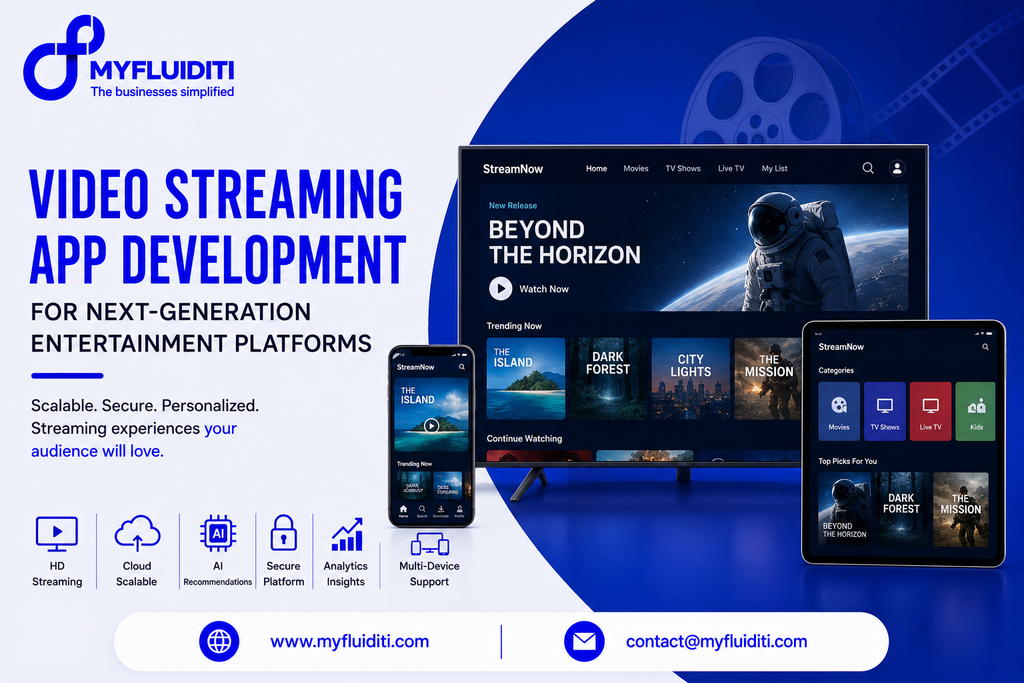
Introduction The rapid growth of digital entertainment has transformed how people watch movies, series, live events, educational content, sports, and user-generated videos. Audiences increasingly expect instant access to high-quality content across smartphones, tablets, smart TVs, desktops, and other connected devices. This shift has created significant opportunities for businesses to build innovative video streaming platforms that deliver convenient, personalized, and engaging viewing experiences. However, building a successful streaming platform requires more than a video player. It requires scalable architecture, high-quality content delivery, personalized recommendations, secure user management, seamless playback, analytics, and reliable cloud infrastructure. At MyFluiditi, we help businesses transform entertainment concepts into scalable video streaming applications by combining modern software engineering, cloud technologies, AI, analytics, and user-focused design. Understanding Video Streaming App Development Video streaming app development involves creating digital platforms that allow users to discover, access, stream, and interact with video content through internet-connected devices. A modern platform can include user registration, content catalogs, search, categories, playlists, watchlists, video playback, subscriptions, payments, recommendations, notifications, and administrative management. Custom video streaming development enables businesses to design these capabilities around their audience, content strategy, and monetization model. MyFluiditi helps organizations plan and build video streaming applications that connect content, technology, user experience, and business operations into a unified digital platform. Why Businesses Are Investing in Video Streaming Platforms Digital audiences increasingly prefer on-demand and personalized entertainment experiences. Businesses can use video streaming platforms to distribute premium content, educational materials, live events, training programs, entertainment, and specialized video services. Streaming platforms can also create direct relationships between content providers and audiences while opening opportunities for subscription, advertising, and other digital revenue models. MyFluiditi helps businesses identify suitable video streaming solutions based on their target audience, content requirements, business model, and long-term digital objectives. Creating Seamless Video Streaming Experiences A successful streaming platform needs to make content discovery and playback simple. Users expect applications to load quickly, provide intuitive navigation, remember viewing preferences, and deliver smooth playback. Poor performance, buffering, complicated navigation, or inconsistent experiences can reduce engagement. MyFluiditi focuses on user-centric video streaming app development, combining intuitive interfaces with optimized backend systems and content delivery technologies to create seamless digital entertainment experiences. High-Quality Video Streaming Video quality is one of the most important factors influencing the viewing experience. Different users may have different internet speeds, devices, screen sizes, and network conditions. Adaptive streaming technologies can adjust video quality according to available bandwidth and device capabilities, helping maintain smooth playback. High-quality video streaming requires appropriate encoding, content delivery, caching, and infrastructure optimization. MyFluiditi helps businesses build streaming architectures that balance video quality, performance, bandwidth efficiency, and user experience. Scalable Video Streaming Architecture A streaming platform may begin with a small audience but eventually need to support thousands or millions of viewers and large volumes of video content. The architecture must therefore be capable of handling increasing concurrent users, traffic, storage requirements, and content delivery workloads. Scalable video streaming architecture can include cloud infrastructure, content delivery networks, optimized databases, caching, APIs, and modular services. MyFluiditi designs platforms with future growth in mind so businesses can expand their audience and content libraries without unnecessary technology limitations. Cloud-Based Video Streaming Solutions Cloud technology provides the infrastructure required to store, process, manage, and distribute large volumes of video content. Cloud platforms can support storage, databases, application hosting, analytics, monitoring, and scalable computing resources. Cloud-based video streaming allows businesses to adapt infrastructure according to changing viewer demand and content requirements. MyFluiditi combines cloud technologies with video streaming development to create flexible platforms designed for performance, reliability, scalability, and operational efficiency. Personalized Video Recommendations As streaming libraries become larger, users may find it difficult to discover content that matches their interests. Artificial Intelligence and Machine Learning can help platforms analyze relevant viewing patterns, preferences, interactions, and content characteristics to generate personalized recommendations. AI-powered video recommendation systems can help users discover movies, shows, educational videos, live content, or other relevant media. MyFluiditi can integrate intelligent recommendation capabilities into streaming platforms to create more personalized content discovery experiences. AI-Powered Content Discovery Artificial Intelligence can enhance video platforms beyond basic recommendations. AI can support intelligent search, content categorization, metadata generation, personalized discovery, audience segmentation, and other platform capabilities. AI-powered video streaming platforms can make large content libraries easier to navigate while providing users with more relevant experiences. MyFluiditi helps businesses identify practical AI use cases and integrate intelligent capabilities into video platforms based on their specific business requirements. Video Search and Content Discovery Search functionality is essential for platforms containing large volumes of video content. Users should be able to quickly find movies, shows, creators, channels, categories, and other content. Intelligent search can combine keywords, metadata, filters, categories, recommendations, and other relevant signals to improve discovery. MyFluiditi develops video search and discovery solutions that help users navigate content efficiently while supporting broader engagement and personalization strategies. Multi-Device Video Streaming Modern audiences access digital video from multiple devices, including smartphones, tablets, laptops, desktops, smart TVs, and other connected devices. Businesses can benefit from providing consistent experiences across relevant platforms. Cross-platform video streaming development can help organizations reach wider audiences while maintaining consistent branding and functionality. MyFluiditi develops web and mobile streaming applications connected to scalable backend systems, allowing businesses to create cohesive experiences across appropriate devices. Subscription and Monetization Models Video streaming businesses can use different monetization strategies based on their content and audience. Subscription plans, advertising-supported streaming, pay-per-view access, premium content, and hybrid models can all provide revenue opportunities. Video streaming monetization requires reliable payment processing, subscription management, user entitlements, billing, and analytics. MyFluiditi helps businesses integrate appropriate monetization functionality into streaming platforms while maintaining a smooth and transparent user experience. Advertising-Based Video Streaming Advertising can provide an important revenue stream for streaming platforms offering free or partially free content. Businesses can incorporate appropriate advertising technologies to deliver advertisements while maintaining the overall viewing experience. Video streaming advertising solutions can support targeted campaigns, ad management, performance tracking, and revenue optimization. MyFluiditi helps businesses integrate advertising functionality according to their platform’s business
Speech Recognition Technology for Transforming Business Communication

Introduction The way businesses communicate with customers, employees, and digital systems is rapidly changing as Artificial Intelligence becomes an integral part of modern technology. Voice has emerged as a convenient and natural method for interacting with applications, devices, and business platforms. Speech recognition technology enables computers and software systems to interpret spoken language and convert it into meaningful digital information. From customer service and virtual assistants to transcription, voice search, accessibility, and workflow automation, speech recognition can improve how organizations communicate and operate. At MyFluiditi, we help businesses explore and implement intelligent speech recognition solutions that connect voice technology with practical business requirements, creating more accessible, responsive, and efficient digital experiences. Understanding Speech Recognition Technology Speech recognition is an Artificial Intelligence technology that enables computers to recognize and process human speech. Modern speech recognition systems can convert spoken words into text and, depending on their design, identify language, understand context, and connect voice input with business workflows. AI speech recognition combines technologies such as machine learning, Natural Language Processing, acoustic modeling, and language processing to improve the accuracy and usefulness of voice interactions. MyFluiditi helps businesses identify relevant speech recognition use cases and integrate voice capabilities into web applications, mobile applications, enterprise platforms, and other digital solutions. Why Speech Recognition Matters for Modern Businesses Businesses manage large volumes of communication every day through customer calls, meetings, support interactions, voice messages, interviews, and internal discussions. Processing all this information manually can consume significant time and resources. Speech recognition can help organizations convert spoken information into structured digital content and automate selected communication processes. Speech-to-text technology can improve productivity by reducing manual transcription and enabling businesses to process voice information more efficiently. MyFluiditi helps organizations identify areas where voice technology can create measurable improvements in communication and operational workflows. Transforming Customer Communication Customer expectations increasingly focus on convenience and immediate assistance. Voice-enabled systems can provide customers with alternative ways to interact with businesses, particularly when typing is inconvenient or when hands-free communication is preferred. Speech recognition can support voice-based customer service, virtual assistants, appointment systems, product searches, and other conversational experiences. MyFluiditi develops voice-enabled customer experiences that can connect speech recognition with business applications, allowing organizations to make customer interactions more natural and accessible. Speech-to-Text for Business Productivity One of the most widely used applications of speech recognition is converting spoken language into written text. Businesses can use speech-to-text technology for meeting transcription, interviews, customer conversations, documentation, note-taking, and other communication processes. Automated transcription can reduce the time employees spend manually converting audio into written information. MyFluiditi helps organizations integrate speech-to-text capabilities into appropriate business applications, enabling teams to capture and process spoken information more efficiently. Voice-Powered Business Applications Speech recognition can be integrated into applications to provide users with voice-based controls and interactions. Employees or customers may use voice commands to search for information, enter data, navigate features, or initiate predefined actions. Voice-enabled applications can improve accessibility and provide an alternative interaction method for users who prefer speaking over typing. MyFluiditi integrates speech recognition into digital products based on user requirements and business workflows, helping organizations create more flexible application experiences. Natural Language Processing and Speech Recognition Speech recognition converts spoken language into a machine-readable format, while Natural Language Processing can help systems interpret the meaning and intent behind that information. Combining speech recognition and NLP enables businesses to move beyond transcription toward intelligent conversational experiences. This combination can support virtual assistants, customer support systems, voice search, automated workflows, and conversational applications. MyFluiditi helps businesses connect voice processing with appropriate NLP capabilities to create intelligent solutions that understand and respond to user requests. AI-Powered Voice Assistants Voice assistants can provide users with a conversational interface for accessing information and completing selected tasks. Businesses can use AI-powered voice assistants for customer support, internal knowledge access, appointment scheduling, information retrieval, and other defined workflows. AI voice assistants can reduce friction by allowing users to interact naturally through speech. MyFluiditi helps businesses design and integrate voice assistant capabilities while connecting them with relevant data sources, APIs, and enterprise systems. Speech Recognition for Customer Service Customer support teams frequently handle repetitive questions and large volumes of conversations. Speech recognition can assist by transcribing calls, identifying relevant information, supporting agent workflows, and enabling voice-based automation. AI-powered customer service can combine speech recognition with conversational AI and analytics to improve how businesses manage customer interactions. MyFluiditi helps organizations explore voice technologies that complement customer service teams and improve the efficiency of communication processes. Speech Analytics for Business Insights Voice interactions contain valuable information about customer concerns, preferences, questions, and experiences. When speech is converted into structured data, businesses can analyze conversations to identify trends and opportunities. Speech analytics can support customer experience analysis, quality monitoring, sentiment analysis, compliance workflows, and service improvement, depending on the application and applicable requirements. MyFluiditi helps businesses connect speech recognition with analytics solutions to transform relevant voice data into actionable insights. Multilingual Speech Recognition Businesses serving diverse audiences may need technology capable of processing multiple languages and different speech patterns. Multilingual speech recognition can help organizations provide more accessible digital services across different linguistic groups. Multilingual voice technology can support transcription, customer service, voice search, and conversational applications when appropriate language models and datasets are available. MyFluiditi helps businesses evaluate multilingual requirements and incorporate suitable speech technologies into their digital platforms. Speech Recognition and Accessibility Voice technology can make digital applications more accessible for users who experience difficulties with traditional keyboard or touch-based interactions. Speech-enabled interfaces can provide alternative methods for entering information, navigating applications, and accessing digital services. Voice accessibility solutions can therefore contribute to more inclusive digital experiences. MyFluiditi considers accessibility as part of digital product design and can integrate speech recognition where voice interaction can provide meaningful benefits to users. Speech Recognition for Workflow Automation Speech recognition becomes even more valuable when voice input can trigger defined business workflows. For example, a user could provide a spoken request that is converted into text, interpreted by an AI system,
CodeIgniter Services for Modernizing Business Web Applications
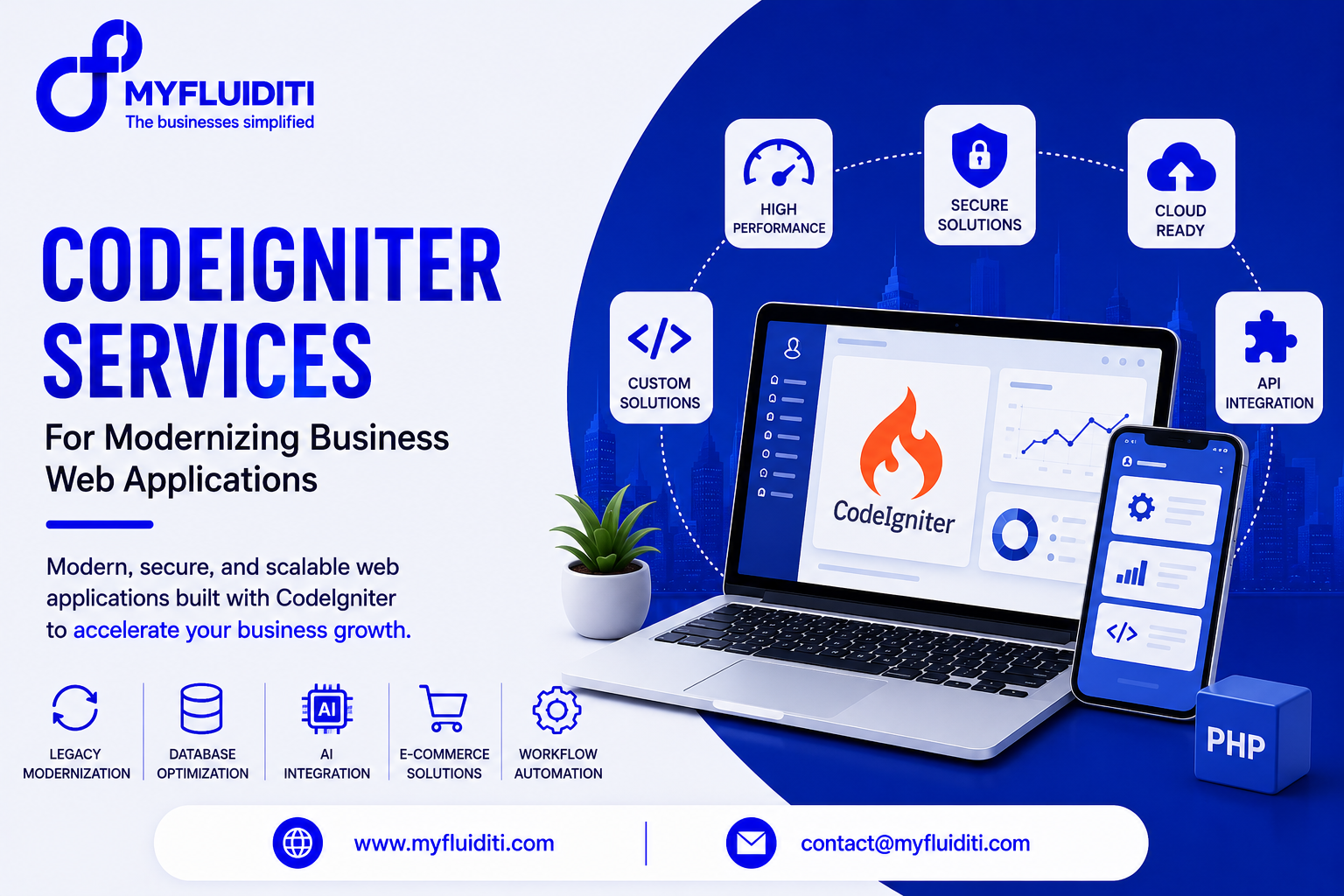
Introduction Businesses increasingly depend on web applications to manage operations, engage customers, automate workflows, and deliver digital services. As organizations grow, outdated applications can become difficult to maintain, slow to respond, or disconnected from modern business systems. Modernizing these applications requires a technology approach that improves performance, scalability, security, usability, and integration capabilities without unnecessarily disrupting existing operations. CodeIgniter provides a lightweight PHP framework that can serve as a practical foundation for building and modernizing dynamic web applications. At MyFluiditi, we help businesses transform legacy and existing web applications into scalable digital solutions by combining CodeIgniter expertise with modern development practices, cloud technologies, API integration, security, and user-focused design. Understanding CodeIgniter Services CodeIgniter is a lightweight PHP framework designed to simplify the creation of dynamic web applications. Its structured architecture and relatively lightweight footprint make it suitable for businesses that need customized web solutions with efficient application performance. CodeIgniter services can support application modernization, custom web platforms, business portals, e-commerce solutions, content-driven applications, APIs, and enterprise web systems. MyFluiditi evaluates business requirements and existing technology environments before determining how CodeIgniter can be used to improve application functionality and support long-term digital objectives. Why Businesses Need Web Application Modernization Legacy applications can become increasingly challenging as technologies, customer expectations, security requirements, and business processes evolve. Older systems may contain outdated interfaces, inefficient workflows, limited integration capabilities, or performance constraints. Web application modernization provides an opportunity to improve these systems while preserving valuable business functionality. MyFluiditi helps organizations assess their existing applications and identify opportunities to improve architecture, performance, security, integrations, and user experience through a structured modernization approach. Building High-Performance Web Applications Performance is a critical factor in modern digital experiences. Users expect websites and applications to load quickly, respond smoothly, and remain reliable during periods of increased activity. High-performance CodeIgniter solutions can be designed around optimized application logic, efficient database interactions, appropriate caching, optimized APIs, and scalable infrastructure. MyFluiditi focuses on performance throughout the application lifecycle, helping businesses create web platforms that deliver responsive experiences while supporting growing workloads. Custom CodeIgniter Solutions for Business Requirements Businesses often have unique processes that cannot be fully supported by generic software. Custom web applications can provide functionality specifically designed around operational requirements, customer journeys, and business models. Custom CodeIgniter solutions can include business portals, customer management systems, e-commerce platforms, dashboards, workflow applications, and specialized digital services. MyFluiditi works closely with organizations to understand their processes and create web solutions that address practical business requirements. Modernizing Legacy PHP Applications Many organizations continue to operate applications built using older PHP technologies. Replacing an entire application can be expensive and disruptive, making modernization an attractive alternative in suitable situations. CodeIgniter can provide a framework-based approach for restructuring and improving certain PHP applications. PHP application modernization can involve refactoring code, improving architecture, updating interfaces, optimizing databases, strengthening security, and introducing modern integrations. MyFluiditi helps businesses evaluate modernization opportunities and plan improvements around their operational priorities. User-Centric Web Application Design Technology modernization should not focus solely on backend improvements. Users interact directly with application interfaces, making usability an important part of modernization. Clear navigation, responsive layouts, accessible interfaces, and intuitive workflows can improve customer and employee experiences. CodeIgniter UI/UX solutions can combine modern interface design with reliable backend functionality. MyFluiditi integrates user experience considerations into web application projects to help businesses create digital platforms that are easier to use and aligned with customer expectations. Database Integration and Optimization Business web applications often depend on databases to store customer information, transactions, products, operational records, and other important data. As applications grow, inefficient queries and poorly structured data access can affect performance. CodeIgniter database integration can support structured interactions between web applications and business data environments. MyFluiditi focuses on efficient data handling and database optimization to help applications remain responsive while supporting increasing data volumes. API Integration for Connected Applications Modern businesses rely on interconnected technology ecosystems rather than isolated applications. Web platforms may need to communicate with CRM systems, ERP platforms, payment gateways, mobile applications, cloud services, analytics platforms, and third-party applications. CodeIgniter API integration enables web applications to exchange data and interact with external services. MyFluiditi develops secure and scalable API integrations that help organizations connect their applications and reduce data silos. Secure CodeIgniter Web Solutions Web applications can process sensitive customer information, business data, credentials, and transactions, making security an essential consideration. Authentication, authorization, input validation, secure APIs, encryption, access controls, monitoring, and responsible data handling can contribute to a stronger security posture. Secure CodeIgniter solutions incorporate security considerations throughout application architecture and implementation. MyFluiditi follows security-conscious practices to help businesses create reliable web applications while addressing their specific security requirements. Cloud-Based CodeIgniter Applications Cloud technologies can provide businesses with flexible infrastructure for hosting and scaling web applications. Cloud environments can support application servers, databases, storage, monitoring, backups, and scalable computing resources. Cloud-based CodeIgniter applications can be designed to accommodate changing traffic and business requirements while providing greater flexibility in infrastructure management. MyFluiditi helps businesses integrate appropriate cloud technologies into their modernization strategies, creating web applications that are prepared for future growth. CodeIgniter for E-Commerce Applications E-commerce businesses require digital platforms capable of managing products, customers, orders, payments, inventory, and personalized shopping experiences. CodeIgniter can be used to create customized e-commerce functionality according to specific business requirements. CodeIgniter e-commerce solutions can integrate payment gateways, inventory systems, customer management platforms, analytics tools, and other business applications. MyFluiditi helps organizations create scalable e-commerce platforms that prioritize performance, security, usability, and customer experience. Workflow Automation Business applications often contain repetitive activities such as approvals, notifications, data entry, reporting, and task assignments. Automating appropriate workflows can reduce manual effort and improve process consistency. CodeIgniter workflow automation can connect application functionality with predefined business rules and external systems. MyFluiditi helps businesses identify suitable processes for automation and integrate automated workflows into their web applications to improve operational efficiency. AI Integration with CodeIgniter Applications Artificial Intelligence can introduce intelligent capabilities into traditional web applications. Businesses can integrate AI-powered chatbots, recommendation engines, predictive