CakePHP Development Services for Accelerating Digital Business Growth
Introduction Businesses today need web applications that are fast, scalable, secure, and capable of adapting to changing customer and operational requirements. As organizations increasingly depend on digital platforms for customer engagement, internal workflows, e-commerce, and business operations, choosing the right development framework becomes an important technology decision. CakePHP development provides a structured PHP framework for creating dynamic and scalable web applications while supporting efficient development and maintainable code. At MyFluiditi, we help businesses build customized web applications that combine performance, usability, scalability, and modern technology to support long-term digital growth. Understanding CakePHP Development CakePHP is an open-source PHP framework designed to simplify the development of web applications. Its structured architecture and development conventions can help teams build applications more efficiently while maintaining organized code. CakePHP web development can be used for business portals, content management systems, e-commerce applications, enterprise platforms, customer portals, and custom web solutions. MyFluiditi uses a business-focused development approach, understanding application requirements and user needs before designing solutions around the organization’s technology and growth objectives. Why Businesses Choose CakePHP Modern businesses need applications that can evolve as their requirements change. CakePHP provides a structured development environment that can support the creation of customized web applications while helping developers maintain consistent development practices. Its framework capabilities can support routing, database interaction, authentication, form handling, and other common web application requirements. MyFluiditi helps businesses determine where CakePHP development services can provide value and creates applications tailored to their specific workflows and digital objectives. Building Scalable Web Applications Scalability is essential for businesses expecting their user base, data volumes, and application functionality to grow. A web application should be capable of handling increasing workloads without requiring extensive redevelopment. Scalable CakePHP development involves thoughtful architecture, optimized database interactions, efficient application logic, and appropriate infrastructure. MyFluiditi focuses on building web applications that can evolve with business growth while maintaining performance and usability. Custom CakePHP Web Development Every business has unique processes, customer journeys, and technology requirements. Generic software may not provide the flexibility needed to support specialized workflows. Custom CakePHP development enables businesses to create web applications around their specific operational needs. MyFluiditi develops customized web solutions for different business models, combining application functionality, user experience, backend development, integrations, and scalable architecture to create solutions aligned with business objectives. CakePHP for Business Web Applications Business applications often need to manage users, workflows, databases, reports, permissions, and integrations within a single digital environment. CakePHP can provide a structured foundation for developing such applications. From internal management systems to customer-facing platforms, CakePHP web applications can be customized according to business requirements. MyFluiditi helps organizations transform operational requirements into practical web applications designed to improve efficiency and digital accessibility. Performance Optimization Website and application performance directly affects user experience and business outcomes. Slow page loading, inefficient database queries, or poorly optimized application components can negatively influence engagement. CakePHP performance optimization involves evaluating application architecture, database operations, queries, caching, APIs, and infrastructure to identify potential bottlenecks. MyFluiditi focuses on performance as part of the development lifecycle, helping businesses create responsive and efficient web applications. Secure CakePHP Development Web applications frequently process customer information, account details, transactions, and business data, making security an important consideration throughout development. Authentication, authorization, secure data handling, input validation, access controls, and protected APIs can help create more reliable applications. Secure CakePHP development incorporates security-conscious practices into application architecture and implementation. MyFluiditi considers security requirements from the early stages of development to help businesses build dependable digital platforms. Database Integration and Management Business applications often depend on databases to store customer records, transactions, product information, operational data, and other important information. Efficient database architecture and interaction are essential for application performance and reliability. CakePHP provides capabilities for working with databases and organizing application data. MyFluiditi develops database-driven CakePHP applications with attention to data structure, application performance, scalability, and integration requirements. API Integration with CakePHP Applications Modern web applications frequently need to communicate with external platforms such as payment gateways, CRM systems, ERP applications, cloud services, analytics platforms, mobile applications, and third-party APIs. CakePHP API integration enables applications to exchange information with other digital systems and create connected business workflows. MyFluiditi develops integration solutions that connect web applications with relevant services, helping businesses reduce disconnected processes and create more unified digital ecosystems. CakePHP for E-Commerce Development E-commerce businesses require reliable web platforms capable of managing products, customers, orders, payments, inventory, and digital experiences. CakePHP can be used as a foundation for developing customized e-commerce applications according to specific business requirements. CakePHP e-commerce development can support customized shopping experiences and integrations with payment, inventory, and business management systems. MyFluiditi helps businesses create e-commerce platforms that focus on usability, performance, security, scalability, and customer experience. CakePHP and Cloud Technologies Cloud infrastructure can provide businesses with flexible resources for hosting and scaling web applications. Cloud-based environments can support application deployment, databases, storage, monitoring, backups, and changing traffic requirements. MyFluiditi develops cloud-ready web applications designed to accommodate business growth and evolving technology requirements. By combining CakePHP development with suitable cloud infrastructure, businesses can establish flexible digital platforms that can adapt to changing workloads. CakePHP Development for Digital Transformation Digital transformation involves more than moving existing processes online. Businesses need to rethink workflows, connect systems, automate repetitive activities, improve customer experiences, and use data more effectively. CakePHP development services can contribute to this transformation by providing customized web applications that support modern business processes. MyFluiditi helps organizations identify opportunities for application modernization and develops digital solutions that connect technology with operational goals. Agile CakePHP Development Business requirements can evolve during the development lifecycle as organizations receive feedback from users and identify new priorities. Agile development provides a flexible approach that supports iterative development, continuous feedback, testing, and improvement. MyFluiditi follows collaborative development practices that allow businesses to remain involved throughout the project. Agile CakePHP development can help teams adapt to changing requirements while maintaining structured milestones and development quality. Testing and Quality Assurance A reliable web application requires comprehensive testing before and after deployment. Functional testing, performance
iOS App Development for Building High-Performance Mobile Experiences
Introduction Mobile applications have become an essential part of how modern businesses connect with customers, deliver services, streamline operations, and build digital products. Among mobile platforms, iOS continues to provide businesses with opportunities to reach users through premium devices and a highly integrated digital ecosystem. However, building a successful iOS application requires more than writing code. Businesses need a combination of high-performance development, intuitive UI/UX design, secure architecture, scalable backend systems, seamless integrations, and continuous optimization. At MyFluiditi, we help businesses transform ideas into custom iOS applications designed around their users, business objectives, and long-term growth requirements. Our broader mobile development approach covers ideation, UI/UX, development, testing, deployment, and post-launch support. Understanding iOS App Development iOS app development involves creating applications for Apple’s mobile ecosystem using technologies and frameworks suited to iPhone and iPad experiences. Businesses can develop applications for e-commerce, healthcare, finance, education, logistics, social platforms, on-demand services, SaaS products, and enterprise operations. A successful custom iOS application should combine reliable functionality with an intuitive user experience and strong performance. MyFluiditi focuses on developing applications around specific business requirements rather than relying on generic application templates, helping organizations create digital products that are aligned with their target users and market objectives. Why Businesses Choose iOS Applications iOS applications can provide businesses with opportunities to create polished mobile experiences, strengthen customer engagement, and build direct digital channels. Organizations can use iOS applications to provide personalized services, facilitate transactions, manage workflows, communicate with customers, and deliver digital products. For businesses targeting iPhone and iPad users, investing in professional iOS app development can create a dedicated experience that supports brand positioning and customer retention. MyFluiditi helps businesses evaluate their application requirements and translate their ideas into scalable mobile solutions. Building High-Performance iOS Applications Application performance directly influences how users perceive a digital product. Slow loading, inefficient navigation, crashes, or inconsistent interactions can negatively affect user satisfaction. High-performance iOS development focuses on responsive interfaces, optimized application logic, efficient data handling, reliable APIs, and appropriate backend architecture. MyFluiditi’s development approach emphasizes scalability, performance, and user experience as key foundations for business-ready applications. User-Centric UI and UX Design A successful mobile application should be easy to understand and navigate. From onboarding and account creation to search, transactions, notifications, and profile management, every interaction should be designed around user expectations. iOS UI/UX design plays an important role in making applications intuitive and engaging. MyFluiditi provides UI/UX design as part of its end-to-end application development approach, helping businesses create mobile experiences that are visually consistent, simple to navigate, and aligned with their product objectives. Custom iOS App Development for Different Business Models Businesses have different application requirements depending on their industry and revenue model. An e-commerce company may need product catalogs and secure payments, while a healthcare platform may require appointment management and patient-focused workflows. A logistics company may need real-time tracking, whereas a SaaS business may require subscription management and enterprise integrations. Custom iOS app development allows these capabilities to be designed around specific business processes. MyFluiditi works across industries including healthcare, logistics, e-commerce, education, and on-demand services, developing applications based on the requirements of each digital product. iOS Applications with AI Capabilities Artificial Intelligence is expanding what mobile applications can accomplish. Businesses can integrate AI-powered chatbots, recommendation engines, predictive analytics, natural language processing, intelligent automation, and personalized experiences into mobile applications. AI-powered iOS applications can help organizations create smarter customer interactions and automate selected workflows. MyFluiditi combines mobile development with AI capabilities to help businesses develop applications that are more intelligent, responsive, and data-driven. Secure iOS Application Development Security is an important consideration for applications that handle personal information, transactions, business data, or customer accounts. Secure authentication, authorization, encrypted communication, appropriate API protection, data management, and secure application architecture can help protect users and businesses. Secure iOS app development should consider security throughout the development lifecycle rather than treating it as a final-stage activity. MyFluiditi incorporates security-conscious development practices into application architecture and implementation based on the requirements of each project. API Integration and Backend Development An iOS application often needs to communicate with backend systems, databases, payment platforms, CRM systems, cloud services, analytics tools, and third-party APIs. Reliable backend architecture allows the mobile application to exchange information efficiently while supporting business workflows. iOS API integration connects the application with the wider digital ecosystem and enables features such as authentication, payments, notifications, content management, and real-time information. MyFluiditi provides full-cycle development capabilities, including scalable backend systems and API integration, allowing businesses to build connected mobile products. Cloud-Based iOS Applications Cloud infrastructure can provide the backend foundation required for modern mobile applications. Cloud services can support databases, application APIs, file storage, authentication, analytics, notifications, and scalable computing resources. Cloud-based iOS development allows businesses to build applications capable of supporting changing workloads and growing user bases. MyFluiditi combines mobile application development with cloud and backend technologies to create scalable digital ecosystems that can evolve as business requirements increase. iOS App Development for Startups Startups often need to validate an idea quickly while controlling development costs and technical risk. An MVP approach allows businesses to launch essential functionality, gather user feedback, and improve the product based on actual market behavior. iOS MVP development can help startups test product-market fit before investing heavily in advanced features. MyFluiditi supports startups through product discovery, UI/UX design, agile development, testing, deployment, and scalable architecture, helping founders move from an initial concept toward a market-ready digital product. Agile Development for Faster Product Delivery Mobile applications frequently evolve as businesses receive user feedback and market requirements change. Agile development enables teams to work through iterative development cycles, review progress regularly, and introduce improvements throughout the project. Agile iOS development can provide greater flexibility while maintaining structured development milestones. MyFluiditi follows agile and sprint-based approaches in its mobile development work, providing regular updates and milestone-based tracking so businesses can remain involved throughout development. Testing and Quality Assurance Quality assurance is essential for creating reliable mobile applications. iOS applications need to be tested across relevant
AI-Powered Dating App Development for Smarter Matchmaking
Introduction The way people build social connections has changed significantly with the growth of smartphones, mobile applications, and digital communities. Dating platforms have evolved from simple profile-based applications into sophisticated digital ecosystems that use personalization, intelligent recommendations, real-time communication, location-based services, and advanced security features. Users increasingly expect dating applications to provide relevant matches, seamless interactions, privacy, and engaging experiences rather than simply displaying a list of profiles. AI-powered dating app development enables businesses to create intelligent matchmaking platforms that analyze relevant user preferences and behavioral patterns to support more meaningful connections. At MyFluiditi, we help businesses develop scalable dating applications that combine Artificial Intelligence, modern mobile technologies, personalization, secure communication, and intuitive user experiences. Understanding AI-Powered Dating App Development AI-powered dating app development involves combining conventional dating application functionality with Artificial Intelligence and data-driven technologies. A modern platform can include user registration, profile creation, preference management, matchmaking, messaging, notifications, location-based discovery, subscriptions, moderation, and administrative management. AI can enhance these capabilities by supporting personalized recommendations, profile analysis, behavioral insights, and intelligent matchmaking. MyFluiditi develops custom dating applications around specific business models and target audiences, ensuring that technology, design, functionality, and scalability work together as one digital ecosystem. The Role of AI in Modern Matchmaking Traditional matchmaking systems may rely heavily on manually selected preferences such as age, location, interests, or lifestyle choices. Artificial Intelligence can introduce additional intelligence by analyzing relevant interaction patterns and user preferences. AI matchmaking algorithms can evaluate multiple signals to identify potentially compatible profiles based on the platform’s defined criteria. Over time, appropriate behavioral data can help refine recommendations and improve the relevance of suggested connections. MyFluiditi helps businesses design intelligent matchmaking functionality based on their application goals while ensuring that recommendations remain aligned with user preferences and platform policies. Personalized Dating Experiences Personalization has become an important part of modern digital applications. Users are more likely to engage with platforms that present relevant content and recommendations rather than generic experiences. In dating applications, personalization can influence profile discovery, match recommendations, communication prompts, and content presentation. Personalized matchmaking can help create a more relevant user journey by considering appropriate preferences and interactions. MyFluiditi integrates personalization capabilities into dating applications to help businesses create engaging experiences that adapt to individual users while maintaining clear control over the recommendation logic. Intelligent Profile Recommendations A successful dating application needs to help users discover profiles that match their interests and preferences. AI-powered recommendation systems can analyze available profile information and relevant interaction signals to identify potential matches. The goal is not simply to maximize the number of recommendations but to improve their relevance and usefulness. MyFluiditi develops AI-powered recommendation systems that can be integrated into dating platforms to support profile discovery and improve the overall matchmaking journey. Location-Based Matchmaking Location is an important consideration for many social dating platforms because users may prefer to connect with people within a particular geographic area. Location-based technologies can allow applications to provide relevant discovery options based on user-defined distance or location preferences. Location-based dating app development can integrate mapping technologies and appropriate geolocation capabilities while giving users control over how their location information is used. MyFluiditi develops location-aware application functionality with attention to usability, privacy, and business requirements. Creating Engaging User Experiences The success of a dating application depends heavily on how easily users can navigate the platform and interact with other members. Registration, profile creation, discovery, matching, messaging, and account management should feel intuitive and consistent across devices. Dating app UI/UX design therefore plays a significant role in user engagement and retention. MyFluiditi combines user research, interface design, mobile development, and usability considerations to create dating applications that are visually engaging while keeping important interactions simple and accessible. Real-Time Messaging and Communication Once users discover a potential connection, communication becomes a central part of the dating experience. Modern applications can provide real-time messaging, typing indicators, notifications, media sharing, and other communication features depending on platform requirements. Real-time chat development can help users communicate conveniently while creating a more interactive social environment. MyFluiditi integrates scalable communication functionality into dating applications, ensuring that messaging capabilities are connected with user accounts, notifications, moderation systems, and appropriate security controls. AI-Powered Conversation Assistance Artificial Intelligence can also support communication experiences within dating applications. Depending on the platform’s objectives, AI can provide conversation suggestions, profile-based prompts, or assistance with initiating conversations. Such functionality should enhance interaction without attempting to replace authentic human communication. MyFluiditi can integrate AI-powered conversation features into dating platforms where they provide genuine user value, while allowing businesses to establish appropriate boundaries around automated interactions and user control. Safety and User Protection Trust and safety are critical components of any social dating platform. Users need confidence that their information and interactions are handled responsibly. Dating applications may incorporate profile verification, reporting mechanisms, blocking functionality, moderation workflows, authentication, suspicious activity detection, and privacy controls. Dating app security should be considered throughout the application lifecycle rather than added only after development. MyFluiditi incorporates security-conscious development practices and can integrate safety-oriented features based on the platform’s requirements to create a more reliable digital environment. AI-Based Content Moderation User-generated content introduces additional challenges for dating platforms because profiles, images, messages, and other interactions may require moderation. AI-based systems can assist with identifying potentially inappropriate content or suspicious behavior for further review. AI content moderation can help organizations manage large volumes of user-generated activity more efficiently when combined with appropriate policies and human oversight. MyFluiditi helps businesses explore moderation technologies that support platform safety while maintaining appropriate review mechanisms for sensitive or ambiguous cases. Building Trust Through Profile Verification Profile authenticity can influence user confidence and platform engagement. Dating applications can incorporate verification mechanisms designed to help distinguish genuine users from fraudulent or misleading accounts. Depending on the platform’s requirements, verification can involve identity checks, phone or email verification, profile validation, or other appropriate mechanisms. MyFluiditi develops secure user verification workflows that can be integrated into the registration and account-management experience while balancing security with user convenience. Subscription
Social Media Optimization for Building Stronger Digital Brands
Introduction Social media has become a central component of modern digital marketing, giving businesses the ability to communicate with audiences, strengthen brand visibility, generate leads, and build lasting customer relationships. However, simply maintaining profiles across multiple platforms is no longer enough to achieve meaningful business results. Organizations need a structured approach that combines profile optimization, audience research, content strategy, engagement, analytics, search visibility, and continuous performance improvement. Social Media Optimization (SMO) helps businesses strengthen their social presence by making digital profiles, content, and interactions more relevant and discoverable. At MyFluiditi, we help businesses develop data-driven social media strategies that improve online visibility, strengthen brand positioning, increase audience engagement, and support measurable business growth. Understanding Social Media Optimization Social Media Optimization is the process of improving a brand’s social media presence to increase visibility, engagement, discoverability, and overall digital performance. It includes optimizing business profiles, developing relevant content, using appropriate keywords and hashtags, improving audience interactions, and analyzing platform performance. Unlike simply publishing posts, Social Media Optimization focuses on creating a connected strategy where every social activity supports a specific business objective. MyFluiditi helps organizations optimize their social presence based on their target audience, industry, brand identity, and marketing goals. Why Social Media Optimization Matters for Digital Brands Customers frequently use social platforms to discover businesses, research products and services, evaluate credibility, and communicate with brands. An incomplete profile, inconsistent messaging, or irrelevant content can make it difficult for an organization to establish a strong digital identity. Effective social media optimization strategies help businesses present consistent brand information while making their content easier for relevant audiences to discover. MyFluiditi works with businesses to strengthen their digital presence across suitable social platforms, helping create a consistent and recognizable brand experience. Optimizing Social Media Profiles A social media profile is often one of the first digital touchpoints between a business and a potential customer. Profile descriptions, business information, website links, profile images, contact details, service descriptions, and other elements should clearly communicate what the organization offers. Social media profile optimization helps create a professional and consistent digital identity while improving discoverability within social platforms. MyFluiditi helps businesses structure and optimize their profiles so that visitors can quickly understand the brand, its offerings, and the actions they can take. Developing a Strong Social Media Content Strategy Content is the foundation of an effective social media presence. Businesses need content that informs, educates, engages, and communicates their expertise while remaining relevant to their target audience. Educational posts, industry insights, videos, graphics, customer stories, product information, thought leadership, and other formats can contribute to a well-rounded content strategy. MyFluiditi develops social media content strategies based on audience interests, business objectives, industry trends, and platform behavior, helping organizations maintain a consistent and purposeful digital presence. Using Keywords for Better Social Discoverability Social platforms increasingly function as discovery engines where users search for businesses, products, services, and information. Incorporating relevant keywords naturally into profile descriptions, captions, content titles, and other appropriate areas can improve discoverability. Social SEO connects social media optimization with broader search visibility by making content easier for users and platforms to understand. MyFluiditi incorporates relevant keyword strategies into social media planning while keeping content natural, useful, and aligned with audience search behavior. Creating Consistent Brand Messaging Strong brands maintain consistency across the digital channels where their audiences interact with them. Visual identity, tone of voice, messaging, terminology, and value propositions should work together to create a recognizable brand experience. Social media branding helps businesses establish stronger recognition while creating greater consistency across posts and campaigns. MyFluiditi helps organizations align their social content with their broader brand strategy so that each platform contributes to a unified digital identity. Improving Audience Engagement Social media is fundamentally interactive, making audience engagement an important part of optimization. Responding to comments, answering questions, participating in conversations, encouraging discussions, and acknowledging customer feedback can strengthen relationships between businesses and their audiences. Social media engagement can also provide valuable insights into customer interests and expectations. MyFluiditi helps businesses develop engagement strategies that encourage meaningful interactions instead of focusing only on follower counts or impressions. Social Media Optimization for Lead Generation A strong social media presence can support the complete customer journey from awareness to consideration and conversion. Businesses can use optimized profiles, valuable content, landing pages, calls to action, lead-generation campaigns, and direct communication to guide interested users toward the next stage. Social media lead generation becomes more effective when social platforms are connected with websites, CRM systems, marketing automation, and sales processes. MyFluiditi helps organizations create connected social strategies that turn relevant audience interactions into qualified business opportunities. Social Media and Search Engine Optimization Social media and SEO are separate disciplines, but they can complement one another within a broader digital marketing strategy. Social content can increase content visibility, drive referral traffic, strengthen brand awareness, and create opportunities for audiences to discover a company’s website and resources. At the same time, strong website content can provide valuable material for social distribution. MyFluiditi connects social media optimization and SEO strategies to create a broader digital visibility framework that supports both audience engagement and organic discovery. Platform-Specific Social Media Optimization Different social platforms attract different audiences and encourage different types of content and interaction. LinkedIn may be particularly relevant for B2B thought leadership, while Instagram can support visual storytelling, and YouTube can provide opportunities for long-form video content. Effective social media marketing therefore requires platform-specific planning rather than publishing identical content everywhere. MyFluiditi helps businesses identify suitable platforms and adapt content, messaging, formats, and engagement strategies to each channel while maintaining consistent brand positioning. Data-Driven Social Media Optimization Successful social media strategies require continuous measurement. Businesses can evaluate impressions, reach, engagement, audience growth, website traffic, lead generation, conversions, content performance, and other relevant metrics to understand what is producing value. Social media analytics helps transform performance data into actionable insights. MyFluiditi uses data-driven approaches to evaluate campaign performance, identify content opportunities, understand audience behavior, and refine social media strategies based on measurable
Enterprise-Focused SAP Development Solutions for Modern Businesses
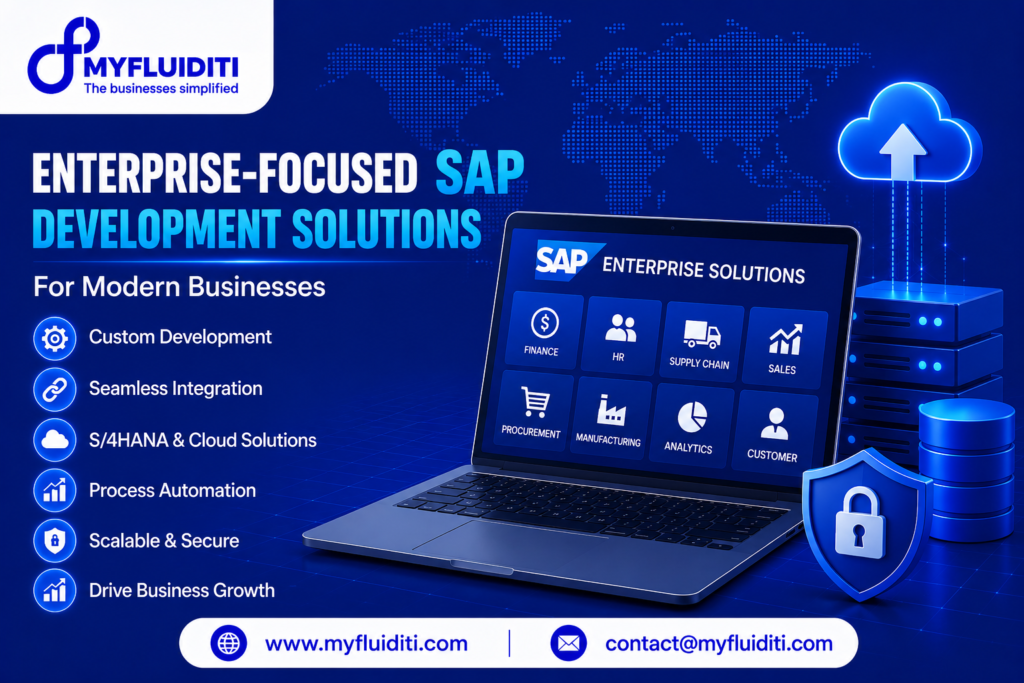
Introduction Modern enterprises operate across increasingly complex business environments where finance, human resources, supply chain, procurement, manufacturing, sales, customer management, and analytics must work together efficiently. As organizations expand, disconnected applications and fragmented data can make it difficult to maintain operational visibility and support informed decision-making. SAP development solutions provide enterprises with a powerful foundation for integrating business processes, centralizing information, and modernizing technology environments. With SAP development, consulting, integration, customization, and cloud technologies, organizations can create connected enterprise ecosystems that support efficiency, scalability, and digital transformation. At MyFluiditi, we help businesses align SAP capabilities with their operational requirements by delivering customized development, integration, consulting, and technology solutions designed around long-term business objectives. Understanding SAP Development Solutions SAP development involves customizing, extending, integrating, and optimizing SAP environments to support specific organizational requirements. While standard SAP functionality can address many enterprise processes, businesses often require additional applications, workflows, integrations, reports, interfaces, and custom functionality. Custom SAP development helps organizations adapt their SAP environment to unique business processes without unnecessarily disrupting existing operations. MyFluiditi works with businesses to understand their technology landscape and develop SAP solutions that align enterprise applications with operational workflows, data requirements, and strategic goals. Why SAP Matters for Modern Enterprises Enterprise organizations need a technology environment capable of managing large volumes of business data while supporting interconnected processes. SAP can provide a centralized ecosystem for managing important business functions and enabling information to flow across departments. SAP solutions for enterprises can help organizations improve visibility across finance, procurement, supply chain, manufacturing, sales, and other operational areas. MyFluiditi helps businesses evaluate their SAP requirements and identify opportunities to improve processes through development, integration, automation, and modernization. SAP Consulting Services for Business Transformation Successful SAP initiatives require more than technical implementation. Organizations need to understand how technology can support their business objectives and operational requirements. SAP consulting services can help businesses assess existing systems, identify process improvement opportunities, define technology requirements, and develop transformation strategies. MyFluiditi takes a business-focused approach to SAP consulting, working to understand organizational challenges before recommending development or integration approaches. This helps businesses align SAP investments with measurable operational and strategic outcomes. Customizing SAP for Business Requirements Every enterprise has unique workflows, approval structures, reporting requirements, and operational processes. Standard SAP functionality may not always provide the exact capabilities required by an organization. SAP customization and development can extend the platform to support specific business needs through custom applications, workflows, interfaces, reports, and integrations. MyFluiditi helps businesses identify where customization can provide value while focusing on maintainability, scalability, and alignment with the wider SAP environment. SAP Integration for Connected Business Operations Modern enterprises rarely operate using a single technology platform. SAP environments often need to communicate with CRM systems, e-commerce platforms, third-party applications, cloud services, payment systems, analytics platforms, and custom software. SAP integration services help connect these systems so information can move between applications more efficiently. MyFluiditi develops integration solutions that connect SAP with relevant enterprise technologies through APIs, middleware, and appropriate integration approaches, helping organizations reduce data silos and create more connected business processes. SAP S/4HANA and Enterprise Modernization As enterprises modernize their technology environments, SAP S/4HANA has become an important component of many transformation strategies. Modern SAP environments can support organizations seeking improved analytics, simplified processes, and more flexible enterprise operations. SAP S/4HANA development and modernization require careful planning around existing systems, data, integrations, workflows, and business continuity. MyFluiditi helps organizations approach SAP modernization strategically, aligning technology changes with business requirements while preparing enterprise systems for future digital initiatives. Cloud-Based SAP Solutions Cloud technology is changing how organizations deploy and manage enterprise applications. Cloud-based SAP environments can provide flexibility, scalability, and access to modern infrastructure capabilities while supporting evolving business requirements. SAP cloud solutions can also help organizations integrate enterprise applications with broader cloud ecosystems and modern digital services. MyFluiditi supports businesses in developing and integrating SAP solutions within appropriate cloud environments, focusing on scalability, security, performance, and long-term maintainability. SAP Application Development Businesses may require custom applications that extend SAP functionality or provide specialized interfaces for employees, customers, suppliers, or partners. SAP application development can create tailored digital experiences while connecting application functionality with enterprise data and workflows. MyFluiditi develops custom applications that work alongside SAP environments, helping organizations modernize user experiences, streamline workflows, and provide more accessible ways for users to interact with enterprise systems. SAP Workflow Automation Enterprise processes often involve approvals, notifications, document handling, data validation, and repetitive administrative activities. Manual workflows can create delays and increase the possibility of errors. SAP workflow automation can help organizations streamline repetitive processes by introducing automated approvals, notifications, task assignments, and workflow rules. MyFluiditi helps businesses identify processes suitable for automation and integrate workflow capabilities into SAP environments, supporting greater operational efficiency and process consistency. SAP Data and Business Intelligence Enterprise systems generate substantial volumes of operational data, but businesses need appropriate tools to transform that information into actionable insights. SAP environments can support reporting, analytics, dashboards, and business intelligence capabilities that help organizations understand operational performance. SAP analytics solutions can provide insights across finance, supply chain, sales, inventory, procurement, and other functions. MyFluiditi helps businesses connect SAP data with analytics capabilities to support more informed decision-making and improve organizational visibility. SAP Development for Supply Chain Management Supply chain operations depend on accurate information across procurement, inventory, production, logistics, suppliers, and customers. Disconnected systems can make it difficult to understand inventory levels, demand, supplier performance, and operational bottlenecks. SAP supply chain solutions can connect important processes within a centralized enterprise environment. MyFluiditi helps organizations develop and integrate SAP capabilities that support supply chain visibility, workflow optimization, data connectivity, and operational efficiency. SAP Solutions for Finance and Accounting Financial operations require accurate data, timely reporting, and consistent processes across an organization. SAP can provide enterprise-level capabilities for accounting, financial management, reporting, and related business processes. SAP finance solutions can help organizations centralize financial information and improve visibility across business operations. MyFluiditi supports businesses in extending, integrating, and optimizing SAP environments to address