Why Documentation Matters in Software Development Projects

Writing code is only half the battle. When you build a powerful application, the way you record, explain, and maintain that system is just as crucial as the underlying architecture. Teams often push documentation to the bottom of their priority list. They want to ship features faster and hit deadlines sooner. However, skipping this vital step creates massive roadblocks down the line. At myfluiditi, we build advanced AI-driven web applications for businesses across the USA. We know firsthand that excellent code needs excellent instructions. Without clear guidelines, even the smartest artificial intelligence solutions become difficult to scale and maintain. This post explores the exact reasons why comprehensive documentation is a non-negotiable asset. You will learn the core benefits, discover industry best practices, and see how to apply these strategies to your own builds. The Hidden Engine of Software Development Projects Every successful application relies on a foundation of clear communication. When you look at the most successful Software Development Projects, you will find a common thread. They all maintain strict, organized, and accessible records of their work. Documentation acts as the hidden engine that keeps everything moving forward smoothly. Without it, developers spend countless hours trying to decipher old code. They waste time reverse-engineering features that someone else built months ago. This lack of clarity drains resources and frustrates your engineering team. By maintaining a robust library of technical notes, you eliminate this friction. Your team can focus on creating new value instead of solving old mysteries. Defining Documentation in Software Development Projects Before we explore the benefits, we must define what we actually mean. Documentation in Software Development Projects covers a wide range of materials. It is not just a single manual or a read-me file. It is a living, breathing ecosystem of information that supports your entire application lifecycle. Code-Level Documentation This is the most granular level of information. It involves comments left directly inside the source code to explain complex logic. Good code-level notes help other engineers understand why a specific approach was taken. It prevents accidental breaks when someone updates a function later on. System Architecture Guidelines These documents provide a bird’s-eye view of your entire application. They map out how different microservices talk to each other. For AI-driven web apps like those we build at myfluiditi, system architecture notes are critical. They show exactly where the machine learning models sit within the broader web infrastructure. End-User Manuals Your customers need help navigating your final product. End-user materials include FAQs, tutorials, and troubleshooting guides. They bridge the gap between technical complexity and user-friendly experiences. When you invest in these resources, you drastically reduce the burden on your customer support team. Top Reasons Why Documentation Matters for Software Development Projects You might wonder if the time spent writing notes is truly worth the effort. The answer is a resounding yes. The impact on Software Development Projects is massive, affecting everything from team morale to the company bottom line. Seamless Knowledge Transfer People change jobs, take vacations, or move to different departments. If all the knowledge about your application lives inside one person’s head, you face a massive risk. Proper documentation ensures that critical information survives staff transitions. New hires can read the project history and get up to speed in days rather than weeks. Slashing Technical Debt Technical debt accumulates when teams take shortcuts to meet deadlines. Over time, these shortcuts make the codebase fragile and hard to update. Thorough records help you track these shortcuts so you can fix them later. By shining a light on technical debt, you keep your code clean and manageable over the long term. Ensuring Quality and Consistency When multiple developers work on the same application, coding styles can clash. Standardized guidelines ensure everyone follows the same rules. This consistency makes the code easier to read and test. It leads to fewer bugs and a much smoother user experience across the board. The Financial Impact on Software Development Projects Poor communication costs money. When we analyze failed Software Development Projects, a lack of documentation often plays a starring role. Developers spend roughly twenty percent of their time just looking for information. That is one full day a week wasted on avoidable searches. When you scale this inefficiency across an entire engineering department, the financial loss is staggering. Good records eliminate this wasted time. They streamline troubleshooting, making it faster to identify and fix critical bugs. This efficiency directly translates to lower operational costs and higher profit margins for your business. How AI is Changing Documentation in Software Development Projects The tech landscape is evolving rapidly, and artificial intelligence is leading the charge. At myfluiditi, we see how AI transforms the way teams handle information. The integration of AI into Software Development Projects means documentation is no longer a purely manual chore. Machine learning algorithms can now analyze your codebase and generate technical notes automatically. They can highlight missing comments and suggest better ways to explain complex logic. This automation saves developers hundreds of hours every year. It ensures your records stay up to date, even during rapid agile sprints. Best Practices for Managing Software Development Projects Knowing the value of information is one thing. Actually maintaining it is another challenge entirely. To get the most out of your Software Development Projects, you need a disciplined approach to writing and updating your materials. Treat Docs Like Code You should review your technical notes with the same rigor you apply to your source code. Require peer reviews for every major update to your manuals. Store your files in version control systems like Git. This way, you can track changes over time and roll back mistakes if necessary. Keep it Agile and Iterative Do not wait until the very end of a build to start writing. Make documentation a required part of every single sprint. When a developer finishes a feature, they must also finish the corresponding notes. This iterative approach prevents a massive backlog of writing tasks from piling up at launch
Website Redesign Strategy: When to Rebuild Your Site

Your website serves as the digital front door to your business. When customers seek your services, they expect a seamless, secure, and modern experience. If your site feels clunky, slow, or outdated, those potential customers will leave and find a competitor. Knowing exactly when to rebuild your site and how to approach the process can save your business time, money, and lost revenue. You need a clear plan. Developing a comprehensive website redesign strategy ensures that you do not just change the look of your site, but that you improve its performance, user experience, and conversion rates. In this guide, we will explore the critical signs that indicate it is time for a rebuild. We will walk through the essential phases of planning your overhaul, and we will highlight how MyFluiditi, a leading web app AI development company in the USA, can help you integrate cutting-edge artificial intelligence into your new platform. What Constitutes a Strong Website Redesign Strategy? A website redesign strategy is a detailed action plan that guides the complete overhaul of your digital presence. It goes far beyond picking a new color scheme or updating your logo. It involves analyzing your current performance metrics, understanding your target audience, and mapping out a user journey that drives results. When you build a proper website redesign strategy, you align your business goals with your digital assets. You evaluate what works on your current site and identify the bottlenecks preventing users from converting. This strategy acts as a blueprint for your web developers, designers, and content creators, ensuring everyone works toward a unified vision. Without a solid plan, a redesign can quickly become a costly disaster. You might lose your hard-earned search engine rankings, confuse your existing customers, or launch a site filled with bugs. By prioritizing strategy over aesthetics, you protect your brand and set the stage for long-term growth. Clear Signs Your Business Needs a Website Redesign Strategy How do you know it is time to tear down your old site and start fresh? You should look for specific indicators in your performance data and user feedback. High Bounce Rates and Declining Conversions If visitors arrive on your site and leave immediately without interacting, you have a problem. High bounce rates often indicate that your site does not meet user expectations. Perhaps the navigation is confusing, the layout is cluttered, or the messaging is unclear. If your lead generation forms remain empty and sales drop, you must implement a new website redesign strategy to rethink your conversion funnels. Your Brand Has Fundamentally Evolved Businesses grow and change. The products you offered five years ago might not represent your core focus now. If your current website reflects an old version of your company, it will confuse your target market. A redesign allows you to align your digital presence with your updated brand identity, values, and service offerings. The Platform Lacks Mobile Responsiveness Most users browse the internet on their smartphones. If your website forces mobile users to pinch, zoom, and scroll horizontally to read your content, you are alienating a massive segment of your audience. Search engines also penalize sites that lack mobile-friendliness. You must ensure your site provides a flawless experience across all devices. Slow Page Load Speeds Speed matters. If your site takes more than three seconds to load, a significant percentage of visitors will abandon it. Outdated code, unoptimized media, and poor server configurations drag down performance. Rebuilding your site allows you to utilize modern, lightweight frameworks that deliver blazing-fast load times. Outdated Technology and Security Vulnerabilities Cyber threats evolve rapidly. If your site runs on an old content management system or relies on unsupported plugins, you expose your business and your customers to data breaches. Upgrading your architecture enhances your security posture, protects sensitive information, and builds trust with your users. The Role of AI in Your Website Redesign Strategy Artificial intelligence is changing how we build and interact with the web. As an AI web app development company, MyFluiditi knows that integrating smart technologies into your rebuild can drastically improve user engagement. Delivering Personalization at Scale Static websites show the same content to every visitor. AI allows you to create dynamic experiences. By analyzing user behavior, location, and past interactions, your website can recommend specific products, highlight relevant blog posts, or alter the layout to suit individual preferences. Incorporating AI personalization into your website redesign strategy helps you treat every visitor like a VIP. Advanced Analytics and Predictive Modeling Standard analytics tell you what happened in the past. AI analytics can predict what will happen next. Machine learning algorithms can identify patterns in user navigation, helping you anticipate where visitors will click and what obstacles they might face. This data empowers you to make proactive design choices rather than reactive fixes. Intelligent Chatbots and Customer Support Users expect instant answers. Integrating AI-powered chatbots provides your customers with 24/7 support. These tools can answer common questions, guide users through the checkout process, and qualify leads before passing them to your human sales team. Key Components of a Successful Website Redesign Strategy To achieve your desired outcomes, your plan must include several foundational elements. Skipping any of these components can lead to project delays and subpar results. Define Clear, Measurable Goals You cannot measure success if you do not define it first. Are you trying to increase online sales by 20%? Do you want to double your email subscriber list? Do you need to reduce customer support calls by improving your FAQ section? Establish specific, measurable, achievable, relevant, and time-bound (SMART) goals to guide your decisions. Deeply Understand Your Target Audience Your website exists to serve your customers. You need to know their pain points, preferences, and browsing habits. Develop detailed buyer personas to represent your ideal customers. Use surveys, interviews, and analytics data to gather insights. Every design and content decision should cater to the needs of these personas. Conduct a Comprehensive SEO Audit Many businesses lose their search engine traffic during a redesign
Custom Web Application Development: When Businesses Should Build Instead of Buy

Every business leader eventually faces the same critical software dilemma. Your company is growing, operations are becoming more complex, and your current technology stack is straining under the pressure. You need a new solution to handle operations, manage customer data, or streamline internal workflows. The question is: do you purchase a pre-packaged software subscription, or do you invest in custom web application development? Many organizations default to buying off-the-shelf software because it seems quicker and cheaper upfront. However, as your business processes mature, forcing your operations into rigid, generalized software often creates more problems than it solves. Workarounds become standard practice. Data silos emerge. Employee productivity drops as teams switch between disconnected tools. This guide breaks down exactly when and why USA-based business decision-makers should choose to build rather than buy. We will explore common operational pain points, compare the long-term value of both approaches, and demonstrate how custom web application development delivers superior ROI, unmatched scalability, and seamless AI integration. The Software Dilemma: The Limits of Off-the-Shelf Solutions Pre-packaged software serves a massive, generalized market. To appeal to thousands of different companies across various industries, vendors must build broad, generic features. They aim for the middle of the bell curve. If your business processes fall outside that average, you are out of luck. When you buy off-the-shelf software, you rarely get exactly what you need. You might pay for dozens of features you never use. Conversely, you might find that the software lacks the one specific feature critical to your daily operations. This forces your team to develop manual workarounds, defeating the purpose of adopting new technology in the first place. Furthermore, you do not own the software. You rent it. You are entirely at the mercy of the vendor’s roadmap, pricing model, and server stability. If the vendor decides to deprecate a feature your team relies on, or if they double their subscription fees next year, you have little recourse. Understanding Custom Web Application Development Custom web application development is the process of designing, building, and deploying software tailored specifically to your organization’s unique requirements. Instead of changing your business processes to fit the software, the software is engineered to fit your exact business processes. This approach gives you complete control over the functionality, user interface, security standards, and integration capabilities of your tools. Whether you need a sophisticated customer portal, an intelligent inventory management system, or a centralized dashboard powered by artificial intelligence, custom web application development provides a precise solution. When you partner with a specialized firm like myfluiditi.com, you are not just getting code. You are getting a strategic asset designed to give you a competitive advantage in your specific market. You own the intellectual property, control the update schedule, and dictate how the application evolves as your business grows. Identifying Business Pain Points: Signs You Need a Custom Solution How do you know when it is time to move away from generic software? Decision-makers should look for specific operational bottlenecks that signal the need for a tailored approach. If your organization is experiencing any of the following pain points, investing in custom web application development is likely the right move. 1. Inefficient Workarounds and Manual Processes Are your employees exporting data from one system, formatting it in a spreadsheet, and manually uploading it into another? This type of operational friction costs companies thousands of hours in lost productivity every year. A bespoke web app integrates all your necessary functions into a single, cohesive workflow, eliminating manual data entry and reducing human error. 2. Lack of Competitive Differentiation If you use the exact same software as your competitors, you are limited to the exact same capabilities. You cannot offer a vastly superior digital customer experience if your backend technology is identical to the rest of the industry. Custom web application development allows you to build unique features, services, and client portals that set you apart in the marketplace. 3. Escalating Subscription Costs Software-as-a-Service (SaaS) pricing models often scale by user seat or data volume. As your company grows, these costs compound rapidly. What started as an affordable $50-per-user monthly fee can quickly become a six-figure annual expense as you add hundreds of employees. Building your own software requires an upfront investment, but it eliminates per-user licensing fees forever. 4. Poor System Integration Modern businesses rely on multiple tools—CRM systems, accounting software, marketing platforms, and operational databases. Generic software often struggles to communicate seamlessly with specialized legacy systems. A custom-built application acts as the perfect connective tissue. It can be engineered with specific APIs to pull and push data across your entire technology stack. The Build vs. Buy Debate: A Detailed Comparison To make an informed decision, executives must evaluate both paths across several key business metrics. Let us compare off-the-shelf software and custom web application development side-by-side. Speed to Deployment Buying pre-packaged software is undeniably faster in the short term. You can sign up, pay the subscription fee, and start onboarding employees the same week. Custom development takes time. It requires a discovery phase, design, coding, testing, and deployment. However, the initial speed of generic software often degrades over time as teams struggle with implementation hurdles and training on unintuitive systems. Total Cost of Ownership (TCO) Off-the-shelf software boasts low initial costs, but the long-term TCO is often much higher due to perpetual licensing fees, costly premium add-ons, and integration expenses. Custom web application development requires a larger initial capital expenditure. Over a three to five-year period, however, the bespoke solution typically becomes significantly more cost-effective as you avoid recurring enterprise licensing fees. Security and Compliance For USA businesses handling sensitive data, security is paramount. Generic software presents a large, lucrative target for hackers. If a vendor experiences a breach, your data is compromised. Custom web application development allows you to implement stringent, specialized security protocols tailored to your industry regulations (like HIPAA or SOC 2). The proprietary nature of your custom code also makes it a smaller, harder target for malicious actors. User
B2B Software Company Website Analysis Criteria That Improve Lead Generation

A B2B software company’s website is its most critical marketing and sales asset. It serves as the digital storefront, the primary information hub, and the engine for lead generation. Yet, many of these digital assets underperform, failing to convert visitors into qualified leads. The reason often lies in a lack of a structured, comprehensive evaluation process. To transform a website from a simple brochure into a high-performance lead generation machine, you need a robust framework. This involves a deep dive into specific, data-driven b2b software company website analysis criteria designed to identify weaknesses and uncover opportunities for growth. For B2B decision-makers, understanding these criteria is the first step toward building a digital presence that doesn’t just attract traffic but actively drives revenue. This comprehensive guide will walk you through the essential analysis criteria that matter most. We will explore technical SEO, user experience (UX) and user interface (UI) design, conversion rate optimization (CRO), the transformative potential of AI integration, critical performance metrics, and the strategic use of lead magnets. By applying these standards, you can systematically diagnose your website’s health, implement targeted improvements, and ultimately, significantly enhance your lead generation efforts. The Foundation: Technical SEO for Visibility and Authority Before a visitor can become a lead, they must first find your website. Technical SEO is the foundation upon which all other digital marketing efforts are built. It ensures that search engines can crawl, index, and understand your content, making it visible to your target audience. A failure in technical SEO renders even the most compelling content invisible. A thorough website analysis must begin here. Crawlability and Indexability Search engine bots, or crawlers, discover and index pages on the web. If they can’t access your site, it won’t appear in search results. Your analysis should verify several key elements: Robots.txt File: This simple text file tells search engines which pages or sections of your site they should not crawl. A misconfigured robots.txt can inadvertently block critical pages, making them invisible to search. Your analysis must confirm that it isn’t disallowing important content, stylesheets, or scripts that are necessary for Google to render the page correctly. XML Sitemap: An XML sitemap acts as a roadmap for search engines, listing all the important URLs on your website. It helps crawlers discover new content faster and understand your site structure. The analysis should check if the sitemap exists, is submitted to Google Search Console, is free of errors (like 404s or non-canonical URLs), and is dynamically updated as you add or remove pages. Site Architecture: A logical, hierarchical site structure is crucial for both users and search engines. A flat, well-organized architecture, where important pages are only a few clicks from the homepage, allows “link equity” to flow effectively throughout the site. The analysis should map out the current structure to identify deep, orphaned pages (pages with no internal links pointing to them) that are difficult for crawlers to find. A silo structure, where content is grouped into clear thematic categories (e.g., /products/, /solutions/, /resources/), is often the most effective model for B2B software sites. On-Page SEO Elements Once crawlers can access your site, on-page elements help them understand the context and relevance of your content. These are fundamental b2b software company website analysis criteria for ranking for your target keywords. Title Tags and Meta Descriptions: These HTML elements are your first chance to make an impression in the search results. Title tags are a significant ranking factor, while meta descriptions influence click-through rates. The analysis should audit every key page for optimized, unique, and compelling titles and descriptions that include target keywords and a clear value proposition. Header Tags (H1, H2, H3): Headers structure your content, making it easier for readers to scan and for search engines to understand the hierarchy of information. Every page should have a single, unique H1 tag that encapsulates the page’s main topic. Subsequent H2s and H3s should break down the content logically, incorporating related keywords. Schema Markup: Schema is a form of structured data that helps search engines better understand the content on your pages. For a B2B software company, implementing SoftwareApplication schema, Organization schema, FAQPage schema, and Article schema can lead to rich snippets in search results, increasing visibility and click-through rates. The analysis must identify opportunities to apply relevant schema across the site. Website Speed and Core Web Vitals Website performance is no longer just a user experience issue; it’s a critical ranking factor. Google’s Core Web Vitals are a set of metrics that measure real-world user experience for loading performance, interactivity, and visual stability. Largest Contentful Paint (LCP): Measures the time it takes for the largest content element (e.g., an image or block of text) on the page to become visible. An ideal LCP is 2.5 seconds or less. First Input Delay (FID) / Interaction to Next Paint (INP): FID measures the time from when a user first interacts with a page (e.g., clicks a button) to the time when the browser is actually able to respond to that interaction. INP is a newer metric that will replace FID, assessing overall responsiveness. A good score is under 100 milliseconds. Cumulative Layout Shift (CLS): Measures visual stability, quantifying how much unexpected layout shift occurs during the entire lifespan of the page. A low CLS score ensures the page doesn’t move around unexpectedly, preventing users from clicking on the wrong thing. An ideal score is 0.1 or less. An analysis using tools like Google PageSpeed Insights and Google Search Console’s Core Web Vitals report is essential. Identifying and fixing issues-such as optimizing images, leveraging browser caching, and minifying code-is a high-impact activity for both SEO and user experience. The User Journey: UX/UI Analysis for Engagement and Trust Once a user lands on your site, the user experience (UX) and user interface (UI) take over. For a B2B software company, where purchase decisions are complex and involve multiple stakeholders, a seamless, intuitive, and trustworthy experience is paramount. Poor UX is a primary driver of high bounce
React Native vs Flutter: Which Is Better for US Businesses in 2026?
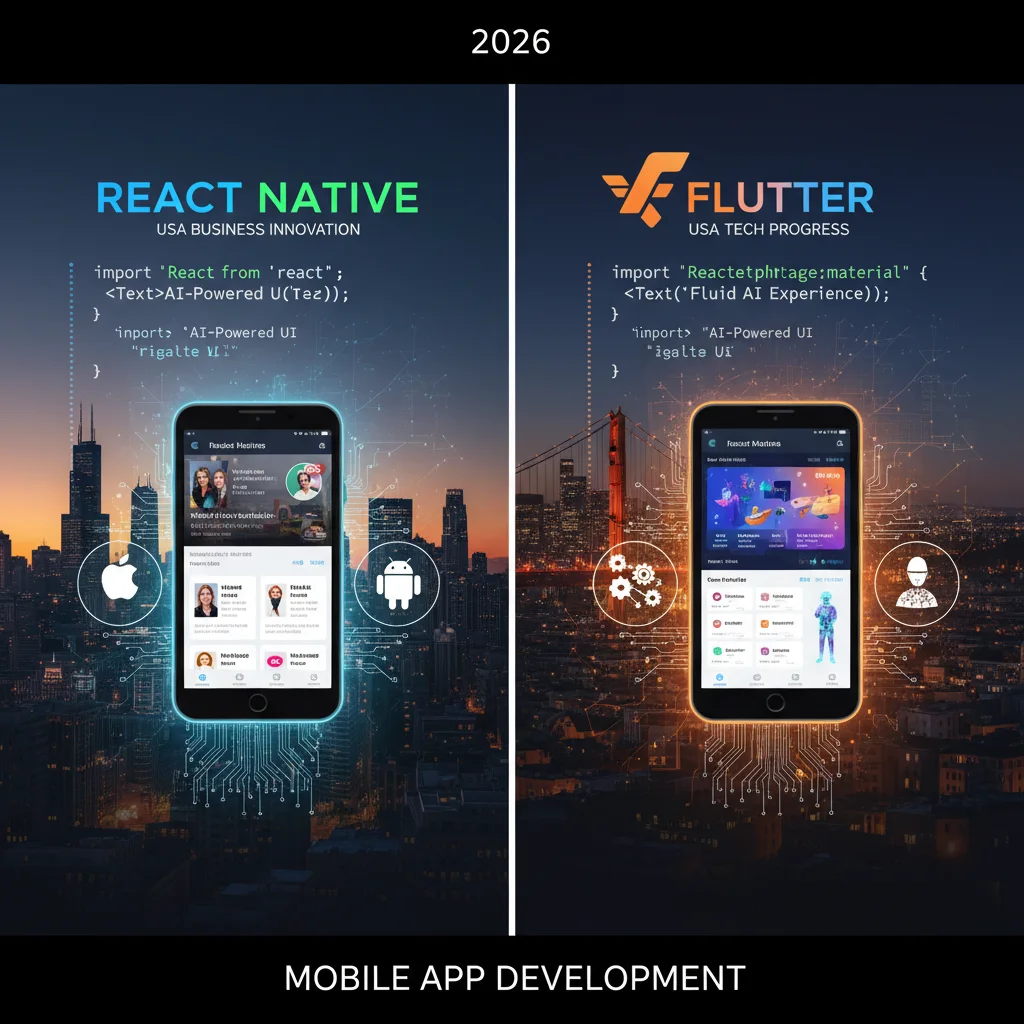
Building a mobile application has evolved significantly over the past decade. For US businesses looking to dominate their respective markets, the right technology stack is a critical decision. You want a framework that supports rapid development, delivers native-like performance, and seamlessly integrates with advanced artificial intelligence. At myfluiditi, an expert AI development company, we frequently guide enterprises through this exact technological crossroads. The debate over React Native vs Flutter is more relevant than ever in 2026. Both frameworks offer incredible capabilities, but they cater to different business needs, development styles, and product visions. This comprehensive guide will break down everything US companies need to know. We will explore technical performance, user interface capabilities, developer ecosystems, and AI integration. By the end of this deep dive, you will have a clear, strategic roadmap for choosing the optimal framework for your next AI-driven mobile application. The Mobile App Landscape in 2026 The mobile application market in the United States demands perfection. Users expect lightning-fast load times, fluid animations, and personalized experiences powered by artificial intelligence. A clunky interface or a slow application directly translates to lost revenue and damaged brand reputation. The Rise of AI-First Mobile Applications We are no longer building apps that simply display data. Modern applications require real-time machine learning inference, natural language processing, and predictive analytics. Whether you run a healthcare startup requiring secure patient data analysis or a retail enterprise needing intelligent product recommendations, AI is the new baseline. Why Cross-Platform Development Wins Native development (building separately for iOS using Swift and Android using Kotlin) is expensive and time-consuming. US developer salaries remain high, making dual codebases a heavy financial burden. Cross-platform frameworks solve this by allowing you to write code once and deploy it across multiple platforms. This is exactly why the conversation around React Native vs Flutter dominates tech boardrooms across the country. Understanding the Contenders Before diving into the granular technical details, we need to understand the origins and philosophies behind each framework. What is React Native? Created by Meta (formerly Facebook) and open-sourced in 2015, React Native uses JavaScript (and TypeScript) to build mobile applications. It leverages the popular React library, allowing developers to construct user interfaces using familiar web development paradigms. React Native does not render web views. Instead, it uses a bridge (and more recently, the Fabric rendering system and Java Native Interface) to invoke native UI components. This means a button in React Native renders as a true iOS or Android button on the device. What is Flutter? Developed by Google and released in 2017, Flutter takes a radically different approach. It uses the Dart programming language and its own high-performance rendering engine (Impeller). Instead of relying on native OEM widgets, Flutter draws every pixel on the screen itself. This approach guarantees absolute consistency across devices. A Flutter app will look exactly the same on an iPhone running the latest iOS as it does on a five-year-old Android device. Architectural Differences: The Core Debate The fundamental architecture of these two frameworks dictates how they perform, how they scale, and how difficult they are to maintain. The core of the React Native vs Flutter debate lies in how they communicate with the device hardware. React Native Architecture Historically, React Native relied on a JavaScript bridge. The JavaScript code would send serialized JSON messages across this bridge to the native side. This worked well for standard applications but often caused bottlenecks during heavy animations or complex data processing. In recent years, the React Native community rolled out the “New Architecture.” This includes the JavaScript Interface (JSI), which allows JavaScript to hold direct references to native C++ objects. This eliminates the need for serialized bridge communication, vastly improving performance. Flutter Architecture Flutter avoids the bridge concept entirely. The Dart code compiles directly into native ARM machine code. The engine handles all rendering, input, and event loops. Because Flutter bypasses the native UI toolkit, it avoids the overhead of translating commands between the framework and the operating system. Performance Comparison: Speed and Efficiency Performance is non-negotiable for US businesses. A delay of just one second can result in a significant drop in conversion rates. Let’s examine React Native vs Flutter through the lens of raw performance. CPU and Memory Usage Flutter generally outperforms React Native in CPU-intensive tasks because Dart compiles to native code. When your application requires heavy mathematical computations-such as processing local AI models or handling complex state management-Flutter maintains steady frame rates more reliably. React Native is highly performant for most standard business applications. However, if your app heavily relies on continuous data streaming or highly complex background processing, you may need to write custom native modules in Swift or Kotlin to maintain optimal performance. Rendering and Animations Flutter’s Impeller rendering engine is a game-changer for 2026. It precompiles shaders, completely eliminating the “jank” (stuttering) that plagued early cross-platform apps. If your application relies on complex, custom animations or heavily branded interfaces, Flutter offers a smoother experience out of the box. React Native animations are typically handled by libraries like Reanimated. While you can achieve smooth 60fps animations, it requires a deeper understanding of the framework’s mechanics to ensure the animations run on the native UI thread rather than the JavaScript thread. User Interface and User Experience The way your app looks and feels determines how users perceive your brand. The UI strategies in React Native vs Flutter are vastly different. React Native: The Native Feel Because React Native uses native components, your app automatically inherits the look and feel of the platform it runs on. An iOS user will see familiar iOS toggles, date pickers, and navigation bars. An Android user will see Material Design components. This is highly beneficial if your goal is to make the app feel exactly like a standard platform application. However, if you want a uniform, highly custom brand design across both platforms, you will spend extra time overriding these native defaults. Flutter: The Custom Canvas Flutter provides an extensive library of custom widgets.